



FUCIBET 20 mg /G Cream

Prescription review online
A doctor will review your case and decide whether a prescription is medically appropriate.

Talk to a doctor about this medicine
Discuss your symptoms and possible next steps in a quick online consultation.



How to use FUCIBET 20 mg/g + 1 mg/g CREAM
Contents of the leaflet
- Introduction
- What Fucibet is and what it is used for
- What you need to know before using Fucibet
- How to use Fucibet
- Possible side effects
- Storage of Fucibet
- Package contents and additional information
Introduction
Leaflet:information for the user
Fucibet 20 mg/g + 1 mg/g cream
fusidic acid and betamethasone
Read the entire leaflet carefully before starting to use this medicine, as it contains important information for you.
- Keep this leaflet, as you may need to read it again.
- If you have any questions, ask your doctor or pharmacist.
- This medicine has been prescribed to you only, and you should not give it to others, even if they have the same symptoms as you, as it may harm them.
- If you experience side effects, consult your doctor or pharmacist, even if they are side effects not listed in this leaflet. See section 4.
Contents of the leaflet
- What Fucibet is and what it is used for
- What you need to know before using Fucibet
- How to use Fucibet
- Possible side effects
- Storage of Fucibet
- Package contents and additional information
1. What Fucibet is and what it is used for
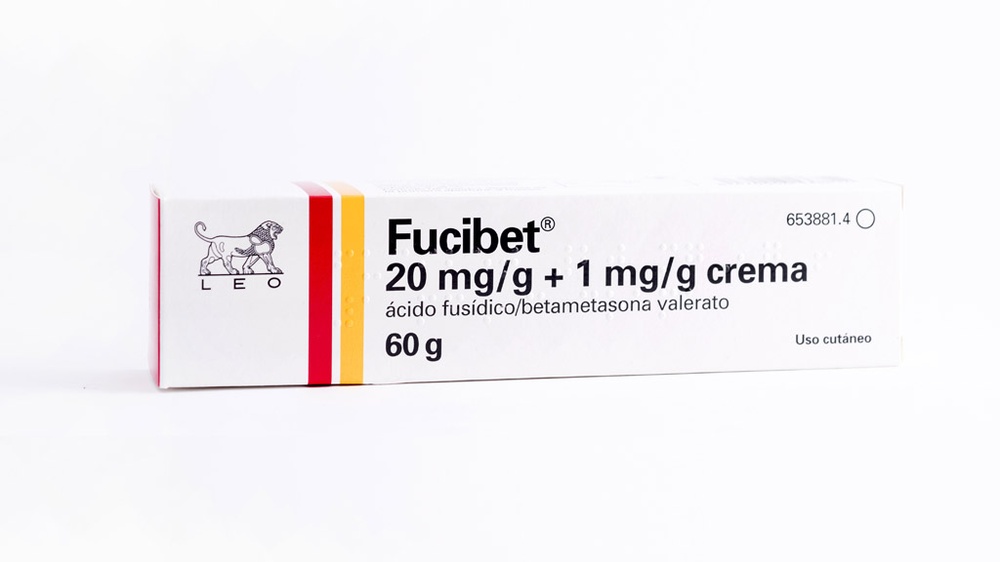
 Fucibet cream combines the antibacterial action of fusidic acid (antibiotic) with the anti-inflammatory effect of a corticosteroid, betamethasone (as valerate).
It is used for the local treatment, in adults and children, of eczematous dermatitis, such as: atopic eczema, infantile eczema, discoid eczema (in the form of circular patches), stasis eczema (eczema on the legs that appears in some patients with hypertension), contact eczema, and seborrheic eczema, in which a secondary bacterial infection has been confirmed or is suspected.
You should consult a doctor if it worsens or does not improve after 14 days.

Not sure if this medicine is right for you?
Discuss your symptoms and treatment with a doctor online.
2. What you need to know before using Fucibet
Do not use Fucibet:
- if you are allergic to fusidic acid, sodium fusidate, betamethasone (as valerate), or any of the other components of this medicine (listed in section 6).
Fucibet contains a corticosteroid, betamethasone (as valerate), and should not be used in the following situations:
- if you have a generalized fungal disease,
- if you have a skin infection caused by fungi, viruses, or bacteria,
- if you have tuberculosis,
- if you have dermatitis around the mouth,
- if you have rosacea (significant redness of the facial skin).
Warnings and precautions
Consult your doctor or pharmacist before starting to use Fucibet.
- The use of Fucibet should be limited to 14 days. Long-term treatment may result in a higher risk of side effects, such as skin thinning, and the risk of masking infections for which this medicine is not suitable.
- Caution should be exercised depending on the place of application, due to the possible systemic absorption of the medicine, which could cause disorders of adrenal gland function, see section 4 Possible side effects.
- Fucibet should be applied with caution when used near the eyes. If accidental contact with the eyes occurs, rinse the eyes with plenty of water and consult an ophthalmologist if necessary (see section 4).
- Contact your doctor if you experience blurred vision or other visual disturbances.
- Fucibet may increase susceptibility to infections, worsen existing infections, and activate latent infections.
Children and adolescents
Fucibet should be used with caution in children and adolescents, as they may be more susceptible to developing Cushing's syndrome (characterized by a rounded face, fat accumulation, delayed healing, fatigue...) due to increased absorption through the skin. Prolonged treatments, application of large amounts of medicine, and occlusion of the affected area should be avoided, see section 3.
Using Fucibet with other medicines
Inform your doctor or pharmacist if you are using or have recently used any other medicine. The interaction with other systemically administered medicines is considered minimal.
Pregnancy and breastfeeding
If you are pregnant or breastfeeding, think you may be pregnant, or plan to become pregnant, consult your doctor or pharmacist before using this medicine.
This medicine should not be used during pregnancy, as your doctor will assess the benefit of treatment for the mother and the risk to the child.
This medicine can be used during breastfeeding, but it is recommended to avoid applying the medicine to the breasts.
Driving and using machines
The influence of this medicine on the ability to drive and use machines is nil or insignificant.
Fucibet contains cetyl alcohol and chlorocresol
This medicine may cause local skin reactions (such as contact dermatitis) because it contains cetyl alcohol.
This medicine may cause allergic reactions because it contains chlorocresol.
3. How to use Fucibet
Follow the instructions for administration of this medicine indicated by your doctor. In case of doubt, consult your doctor or pharmacist again.
Administration: cutaneous route.
The recommended dose for adults and pediatric population (children and adolescents) is:
Apply a thin layer of cream carefully to the affected area, two or three times a day, for a maximum of 14 days.
In adults, the treatment of more resistant lesions may be reinforced by applying this medicine with an occlusive dressing. In these cases, nocturnal occlusion is generally considered an adequate option.
In children and adolescents, no occlusive dressing should be applied, nor large amounts of product to cover the area to be treated.
After applying this medicine, wash your hands carefully, unless your hands are the area to be treated.
If you use more Fucibet than you should
If you have applied more cream than you should, consult your doctor or pharmacist.
In case of overdose or accidental ingestion, consult your doctor or pharmacist immediately or call the Toxicology Information Service, phone 91 562 04 20, indicating the medicine and the amount ingested.
If you forget to use Fucibet
In case you forget to apply the cream at the scheduled time, apply it as soon as possible and continue according to the usual schedule.
If you interrupt treatment with Fucibet
If you forget to apply this medicine, do so as soon as you remember. Perform the next application according to the usual schedule.
If you have any other questions about the use of this medicine, ask your doctor or pharmacist.

Started taking the medicine and have questions?
Discuss your symptoms and treatment with a doctor online.
4. Possible side effects
Like all medicines, Fucibet can cause side effects, although not everyone gets them.
Side effects uncommon(may affect up to 1 in 100 people):
- allergic reactions
- contact dermatitis
- worsening of eczema
- burning sensation on the skin
- itching
- dryness of the skin
- pain at the application site
- irritation at the application site
Side effects rare(may affect up to 1 in 1,000 people):
- redness
- urticaria
- skin rash
- swelling at the application site
- appearance of blisters at the application site
Side effects with an unknown frequency (cannot be estimated from the available data):
- blurred vision
Other side effects caused by prolonged treatment with potent corticosteroids may include:
- disorders of adrenal gland function, characterized by symptoms such as fatigue, depression, and anxiety
- increased pressure inside the eye and glaucoma, especially if applied near the eyes for a prolonged period
- skin effects such as: skin thinning (cutaneous atrophy), dermatitis (including contact dermatitis and acneiform dermatitis), perioral dermatitis, skin stretch marks, dilation of small skin vessels (telangiectasia), rosacea, redness, excessive hair growth (hypertrichosis), excessive sweating (hyperhidrosis), and depigmentation. Small hematomas (ecchymosis) may also appear after prolonged use of topical corticosteroids.
Reporting side effects:
If you experience any side effects, consult your doctor or pharmacist, even if they are possible side effects not listed in this leaflet. You can also report them directly through the Spanish Medicines and Health Products Agency's pharmacovigilance system: www.notificaRAM.es. By reporting side effects, you can help provide more information on the safety of this medicine.
5. Storage of Fucibet
Keep this medicine out of the sight and reach of children.
Do not use this medicine after the expiration date stated on the carton after CAD. The expiration date is the last day of the month indicated.
Discard the tube 3 months after the first opening. Indicate the opening date in the box on the outer packaging.
Do not store above 30°C. Store in the original packaging.
Medicines should not be disposed of via wastewater or household waste. Deposit the containers and medicines you no longer need at the pharmacy's SIGRE point. If in doubt, ask your pharmacist how to dispose of the containers and medicines you no longer need. This will help protect the environment.
6. Package contents and additional information
Composition ofFucibet
- The active ingredients are fusidic acid and betamethasone (as valerate).
Each gram of cream contains 20 mg of fusidic acid and 1 mg of betamethasone (as valerate).
- The other ingredients are white petrolatum, cetyl alcohol, liquid paraffin, macrogol cetostearyl ether, sodium dihydrogen phosphate dihydrate, chlorocresol, sodium hydroxide, all-rac-α-tocopherol, and purified water.
Appearance of the productand package contents
Fucibet is a white cream.
Each carton contains an aluminum tube with a polyethylene screw cap with 30 or 60 grams of cream.
Only some package sizes may be marketed.
Marketing authorization holder and manufacturer
Marketing authorization holder
LEO Pharma Laboratories, S.A.
Via Laietana 33, 7th floor
08003 Barcelona
Spain
Manufacturer
LEO Laboratories Limited
Cashel Road
Dublin 12 (Ireland).
LEO Pharma Manufacturing Italy S.r.l.
Via E. Schering 21
20054 Segrate (MI)
Italy.
Date of the last revision of this leaflet August 2018
Detailed and updated information on this medicine is available on the website of the Spanish Agency for Medicines and Health Products (AEMPS) http://www.aemps.gob.es
- Country of registration
- Dosage formCREAM, 2 g fusidic acid; 0.1 g betamethasone valerate
- ATC codeD07CC01
- Active substance
- Prescription requiredYes
- Manufacturer
- CompositionCETOESTEARILICO, ALCOHOL (7,2 g mg), HIDROXIDO DE SODIO (E 524) (pH c.s. - mg), CLOROCRESOL (0,1 g mg), DIHIDROGENOFOSFATO DE SODIO DIHIDRATO (0,3 g mg), ETER CETOESTEARILICO DE POLIETILENGLICOL (BRIJ 72) (1,8 g mg)
- This information is for reference only and does not constitute medical advice. Always consult a doctor before taking any medication. Oladoctor is not responsible for medical decisions based on this content.
- Alternatives to FUCIBET 20 mg/g + 1 mg/g CREAMDosage form: CREAM, 1 mg betamethasone (as 17-valerate); 1 mg gentamicin (as sulfate)Active substance: betamethasone and antibioticsManufacturer: Organon Salud S.L.Prescription requiredDosage form: CREAM, 0.5 mg/g + 1 mg/gActive substance: betamethasone and antibioticsManufacturer: Organon Salud S.L.Prescription requiredDosage form: CREAM, 20 mg/g + 1 mg/gActive substance: betamethasone and antibioticsManufacturer: Leo Pharma A/SPrescription required
Online doctors for FUCIBET 20 mg/g + 1 mg/g CREAM
Discuss questions about FUCIBET 20 mg/g + 1 mg/g CREAM, including use, safety considerations and prescription review, subject to medical assessment and local regulations.



Get FUCIBET 20 mg/g + 1 mg/g CREAM Prescription Online
Fill in a 2-min form
Tell us your symptoms, history, and what medicine you're requesting.
Pick a doctor or let us assign
Choose a specialist or we'll match you with the next available doctor.
Doctor reviews your case
Usually within 30 minutes. They may ask follow-up questions via chat.
Collect from any pharmacy
Electronic prescription sent to your email — valid across Spain.
Frequently Asked Questions
FUCIBET 20 mg/g + 1 mg/g CREAM requires a prescription in Spain. You can check with a doctor online whether this medicine may be appropriate for your situation.
The active ingredient in FUCIBET 20 mg/g + 1 mg/g CREAM is betamethasone and antibiotics. This information helps identify medicines with the same composition but different brand names.
FUCIBET 20 mg/g + 1 mg/g CREAM is manufactured by Laboratorios Leo Pharma S.A.. Pharmacy brands and packaging may differ depending on the distributor.
Doctors such as Family doctors, Psychiatrists, Dermatologists, Cardiologists, Endocrinologists, Gastroenterologists, Pulmonologists, Nephrologists, Rheumatologists, Hematologists, Infectious disease physicians, Allergists, Geriatricians, Paediatricians, Oncologists may assess whether FUCIBET 20 mg/g + 1 mg/g CREAM is appropriate, depending on your situation and local regulations. You can book an online consultation to discuss your symptoms and possible next steps.
Spain has a well-developed healthcare infrastructure across major cities such as Madrid, Barcelona, Valencia, and Seville. Pharmacies are widely available and operate under strict regulations, ensuring access to prescribed medications.
You can buy FUCIBET 20 mg/g + 1 mg/g CREAM in Madrid, Barcelona, Seville, or Valencia at any local pharmacy with a valid prescription.
To obtain a prescription, you can use Oladoctor:
Other medicines with the same active substance (betamethasone and antibiotics) include CELESTODERM 1 mg/g + 1 mg/g CREAM, DIPROGENTA 0.5 mg/g + 1 mg/g cream, FUCIBET LIPID 20 mg/g + 1 mg/g CREAM. These may have different brand names or formulations but contain the same therapeutic ingredient. Always consult a doctor before switching or starting a new medicine.
