


FOSAPREPITANT TARBIS 150 mg POWDER FOR SOLUTION FOR INFUSION



How to use FOSAPREPITANT TARBIS 150 mg POWDER FOR SOLUTION FOR INFUSION
Translated with AI
This page provides general information and does not replace a doctor’s consultation. Always consult a doctor before taking any medication. Seek urgent medical care if symptoms are severe.
Show originalContents of the leaflet
Introduction
Package Leaflet: Information for the User
Fosaprepitant Tarbis 150 mg powder for solution for infusion EFG
Read all of this leaflet carefully before you start using this medicine because it contains important information for you.
- Keep this leaflet, you may need to read it again.
- If you have any further questions, ask your doctor, pharmacist, or nurse.
- If you get any side effects, talk to your doctor, pharmacist, or nurse. This includes any possible side effects not listed in this leaflet. See section 4.
Contents of the pack
1 What is Fosaprepitant Tarbis and what is it used for
- What you need to know before you use Fosaprepitant Tarbis
- How to use Fosaprepitant Tarbis
- Possible side effects
- Storage of Fosaprepitant Tarbis
- Contents of the pack and other information
1. What is Fosaprepitant Tarbis and what is it used for
Fosaprepitant Tarbis contains the active substance fosaprepitant which is converted into aprepitant in your body. It belongs to a group of medicines called "neurokinin 1 (NK1) receptor antagonists". The brain has a specific area that controls nausea and vomiting. Fosaprepitant Tarbis works by blocking the signals to this area, thereby reducing nausea and vomiting. Fosaprepitant Tarbis is used in adults, adolescents, and children from 6 months of age, in combination with other medicines, to prevent nausea and vomiting caused by a type of chemotherapy (cancer treatment) that induces strong or moderate nausea and vomiting.

2. What you need to know before you use Fosaprepitant Tarbis
Do not use Fosaprepitant Tarbis
- if you are allergic to fosaprepitant, aprepitant, or polysorbate 80 or any of the other ingredients of this medicine (listed in section 6).
- with medicines that contain pimozide (used to treat psychiatric disorders), terfenadine, and astemizole (used for allergic rhinitis and other allergic disorders), cisapride (used to treat digestive problems). Inform your doctor if you are taking these medicines as treatment needs to be modified before starting fosaprepitant.
Warnings and precautions
Talk to your doctor, pharmacist, or nurse before starting fosaprepitant.
Before treatment with this medicine, tell your doctor if you have liver disease, because the liver is important for removing the medicine from the body. Therefore, your doctor may need to monitor your liver condition.
Children and adolescents
Do not give fosaprepitant to children under 6 months of age or weighing less than 6 kg, because the use of this medicine has not been studied in this population.
Other medicines and Fosaprepitant Tarbis
Fosaprepitant may affect other medicines both during and after treatment with fosaprepitant. There are some medicines that should not be used with fosaprepitant (such as pimozide, terfenadine, astemizole, and cisapride) or that require a dose adjustment (see also ‘Do not use Fosaprepitant Tarbis’).
The effects of fosaprepitant or other medicines may be influenced if you take fosaprepitant with other medicines, including those listed below. Talk to your doctor or pharmacist if you are taking any of the following medicines:
- contraceptive medicines that may include birth control pills, skin patches, implants, and certain intrauterine devices (IUDs) that release hormones, may not work properly when taken with Fosaprepitant Tarbis. During treatment with Fosaprepitant Tarbis and up to 2 months after using Fosaprepitant Tarbis, you should use other non-hormonal methods or additional methods of contraception,
- cyclosporine, tacrolimus, sirolimus, everolimus (immunosuppressants),
- alfentanil, fentanyl (used to treat pain),
- quinidine (used to treat irregular heartbeats),
- irinotecan, etoposide, vinorelbine, ifosfamide (medicines used to treat cancer),
- medicines that contain ergotamine derivatives, such as ergotamine and dihydroergotamine (used to treat migraines),
- warfarin, acenocoumarol (blood thinners; blood tests may be needed),
- rifampicin, clarithromycin, telithromycin (antibiotics used to treat infections),
- phenytoin (a medicine used to treat seizures),
- carbamazepine (used to treat depression and epilepsy),
- midazolam, triazolam, phenobarbital (medicines used to calm or help you sleep),
- St. John's Wort (a plant-based preparation used to treat depression),
- protease inhibitors (used to treat HIV infections),
- ketoconazole, except shampoo (used to treat Cushing's syndrome when the body produces too much cortisol),
- itraconazole, voriconazole, posaconazole (antifungals),
- nefazodone (used to treat depression),
- diltiazem (a medicine used to treat high blood pressure),
- corticosteroids (such as dexamethasone),
- anxiety medicines (such as alprazolam),
- tolutamide (a medicine used to treat diabetes).
Tell your doctor if you are using, have recently used, or might use any other medicines or herbal remedies.
Pregnancy and breastfeeding
This medicine should not be used during pregnancy unless clearly necessary. If you are pregnant or breastfeeding, think you may be pregnant, or plan to become pregnant, consult your doctor before using this medicine.
For information on birth control, see ‘Other medicines and Fosaprepitant Tarbis’.
It is not known if fosaprepitant passes into breast milk; therefore, breastfeeding is not recommended during treatment with this medicine. It is important to tell your doctor before receiving this medicine if you are breastfeeding or plan to breastfeed.
Driving and using machines
It should be taken into account that some people experience dizziness and drowsiness after using fosaprepitant. If you feel dizzy or drowsy, avoid driving or using machines after using this medicine (see ‘Possible side effects’).
Fosaprepitant Tarbis contains sodium
This medicine contains less than 23 mg of sodium (1 mmol) per dose; this is essentially “sodium-free”.
3. How to use Fosaprepitant Tarbis

In adults (from 18 years of age), the recommended dose of fosaprepitant is 150 mg of fosaprepitant on day 1 (day of chemotherapy).
In children and adolescents (between 6 months and 17 years of age), the recommended dose of fosaprepitant is based on the patient's age and weight. Depending on the chemotherapy received, fosaprepitant can be administered in two ways:
Fosaprepitant is administered only on day 1 (single-day chemotherapy)
Fosaprepitant is administered on days 1, 2, and 3 (one or several days of chemotherapy)
- On days 2 and 3, oral formulations of aprepitant may be prescribed instead of Fosaprepitant Tarbis.
The powder is reconstituted and diluted before use. The infusion solution is administered by a healthcare professional, such as a doctor or nurse, by intravenous infusion (a drip) approximately 30 minutes before chemotherapy starts in adults or 60-90 minutes before chemotherapy starts in children and adolescents. Your doctor may ask you to take other medicines to prevent nausea and vomiting, including corticosteroids (such as dexamethasone) and a 5-HT3 antagonist (such as ondansetron). In case of doubt, consult your doctor or pharmacist.
4. Possible side effects
Like all medicines, this medicine can cause side effects, although not everybody gets them.
Stop taking fosaprepitant and contact your doctor immediately if you notice any of the following side effects, which may be serious and require urgent medical attention:
- Hives, rash, itching, difficulty breathing or swallowing, or a severe drop in blood pressure (frequency not known, cannot be estimated from the available data): these are signs of a severe allergic reaction.
- Reactions at the infusion site or near it. The most severe infusion site reactions have occurred with a certain type of chemotherapy that can burn or blister your skin (vesicant) with side effects including pain, swelling, and redness. In some people receiving this type of chemotherapy, death of skin tissue (necrosis) has occurred.
Other side effects that have been reported are listed below.
Common side effects(may affect up to 1 in 10 people) are:
- constipation, indigestion,
- headache,
- fatigue,
- loss of appetite,
- hypo,
- increased liver enzymes in the blood.
Uncommon side effects(may affect up to 1 in 100 people) are:
- dizziness, drowsiness,
- acne, rash,
- anxiety,
- belching, nausea, vomiting, heartburn, stomach pain, dry mouth, flatulence,
- increased need to urinate with pain or discomfort,
- weakness, general feeling of being unwell,
- flushing, redness of the face/skin, hot flushes,
- rapid or irregular heartbeat, increased blood pressure,
- fever with increased risk of infection, decreased red blood cells,
- pain at the injection site, redness at the injection site, itching at the injection site, inflammation of the veins at the injection site.
Rare side effects(may affect up to 1 in 1,000 people) are:
- difficulty thinking, lack of energy, altered taste,
- sensitivity of the skin to sunlight, excessive sweating, oily skin, skin ulcers, itching, Stevens-Johnson syndrome/toxic epidermal necrolysis (a rare, severe skin reaction),
- euphoria (feeling of extreme happiness), disorientation,
- bacterial infection, fungal infection,
- severe constipation, stomach ulcer, inflammation of the small intestine and colon, mouth ulcers, abdominal swelling,
- increased need to urinate, urinating more than usual, presence of sugar or blood in the urine,
- chest discomfort, swelling, changes in walking,
- cough, mucous in the back of the throat, throat irritation, sneezing, sore throat,
- eye discharge or itching,
- ringing in the ears,
- muscle spasms, muscle weakness,
- excessive thirst,
- slow heartbeat, disease of the blood vessels and blood,
- decreased white blood cells, low sodium levels in the blood, weight loss,
- hardening of the injection site.
Reporting of side effects
If you experience any side effects, talk to your doctor, pharmacist, or nurse. This includes any possible side effects not listed in this leaflet. You can also report side effects directly via the Spanish Medicines Agency's website: https://www.notificaram.es.
By reporting side effects, you can help provide more information on the safety of this medicine.
5. Storage of Fosaprepitant Tarbis
Keep this medicine out of the sight and reach of children.
Do not use this medicine after the expiry date which is stated on the carton and vial after EXP. The first two numbers indicate the month; the next four numbers indicate the year.
Store in a refrigerator (2°C - 8°C).
The reconstituted and diluted solution is stable for 24 hours at 20-25°C.
Medicines should not be disposed of via wastewater or household waste. Ask your pharmacist how to dispose of medicines no longer required. These measures will help protect the environment.
6. Contents of the pack and other information
Composition of Fosaprepitant Tarbis
The active substance is fosaprepitant. Each vial contains fosaprepitant dimeglumine equivalent to 150 mg of fosaprepitant. After reconstitution and dilution, 1 ml of solution contains 1 mg of fosaprepitant (1 mg/ml).
The other ingredients are: disodium edetate (E-386), polysorbate 80 (E-433), lactose, sodium hydroxide (E-524) (for pH adjustment), and diluted hydrochloric acid (E-507) (for pH adjustment).
Appearance and pack size
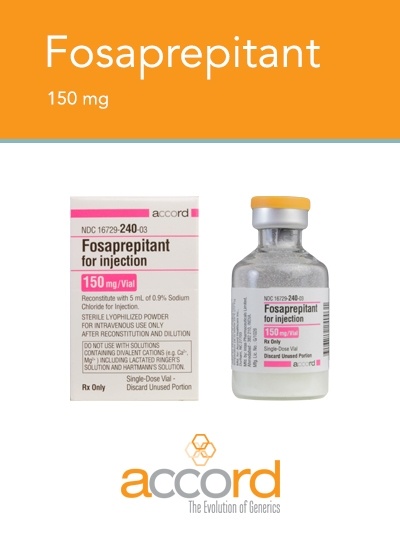
Fosaprepitant Tarbis is a white or off-white lyophilized cake for solution for infusion.
The powder is contained in a transparent glass vial with a rubber stopper and an aluminum seal with a foldable plastic cap.
Each vial contains 150 mg of fosaprepitant.
Pack sizes: 1 and 10 vials.
Not all pack sizes may be marketed.
Marketing authorization holder
Tarbis Farma S.L.
Gran Vía Carlos III, 94
08028 Barcelona
Spain
Manufacturer
Amarox Pharma B.V.
Rouboslaan 32
Voorschoten, 2252TR
Netherlands
This medicine is authorized in the Member States of the European Economic Area under the following names:
Germany: Fosaprepitant Amarox 150 mg Pulver zur Herstellung einer Infusionslösung
Spain: Fosaprepitant Tarbis 150 mg polvo para solución para perfusión EFG
Netherlands: Fosaprepitant Amarox 150 mg poeder voor oplossing voor infusie
Date of last revision of this leaflet:
Detailed and up-to-date information on this medicine is available on the website of the Spanish Agency for Medicines and Health Products (AEMPS) http://www.aemps.gob.es/
…………………………………………………………………………………………………………
This information is intended only for healthcare professionals:
Instructions for reconstitution and dilution of Fosaprepitant Tarbis 150 mg:
- Inject 5 ml of sodium chloride 9 mg/ml (0.9%) injection solution into the vial. Ensure that the sodium chloride 9 mg/ml (0.9%) injection solution is added to the vial along the vial wall to avoid foaming. Gently rotate the vial. Avoid shaking and agitating the sodium chloride 9 mg/ml (0.9%) injection solution in the vial.
- Prepare an infusion bag containing 145 ml of sodium chloride 9 mg/ml (0.9%) injection solution (e.g., by removing 105 ml of sodium chloride 9 mg/ml (0.9%) injection solution from a 250 ml infusion bag of sodium chloride 9 mg/ml (0.9%) injection solution).
- Remove the entire volume from the vial and transfer it into the infusion bag containing 145 ml of sodium chloride 9 mg/ml (0.9%) injection solution to obtain a total volume of 150 ml and a final concentration of 1 mg/ml. Gently invert the bag 2-3 times (see ‘How to use Fosaprepitant Tarbis’).
- Determine the volume to be administered from this prepared infusion bag, according to the recommended dose (see the Summary of Product Characteristics or Package Leaflet, section 4.2).
Adults
The entire volume of the prepared infusion bag should be administered (150 ml).
Pediatric patients
In patients from 12 years of age, the volume to be administered is calculated as follows:
- The volume to be administered (ml) is equal to the recommended dose (mg)
In patients between 6 months and 12 years of age, the volume to be administered is calculated as follows:
- Volume to be administered (ml) = recommended dose (mg/kg) x weight (kg)
- Note: Do not exceed the maximum doses (see the Summary of Product Characteristics or Package Leaflet, section 4.2).
- For volumes less than 150 ml, if necessary, the calculated volume can be transferred to a smaller bag or a syringe before administration by infusion.
The final reconstituted and diluted solution is stable for 24 hours at 20-25°C.
When the solution and the container allow, a visual inspection of parenteral medicines should be performed before they are administered to check for particles or discoloration.
The appearance of the reconstituted solution is the same as the appearance of the diluent used.
Discard any remaining solution and residual material. The disposal of unused medicine and all materials that have come into contact with it should be carried out in accordance with local regulations.
The medicine should not be reconstituted or mixed with solutions for which physical and chemical compatibility has not been established (see the Summary of Product Characteristics or Package Leaflet, section 6.2).
- Country of registration
- Dosage formINJECTABLE PERFUSION, 150 mg
- ATC codeA04AD12
- Active substance
- Prescription requiredYes
- Manufacturer
- This information is for reference only and does not constitute medical advice. Always consult a doctor before taking any medication. Oladoctor is not responsible for medical decisions based on this content.
- Alternatives to FOSAPREPITANT TARBIS 150 mg POWDER FOR SOLUTION FOR INFUSIONDosage form: CAPSULE, 125 and 80 mgActive substance: aprepitantManufacturer: Accord Healthcare S.L.U.Prescription requiredDosage form: CAPSULE, 125 mgActive substance: aprepitantManufacturer: Qilu Pharma Spain S.L.Prescription requiredDosage form: CAPSULE, 125 mg/80 mgActive substance: aprepitantManufacturer: Qilu Pharma Spain S.L.Prescription required


Online doctors for FOSAPREPITANT TARBIS 150 mg POWDER FOR SOLUTION FOR INFUSION
Discuss questions about FOSAPREPITANT TARBIS 150 mg POWDER FOR SOLUTION FOR INFUSION, including use, safety considerations and prescription review, subject to medical assessment and local regulations.










.jpg)
Frequently Asked Questions
