


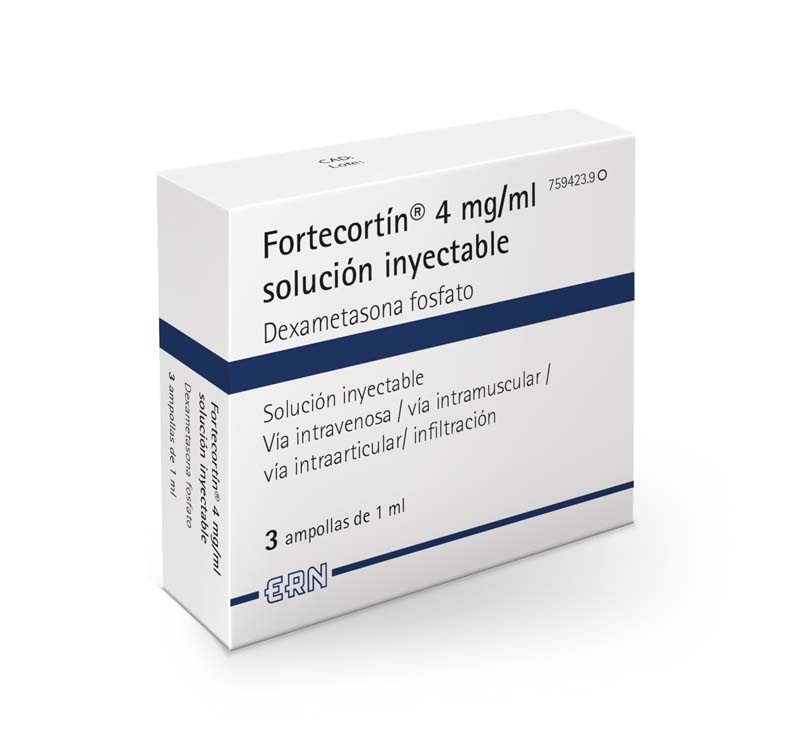
Fortecortin 4 mg/ml injectable solution

Prescription request online
A doctor will review your case and decide whether a prescription is medically appropriate.

Talk to a doctor about this medicine
Discuss your symptoms and possible next steps in a quick online consultation.



How to use FORTECORTIN 4 mg/ml INJECTABLE SOLUTION
Contents of the leaflet
- Introduction
- What is Fortecortin and what is it used for
- What you need to know before you use Fortecortin
- How to use Fortecortin
- Possible Adverse Effects
- Storage of Fortecortin
- Package Contents and Additional Information
Introduction
Package Leaflet: Information for the User
Fortecortin 4 mg/ml Solution for Injection
Dexamethasone phosphate
Read all of this leaflet carefully before you start using this medicine because it contains important information for you.
- Keep this leaflet, you may need to read it again.
- If you have any further questions, ask your doctor or pharmacist.
- This medicine has been prescribed for you only. Do not pass it on to others. It may harm them, even if their signs of illness are the same as yours.
- If you get any side effects, talk to your doctor or pharmacist. This includes any possible side effects not listed in this leaflet. See section 4.
Contents of the pack:
- What is Fortecortin and what is it used for
- What you need to know before you use Fortecortin
- How to use Fortecortin
- Possible side effects
- Storage of Fortecortin
- Contents of the pack and other information
1. What is Fortecortin and what is it used for
Dexamethasone is a synthetic glucocorticoid (adrenocortical hormone) derived from cortisone. It regulates many of the body's metabolic processes with anti-inflammatory and immunosuppressive activity.
Fortecortin is used for the treatment of:
By intravenous or intramuscular route:
- Inflammatory processes derived from brain tumors and abscesses (accumulation of pus in the brain), cranioencephalic trauma, neurosurgical operations, or bacterial meningitis.
- Traumatic shock (state of shock after severe injuries).
- Severe acute asthma attacks.
- Initial treatment of severe skin diseases.
- Initial treatment of collagen diseases such as systemic lupus erythematosus.
- Severe infectious diseases (typhoid fever, brucellosis, tuberculosis) always accompanied by appropriate anti-infective treatment.
- Prevention and treatment of nausea and vomiting that occur during chemotherapy and after surgical interventions.
- Short-term adjuvant treatment during acute episodes or exacerbations of rheumatic diseases (joint inflammation).
By intravenous route:
Fortecortin 4 mg/ml solution for injection is used for the treatment of coronavirus disease 2019 (COVID-19) in adult and adolescent patients (from 12 years of age with a body weight of at least 40 kg) with difficulty breathing and who require oxygen therapy.
By intra-articular route:
- Treatment of persistent inflammation in one or several joints: chronic joint inflammation, activated arthritis, acute joint injuries of the shoulder (periarthropathy of the humerus-scapula)
Infiltration:
In justified cases, infiltrative treatment in inflammatory processes (non-bacterial tendosynovitis and bursitis, periarthropathy, tendinopathy)

Not sure if this medicine is right for you?
Discuss your symptoms and treatment with a doctor online.
2. What you need to know before you use Fortecortin
Do not use Fortecortin:
- If you are allergic or have had an allergic reaction to dexamethasone or any of the other components of this medicine (included in section 6). These reactions are more common in patients with a history of allergy to any medicine.
- By intravenous administration if you have a systemic infection, unless you are receiving specific anti-infective treatment.
- If you are going to be administered Fortecortin by injection into the joint and you have:
- Infections in the joint to be treated or very close to it
- Bacterial arthritis (wear and tear of the joints produced by bacterial infection)
- Instability of the joint to be treated
- Tendency to bleed (spontaneously or due to anticoagulants)
- Calcification around the joint
- Avascular osteonecrosis (bone injury due to lack of blood supply to the bone)
- Tendon rupture
- Charcot's disease (degenerative disease that affects the joints)
- By infiltration if there is an infection in the application area and you are not receiving appropriate complementary treatment.
Warnings and precautions
Administration of Fortecortin may induce adrenocortical insufficiency, especially if high doses are administered for a prolonged period.
Avoid sudden withdrawal of treatment, especially in prolonged treatments, as a corticosteroid withdrawal syndrome may appear, characterized by general malaise, weakness, and muscle pain, difficulty breathing, loss of appetite, nausea, vomiting, fever, decrease in blood pressure and blood glucose levels.
In certain special situations of physical stress during treatment with Fortecortin (e.g., febrile disorders, accidents, operations, childbirth), a temporary increase in the daily dose of corticosteroid may be necessary.
Fortecortin may increase the risk of contracting infections as well as hiding the signs of an infection and/or making its diagnosis difficult. Latent infections may reactivate during the use of corticosteroids.
In the following cases, close monitoring of the treatment by your doctor will be necessary:
- In acute and chronic bacterial infections.
- If you have lymph node inflammation (lymph nodes that help defend the body) after being administered the tuberculosis vaccine.
- If you have a history of tuberculosis.
- Patients with chronic hepatitis (inflammation of the liver).
- Acute viral infections (hepatitis B, herpes, chickenpox, poliomyelitis, measles).
- Infections caused by fungi or parasites.
- If you need to be vaccinated or have been vaccinated between approximately 8 weeks before and 2 weeks after.
- If you have diabetes, digestive ulcers, or inflammatory diseases of the digestive system, osteoporosis (loss of calcium in the bones), heart failure, high blood pressure, and psychiatric disorders.
- If you have glaucoma (increased intraocular pressure), corneal ulcers or injuries, blurred vision, or other visual disturbances.
Long-term treatment with Fortecortin will only be established when it is strictly necessary and should be associated with specific treatment corresponding to each case.
Administration of Fortecortin may alter the value of some laboratory tests.
Especially with long-term treatment with high doses of Fortecortin, it is necessary to consider sufficient potassium intake and restricted salt intake, and monitor blood potassium levels.
Administration of high doses of dexamethasone may cause a decrease in heart rate in some patients.
Severe anaphylactic reactions (immune system overreaction) may occur.
If you have myasthenia gravis (severe muscle weakness), it may initially worsen during treatment with Fortecortin.
If the intravenous administration of Fortecortin is too rapid, a sensation of tingling or numbness may appear, which can last for a few minutes.
If Fortecortin is administered locally (by intramuscular, intra-articular, or infiltration routes), undesired systemic effects may occur.
Administration of Fortecortin into the joints increases the risk of joint infection; likewise, continued use over long periods may cause joint wear.
In postmenopausal women, Fortecortin may increase the risk of osteoporosis.
You should inform your doctor if you have any of the following symptoms of tumor lysis syndrome (TLS) such as muscle cramps, muscle weakness, confusion, vision loss or alteration, and difficulty breathing, in case you suffer from a malignant hematological process.
Children and adolescents
In children, the doctor should assess the benefits of treatment, as the use of glucocorticoids may affect their growth.
Dexamethasone should not be used routinely in premature newborns with respiratory problems.
Elderly
In patients over 65 years of age, the doctor should assess the benefits of treatment and possible risks, as these patients may experience more adverse effects, such as osteoporosis.
Use of Fortecortin with other medicines
Inform your doctor or pharmacist if you are taking or have recently taken any other medicines, including those obtained without a prescription, homeopathic medicines, herbal remedies, and other health-related products, as it may be necessary to interrupt treatment or adjust the dose of some of them. Note that these instructions may also apply to medicines used before or after.
This is especially important if you are taking the following medicines:
- Non-steroidal anti-inflammatory drugs (NSAIDs) such as indomethacin and salicylates, as they increase the risk of gastrointestinal ulcers and bleeding.
- Oral antidiabetics and insulin, as their effect may be reduced.
- Antiepileptics (carbamazepine), antiarrhythmics (phenytoin), anti-asthmatics and bronchodilators (ephedrine), antitubercular antibiotics (rifampicin), barbiturates, and primidone, as they may decrease the effects of dexamethasone.
- Medicines that delay degradation in the liver, such as some antifungal medicines (ketoconazole, itraconazole) and certain antiretroviral medicines, as they may increase the action of corticosteroids. Therefore, your doctor will perform thorough checks if you are taking these medicines (including some for HIV: ritonavir, cobicistat).
- Coumarin derivatives (oral anticoagulants), as their anticoagulant effect may be modified.
- Estrogens (e.g., for contraceptive use) may increase the action of dexamethasone.
- Atropine and other anticholinergic medicines, as they may increase intraocular pressure.
- Medicines used to treat heart diseases, such as cardiac glycosides, as their effect may be increased by decreases in potassium levels.
- Diuretics/laxatives, as they may increase potassium elimination.
- Praziquantel, as glucocorticoids may cause a decrease in praziquantel blood levels.
- Antihypertensive medicines (ACE inhibitors), as they may increase the risk of alterations in blood components.
- Medicines against malaria (chloroquine, hydroxychloroquine, mefloquine), as they may increase the risk of muscle diseases or heart muscle diseases (myopathies, cardiomyopathies).
- Immunosuppressive substances, as they may increase the risk of infections. Additionally, in the case of cyclosporine, cyclosporine blood levels may be elevated, which increases the risk of seizures.
- Non-depolarizing muscle relaxants, as muscle relaxation may be prolonged.
- Protirelin, as its effects on thyroid-stimulating hormone (TSH) may be affected.
- Fluoroquinolones, as they may increase the risk of tendon alterations.
- Amphotericin B, as it may increase the risk of decreased potassium levels (hypokalemia).
- Albendazole, as it may increase the levels of its active metabolite in the blood.
- Vaccines, as the immune response to the vaccine may be inadequate.
Do not stop taking any other steroid medicine unless your doctor has told you to.
Talk to your doctor, pharmacist, or nurse before you are given this medicine.
Pregnancy, breastfeeding, and fertility
If you are pregnant or breastfeeding, think you may be pregnant, or plan to become pregnant, consult your doctor or pharmacist before using this medicine.
Pregnancy
Dexamethasone crosses the placenta. During pregnancy, especially in the first three months, treatment should only be administered after carefully weighing the risk/benefit ratio. Therefore, women should inform their doctor about an existing or suspected pregnancy. With long-term treatment with glucocorticoids during pregnancy, fetal growth disorders cannot be ruled out. If glucocorticoids are administered at the end of pregnancy, inadequate adrenal function may appear in the newborn, requiring initiation of replacement therapy with reduced doses in the newborn.
Breastfeeding
Glucocorticoids, including dexamethasone, pass into breast milk. So far, no harm has been reported in the infant. However, the need for administration during breastfeeding should be carefully examined. If high doses are necessary for medical reasons, breastfeeding should be interrupted. Consult your doctor immediately.
Fertility
The effects of Fortecortin on fertility have not been studied.
Driving and using machines
There are no data on how Fortecortin affects driving or operating machinery, so try not to perform tasks that require special attention until you verify how you tolerate the medicine.
Fortecortin contains sodium
This medicine contains less than 23 mg (1 mmol) of sodium per ampoule, so it is considered essentially "sodium-free".
Influence on laboratory results
This medicine may alter the values of certain laboratory tests. Additionally, skin reactions in allergy tests may be masked.
Use in athletes
This medicine contains a component that may produce a positive result in doping tests.
3. How to use Fortecortin
Take Fortecortin only as your doctor has indicated. Your doctor will determine the dose individually and decide how long you should be administered dexamethasone. In case of doubt, consult your doctor or pharmacist again.
It should be taken into account that the dosage requirements are variable and should be individualized based on the disease and the patient's response.
Fortecortin is injected slowly intravenously, although it can also be administered, depending on the indication, by intramuscular, intra-articular, or infiltration routes.
Intravenous or intramuscular route:
Fortecortin is normally injected slowly (over 2-3 minutes) intravenously, but it can also be administered intramuscularly. The dose and duration of treatment depend on the indication and severity of the disease to be treated. After obtaining an initial favorable response, your doctor will establish the most suitable maintenance dose for you. Reduction of the dose as well as suspension of treatment should always be done progressively.
For the treatment of COVID-19
In adult patients, it is recommended to administer 7.2 mg of dexamethasone phosphate (which is equivalent to 6 mg of dexamethasone base) intravenously once a day, for a maximum of 10 days.
Use in adolescents
It is recommended to administer 7.2 mg of dexamethasone phosphate (which is equivalent to 6 mg of dexamethasone base) intravenously once a day to pediatric patients (adolescents from 12 years of age) for a maximum of 10 days.
Renal and hepatic insufficiency
No specific dose adjustment is necessary for patients with renal insufficiency.
In patients with hepatic insufficiency, comparatively lower doses may be sufficient, or the dose may need to be reduced.
Use in children and adolescents
In general, the recommended daily dose in children is 0.08-0.3 mg/kg, depending on the severity and type of disease.
Intra-articular or infiltration route:
Intra-articular injections are considered as open joint surgery and should be performed under strict aseptic conditions. Normally, a single intra-articular injection is sufficient to relieve symptoms. If it is considered necessary to administer an additional dose, it should not be administered before at least 3 or 4 weeks have passed since the first dose. The number of injections per joint should be limited to 3 or 4 as a maximum. Medical follow-up of the joint is recommended, especially in the case of repeated injections.
Local injections or infiltrations are usually administered at doses of 0.2-6 mg of dexamethasone, depending on the size of the joints.
If you use more Fortecortin than you should
In case of overdose or accidental ingestion, consult your doctor or pharmacist immediately or call the Toxicology Information Service, phone: 91 562 04 20, indicating the medicine and the amount used.
Acute intoxications with dexamethasone are not known. In the event of an overdose, it is expected that the adverse reactions described in this leaflet will occur to a greater extent.
If you stop treatment with Fortecortin
Do not stop treatment before your doctor indicates it, nor suddenly, as it may worsen your disease.
Reduction of the dose should be done progressively. Similarly, suspension of treatment should always be done progressively.
Excessive rapid decrease in the dose after long-term treatment may cause symptoms such as muscle and joint pain. Your doctor will gradually reduce the dose you should use.
If you have any other doubts about the use of this product, ask your doctor or pharmacist.

Started taking the medicine and have questions?
Discuss your symptoms and treatment with a doctor online.
4. Possible Adverse Effects
Like all medicines, this medicine can cause adverse effects, although not all people suffer from them.
The terms used to describe the frequency of adverse effects are based on the following definitions: Very common (may affect more than 1 in 10 people), common (may affect up to 1 in 10 people), uncommon (may affect up to 1 in 100 people), rare (may affect up to 1 in 1,000 people), very rare (may affect up to 1 in 10,000 people), frequency not known (cannot be estimated from available data).
Due to the wide range of therapeutic use, dosage, and treatment duration, the frequency of Fortecortin's adverse effects is not known.
Blood and lymphatic system disorders: Alteration of blood cells (white blood cells and lymphocytes, among others).
Endocrine disorders: Adrenal suppression and induction of symptoms similar to Cushing's syndrome (moon face, trunk adiposity).
Eye disorders: Glaucoma (increased intraocular pressure), cataracts, worsening of corneal ulcer symptoms; eye infections, ptosis, pupil dilation (mydriasis), burning, scleral perforation, and in rare cases, reversible exophthalmos.
Visual disturbances, blurred vision, loss of vision, with frequency not known.
Gastrointestinal disorders: Gastric discomfort, ulcer, gastrointestinal bleeding, pancreatitis.
Immune system disorders: Hypersensitivity reactions, severe allergic reactions such as: cardiac rhythm problems, bronchospasm, blood pressure changes, circulatory failure, cardiac arrest.
Infections and infestations: Masking of infections, existing infections may worsen or reactivate, and new infections may appear, activation of intestinal parasitic diseases (strongyloidiasis).
Metabolism and nutrition disorders: Fluid retention (edema), potassium loss (which can cause arrhythmias), weight gain, increased blood sugar, diabetes mellitus, hypercholesterolemia, hypertriglyceridemia, increased appetite.
Musculoskeletal and connective tissue disorders: Muscle atrophy and weakness, myopathy, tendon alterations, osteoporosis, aseptic osteonecrosis, growth retardation in children, epidural lipomatosis.
Note: Excessively rapid dose reduction after long-term treatment may cause symptoms such as muscle and joint pain.
Nervous system disorders: Increased intracranial pressure (pseudotumor cerebri), increased spasms in epileptic patients or onset of epilepsy (convulsions).
Psychiatric disorders: Psychosis, mania, depression, hallucinations, emotional instability, irritability, increased activity, euphoria, anxiety, sleep disturbances, suicidal thoughts.
Reproductive system and breast disorders: Alteration of sex hormone secretion (absence of menstruation, excessive hair growth, impotence).
Skin and subcutaneous tissue disorders: Acne, dermatitis around the mouth, stretch marks, skin atrophy, petechiae, telangiectasias, bruising, hirsutism, skin color changes.
Cardiac disorders: Heart failure.
Vascular disorders: Hypertension, increased risk of arteriosclerosis and thrombosis, vasculitis (also as a withdrawal symptom after long-term treatment), fragility of small blood vessels.
General disorders and administration site conditions: Delayed wound healing, hypoaesthesia.
Reporting of Adverse Effects
If you experience any type of adverse effect, consult your doctor or pharmacist, even if it is a possible adverse effect not listed in this prospectus. You can also report them directly through the Spanish Pharmacovigilance System for Human Use Medicines: www.notificaram.es. By reporting adverse effects, you can contribute to providing more information on the safety of this medicine.
5. Storage of Fortecortin
Do not store above 25°C. Keep the ampoules in the outer packaging to protect them from light.
Keep this medicine out of the sight and reach of children.
Do not use this medicine after the expiry date stated on the packaging after CAD. The expiry date is the last day of the month indicated.
This medicine is for single use and must be administered immediately after opening. Any unused portion must be discarded.
Only transparent and particle-free solutions should be used.
Do not use this medicine if you notice visible signs of deterioration.
Medicines should not be disposed of via wastewater or household waste. Deposit the packaging and unused medicines at the pharmacy's SIGRE point. In case of doubt, ask your pharmacist how to dispose of the packaging and unused medicines. This will help protect the environment.
6. Package Contents and Additional Information
Composition of Fortecortin 4 mg/ml
- The active ingredient is dexamethasone phosphate. Each ampoule of injectable solution contains 4 mg of dexamethasone phosphate (as sodium phosphate dexamethasone, 4.37 mg) (equivalent to 3.33 mg of dexamethasone base).
- The other components are: sodium citrate, creatinine, disodium edetate, sodium hydroxide, and water for injectable preparations.
Appearance of the Product and Package Contents
It is presented in the form of colorless type I glass ampoules. Packages containing 3, 100, and 200 ampoules of injectable solution.
Marketing Authorization Holder
LABORATORIOS ERN, S.A.
Perú, 228
08020 Barcelona
Spain
Manufacturer
LABORATORIOS ERN, S.A.
Gorgs Lladó, 188
08210 Barberá del Vallés, Barcelona, Spain
Date of the Last Revision of this Prospectus:January 2022
Detailed and updated information on this medicine is available on the website of the Spanish Agency for Medicines and Health Products (AEMPS) http://www.aemps.gob.es/
--------------------------------------------------------------------------------------------------------------------
This information is intended only for healthcare professionals:
Fortecortin should not be mixed with other medicines due to lack of compatibility data. It should preferably be administered directly by intravenous route or injected into the infusion line. However, the injectable solution of Fortecortin is compatible with the following infusion solutions (250 ml and 500 ml each) and must be used within 24 hours: isotonic saline solution, Ringer's solution, and 5% glucose solution.
If Fortecortin is used in combination with infusion solutions, attention should be paid to the information on compatibility, contraindications, adverse reactions, and interactions provided by the manufacturers of the solutions.
- Country of registration
- Dosage formINJECTABLE, 4 mg dexamethasone
- ATC codeH02AB02
- Active substance
- Prescription requiredYes
- Manufacturer
- CompositionEDETATO DE DISODIO (0,50 mg mg), HIDROXIDO DE SODIO (E 524) (c.s.p ajuste PH - mg), CITRATO DE SODIO (E-331) (10 mg mg)
- This information is for reference only and does not constitute medical advice. Always consult a doctor before taking any medication. Oladoctor is not responsible for medical decisions based on this content.
- Alternatives to FORTECORTIN 4 mg/ml INJECTABLE SOLUTIONDosage form: TABLET, 20 mgActive substance: dexamethasoneManufacturer: Mabo Farma S.A.Prescription requiredDosage form: TABLET, 4 mgActive substance: dexamethasoneManufacturer: Mabo Farma S.A.Prescription requiredDosage form: TABLET, 8 mgActive substance: dexamethasoneManufacturer: Mabo Farma S.A.Prescription required
Online doctors for FORTECORTIN 4 mg/ml INJECTABLE SOLUTION
Discuss questions about FORTECORTIN 4 mg/ml INJECTABLE SOLUTION, including use, safety considerations and whether a prescription is appropriate, subject to medical assessment and local regulations.

Frequently Asked Questions
FORTECORTIN 4 mg/ml INJECTABLE SOLUTION requires a prescription in Spain. You can check with a doctor online whether this medicine may be appropriate for your situation.
The active ingredient in FORTECORTIN 4 mg/ml INJECTABLE SOLUTION is dexamethasone. This information helps identify medicines with the same composition but different brand names.
FORTECORTIN 4 mg/ml INJECTABLE SOLUTION is manufactured by Laboratorios Ern S.A.. Pharmacy brands and packaging may differ depending on the distributor.
Doctors such as Family doctors, Psychiatrists, Dermatologists, Cardiologists, Endocrinologists, Gastroenterologists, Pulmonologists, Nephrologists, Rheumatologists, Hematologists, Infectious disease physicians, Allergists, Geriatricians, Paediatricians, Oncologists may assess whether FORTECORTIN 4 mg/ml INJECTABLE SOLUTION is appropriate, depending on your situation and local regulations. You can book an online consultation to discuss your symptoms and possible next steps.
The prescription is issued by a doctor after assessing your health. In Spain, FORTECORTIN 4 mg/ml INJECTABLE SOLUTION is then dispensed in pharmacies with that prescription. An online consultation does not guarantee that a prescription will be issued: the decision always rests with the doctor.
To request an assessment, you can use Oladoctor:
Other medicines with the same active substance (dexamethasone) include DEXAMETHASONE ABDRUG 20 mg TABLETS, DEXAMETHASONE ABDRUG 4 mg TABLETS, DEXAMETHASONE ABDRUG 8 mg TABLETS. These may have different brand names or formulations but contain the same therapeutic ingredient. Always consult a doctor before switching or starting a new medicine.
