



FINLEE 10 mg Dispersible Tablets

Prescription review online
A doctor will review your case and decide whether a prescription is medically appropriate.

Talk to a doctor about this medicine
Discuss your symptoms and possible next steps in a quick online consultation.



How to use FINLEE 10 mg DISPERSIBLE TABLETS
Contents of the leaflet
- Introduction
- What is Finlee and what is it used for
- What you need to know before giving Finlee
- How to give Finlee
- Possible Adverse Effects
- Storage of Finlee
- Container Contents and Additional Information
Introduction
Package Leaflet: Information for the Patient
Finlee 10mg dispersible tablets
dabrafenib
Read all of this leaflet carefully before your child starts taking this medicine because it contains important information.
- Keep this leaflet, as you may need to read it again.
- If you have any further questions, ask your doctor, pharmacist, or nurse.
- This medicine has been prescribed for your child only, and you should not give it to others, even if they have the same symptoms as your child, as it may harm them.
- If your child experiences side effects, consult a doctor, pharmacist, or nurse, even if they are side effects not listed in this leaflet. See section 4.
- The information in this leaflet is for you or your child, but the leaflet will only say "your child".
Contents of the Package Leaflet
- What is Finlee and what is it used for
- What you need to know before giving Finlee
- How to give Finlee
- Possible side effects
- Storing Finlee
- Package Contents and Additional Information
1. What is Finlee and what is it used for
Finlee is a medicine that contains the active substance dabrafenib.
It is used in combination with another medicine (trametinib oral solution) in children from 1 year of age to treat a type of brain tumor called glioma.
Finlee may be used in patients with:
- low-grade glioma
- high-grade glioma when the patient has received at least one treatment with radiation and/or chemotherapy.
Finlee is used to treat patients whose brain tumor has a specific mutation (change) in a gene called BRAF. This mutation causes the body to produce defective proteins that can lead to the development of the tumor. The doctor will assess this mutation before starting treatment.
In combination with trametinib, Finlee targets these defective proteins and slows down or stops the growth of the tumor. Also, read the package leaflet of trametinib oral solution.

Not sure if this medicine is right for you?
Discuss your symptoms and treatment with a doctor online.
2. What you need to know before giving Finlee
Do not give Finlee
Warnings and Precautions
Consult your doctor before giving Finlee. The doctor needs to know if your child:
- has eye problems, such as blockage of the veins that supply the eye (retinal vein occlusion) or swelling of the eye that may be due to a blockage of fluid (chorioretinopathy).
- has heart problems, such as heart failure or problems with the way the heart beats.
- has or has had kidney problems.
- has or has had liver problems.
- has or has had lung or breathing problems, such as difficulty breathing, often accompanied by dry cough, shortness of breath, and fatigue.
- has or has had gastrointestinal problems, such as diverticulitis (inflamed pouches in the colon) or metastases in the gastrointestinal tract.
Before your child starts taking Finlee, during, and after treatment, the doctor will perform checks to prevent complications.
Skin Examination
Finlee may cause skin cancer. In general, these skin changes remain localized and can be removed by surgery, and treatment with Finlee can continue without interruption. The doctor may examine your child's skin before and regularly during treatment.
Check your child's skin monthly during treatment and for 6 months after stopping this medicine. Tell the doctoras soon as possible if you notice any changes in your child's skin, such as a new wart, skin sore, or a red lump that bleeds or does not heal, or a change in the size or color of a mole.
Tumor Lysis Syndrome
If your child experiences the following symptoms, tell the doctor immediately, as it may be a life-threatening condition: nausea, difficulty breathing, irregular heartbeats, muscle cramps, seizures, cloudy urine, decreased urine production, and fatigue. These may be caused by a group of metabolic complications that can occur during cancer treatment and are caused by the breakdown products of dying cancer cells (tumor lysis syndrome or TLS) and can cause changes in kidney function (see also section 4).
Children under 1 year of age
The effects of Finlee in children under 1 year of age are unknown. Therefore, Finlee is not recommended in this age group.
Patients over 18 years of age
Information on treatment in patients over 18 years of age with glioma is limited, so the doctor must assess the continuation of treatment until adulthood.
Other Medicines and Finlee
Before starting treatment, tell the doctor, pharmacist, or nurse if your child is taking, has recently taken, or might take any other medicines. This includes medicines bought without a prescription.
Some medicines may affect the way Finlee works or make it more likely that your child will have side effects. Finlee may also affect the way other medicines work. These include:
- medicines used for birth control (contraceptives) that contain hormones, such as the pill, injections, or patches
- medicines used to make the blood thinner, such as warfarin and acenocoumarol
- medicines used to treat heart conditions, such as digoxin
- medicines used to treat fungal infections, such as itraconazole, voriconazole, and posaconazole
- medicines used to treat Cushing's disease, such as ketoconazole
- certain medicines called calcium channel blockers used to treat high blood pressure, such as diltiazem, felodipine, nicardipine, nifedipine, or verapamil
- medicines used to treat cancer, such as cabazitaxel
- certain medicines used to lower fat (lipid) levels in the blood, such as gemfibrozil
- certain medicines used to treat certain psychiatric conditions, such as haloperidol
- certain medicines called antibiotics, such as clarithromycin, doxycycline, and telithromycin
- certain medicines used to treat tuberculosis, such as rifampicin
- certain medicines used to lower cholesterol levels, such as atorvastatin and simvastatin
- certain medicines called immunosuppressants, such as cyclosporin, tacrolimus, and sirolimus
- certain medicines called anti-inflammatory medicines, such as dexamethasone and methylprednisolone
- certain medicines used to treat HIV, such as ritonavir, amprenavir, indinavir, darunavir, delavirdine, efavirenz, fosamprenavir, lopinavir, nelfinavir, tipranavir, saquinavir, and atazanavir
- certain medicines used to help with sleep, such as diazepam, midazolam, zolpidem
- certain medicines used for pain relief, such as fentanyl or methadone
- medicines used to treat seizures (epileptic fits), such as phenytoin, phenobarbital, primidone, valproic acid, or carbamazepine
- medicines called antidepressants, such as nefazodone and St. John's Wort (Hypericum perforatum).
Consult your doctor, pharmacist, or nurseif your child is taking any of these medicines (or if you are not sure). Your doctor may consider adjusting the dose.
Pregnancy, Breast-feeding, and Fertility
Pregnancy
- If your daughter is pregnant or thinks she may be pregnant, consult a doctor or nurse before using this medicine. Finlee may harm the fetus.
- If your daughter becomes pregnant while taking this medicine, consult a doctor immediately.
Breast-feeding
It is not known if Finlee can pass into breast milk. If your daughter is breast-feeding or plans to breast-feed, she should inform her doctor. You, your daughter, and the doctor will decide whether to take Finlee or breast-feed.
Fertility
Finlee may reduce sperm count and may not return to normal levels until after stopping treatment with Finlee.
Taking Finlee with trametinib oral solution: Trametinib may affect fertility in both males and females.
Before starting treatment with Finlee, talk to the doctor about options to improve the chances of your child having children in the future.
Contraception
- If your daughter can become pregnant, she must use a reliable method of birth control (contraceptive) while taking Finlee in combination with trametinib oral solution and for at least 16 weeks after the last dose of Finlee and trametinib.
- Hormonal birth control methods (such as the pill, injections, or patches) may not be as effective when taking Finlee in combination with trametinib oral solution. Therefore, while taking this combination of medicines, your daughter needs to use another effective birth control method to avoid becoming pregnant. Consult a doctor or nurse.
Driving and Using Machines
Finlee may cause side effects that can affect your child's ability to drive, ride a bike, use machines, or participate in other activities that require being alert. If your child has vision problems or feels tired, weak, or lacks energy, they should avoid these types of activities.
The description of side effects can be found in section 4. For more information, read the entire package leaflet.
If you are not sure, talk to a doctor, pharmacist, or nurse. Your child's ability to perform these types of activities may also be affected by their own illness, symptoms, or treatment.
Finlee contains potassium
This medicine contains potassium, less than 1 mmol (39 mg) per maximum daily dose; this is essentially "potassium-free".
Finlee contains benzyl alcohol
This medicine contains less than 0.00078 mg of benzyl alcohol in each dispersible tablet.
Benzyl alcohol may cause allergic reactions.
Consult a doctor or pharmacist if your daughter is pregnant or breast-feeding. This is because large amounts of benzyl alcohol can accumulate in your daughter's body and cause side effects (metabolic acidosis).
Consult a doctor or pharmacist if your child has liver or kidney disease. This is because large amounts of benzyl alcohol can accumulate in your child's body and cause side effects (metabolic acidosis).
3. How to give Finlee
Follow the instructions for giving this medicine to your child exactly as told by the doctor, pharmacist, or nurse. If you are unsure, consult the doctor, pharmacist, or nurse again.
How much to give
The doctor will decide the correct dose of Finlee based on your child's body weight.
The doctor will decide if your child needs to take a lower dose based on the side effects they experience.
How to give it
Read the instructions for use at the end of this leaflet for more information on how to prepare and give the dispersible tablet solution.
- Give Finlee twice a day. Giving Finlee at the same time every day will help you remember when to give the medicine. The doses of Finlee should be given 12 hours apart. Trametinib oral solution is only taken once a day. Give trametinib oral solution with either the morning or evening dose of Finlee.
- Give Finlee on an empty stomach, at least 1 hour before or 2 hours after a meal, which means:
- after taking Finlee, your child must wait at least 1 hourbefore eating.
- after eating, your child must wait at least 2 hoursbefore taking Finlee.
- if necessary, breast milk and/or formula can be given on demand.
If you give too much Finlee
If you give too much Finlee, contact a doctor, pharmacist, or nurse immediately. If possible, show them the Finlee packaging with the package leaflet.
If you forget to give Finlee
If it has been less than 6 hours since the missed dose, give it as soon as you remember.
If it has been 6 hours or more since the missed dose, do not make up for the missed dose. Give the next dose at the usual time and then continue giving Finlee at the usual time.
Do not give a double dose to make up for missed doses.
If your child vomits after taking Finlee
If your child vomits after taking Finlee, do not give another dose until the next scheduled dose.
If you stop treatment with Finlee
Give Finlee for the time the doctor has told you. Do not stop treatment unless the doctor tells you to.
If you have any other questions about the use of this medicine, ask your doctor, pharmacist, or nurse.

Started taking the medicine and have questions?
Discuss your symptoms and treatment with a doctor online.
4. Possible Adverse Effects
Like all medicines, this medicine may cause adverse effects, although not all people suffer from them.
Stop giving this medicine and seek urgent medical attention if your child has any of the following symptoms:
- coughing up blood, blood in the urine, vomiting blood or if the vomit has the appearance of "coffee grounds", if they have red or black stools with a tar-like appearance. These may be signs of bleeding.
- fever (temperature of 38 °C or higher).
- chest pain or difficulty breathing, sometimes with fever or cough. These may be signs of pneumonitis or inflamed lungs (interstitial lung disease).
- blurred vision, loss of vision or other changes in vision. These may be signs of retinal detachment.
- redness of the eyes, eye pain, increased sensitivity to light. These may be signs of uveitis.
- unexplained muscle pain, muscle cramps or muscle weakness, dark urine. These may be signs of rhabdomyolysis.
- severe abdominal pain. This may be a sign of pancreatitis.
- fever, swelling of the lymph nodes, bruising or rash at the same time. These may be signs of a condition in which the immune system produces too many cells that fight infections, which can cause various symptoms (hemophagocytic lymphohistiocytosis).
- nausea, difficulty breathing, irregular heartbeats, muscle cramps, seizures, cloudy urine, decreased urine production and fatigue. These may be signs of a condition resulting from the rapid breakdown of cancer cells that in some people can be fatal (tumor lysis syndrome or TLS).
- red patches on the trunk, circular or target-like, with or without central blisters, skin peeling, ulcers in the mouth, throat, nose, genitals and eyes. These may be signs of severe skin rashes, which can be life-threatening and may be preceded by fever and flu-like symptoms (Stevens-Johnson syndrome), generalized rash, fever and swollen lymph nodes (DRESS).
Other possible adverse effects
Very common(may affect more than 1 in 10 people)
- headache
- dizziness
- cough
- diarrhea, feeling of dizziness (nausea), discomfort (vomiting), constipation, stomach pain
- skin problems such as rash, acne-like rash, dry or itchy skin, redness of the skin
- wart-like growths (cutaneous papilloma)
- skin infection under the nails
- pain in arms or legs or joints
- lack of energy or feeling weak or tired
- weight gain
- upper respiratory tract infections with symptoms such as sore throat and nasal congestion (nasopharyngitis)
- increased liver enzymes in blood tests
- low levels of white blood cells (neutropenia, leucopenia)
- low levels of red blood cells (anemia)
Common(may affect up to 1 in 10 people)
- frequent urination with pain or burning sensation (urinary tract infection)
- skin effects including skin infection (cellulitis), inflammation of the hair follicles in the skin, inflamed and peeling skin (generalized exfoliative dermatitis), thickening of the outer layer of the skin (hyperkeratosis)
- decreased appetite
- low blood pressure (hypotension)
- high blood pressure (hypertension)
- shortness of breath
- mouth ulcers or mouth pain, inflammation of the mucous membranes
- inflammation of the fatty layer under the skin (panniculitis)
- unusual hair loss or thinning hair
- redness and pain in the hands and feet (hand-foot syndrome)
- muscle spasms
- chills
- allergic reaction (hypersensitivity)
- dehydration
- vision problems including blurred vision
- decreased heart rate (bradycardia)
- fatigue, chest discomfort, feeling of dizziness, palpitations (reduced ejection fraction)
- swelling of the tissues (edema)
- muscle pain (myalgia)
- fatigue, chills, sore throat, joint or muscle pain (flu-like illness)
- abnormal results of tests related to creatine phosphokinase, an enzyme found mainly in the heart, brain and skeletal muscle
- increased blood sugar levels
- low levels of sodium or phosphate in the blood
- decreased platelet count in the blood (cells that help blood clotting)
- increased sensitivity of the skin to the sun
Uncommon(may affect up to 1 in 100 people)
- irregular heartbeats (atrioventricular block)
- inflammation of the intestines (colitis)
- cracked skin
- night sweats
- excessive sweating
- raised, painful, red to dark purple skin patches or sores that appear mainly on the arms, legs, face and neck, with fever (signs of acute febrile neutrophilic dermatosis)
In addition to the adverse effects described above, the following adverse effects have only been reported in adult patients so far, although they may also occur in children:
- nervous system problems that can cause pain, numbness or tingling in the hands and feet and/or muscle weakness (peripheral neuropathy)
- dry mouth
- kidney failure
- benign skin tumor (acrocordon)
- inflammatory disease that mainly affects the skin, lungs, eyes and lymph nodes (sarcoidosis)
- kidney inflammation
- hole (perforation) in the stomach or intestines
- inflammation of the heart muscle that can cause difficulty breathing, fever, palpitations and chest pain
Reporting of adverse effects
If your child experiences any type of adverse effect, consult a doctor, pharmacist or nurse, even if it is a possible adverse effect that is not listed in this leaflet. You can also report them directly through the national reporting system included in Appendix V. By reporting adverse effects, you can contribute to providing more information on the safety of this medicine.
5. Storage of Finlee
Keep this medicine out of the sight and reach of children.
Do not use this medicine after the expiry date that appears on the label of the bottle and on the packaging, after CAD. The expiry date is the last day of the month indicated.
Administer the solution no later than 30 minutes after the tablets have been dissolved.
This medicine does not require any special storage temperature.
Store in the original packaging to protect it from moisture.
Medicines should not be disposed of via wastewater or household waste. Ask your pharmacist how to dispose of the packaging and any unused medicines. This will help protect the environment.
6. Container Contents and Additional Information
Composition ofFinlee
- The active ingredient is dabrafenib. Each dispersible tablet contains dabrafenib mesylate equivalent to 10 mg of dabrafenib.
- The other ingredients are: mannitol (E 421), microcrystalline cellulose (E 460), crospovidone (E 1202), hypromellose (E 464), potassium acesulfame (E 950) (see section 2), magnesium stearate (E 470b), artificial berry flavor (maltodextrin, propylene glycol [E 1520], artificial flavors, triethyl citrate [E 1505], benzyl alcohol [E 1519] [see section 2]) and anhydrous colloidal silica (E 551).
Appearance of the Product and Container Contents
The Finlee 10 mg dispersible tablets are white to slightly yellow, round, 6 mm, marked with a "D" on one face and "NVR" on the other.
The bottles are made of plastic, white in color with plastic screw caps.
The bottles also include a silica gel desiccant in a small cylindrical container. These desiccants should be left inside the bottle and should not be ingested.
Finlee 10 mg dispersible tablets are available in containers containing 1 or 2 bottles (210 or 420 dispersible tablets) and 2 dosing cups.
Marketing Authorization Holder
Novartis Europharm Limited
Vista Building
Elm Park, Merrion Road
Dublin 4
Ireland
Manufacturer
Lek Pharmaceuticals d.d.
Verovškova ulica 57
1526, Ljubljana
Slovenia
Novartis Pharmaceutical Manufacturing LLC
Verovškova ulica 57
1000, Ljubljana
Slovenia
Novartis Pharma GmbH
Roonstrasse 25
90429 Nuremberg
Germany
Novartis Farmacéutica S.A.
Gran Via de les Corts Catalanes 764
08013 Barcelona
Spain
Novartis Pharma GmbH
Sophie-Germain-Strasse 10
90443 Nürnberg
Germany
You can request more information about this medication by contacting the local representative of the marketing authorization holder:
België/Belgique/Belgien Novartis Pharma N.V. Tél/Tel: +32 2 246 16 11 | Lietuva SIA Novartis Baltics Lietuvos filialas Tel: +370 5 269 16 50 |
| Luxembourg/Luxemburg Novartis Pharma N.V. Tél/Tel: +32 2 246 16 11 |
Ceská republika Novartis s.r.o. Tel: +420 225 775 111 | Magyarország Novartis Hungária Kft. Tel.: +36 1 457 65 00 |
Danmark Novartis Healthcare A/S Tlf.: +45 39 16 84 00 | Malta Novartis Pharma Services Inc. Tel: +356 2122 2872 |
Deutschland Novartis Pharma GmbH Tel: +49 911 273 0 | Nederland Novartis Pharma B.V. Tel: +31 88 04 52 111 |
Eesti SIA Novartis Baltics Eesti filiaal Tel: +372 66 30 810 | Norge Novartis Norge AS Tlf: +47 23 05 20 00 |
Ελλάδα Novartis (Hellas) A.E.B.E. Τηλ: +30 210 281 17 12 | Österreich Novartis Pharma GmbH Tel: +43 1 86 6570 |
España Novartis Farmacéutica, S.A. Tel: +34 93 306 42 00 | Polska Novartis Poland Sp. z o.o. Tel.: +48 22 375 4888 |
France Novartis Pharma S.A.S. Tél: +33 1 55 47 66 00 | Portugal Novartis Farma - Produtos Farmacêuticos, S.A. Tel: +351 21 000 8600 |
Hrvatska Novartis Hrvatska d.o.o. Tel. +385 1 6274 220 | România Novartis Pharma Services Romania SRL Tel: +40 21 31299 01 |
Ireland Novartis Ireland Limited Tel: +353 1 260 12 55 | Slovenija Novartis Pharma Services Inc. Tel: +386 1 300 75 50 |
Ísland Vistor hf. Sími: +354 535 7000 | Slovenská republika Novartis Slovakia s.r.o. Tel: +421 2 5542 5439 |
Italia Novartis Farma S.p.A. Tel: +39 02 96 54 1 | Suomi/Finland Novartis Finland Oy Puh/Tel: +358 (0)10 6133 200 |
Κύπρος Novartis Pharma Services Inc. Τηλ: +357 22 690 690 | Sverige Novartis Sverige AB Tel: +46 8 732 32 00 |
Latvija SIA Novartis Baltics Tel: +371 67 887 070 |
Date of Last Revision of this Leaflet:
Other Sources of Information
Detailed information on this medication is available on the European Medicines Agency website: https://www.ema.europa.eu.
INSTRUCTIONS FOR USE
SECTIONAADMINISTRATION WITH THE DOSING CUP | |
The tablets must be dissolved in water before giving Finlee. Follow the instructions below to dissolve the tablets in water. If Finlee solution comes into contact with your skin, wash the area well with water and soap. If Finlee solution comes into contact with your eyes, rinse them well with cold water. In case of spillage, follow the information in the "SPILL CLEANUP" section. | |
1 Wash and dry your hands before administering Finlee. | |
2 Add non-carbonated drinking water to the dosing cup:
| |
3 Remove the child-resistant cap by pressing the cap down and turning it counterclockwise. | |
4 Count the prescribed number of tablets into your hand and place them in the dosing cup. The bottle includes 2 plastic containers with silica gel desiccant to keep the dispersible tablets dry. If the containers fall, put them back in the bottle. Do not throw awaythe containers. Close the bottle with the cap. Keep the bottle closed in the container out of sight and reach of children. |
|
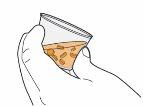
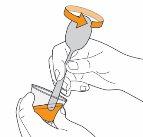
5 Tilt the dosing cup slightly and gently stir with the handle of a stainless steel spoon until the tablets are completely dissolved (may take 3 minutes or more). The solution will have a cloudy white appearance when ready. Administer the solution before 30 minutes have passed since the dissolution of the tablets. |
|
6 Make sure your child drinks the entire solution from the dosing cup. |
|
7 Add approximately 5 ml of non-carbonated drinking water to the empty dosing cup and stir with the handle of the stainless steel spoon (it may be difficult to see if there are remaining tablet residues in the dosing cup). | |
8 Make sure your child also drinks the entire solution from the dosing cup. | |
9 If 5 to 15 tablets are prescribed: repeat steps 7 to 8. | |
10 For cleaning instructions, see "SECTION C". |
SECTIONBADMINISTRATION VIA ORAL SYRINGE OR FEEDING TUBE | ||||||
Minimum Feeding Tube Size:
| ||||||
1 Follow steps 1 to 5 of "SECTION A" to dissolve the tablets, then continue with step 2 of this section. | ||||||
2 Draw up the entire solution from the dosing cup with a feeding tube-compatible syringe or oral syringe. | ||||||
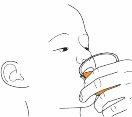
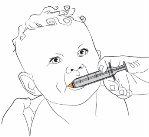
3a Administration via oral syringe:Place the tip of the oral syringe inside the mouth with the tip touching the inside of either cheek. Slowly press the plunger to the bottom to give the full dose. WARNING:Administering Finlee directly into the throat or pushing the plunger too quickly can cause choking. |
| |||||
3b Administration via feeding tube:Dispense the solution into the feeding tube according to the feeding tube manufacturer's instructions. | ||||||
4 Add approximately 5 ml of non-carbonated drinking water to the empty dosing cup and stir with the handle of the stainless steel spoon to loosen the residue (it may be difficult to see if there are remaining tablet residues in the dosing cup). | ||||||
5 Draw up the entire solution from the dosing cup with a feeding tube-compatible syringe or oral syringe. | ||||||
6 Dispense the solution into the feeding tube or into the mouth. | ||||||
7 Repeat steps 4 to 6 a total of 3 times to give a full dose. | ||||||
8 For cleaning instructions, see "SECTION C". |
SECTIONCCLEANING |
Dosing Cup
Spoon
Oral Syringe If used, clean the oral syringe as follows:
You can use the dosing cup for up to 4 months after the first use. After 4 months, discard the dosing cup in the household trash. |
SPILL CLEANUP |
Follow these steps if Finlee oral solution spills:
|
- Country of registration
- Dosage formTABLET, 10 mg
- ATC codeL01EC02
- Active substance
- Prescription requiredYes
- Manufacturer
- CompositionMANITOL (E-421) (36,24 mg mg), ACESULFAMO POTASICO (2,65 mg mg), PROPILENGLICOL (c.s.p.10 mg mg)
- This information is for reference only and does not constitute medical advice. Always consult a doctor before taking any medication. Oladoctor is not responsible for medical decisions based on this content.
- Alternatives to FINLEE 10 mg DISPERSIBLE TABLETSDosage form: CAPSULE, 50 mgActive substance: dabrafenibManufacturer: Novartis Europharm LimitedPrescription requiredDosage form: CAPSULE, 75 mgActive substance: dabrafenibManufacturer: Novartis Europharm LimitedPrescription requiredDosage form: CAPSULE, 50 mgActive substance: encorafenibManufacturer: Pierre Fabre MedicamentPrescription required
Online doctors for FINLEE 10 mg DISPERSIBLE TABLETS
Discuss questions about FINLEE 10 mg DISPERSIBLE TABLETS, including use, safety considerations and prescription review, subject to medical assessment and local regulations.
Get FINLEE 10 mg DISPERSIBLE TABLETS Prescription Online
Fill in a 2-min form
Tell us your symptoms, history, and what medicine you're requesting.
Pick a doctor or let us assign
Choose a specialist or we'll match you with the next available doctor.
Doctor reviews your case
Usually within 30 minutes. They may ask follow-up questions via chat.
Collect from any pharmacy
Electronic prescription sent to your email — valid across Spain.
Frequently Asked Questions
FINLEE 10 mg DISPERSIBLE TABLETS requires a prescription in Spain. You can check with a doctor online whether this medicine may be appropriate for your situation.
The active ingredient in FINLEE 10 mg DISPERSIBLE TABLETS is dabrafenib. This information helps identify medicines with the same composition but different brand names.
FINLEE 10 mg DISPERSIBLE TABLETS is manufactured by Novartis Europharm Limited. Pharmacy brands and packaging may differ depending on the distributor.
Doctors such as Family doctors, Psychiatrists, Dermatologists, Cardiologists, Endocrinologists, Gastroenterologists, Pulmonologists, Nephrologists, Rheumatologists, Hematologists, Infectious disease physicians, Allergists, Geriatricians, Paediatricians, Oncologists may assess whether FINLEE 10 mg DISPERSIBLE TABLETS is appropriate, depending on your situation and local regulations. You can book an online consultation to discuss your symptoms and possible next steps.
Spain has a well-developed healthcare infrastructure across major cities such as Madrid, Barcelona, Valencia, and Seville. Pharmacies are widely available and operate under strict regulations, ensuring access to prescribed medications.
You can buy FINLEE 10 mg DISPERSIBLE TABLETS in Madrid, Barcelona, Seville, or Valencia at any local pharmacy with a valid prescription.
To obtain a prescription, you can use Oladoctor:
Other medicines with the same active substance (dabrafenib) include TAFINLAR 50 mg hard capsules, TAFINLAR 75 mg hard capsules, BRAFTOVI 50 mg HARD CAPSULES. These may have different brand names or formulations but contain the same therapeutic ingredient. Always consult a doctor before switching or starting a new medicine.
