



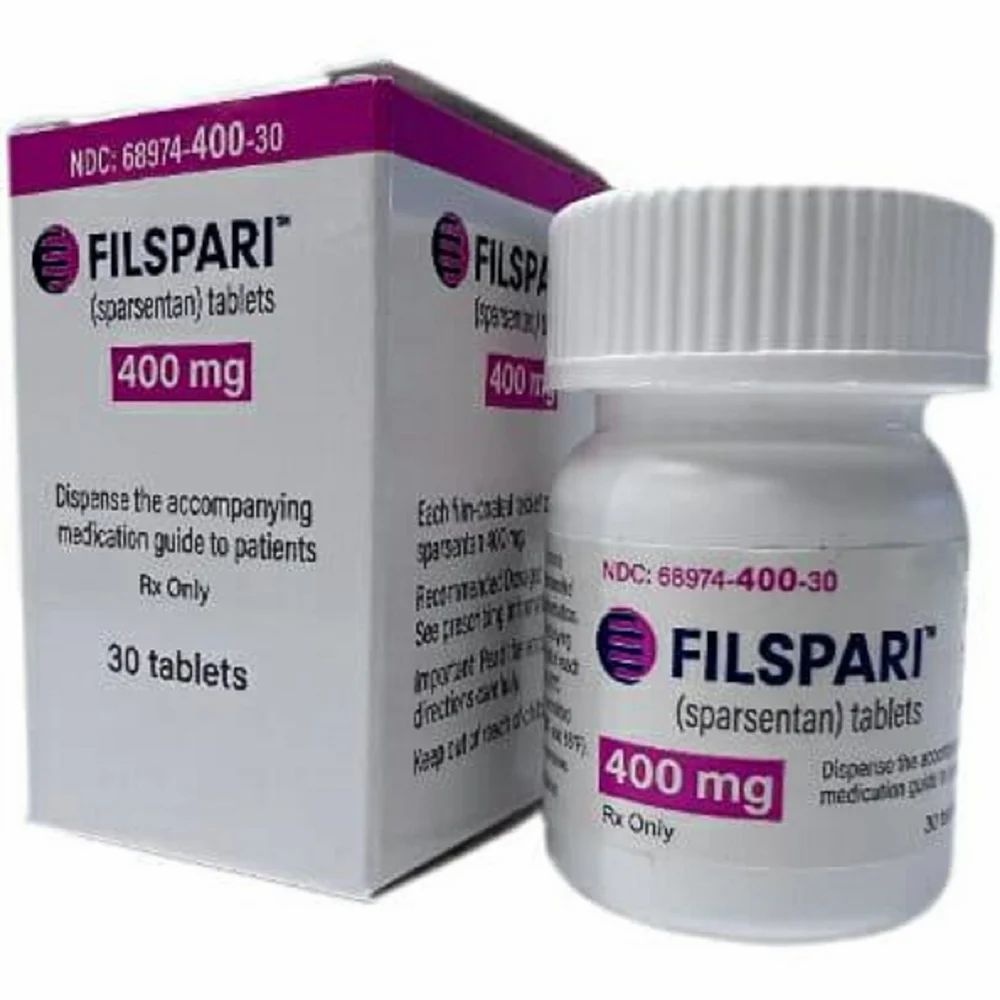
FILSPARI 400 mg Film-Coated Tablets

Prescription review online
A doctor will review your case and decide whether a prescription is medically appropriate.

Talk to a doctor about this medicine
Discuss your symptoms and possible next steps in a quick online consultation.



How to use FILSPARI 400 mg FILM-COATED TABLETS
Contents of the leaflet
- Introduction
- What is Filspari and what is it used for
- What you need to know before you take Filspari
- How to take Filspari
- Possible side effects
- Storage of Filspari
- Contents of the pack and other information
Introduction
Package Leaflet: Information for the Patient
Filspari 200 mg Film-Coated Tablets
Filspari 400 mg Film-Coated Tablets
esparsentan
This medicinal product is subject to additional monitoring, which will allow for the quick identification of new safety information. You can help by reporting any side effects you may get. The last section of this leaflet includes information on how to report side effects.
Read all of this leaflet carefully before you start taking this medicine, because it contains important information for you.
- Keep this leaflet, you may need to read it again.
- If you have any further questions, ask your doctor or pharmacist.
- This medicine has been prescribed for you only. Do not pass it on to others. It may harm them, even if their signs of illness are the same as yours.
- If you get any side effects, talk to your doctor or pharmacist. This includes any possible side effects not listed in this leaflet. See section 4.
- The pack also contains a Patient Card. Read it carefully, as it contains important safety information that you should know before and during treatment with Filspari.
Contents of the pack
- What is Filspari and what is it used for
- What you need to know before you take Filspari
- How to take Filspari
- Possible side effects
- Storage of Filspari
- Contents of the pack and other information
1. What is Filspari and what is it used for
Filspari contains the active substance esparsentan. Filspari blocks the receptors of two hormones called endothelin and angiotensin, which are involved in the regulation of kidney function.
Filspari is used in the treatment of primary immunoglobulin A (IgA) nephropathyin adults with a urinary protein excretion of ≥1.0 g/day (or a urinary protein-to-creatinine ratio of ≥0.75 g/g).
Primary IgA nephropathy is a disease caused by the immune system (the body's natural defenses) that produces a defective version of an antibody called immunoglobulin A (IgA), which accumulates in the clusters of small blood vessels in the kidney, called glomeruli, responsible for filtering the blood. This accumulation damages the glomeruli, causing blood and protein to filter into the urine.
Filspari blocks the receptors of two hormones called endothelin and angiotensin that are involved in the regulation of processes in the kidney, such as inflammation, which lead to the progression of kidney damage. By blocking these receptors, Filspari reduces the amount of protein that filters into the urine and, therefore, helps to slow the progression of the disease.

Not sure if this medicine is right for you?
Discuss your symptoms and treatment with a doctor online.
2. What you need to know before you take Filspari
Do not take Filspari
- if you are allergic to esparsentan or any of the other ingredients of this medicine (listed in section 6)
- if you are pregnant, think you may be pregnant or are planning to have a baby (see section 2 “Pregnancy and breast-feeding”).
- if you are taking any of the following medicines used mainly in the treatment of high blood pressure:
- angiotensin receptor antagonists (such as irbesartan or losartan, valsartan, candesartan, telmisartan),
- endothelin receptor blockers (such as bosentan or ambrisentan, macitentan, sitaxentan), or
- renin inhibitors (such as aliskiren).
Warnings and precautions
Talk to your doctor or pharmacist before starting Filspari if:
- you have low blood pressure (hypotension). Low blood pressure may occur more frequently in elderly patients: your doctor may check your blood pressure during treatment and change the dose of Filspari or stop treatment with Filspari if necessary.
- you have decreased kidney function: your doctor may perform additional tests to monitor your kidney function (by determining creatinine and potassium levels in the blood).
- you experience swelling in your hands, ankles, or feet due to fluid accumulation in your body: your doctor may ask you to take an additional medicine to remove water from your body or may change the dose of Filspari.
- you have liver problems: your doctor will perform a blood test before starting your treatment and regularly during treatment to check if your liver is working properly and will stop treatment with Filspari if necessary. Signs that your liver may not be working properly: nausea (vomiting), vomiting, fever (high temperature), stomach pain (abdominal pain), jaundice (yellowing of the skin or the whites of the eyes), dark urine, itching of the skin, lethargy or fatigue (unusual tiredness), flu-like syndrome (joint and muscle pain along with fever). If you notice any of these signs, tell your doctor immediately.
Children and adolescents
Filspari is not recommended in children under 18 years of age, as there are no studies in this age group.
Other medicines and Filspari
Tell your doctor or pharmacist if you are taking, have recently taken, or might take any other medicines.
Tell your doctor if you are taking medicines for the treatment of high blood pressure. Do not take Filspari if you are taking any of the following medicines: angiotensin receptor antagonists, endothelin receptor blockers, and renin inhibitors (medicines that contain aliskiren) (see section 2 “Do not take Filspari”).
Talk to your doctor or pharmacist if you are taking any of the following medicines:
The concomitant use of Filspari with the following medicines may cause more side effects:
- enalapril or lisinopril (or similar medicines called ACE inhibitors), which are normally used in the treatment of high blood pressure or for other reasons. Side effects may be low blood pressure when standing up from a lying or sitting position, high potassium levels in the blood, and decreased kidney function.
- spironolactone or eplerenone (or similar medicines called mineralocorticoid receptor antagonists) which are normally used to remove excess fluid or in the treatment of heart conditions, as they may increase potassium levels in the blood.
- potassium supplements, potassium-sparing medicines (e.g., diuretics), or salt substitutes that contain potassium, as they may increase potassium levels in the blood.
- medicines used in the treatment of fungal infections (such as itraconazole and fluconazole).
- medicines used in the treatment of bacterial infections (such as clarithromycin and erythromycin).
The effect of Filspari may be reduced by medicines such as:
- rifampicin used to treat bacterial infections
- certain medicines used to treat HIV infections such as efavirenz
- medicines used to treat epilepsy such as carbamazepine, phenytoin, phenobarbital
- St. John's Wort (Hypericum perforatum) used for depression and other disorders
- corticosteroids such as dexamethasone used mainly to treat inflammation
The effect of Filspari may be increased by medicines such as:
- boceprevir or telaprevir used to treat hepatitis C
- conivaptan used to treat low sodium levels in the blood
- certain medicines used to treat HIV infections such as indinavir, lopinavir/ritonavir, nelfinavir, ritonavir
- nefazodone used to treat depression
- medicines used to reduce the activity of the immune system and prevent transplant rejection, such as cyclosporine and tacrolimus
Taking Filspari with food and drinks
People who have been prescribed Filspari should not take grapefruit or grapefruit juice. This is because grapefruit and grapefruit juice can cause more side effects when taken with Filspari.
Pregnancy and breast-feeding
Do not take Filspari if you are pregnant or think you may be pregnant. Filspari may harm the unborn baby.
If you are able to become pregnant, your doctor will ask you to have a pregnancy test before starting Filspari.
- If you are able to become pregnant, use a reliable method of contraception while taking Filspari and for 1 month after stopping treatment. Discuss this with your doctor.
- If you become pregnant or think you may be pregnant while taking Filspari or shortly after stopping treatment (up to 1 month), tell your doctor immediately.
It is not known if Filspari passes into breast milk. Do not breast-feed while taking Filspari. Discuss this with your doctor.
Driving and using machines
Filspari may cause side effects such as dizziness, which may affect your ability to drive or use machines (see section 4). Wait until these effects have passed before driving or using machines.
Filspari contains lactose
If your doctor has told you that you have an intolerance to some sugars, contact them before taking this medicine.
Filspari contains sodium
This medicine contains less than 1 mmol of sodium (23 mg) per tablet; this is essentially “sodium-free”.
3. How to take Filspari
Always take this medicine exactly as your doctor has told you. Check with your doctor or pharmacist if you are not sure.
Recommended dose
The recommended initial dose is one 200 mg tablet once a day. After 14 days, your doctor will increase the dose to 400 mg (2 tablets containing 200 mg of Filspari or 1 tablet containing 400 mg of Filspari) once a day, depending on your tolerance to Filspari.
How to take this medicine
Swallow the tablet whole to avoid the bitter taste. Take it with a glass of water.
If you take more Filspari than you should
If you have taken more tablets than your doctor prescribed, you may experience signs and symptoms of low blood pressure.
If you take too many tablets, contact your doctor immediately.
If you forget to take Filspari
Miss the forgotten dose. Then take the next dose at the scheduled time. Do not take a double dose to make up for forgotten doses.
If you have any further questions on the use of this medicine, ask your doctor or pharmacist.

Started taking the medicine and have questions?
Discuss your symptoms and treatment with a doctor online.
4. Possible side effects
Like all medicines, this medicine can cause side effects, although not everybody gets them.
Very common (may affect up to 1 in 10 people):
- low blood pressure (hypotension)
Common (may affect up to 1 in 10 people):
- feeling of dizziness or lightheadedness when standing up or sitting down due to a drop in blood pressure (orthostatic hypotension),
- dizziness,
- high potassium levels in the blood (hyperkalemia),
- fluid accumulation in the body (edema or swelling), especially in the ankles and feet
- fatigue (tiredness),
- reduced kidney function (especially at the start of treatment; renal impairment),
- sudden kidney failure (especially at the start of treatment; acute kidney injury),
- increased creatinine levels in the blood (a breakdown product of muscles eliminated by the kidneys),
- headache (cephalalgia),
- changes in liver function, measured in blood tests.
Rare (may affect up to 1 in 100 people):
- low red blood cell count (anemia).
Reporting of side effects
If you experience any side effects, talk to your doctor or pharmacist. This includes any possible side effects not listed in this leaflet. You can also report side effects directly via the national reporting system listed in Appendix V. By reporting side effects, you can help provide more information on the safety of this medicine.
5. Storage of Filspari
Keep this medicine out of the sight and reach of children.
Do not use this medicine after the expiry date which is stated on the carton and on the label after “EXP”. The expiry date refers to the last day of that month.
This medicine does not require any special storage conditions.
Medicines should not be disposed of via wastewater or household waste. Ask your pharmacist how to dispose of medicines no longer required. This will help protect the environment.
6. Contents of the pack and other information
Composition of Filspari
- The active substance is esparsentan: each film-coated tablet of Filspari 200 mg contains 200 mg of esparsentan. Each film-coated tablet of Filspari 400 mg contains 400 mg of esparsentan.
- The other ingredients are: microcrystalline cellulose, lactose (see section 2, “Filspari contains lactose”), sodium starch glycolate (type A) (see section 2, “Filspari contains sodium”), colloidal anhydrous silica, magnesium stearate, polyvinyl alcohol, macrogol, talc, titanium dioxide (E171).
Appearance of the product and pack contents
The film-coated tablets of Filspari 200 mg are film-coated tablets, oval in shape, white to off-white in color, with the number “105” on one side. The dimensions of the tablets are approximately 13 mm × 7 mm.
The film-coated tablets of Filspari 400 mg are film-coated tablets, oval in shape, white to off-white in color, with the number “021” on one side. The dimensions of the tablets are approximately 18 mm × 8 mm.
The film-coated tablets of Filspari 200 mg are available in a bottle of 30 film-coated tablets. The film-coated tablets of 400 mg are available in a bottle of 30 film-coated tablets and in a multipack with 90 film-coated tablets (3 bottles of 30 film-coated tablets).
Not all pack sizes may be marketed.
Marketing authorisation holder and manufacturer
Vifor France
100–101 Terrasse Boieldieu
Tour Franklin La Défense 8
92042 Paris La Défense Cedex
France
Date of last revision of this leaflet: 04/2025
Other sources of information
Detailed information on this medicine is available on the European Medicines Agency website: https://www.ema.europa.eu.
- Country of registration
- Dosage formTABLET, 400 mg
- ATC codeC09XX01
- Active substance
- Prescription requiredYes
- Manufacturer
- CompositionLACTOSA ANHIDRA (84 mg mg)
- This information is for reference only and does not constitute medical advice. Always consult a doctor before taking any medication. Oladoctor is not responsible for medical decisions based on this content.
- Alternatives to FILSPARI 400 mg FILM-COATED TABLETSDosage form: TABLET, 200 mgActive substance: Other agents acting on the renin-angiotensin systemManufacturer: Vifor FrancePrescription requiredDosage form: TABLET, 150 mgActive substance: aliskirenManufacturer: Noden Pharma Designated Activity CompanyPrescription requiredDosage form: TABLET, 150 mgActive substance: aliskirenManufacturer: Noden Pharma Designated Activity CompanyPrescription required
Online doctors for FILSPARI 400 mg FILM-COATED TABLETS
Discuss questions about FILSPARI 400 mg FILM-COATED TABLETS, including use, safety considerations and prescription review, subject to medical assessment and local regulations.
Get FILSPARI 400 mg FILM-COATED TABLETS Prescription Online
Fill in a 2-min form
Tell us your symptoms, history, and what medicine you're requesting.
Pick a doctor or let us assign
Choose a specialist or we'll match you with the next available doctor.
Doctor reviews your case
Usually within 30 minutes. They may ask follow-up questions via chat.
Collect from any pharmacy
Electronic prescription sent to your email — valid across Spain.
Frequently Asked Questions
FILSPARI 400 mg FILM-COATED TABLETS requires a prescription in Spain. You can check with a doctor online whether this medicine may be appropriate for your situation.
The active ingredient in FILSPARI 400 mg FILM-COATED TABLETS is Other agents acting on the renin-angiotensin system. This information helps identify medicines with the same composition but different brand names.
FILSPARI 400 mg FILM-COATED TABLETS is manufactured by Vifor France. Pharmacy brands and packaging may differ depending on the distributor.
Doctors such as Family doctors, Psychiatrists, Dermatologists, Cardiologists, Endocrinologists, Gastroenterologists, Pulmonologists, Nephrologists, Rheumatologists, Hematologists, Infectious disease physicians, Allergists, Geriatricians, Paediatricians, Oncologists may assess whether FILSPARI 400 mg FILM-COATED TABLETS is appropriate, depending on your situation and local regulations. You can book an online consultation to discuss your symptoms and possible next steps.
Spain has a well-developed healthcare infrastructure across major cities such as Madrid, Barcelona, Valencia, and Seville. Pharmacies are widely available and operate under strict regulations, ensuring access to prescribed medications.
You can buy FILSPARI 400 mg FILM-COATED TABLETS in Madrid, Barcelona, Seville, or Valencia at any local pharmacy with a valid prescription.
To obtain a prescription, you can use Oladoctor:
Other medicines with the same active substance (Other agents acting on the renin-angiotensin system) include FILSPARI 200 mg FILM-COATED TABLETS, RASILEZ 150 mg FILM-COATED TABLETS, RASILEZ 150 mg FILM-COATED TABLETS. These may have different brand names or formulations but contain the same therapeutic ingredient. Always consult a doctor before switching or starting a new medicine.
