



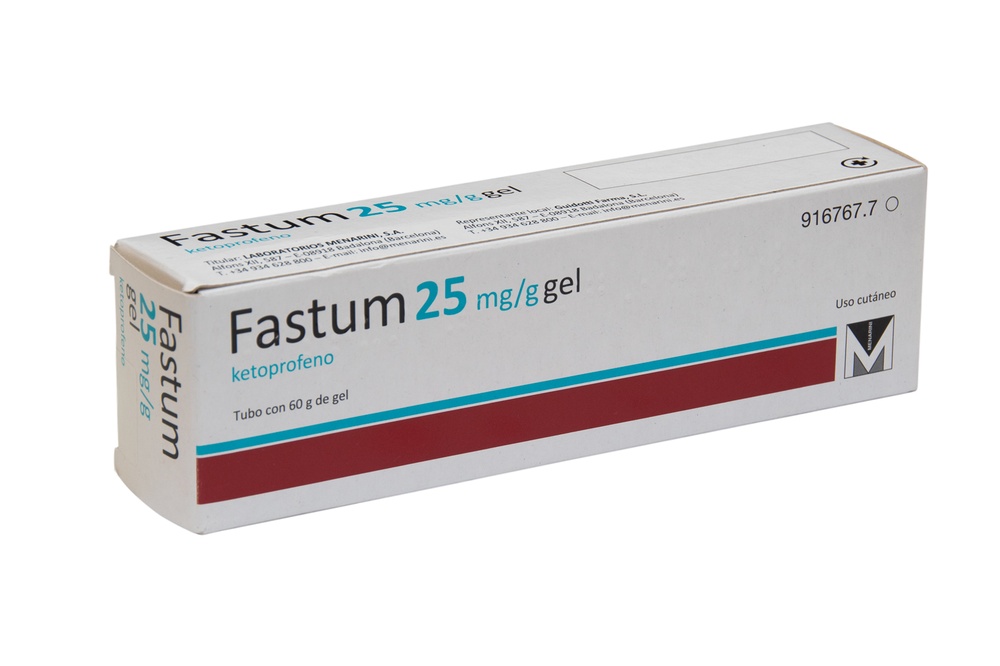
FASTUM 25 mg /G Gel

Prescription review online
A doctor will review your case and decide whether a prescription is medically appropriate.

Talk to a doctor about this medicine
Discuss your symptoms and possible next steps in a quick online consultation.



How to use FASTUM 25 mg/g GEL
Contents of the leaflet
- Introduction
- What is Fastum and what is it used for
- What you need to know before using Fastum
- How to use Fastum
- Possible side effects
- Storage of Fastum
- Package contents and further information
Introduction
Package Leaflet: Information for the User
Fastum 25 mg/g Gel
Ketoprofen
Read the package leaflet carefully before starting to use this medicine, as it contains important information for you.
- Keep this package leaflet, as you may need to read it again.
- If you have any further questions, ask your doctor or pharmacist.
- This medicine has been prescribed for you only. Do not pass it on to others. It may harm them, even if their symptoms are the same as yours.
- If you experience any side effects, talk to your doctor or pharmacist. This includes any possible side effects not listed in this package leaflet. See section 4.
Contents of the Package Leaflet
- What is Fastum and what is it used for
- What you need to know before using Fastum
- How to use Fastum
- Possible side effects
- Storage of Fastum
- Package contents and further information
1. What is Fastum and what is it used for
Fastum contains ketoprofen, which is a medicine belonging to the group of non-steroidal anti-inflammatory drugs.
Fastum is indicated for the treatment of painful, inflammatory, or bruised conditions of the joints, tendons, ligaments, and muscles (arthritis, periarthritis, artrosynovitis, tendinitis, tenosynovitis, bursitis, bruises, sprains, dislocations, meniscal injuries of the knee, torticollis, lumbalgia).

Not sure if this medicine is right for you?
Discuss your symptoms and treatment with a doctor online.
2. What you need to know before using Fastum
Do not use Fastum
- If you have a history of skin allergy to ketoprofen, dexketoprofen, tiaprofenic acid, fenofibrate, UV blockers, perfumes, or any other component of this medicine (listed in section 6).
- If you have experienced allergic reactions to acetylsalicylic acid or any other non-steroidal anti-inflammatory drug (symptoms are difficulty breathing, inflammation of the nasal mucosa, or hives).
- On open wounds, skin infections, eczema, acne, mucous membranes, genital area, eyes, or around the eyes.
- If you are in the last 3 months of pregnancy.
- Stop using Fastum immediately if you experience any skin reaction, including skin reactions after simultaneous application of products containing octocrylene (octocrylene is an excipient in various cosmetic and hygiene products such as shampoo, aftershave lotion, bath and shower gel, skin creams, lip balms, anti-aging creams, makeup removers, hair lacquers, used to delay photodegradation).
- Do not expose treated areas to the sun, even on cloudy days, or to ultraviolet lamps (solar lamps, sunbeds...) during treatment and for 2 weeks after stopping treatment.
Warnings and precautions
Talk to your doctor or pharmacist before starting to use Fastum
- If you have heart, liver, or kidney problems, as isolated cases of systemic adverse reactions affecting the kidneys have been observed when using topical medications from the same group as Fastum.
- Once the gel is applied, do not use tight clothing or occlusive dressings.
- Treatment should be stopped immediately if any skin reaction occurs after applying Fastum.
- The gel should not come into contact with mucous membranes and eyes.
- Exposure to the sun (even on cloudy days) or ultraviolet lamps (UVA) of areas that have been in contact with Fastum can cause skin reactions (photosensitization) that can be potentially severe. Therefore, it is necessary:
- to cover treated areas with clothing to protect them during treatment and for 2 weeks after stopping treatment to avoid any risk of photosensitization.
- wash your hands thoroughly after each application of Fastum.
- Prolonged or excessive use of the product can cause systemic effects such as hypersensitivity and asthma.
- Treatment should be stopped in case of eruption.
- Do not exceed the recommended treatment duration, as the risk of developing contact dermatitis and photosensitivity reactions increases over time.
- Patients with asthma combined with chronic rhinitis, chronic sinusitis, and/or nasal polyps have a higher risk of being allergic to acetylsalicylic acid and/or other non-steroidal anti-inflammatory drugs than the rest of the population.
Children and adolescents
The safety and efficacy of ketoprofen in children have not been established.
Other medicines and Fastum
Tell your doctor or pharmacist if you are using, have recently used, or might use any other medicines, including those obtained without a prescription.
Tell your doctor if you are taking oral anticoagulants (medicines to prevent blood clot formation).
It is unlikely to interact with other medicines due to its direct application to the skin.
Do not apply other topical preparations to the same area of skin where you are using this medicine.
Pregnancy, breastfeeding, and fertility
If you are pregnant or breastfeeding, think you may be pregnant, or plan to become pregnant, consult your doctor or pharmacist before using this medicine.
Do not use ketoprofen if you are in the last 3 months of pregnancy. Do not use ketoprofen during the first 6 months of pregnancy unless clearly necessary and as directed by your doctor. If you need treatment during this period, you should use the minimum dose for the shortest possible time.
Oral formulations (e.g., tablets) may cause adverse effects on the fetus. It is unknown if the same risk applies to ketoprofen via topical route.
There is not enough data on the excretion of ketoprofen in breast milk, so its use is not recommended during breastfeeding.
Driving and using machines
No effects on the ability to drive and use machines have been described.
Fastum contains methylparaben, propylparaben, alcohol (ethanol), and lavender essence.
This medicine may cause allergic reactions (possibly delayed) because it contains methylparaben and propylparaben.
This medicine contains 400 mg of alcohol (ethanol) per gram of gel. It may cause a burning sensation on damaged skin.
This medicine contains lavender essence with benzyl alcohol, amylcinnamaldehyde, citral, eugenol, hydroxycitronellal, coumarin, geraniol, farnesol, linalool, benzyl benzoate, citronellol, and d-limonene, which may cause allergic reactions.
3. How to use Fastum
Topical use.
Follow exactly the administration instructions of this medicine as indicated by your doctor or pharmacist. If in doubt, consult your doctor or pharmacist again.
Fastum is used topically. Apply the gel once or more times a day (3-5 cm or more depending on the extent of the affected area), giving a gentle massage to facilitate absorption.
The total daily dose should not exceed 15 g per day, which is equivalent to 28 cm of skin.
Close the tube of Fastum after each use. Wash your hands after each application.
Your doctor will indicate the duration of your treatment with Fastum.
The duration of continuous treatment with topical ketoprofen should be limited to a maximum of 7 days.
If you think the effect of Fastum is too strong or too weak, tell your doctor or pharmacist.
If you use more Fastum than you should
Due to the topical administration of the medicine, overdose is very unlikely.
In case of accidental ingestion of Fastum, contact your doctor or the emergency department of the nearest hospital immediately.
In case of overdose or accidental ingestion, consult the Toxicology Information Service. Phone 91 562 04 20, indicating the medicine and the amount ingested.
If you forget to use Fastum
If you forget to apply a dose, apply the usual dose as soon as possible, but do not apply a double dose to make up for the forgotten dose.

Started taking the medicine and have questions?
Discuss your symptoms and treatment with a doctor online.
4. Possible side effects
Like all medicines, this medicine can cause side effects, although not everybody gets them.
The most common ones are localized cutaneous side effects, which can spread around the application site and are rarely severe and/or generalized.
Side effects can occur with the following frequency:
Uncommon (may affect up to 1 in 100 people):
- Skin allergic reactions such as redness (erythema), itching (pruritus), or skin inflammation (eczema), burning sensation.
Rare (may affect up to 1 in 1,000 people):
- Skin reaction when exposing the application site to the sun (photosensitivity), redness, or skin bumps. Appearance of white or reddish bumps on the skin with itching (urticaria). More severe reactions, such as blister-like lesions (bullous or flictenular eczema) that can spread or generalize.
Very rare (may affect up to 1 in 10,000 people):
- Stomach or intestine wall injury (ulcer), gastrointestinal bleeding, diarrhea.
- Skin allergic reaction (contact dermatitis).
- Kidney malfunction or worsening of existing kidney malfunction (renal insufficiency).
Frequency not known (cannot be estimated from the available data):
- Generalized urticaria accompanied by swelling of feet, hands, throat, lips, and respiratory tract (angioedema), severe allergic reaction (anaphylactic reaction including anaphylactic shock, hypersensitivity reactions), and bullous dermatitis.
Elderly patients are more susceptible to the adverse effects of non-steroidal anti-inflammatory drugs, the group to which ketoprofen, the active ingredient of Fastum, belongs.
Reporting of side effects
If you experience any side effects, talk to your doctor, pharmacist, or nurse, even if they are not listed in this package leaflet. You can also report them directly through the Spanish Medicines and Healthcare Products Agency (AEMPS) website: www.notificaRAM.es. By reporting side effects, you can help provide more information on the safety of this medicine.
5. Storage of Fastum
Keep this medicine out of the sight and reach of children.
No special storage conditions are required.
Do not use this medicine after the expiry date stated on the packaging. The expiry date is the last day of the month indicated.
Medicines should not be disposed of via wastewater or household waste. Place the packaging and any unused medicine in the pharmacy's SIGRE collection point. If in doubt, ask your pharmacist how to dispose of the packaging and any unused medicine. This will help protect the environment.
6. Package contents and further information
Composition of Fastum
- The active ingredient is ketoprofen. Each gram of gel contains 25 mg of ketoprofen.
- The other ingredients are methylparaben (E-218), propylparaben (E-216), carbomer, ethanol 96%, trometamol, lavender essence (which contains: benzyl alcohol, amylcinnamaldehyde, citral, eugenol, hydroxycitronellal, coumarin, geraniol, farnesol, linalool, benzyl benzoate, citronellol, and d-limonene), and purified water.
Appearance of the product and package contents
Fastum is a transparent gel. Each package contains 60 grams of gel.
Marketing authorization holder and manufacturer
Laboratorios Menarini, S.A.
Alfons XII, 587
08918 Badalona (Barcelona)
Spain
You can request more information about this medicine by contacting the local representative of the marketing authorization holder
Guidotti Farma, S.L.
Alfons XII, 587
08918 Badalona (Barcelona)
Spain
Date of last revision of this package leaflet:January 2023.
Detailed information about this medicine is available on the website of the Spanish Agency for Medicines and Healthcare Products (AEMPS) (http://www.aemps.gob.es/)
- Country of registration
- Dosage formGEL, 25 mg/g
- ATC codeM02AA10
- Active substance
- Prescription requiredYes
- Manufacturer
- CompositionALCOHOL ETILICO (ETANOL) (0,528 ml mg), PARAHIDROXIBENZOATO DE METILO (E-218) (0,8 mg mg), PARAHIDROXIBENZOATO DE PROPILO (0,2 mg mg)
- This information is for reference only and does not constitute medical advice. Always consult a doctor before taking any medication. Oladoctor is not responsible for medical decisions based on this content.
- Alternatives to FASTUM 25 mg/g GELDosage form: CREAM, 1.5 g aceclofenac / 100 gActive substance: aceclofenacManufacturer: Almirall S.A.Prescription requiredDosage form: GEL, 50 mg/gActive substance: ibuprofenManufacturer: Arafarma Group S.A.Prescription not requiredDosage form: GEL, 50 mg/gActive substance: ibuprofenManufacturer: Korhispana S.L.Prescription not required
Online doctors for FASTUM 25 mg/g GEL
Discuss questions about FASTUM 25 mg/g GEL, including use, safety considerations and prescription review, subject to medical assessment and local regulations.
Get FASTUM 25 mg/g GEL Prescription Online
Fill in a 2-min form
Tell us your symptoms, history, and what medicine you're requesting.
Pick a doctor or let us assign
Choose a specialist or we'll match you with the next available doctor.
Doctor reviews your case
Usually within 30 minutes. They may ask follow-up questions via chat.
Collect from any pharmacy
Electronic prescription sent to your email — valid across Spain.
Frequently Asked Questions
FASTUM 25 mg/g GEL requires a prescription in Spain. You can check with a doctor online whether this medicine may be appropriate for your situation.
The active ingredient in FASTUM 25 mg/g GEL is ketoprofen. This information helps identify medicines with the same composition but different brand names.
FASTUM 25 mg/g GEL is manufactured by Laboratorios Menarini S.A.. Pharmacy brands and packaging may differ depending on the distributor.
Doctors such as Family doctors, Psychiatrists, Dermatologists, Cardiologists, Endocrinologists, Gastroenterologists, Pulmonologists, Nephrologists, Rheumatologists, Hematologists, Infectious disease physicians, Allergists, Geriatricians, Paediatricians, Oncologists may assess whether FASTUM 25 mg/g GEL is appropriate, depending on your situation and local regulations. You can book an online consultation to discuss your symptoms and possible next steps.
Spain has a well-developed healthcare infrastructure across major cities such as Madrid, Barcelona, Valencia, and Seville. Pharmacies are widely available and operate under strict regulations, ensuring access to prescribed medications.
You can buy FASTUM 25 mg/g GEL in Madrid, Barcelona, Seville, or Valencia at any local pharmacy with a valid prescription.
To obtain a prescription, you can use Oladoctor:
Other medicines with the same active substance (ketoprofen) include AIRTAL DIFUCREM 15 mg/g CREAM, ARAGEL 50 mg/g GEL, ARTICALM 50 mg/g GEL. These may have different brand names or formulations but contain the same therapeutic ingredient. Always consult a doctor before switching or starting a new medicine.
