






How to use EURARTESIM 320 mg / 40 mg FILM-COATED TABLETS
Translated with AI
This page provides general information and does not replace a doctor’s consultation. Always consult a doctor before taking any medication. Seek urgent medical care if symptoms are severe.
Show originalContents of the leaflet
Introduction
Package Leaflet: Information for the User
Eurartesim 320 mg/40 mg film-coated tablets
Piperaquine tetraphosphate/Artenimol
Read all of this leaflet carefully before you start taking this medicine because it contains important information for you.
- Keep this leaflet, you may need to read it again.
- If you have any further questions, ask your doctor or pharmacist.
- This medicine has been prescribed for you only. Do not pass it on to others. It may harm them, even if their symptoms are the same as yours.
- If you experience any side effects, talk to your doctor or pharmacist. This includes any possible side effects not listed in this leaflet. See section 4.
Contents of the pack
- What is Eurartesim and what is it used for
- What you need to know before you or your child takes Eurartesim
- How to take Eurartesim
- Possible side effects
- Storing Eurartesim
- Contents of the pack and further information
1. What is Eurartesim and what is it used for
Eurartesim contains the active substances piperaquine tetraphosphate and artenimol and is used to treat non-complicated malaria when it is suitable to administer the medicine orally.
Malaria is caused by infection with a parasite called Plasmodium, caused by the bite of an infected mosquito. There are several types of Plasmodiumparasites. Eurartesim kills the Plasmodium falciparumparasite.
The medicine can be taken by adults, adolescents, children, and infants over 6 months who weigh 5 kg or more.

2. What you need to know before you or your child takes Eurartesim
Do not take Eurartesim if you or your child:
- are allergic to the active substances piperaquine tetraphosphate or artenimol or any of the other ingredients of this medicine (listed in section 6);
- have a severe type of malaria infection that has affected parts of the body such as the brain, lungs, or kidneys;
- have a heart disease, such as changes in the rhythm or frequency of the heartbeat, or a heart condition;
- know that a family member (parents, grandparents, brothers, or sisters) died suddenly from a heart problem or was born with heart problems;
- suffer from changes in the levels of salts in the body (hydroelectrolytic imbalances);
- take other medicines that may have an effect on the heartbeat such as:
- quinidine, disopyramide, procainamide, amiodarone, dofetilide, ibutilide, hydroquinidine, or sotalol;
- medicines used to treat depression such as amitriptyline, fluoxetine, or sertraline;
- medicines used to treat mental health problems such as phenothiazines, sertindole, sultopride, chlorpromazine, haloperidol, mesoridazine, pimozide, or thioridazine;
- medicines used to treat infections. These include some types of medicines used to treat bacterial infections (macrolides [such as erythromycin or clarithromycin] and fluoroquinolones [such as moxifloxacin and sparfloxacin]) or fungal infections (including fluconazole and imidazole) as well as pentamidine (used to treat a specific type of pneumonia) and saquinavir (for the treatment of HIV);
- antihistamines used to treat allergies or inflammation such as terfenadine, astemizole, or mizolastine;
- certain medicines used to treat stomach problems, such as cisapride, domperidone, or droperidol;
- other medicines such as vinca alkaloids and arsenic trioxide (used to treat certain cancers), bepridil (used to treat angina), difemanil (used to treat stomach problems), levometadyl, and methadone (used to treat drug addiction) and probucol (used to treat high cholesterol levels in the blood).
- have recently (e.g., during the last month) received treatment for malaria with certain medicines or have taken certain medicines to prevent malaria. These medicines include: mefloquine, halofantrine, lumefantrine, chloroquine, or quinine.
If any of the above points apply to you or your child or if you are not sure, inform your doctor or pharmacist before taking or administering Eurartesim.
Warnings and precautions
Consult your doctor or pharmacist before starting to take this medicine if you or your child:
- have liver or kidney problems;
- have a malaria infection caused by a parasite that is not Plasmodium falciparum;
- take or have taken any other medicine for the treatment of malaria (other than those mentioned above);
- are in the first trimester of pregnancy or breastfeeding (see below);
- are a woman, elderly (over 65 years), or have vomiting;
- take certain medicines that may produce metabolic interactions. Examples are listed in the section “Other medicines and Eurartesim”;
- if after treatment with Eurartesim the malaria infection recurs or does not heal, it is possible that your doctor will prescribe another medicine.
If you have doubts about any of the above points, ask your doctor or pharmacist.
Inform your doctor if after treatment, specific symptoms of serious side effects appear: paleness, general weakness, headache, difficulty breathing, and rapid heartbeat, especially when exercising, confusion, dizziness, or dark-colored urine (for more information, see section 4).
Children
Do not give this medicine to infants under 6 months or with a weight below 5 kg.
Other medicines and Eurartesim
Inform your doctor or pharmacist if you or your child are using, have recently used, or could use any other medicine. Some medicines may affect the way Eurartesim works and your doctor may decide that Eurartesim is not suitable or that more monitoring is needed while you or your child are taking medicines that could produce possible interactions. The following are some examples (although there are more):
- certain medicines used to treat high cholesterol levels in the blood (such as atorvastatin, lovastatin, simvastatin);
- medicines used to treat high blood pressure and heart problems (such as diltiazem, nifedipine, nitrendipine, verapamil, felodipine, amlodipine);
- certain medicines used to treat HIV (antiretrovirals): HIV protease inhibitors (such as atazanavir, darunavir, indinavir, lopinavir, ritonavir), non-nucleoside reverse transcriptase inhibitors (such as efavirenz, nevirapine);
- certain medicines used to treat microbial infections (such as telithromycin, rifampicin, dapsone);
- medicines used to help you sleep: benzodiazepines (such as midazolam, triazolam, diazepam, alprazolam, zaleplon, zolpidem);
- medicines used to prevent/treat epileptic seizures: barbiturates (such as phenobarbital), carbamazepine, or phenytoin;
- medicines used after organ transplantation and in autoimmune diseases (such as cyclosporine, tacrolimus);
- sex hormones, including those contained in hormonal contraceptives (such as gestodene, progesterone, estradiol, testosterone);
- glucocorticosteroids (hydrocortisone, dexamethasone);
- omeprazole (used to treat diseases related to gastric acid production):
- paracetamol (used to treat pain and fever);
- theophylline (used to improve bronchial airflow);
- nefazodone (used to treat depression);
- aprepitant (used to treat nausea);
- certain gases (such as enflurane, halothane, and isoflurane) used for general anesthesia.
Taking Eurartesim with food and drinks
You should take Eurartesim tablets only with water.
Eurartesim should not be taken with grapefruit juice due to possible interactions.
Pregnancy and breastfeeding
Inform your doctor if you are in the first trimester of pregnancy, think you may be pregnant, or become pregnant or are breastfeeding. Animal studies suggest that Eurartesim may cause harm to the fetus when used during the first trimester of pregnancy. Therefore, Eurartesim should not be used during the first trimester of pregnancy if your doctor can give you an alternative medicine. If you discover that you are pregnant within a month of taking Eurartesim, inform your doctor. Exposure of pregnant women during the second or third trimester was not associated with harm to the fetus. If for a pregnant woman Eurartesim is more suitable than other artemisinin combination therapies with more experience of use (or sulfadoxine-pyrimethamine), Eurartesim can be used in the second and third trimesters of pregnancy.
You should not breastfeed while taking this medicine, as it may pass to your child through breast milk.
If you are taking folic acid supplements to prevent possible birth defects of the neural tube, you can continue using these supplements at the same time as Eurartesim.
Consult your doctor or pharmacist before using any medicine during pregnancy or breastfeeding.
Driving and using machines
You can drive or use machines after taking Eurartesim once you have recovered from your illness.
3. How to take Eurartesim
Follow exactly the administration instructions of Eurartesim indicated by your doctor. In case of doubt, consult your doctor or pharmacist again.
You or your child should take this medicine on an empty stomach. You or your child should take each dose when at least 3 hours have passed since the last food intake, and should not eat anything in the 3 hours following each dose of Eurartesim. You or your child can drink water whenever desired.
If it is difficult to swallow the tablets, they can be crushed and mixed with water. The mixture should be drunk immediately.
A cycle of Eurartesim lasts for three consecutive days. Take one dose each day. You should try to take the dose at approximately the same time each of the three days.
The daily dose depends on the body weightof the patient. Your doctor will have prescribed a dose that is suitable for your body weight or that of your child, according to the following table:
Body weight (kg) | Daily dose (mg) | Total number of tablets during treatment |
5 to less than 7 | Half a 160 mg/20 mg tablet per day | 1.5 tablets |
7 to less than 13 | One 160 mg/20 mg tablet per day | 3 tablets |
13 to less than 24 | One 320 mg/40 mg tablet per day | 3 tablets |
24 to less than 36 | Two 320 mg/40 mg tablets per day | 6 tablets |
36 to less than 75 | Three 320 mg/40 mg tablets per day | 9 tablets |
>75 | Four 320 mg/40 mg tablets per day | 12 tablets |
Vomiting when taking this medicine
If it occurs:
- within 30 minutes of taking Eurartesim, the full dose should be taken again.
- between 31-60 minutes, half of the dose should be taken again.
If you or your child also vomits the second dose, do not take or give another dose. Contact your doctor urgently to obtain alternative treatment for malaria.
Taking this medicine if the malaria infection recurs
- If you or your child has another episode of malaria, you may take a second cycle of Eurartesim within a year if your doctor believes it is the appropriate treatment. You or your child should not take more than two cycles in a year. If this happens, inform your doctor. You or your child should not take a second cycle of Eurartesim until at least 2 months have passed since the first cycle.
- If you or your child becomes infected more than twice in a year, your doctor will prescribe alternative treatment.
If you or your child takes more Eurartesim tablets than you should
If you or your child takes a higher dose than recommended, inform your doctor. Your doctor may recommend special monitoring of you and your child since doses higher than those recommended by the doctor may have a serious unwanted effect on the heart (see also section 4).
If you or your child forgets to take Eurartesim
If you or your child forgets to take the second dose of Eurartesim at the correct time, take it as soon as you remember. Then, take the third (last) dose approximately 24 hours after the second dose. If you or your child forgets to take the third (last) dose at the correct time, take it as soon as you remember. Never take more than one dose on the same day to make up for a forgotten dose.
In case of doubt, ask your doctor or pharmacist.
If you or your child stops taking Eurartesim
To make the medicine work effectively, you or your child must take the tablets as instructed and complete the 3-day treatment cycle. If you or your child cannot do this, consult your doctor or pharmacist.
If you have any other questions about the use of this medicine, ask your doctor or pharmacist.

4. Possible side effects
Like all medicines, this medicine can cause side effects, although not everybody gets them. Most side effects are not serious and usually disappear within a few days or weeks after treatment.
Heart problems
A heart problem called QT prolongation can occur when taking Eurartesim and for a few days after the last dose. This can cause a heart rhythm abnormality that can be fatal. In adults and children, other heart rhythm abnormalities with symptoms such as rapid heartbeat (tachycardia) and strong or irregular heartbeat (palpitations) have been observed. The frequency of these side effects is common (may affect up to 1 in 10 people).
Additionally, irregular heartbeat (sinus arrhythmias) or slow heartbeat (bradycardia) have been observed in adults. The frequency of these side effects is uncommon (may affect up to 1 in 100 people).
If you notice anything different in your heartbeat or your child's heartbeat or have symptoms (such as palpitations or irregular heartbeat), you should contact your doctor as soon as possible and before taking the next dose.
Your doctor may perform an electrical tracing of the heart (electrocardiogram, ECG) while you or your child are receiving treatment and after administration of the last dose. Your doctor will inform you when these tracings will be performed.
Problems with red blood cells
Sometimes, after receiving treatment for malaria, a problem with red blood cells called hemolytic anemia can appear. This condition can appear late and present up to a month after the use of Eurartesim (late hemolytic anemia). In most cases, the anemia resolves without specific treatment, but sometimes, in severe cases, blood transfusion may be necessary. Your doctor will perform periodic blood tests. If it is suspected that the lack of red blood cells is caused by your immune system (autoimmune hemolytic anemia), these tests may include a direct antiglobulin test to determine if treatment is needed, for example with corticosteroids. The frequency of these side effects is unknown (cannot be estimated from the available data). Contact your doctor immediately if you or your child presents one or more of the following symptoms after treatment with Eurartesim: paleness, general weakness, headache, difficulty breathing, and rapid heartbeat (especially when exercising), confusion, dizziness, or dark-colored urine.
Other side effects in adults
Common (may affect up to 1 in 10 people)
Anemia, headache, fever, general weakness.
Uncommon (may affect up to 1 in 100 people)
Flu, respiratory infection, loss of appetite, dizziness, seizures (epileptic crises), cough, vomiting, abdominal pain, diarrhea, nausea, liver inflammation or enlargement, liver cell injury, abnormal liver function tests, itching, muscle or joint pain.
Other side effects in children
Very common (may affect more than 1 in 10 people)
Flu, cough, fever.
Common (may affect up to 1 in 10 people)
Respiratory infection, ear infection, anemia, abnormalities in various types of blood cells (white blood cells and platelets), loss of appetite, eye infection, abdominal pain, vomiting, diarrhea, skin inflammation, rash, general weakness.
Uncommon (may affect up to 1 in 100 people)
Abnormalities in red blood cells, excess platelets, enlargement of certain organs (such as the liver or spleen), lymph node inflammation, seizures (epileptic crises), headache, abnormal heart sounds (heard by the doctor with a stethoscope), nosebleeds, nasal discharge, nausea, mouth inflammation, liver inflammation or enlargement, jaundice, abnormal liver function test results, itching, and skin inflammation.
Reporting of side effects
If you experience any side effects, talk to your doctor or pharmacist. This includes any possible side effects not listed in this leaflet. You can also report side effects directly through the national reporting system listed in Appendix V. By reporting side effects, you can help provide more information on the safety of this medicine.
5. Storage of Eurartesim
Keep this medicine out of the sight and reach of children.
Do not use this medicine after the expiry date that appears on the packaging after CAD. The expiry date is the last day of the month indicated.
Do not store above 30°C.
Store in the original packaging to protect from light and moisture.
Do not use this medicine if you notice that the blister is open.
Medicines should not be disposed of via wastewater or household waste. Ask your pharmacist how to dispose of the packaging and medicines that are no longer needed. This will help protect the environment.
6. Package contents and additional information
Composition of Eurartesim
The active ingredients are piperaquine tetraphosphate and artenimol.
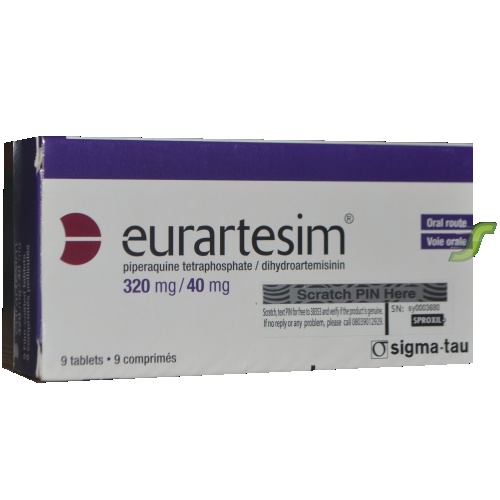
Each film-coated tablet contains 320 mg of piperaquine tetraphosphate (as tetrahydrate) and 40 mg of artenimol.
The other ingredients are:
Core of the tablet: pregelatinized starch, dextrin, hypromellose (E464), sodium croscarmellose, magnesium stearate (E572).
Film coating: hypromellose, titanium dioxide (E171), macrogol 400.
Appearance of Eurartesim and package contents
Eurartesim is a white, film-coated tablet with inscription and a score line in the middle of the tablet.
The 320 mg/40 mg tablets have two letters 'σ' on one face and come in blisters containing 3, 6, 9, 12, 270 or 300 tablets.
Marketing authorization holder
Alfasigma S.p.A.
Via Ragazzi del '99, n. 5
40133 Bologna
Italy
Phone: +39 051 6489602
Fax: +39 051 388689
e-mail: [email protected]
Manufacturer
Alfasigma S.p.A.
Via Pontina km. 30,400
00071 Pomezia (Roma)
Italy
You can request more information about this medicine by contacting the local representative of the marketing authorization holder:
België/Belgique/Belgien, Deutschland
Luxembourg/LuxemburgPharmore GmbH
Alfasigma Belgium sprl/bvba Tel.: +49 (0) 5451 9690-0
Tel: +32 (0)2 420 93 16 [email protected]
Nederland Alfasigma Nederland BV Tel: +31 30 6702020 | Portugal Alfasigma Portugal, Lda Tel: +351 217 226 110 |
España Alfasigma España, S.L. Tel: +34 93 415 48 22 | |
France Alfasigma France Tél: +33 1 45 21 0269 | |
Ελλάδα A VIPharma International A.E. Τηλ: +30 210-6194170 | |
Italy Alfasigma S.p.A. Tel: +39 051 6489602 | |
Κύπρος ISANGEN PHARMA CYPRUS LTD Τηλ: 24-638833, |
България, Ceská republika, Danmark, Eesti, Hrvatska, Ireland, Ísland, Latvija, Lietuva,
Magyarország, Malta, Norge, Österreich, Polska, România, Slovenija, Slovenská republika, Suomi/Finland, Sverige.
Alfasigma S.p.A.
България, Olaszország, Itàlie, Italja, Italien, Italia, Itaalia, Wlochy, Italija, Ítalía, taliansko, Italija
Тел/Teл/Tel/Tlf/Sími/Puh: +39 051 6489602
Date of last revision of this prospectus:November 2024
Detailed information on this medicine is available on the European Medicines Agency website: http://www.ema.europa.eu.
-

- Country of registration
- Dosage formTABLET, 40 mg DHA + 320 mg PQP
- Prescription requiredYes
- Manufacturer
- This information is for reference only and does not constitute medical advice. Always consult a doctor before taking any medication. Oladoctor is not responsible for medical decisions based on this content.
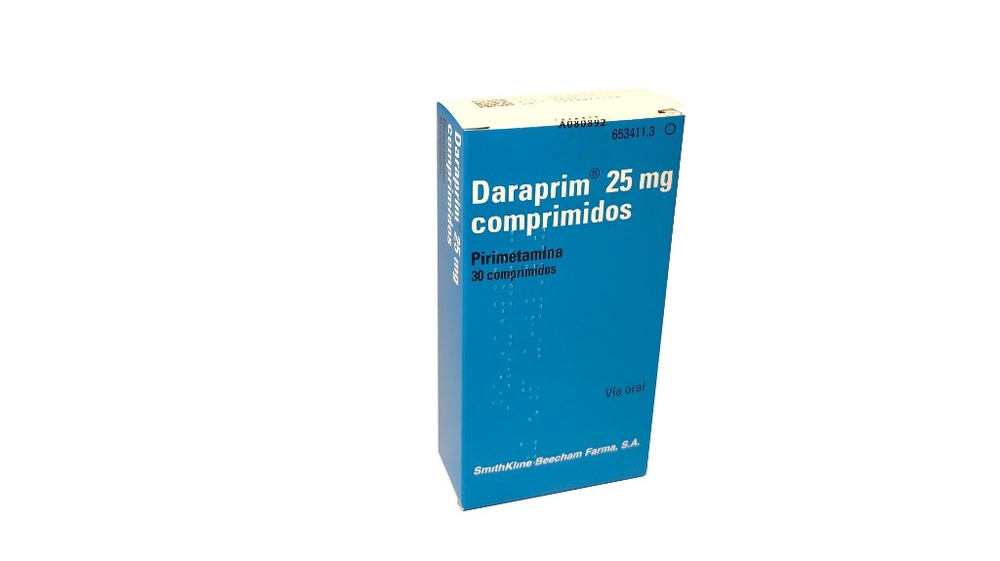
- Alternatives to EURARTESIM 320 mg / 40 mg FILM-COATED TABLETSDosage form: INJECTABLE, 110 mgActive substance: artesunateManufacturer: Amivas Ireland LimitedPrescription requiredDosage form: TABLET, 250 mg/100 mgActive substance: proguanil and atovaquoneManufacturer: Viatris LimitedPrescription requiredDosage form: TABLET, 25 mg pyrimethamineActive substance: pyrimethamineManufacturer: Smithkline Beecham Farma S.A.Prescription required

Online doctors for EURARTESIM 320 mg / 40 mg FILM-COATED TABLETS
Discuss questions about EURARTESIM 320 mg / 40 mg FILM-COATED TABLETS, including use, safety considerations and prescription review, subject to medical assessment and local regulations.









Get EURARTESIM 320 mg / 40 mg FILM-COATED TABLETS Prescription Online
Fill in a 2-min form
Tell us your symptoms, history, and what medicine you're requesting.
Pick a doctor or let us assign
Choose a specialist or we'll match you with the next available doctor.
Doctor reviews your case
Usually within 30 minutes. They may ask follow-up questions via chat.
Collect from any pharmacy
Electronic prescription sent to your email — valid across Spain.
Frequently Asked Questions
EURARTESIM 320 mg / 40 mg FILM-COATED TABLETS requires a prescription in Spain. You can check with a doctor online whether this medicine may be appropriate for your situation.
EURARTESIM 320 mg / 40 mg FILM-COATED TABLETS is manufactured by Alfasigma S.P.A.. Pharmacy brands and packaging may differ depending on the distributor.
Doctors such as Family doctors, Psychiatrists, Dermatologists, Cardiologists, Endocrinologists, Gastroenterologists, Pulmonologists, Nephrologists, Rheumatologists, Hematologists, Infectious disease physicians, Allergists, Geriatricians, Paediatricians, Oncologists may assess whether EURARTESIM 320 mg / 40 mg FILM-COATED TABLETS is appropriate, depending on your situation and local regulations. You can book an online consultation to discuss your symptoms and possible next steps.
Spain has a well-developed healthcare infrastructure across major cities such as Madrid, Barcelona, Valencia, and Seville. Pharmacies are widely available and operate under strict regulations, ensuring access to prescribed medications.
You can buy EURARTESIM 320 mg / 40 mg FILM-COATED TABLETS in Madrid, Barcelona, Seville, or Valencia at any local pharmacy with a valid prescription.
To obtain a prescription, you can use Oladoctor:
Other medicines with the same active substance () include ARTESUNATE AMIVAS 110 mg POWDER AND SOLVENT FOR INJECTABLE SOLUTION, ATOVACUONE/PROGUANIL HYDROCHLORIDE VIATRIS 250 mg/100 mg FILM-COATED TABLETS, DARAPRIM 25 mg TABLETS. These may have different brand names or formulations but contain the same therapeutic ingredient. Always consult a doctor before switching or starting a new medicine.
