



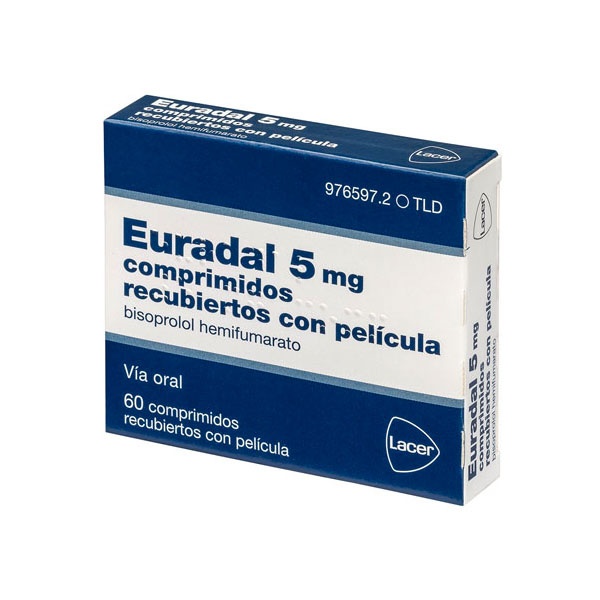
EURADAL 5 mg Film-Coated Tablets

Prescription review online
A doctor will review your case and decide whether a prescription is medically appropriate.

Talk to a doctor about this medicine
Discuss your symptoms and possible next steps in a quick online consultation.



How to use EURADAL 5 mg FILM-COATED TABLETS
Contents of the leaflet
- Introduction
- Euradal 5 mg Film-Coated Tablets
- Bisoprolol Hemifumarate
- Read the entire package leaflet carefully before starting to take this medication, as it contains important information for you.
- What is Euradal and what is it used for
- What you need to know before taking Euradal
- How to take Euradal
- Possible side effects
- Storage of Euradal
- Package contents and additional information.
Introduction
Package Leaflet: Information for the Patient
Euradal 5 mg Film-Coated Tablets

Not sure if this medicine is right for you?
Discuss your symptoms and treatment with a doctor online.
Bisoprolol Hemifumarate
Read the entire package leaflet carefully before starting to take this medication, as it contains important information for you.
- Keep this package leaflet, as you may need to read it again.
- If you have any questions, consult your doctor or pharmacist.
- This medication has been prescribed to you only, and you should not give it to others, even if they have the same symptoms as you, as it may harm them.
- If you experience side effects, consult your doctor or pharmacist, even if they are not listed in this package leaflet.
Contents of the Package Leaflet
1. What is Euradal and what is it used for
2. What you need to know before taking Euradal
3. How to take Euradal
4. Possible side effects
5. Storage of Euradal
6. Package contents and additional information.

Started taking the medicine and have questions?
Discuss your symptoms and treatment with a doctor online.
1. What is Euradal and what is it used for
Bisoprolol, the active ingredient in Euradal, belongs to a group of medications called beta-blockers. These medications work by affecting the body's response to certain nerve impulses, especially in the heart. As a result, bisoprolol slows down the heartbeat and makes the heart more efficient, pumping blood throughout the body. At the same time, it reduces the heart's need for blood and oxygen.
Euradal is used to treat high blood pressure and chronic stable angina.
2. What you need to know before taking Euradal
Do not take Euradal
? Do not take Euradal if you have any of the following conditions:
- allergy (hypersensitivity) to bisoprolol or any of the other ingredients of Euradal (listed in section 6),
- severe asthma or chronic obstructive pulmonary disease,
- severe circulatory problems in the limbs (such as Raynaud's syndrome), which can cause tingling in the fingers and toes or turn them pale or blue,
- untreated pheochromocytoma, a rare tumor of the adrenal gland,
- metabolic acidosis, a condition that occurs when there is too much acid in the blood.
? Do not take Euradal if you have any of the following heart problems:
- uncontrolled acute heart failure with medication,
- worsening of heart failure that requires intravenous injection of medications that increase the heart's contractile force,
- slow heart rate,
- low blood pressure,
- certain heart conditions that cause a very slow or irregular heartbeat,
- cardiogenic shock, a severe and acute heart disease that causes a drop in blood pressure and circulatory failure.
Warnings and precautions
If you have any of the following problems, consult your doctor before taking Euradal. Your doctor may want to take special precautions (such as providing additional treatment or performing more frequent tests):
- diabetes,
- strict fasting,
- if you are receiving certain allergy treatments (desensitization therapy, for example, to prevent hay fever),
- certain heart diseases, such as arrhythmias or severe chest pain at rest (Prinzmetal's angina),
- less severe circulatory problems in the limbs,
- severe persistent asthma or chronic pulmonary disease,
- history of scaly skin rash (psoriasis),
- adrenal gland tumor (pheochromocytoma),
- thyroid disorder.
Also, inform your doctor if you are going to undergo:
- desensitization treatment, as Euradal may make it more likely for you to experience an allergic reaction, or for the reaction to be more severe,
- anesthesia (for example, for surgery), as Euradal may affect how your body reacts to this situation.
Children and adolescents
The efficacy and safety of use in children have not been established. Therefore, the use of Euradal is not recommended in children and adolescents (under 18 years of age).
Taking Euradal with other medications
Tell your doctor or pharmacist if you are using, have recently used, or may need to use any other medication, including those purchased without a prescription.
? Do not take the following medications with Euradal without special advice from your doctor:
- certain medications used to treat high blood pressure, angina, or irregular heartbeat (calcium antagonists such as verapamil and diltiazem);
- certain medications used to treat high blood pressure, such as clonidine, methyldopa, moxonidine, and rilmenidine. However, do not stop taking these medications without consulting your doctor first.
? Consult your doctor before taking the following medications with Euradal; your doctor may need to monitor your condition more frequently:
- certain medications used to treat high blood pressure or angina (dihydropyridine calcium antagonists such as felodipine and amlodipine);
- Class I antiarrhythmics (such as quinidine, disopyramide, lidocaine, phenytoin, flecainide, and propafenone). These medications are used to treat irregular or abnormal heartbeats;
- certain medications used to treat irregular or abnormal heartbeats (Class III antiarrhythmics such as amiodarone);
- locally applied beta-blockers (such as eye drops containing timolol for glaucoma treatment);
- medications for the nervous system used to stimulate internal organs or to treat glaucoma (parasympathomimetics) or used in emergency situations to treat severe circulatory problems (sympathomimetics);
- antidiabetic medications, including insulin;
- anesthetic agents (for example, during surgery);
- digitalis, used to treat heart failure;
- non-steroidal anti-inflammatory drugs (NSAIDs) used to treat arthritis, pain, or inflammation (such as ibuprofen or diclofenac);
- epinephrine, a medication used to treat severe allergic reactions and cardiac arrest;
- any medication that may lower blood pressure as a desired or undesired effect, such as antihypertensives, certain medications for depression (tricyclic antidepressants such as imipramine or amitriptyline), certain medications used to treat epilepsy or during anesthesia (barbiturates such as phenobarbital), or certain medications for treating mental illnesses characterized by loss of contact with reality (phenothiazines);
- mefloquine, used for the prevention or treatment of malaria;
- medications for the treatment of depression called monoamine oxidase inhibitors (except for MAO-B inhibitors).
Taking Euradal with food, drinks, and alcohol
You can take Euradal with or without food.
Use in athletes
Athletes are informed that this medication contains a component that may result in a positive doping test.
Pregnancy, breastfeeding, and fertility
If you are pregnant, think you may be pregnant, or plan to become pregnant, consult your doctor or pharmacist before using this medication.
This medication should not be taken during pregnancy unless it is strictly necessary.
It is not known whether bisoprolol passes into human breast milk. Therefore, breastfeeding is not recommended during treatment with Euradal.
Driving and using machines
Your ability to drive or operate machinery may be affected, depending on how well you tolerate the medication. Be especially careful at the start of treatment, when the dose is increased, or the medication is changed, and also in combination with alcohol.
3. How to take Euradal
Follow your doctor's instructions for taking Euradal exactly. If you are unsure, consult your doctor or pharmacist.
Treatment with Euradal should be started gradually with low doses, which will be increased slowly. In all cases, the dose will be adjusted individually, particularly according to heart rate and therapeutic success.
? Dosage
For both indications, the recommended dose is 1 Euradal 5 mg tablet or half a Euradal 10 mg tablet (equivalent to 5 mg of bisoprolol) once a day.
If necessary, the dose can be increased to 1 Euradal 10 mg tablet or 2 Euradal 5 mg tablets (equivalent to 10 mg of bisoprolol) once a day.
The maximum recommended dose is 20 mg once a day.
? Use in liver and/or kidney impairment
In patients with mild to moderate liver or kidney disorders, no dose adjustment is usually necessary. In patients with severe renal impairment (creatinine clearance <20 ml min) and in patients with severe liver impairment, the daily dose should not exceed 10 mg.< p>
? Use in children
The use of Euradal is not recommended in children.
? Use in elderly patients
No dose adjustment is required in elderly patients.
? Method of administration
Swallow the tablet with a little water in the morning, with or without food. Do not crush or chew the tablet.
? Duration of treatment
Treatment with Euradal is usually long-term.
If you take more Euradal than you should
If you have taken more Euradal than you should, consult your doctor or pharmacist immediately.
In case of overdose, third-degree AV block, slower pulse, and dizziness have been reported. The symptoms that may appear are: difficulty breathing, weak pulse, low blood pressure, dizziness, heart failure, and low blood sugar.
In these cases, treatment with bisoprolol should be discontinued, and symptomatic and supportive treatment should be initiated (which may include the administration of isoprenaline, intravenous fluids, glucagon, diuretics, bronchodilators, and/or glucose, depending on the symptoms and severity of the condition). In some cases, the insertion of a pacemaker may be necessary.
In case of overdose or accidental ingestion, you can also contact the Toxicology Information Service, phone 91 562 04 20, indicating the medication and the amount taken.
If you forget to take Euradal
Do not take a double dose to make up for forgotten doses. Take your usual dose the next morning.
If you stop taking Euradal
Never stop taking Euradal except on the advice of your doctor. Otherwise, your condition may worsen significantly. Treatment should not be stopped abruptly, especially in patients with ischemic heart disease. If you need to stop treatment, your doctor will tell you how to gradually reduce the dose.
If you have any other questions about the use of this medication, ask your doctor or pharmacist.
4. Possible side effects
Like all medications, Euradal can cause side effects, although not everyone will experience them.
The following side effects are described according to their frequency of occurrence:
? Common (affecting at least 1 in 100 patients):
- fatigue, dizziness, headache: these side effects occur especially at the start of treatment. They are usually mild and disappear within 1-2 weeks;
- feeling of cold or numbness in hands or feet;
- low blood pressure;
- stomach or intestinal problems such as nausea, vomiting, diarrhea, or constipation.
? Uncommon (affecting at least 1 in 1,000 patients):
- decreased heart rate (bradycardia);
- worsening of heart failure;
- weakness;
- sleep disturbances;
- depression;
- heart rate problems;
- respiratory problems in patients with asthma or chronic respiratory disease;
- muscle weakness, muscle cramps.
? Rare (affecting at least 1 in 10,000 patients):
- increased blood fat levels;
- hearing problems;
- runny nose;
- decreased tear production;
- increased liver enzymes (ALAT, ASAT), liver inflammation (hepatitis);
- allergic reactions such as itching, redness, skin rash;
- erectile dysfunction;
- nightmares, hallucinations;
- fainting.
? Very rare (affecting less than 1 in 10,000 patients):
- eye irritation and redness (conjunctivitis);
- hair loss;
- appearance or worsening of scaly skin rash (psoriasis); psoriasis-like rash.
If you think any of the side effects you are experiencing is severe or if you notice any other side effects not mentioned in this package leaflet, tell your doctor or pharmacist.
5. Storage of Euradal
Keep this medication out of the sight and reach of children.
No special storage conditions are required.
Do not use Euradal after the expiration date stated on the package after EXP. The expiration date is the last day of the month indicated.
Medications should not be disposed of via wastewater or household waste. Place the packaging and any unused medication in the pharmacy's SIGRE collection point. If you are unsure, ask your pharmacist how to dispose of the packaging and any unused medication. This will help protect the environment.
6. Package contents and additional information.
Composition of Euradal
The active ingredient is bisoprolol hemifumarate. Each film-coated tablet contains 5 mg of bisoprolol hemifumarate.
The other ingredients (excipients) are:
- Tablet core: microcrystalline cellulose, cornstarch, anhydrous colloidal silica, magnesium stearate, crospovidone, calcium hydrogen phosphate dihydrate.
- Coating: hypromellose, yellow iron oxide (E172), titanium dioxide (E171), macrogol 400, dimethicone.
Appearance of the product and package contents
Euradal 5 mg film-coated tablets are pale yellow, round, biconvex, scored on one side, and have no irregularities. There are packages containing 30 and 60 tablets.
Marketing authorization holder and manufacturer
LACER, S.A. - Boters, 5
08290 Cerdanyola del Vallès
Barcelona – Spain
Date of the last revision of this package leaflet:June 2012
Detailed and updated information on this medication is available on the website of the Spanish Agency for Medicines and Health Products (AEMPS) http://www.aemps.gob.es/
- Country of registration
- Dosage formTABLET, 5 mg
- ATC codeC07AB07
- Average pharmacy price2.36 EUR
- Active substance
- Prescription requiredYes
- Manufacturer
- This information is for reference only and does not constitute medical advice. Always consult a doctor before taking any medication. Oladoctor is not responsible for medical decisions based on this content.
- Alternatives to EURADAL 5 mg FILM-COATED TABLETSDosage form: TABLET, 10 mgActive substance: bisoprololManufacturer: Aurovitas Spain, S.A.U.Prescription requiredDosage form: TABLET, 2.5 mgActive substance: bisoprololManufacturer: Aurovitas Spain, S.A.U.Prescription requiredDosage form: TABLET, 5 mgActive substance: bisoprololManufacturer: Aurovitas Spain, S.A.U.Prescription required
Online doctors for EURADAL 5 mg FILM-COATED TABLETS
Discuss questions about EURADAL 5 mg FILM-COATED TABLETS, including use, safety considerations and prescription review, subject to medical assessment and local regulations.
Get EURADAL 5 mg FILM-COATED TABLETS Prescription Online
Fill in a 2-min form
Tell us your symptoms, history, and what medicine you're requesting.
Pick a doctor or let us assign
Choose a specialist or we'll match you with the next available doctor.
Doctor reviews your case
Usually within 30 minutes. They may ask follow-up questions via chat.
Collect from any pharmacy
Electronic prescription sent to your email — valid across Spain.
Frequently Asked Questions
EURADAL 5 mg FILM-COATED TABLETS requires a prescription in Spain. You can check with a doctor online whether this medicine may be appropriate for your situation.
The active ingredient in EURADAL 5 mg FILM-COATED TABLETS is bisoprolol. This information helps identify medicines with the same composition but different brand names.
The average pharmacy price for EURADAL 5 mg FILM-COATED TABLETS is around 2.36 EUR. Prices may vary depending on the manufacturer and dosage form.
EURADAL 5 mg FILM-COATED TABLETS is manufactured by Lacer S.A.. Pharmacy brands and packaging may differ depending on the distributor.
Doctors such as Family doctors, Psychiatrists, Dermatologists, Cardiologists, Endocrinologists, Gastroenterologists, Pulmonologists, Nephrologists, Rheumatologists, Hematologists, Infectious disease physicians, Allergists, Geriatricians, Paediatricians, Oncologists may assess whether EURADAL 5 mg FILM-COATED TABLETS is appropriate, depending on your situation and local regulations. You can book an online consultation to discuss your symptoms and possible next steps.
Spain has a well-developed healthcare infrastructure across major cities such as Madrid, Barcelona, Valencia, and Seville. Pharmacies are widely available and operate under strict regulations, ensuring access to prescribed medications.
You can buy EURADAL 5 mg FILM-COATED TABLETS in Madrid, Barcelona, Seville, or Valencia at any local pharmacy with a valid prescription.
To obtain a prescription, you can use Oladoctor:
Other medicines with the same active substance (bisoprolol) include BISOPROLOL AUROVITAS 10 mg FILM-COATED TABLETS, BISOPROLOL AUROVITAS 2.5 mg FILM-COATED TABLETS, BISOPROLOL AUROVITAS 5 mg FILM-COATED TABLETS. These may have different brand names or formulations but contain the same therapeutic ingredient. Always consult a doctor before switching or starting a new medicine.
