



ESOMEPRAZOL 20 mg Gastro-Resistant Tablets

Prescription review online
A doctor will review your case and decide whether a prescription is medically appropriate.

Talk to a doctor about this medicine
Discuss your symptoms and possible next steps in a quick online consultation.



How to use ESOMEPRAZOL CINFA 20 mg GASTRO-RESISTANT TABLETS
Contents of the leaflet
- Introduction
- What is esomeprazol cinfa and what is it used for
- What you need to know before you take esomeprazol cinfa
- How to take esomeprazol cinfa
- Possible Adverse Effects
- Conservation of Esomeprazol Cinfa
- Package Contents and Additional Information
Introduction
Package Leaflet: Information for the User
esomeprazol cinfa 20 mg gastro-resistant tablets EFG
esomeprazole sodium
Read all of this leaflet carefully before you start taking this medicine because it contains important information for you.
- Keep this leaflet, you may need to read it again.
- If you have any further questions, ask your doctor or pharmacist.
- This medicine has been prescribed for you only. Do not pass it on to others. It may harm them, even if their symptoms are the same as yours.
- If you experience any side effects, talk to your doctor or pharmacist. This includes any possible side effects not listed in this leaflet. See section 4.
Contents of the pack
- What is esomeprazol cinfa and what is it used for
- What you need to know before you take esomeprazol cinfa
- How to take esomeprazol cinfa
- Possible side effects
- Storing esomeprazol cinfa
- Contents of the pack and other information
1. What is esomeprazol cinfa and what is it used for
Esomeprazol cinfa contains a medicine called esomeprazole. This belongs to a group of medicines called ‘proton pump inhibitors’. They work by reducing the amount of acid that the stomach produces.
Esomeprazole is used to treat the following conditions:
Adults
- Gastro-oesophageal reflux disease (GORD). This is where acid from the stomach escapes into the gullet (the tube which carries food from the mouth to the stomach) causing pain and inflammation.
- Stomach ulcers or ulcers of the duodenum (the tube leading out of the stomach) caused by Helicobacter pylori bacteria. If you have this condition, your doctor may also prescribe antibiotics to treat the infection and allow the ulcer to heal.
- Stomach ulcers caused by medicines called NSAIDs (Non-Steroidal Anti-Inflammatory Drugs). Esomeprazole can also be used to stop stomach ulcers from forming if you are taking NSAIDs.
- Too much acid in the stomach caused by a growth in the pancreas (Zollinger-Ellison syndrome).
Adolescents aged 12 years and above
- Gastro-oesophageal reflux disease (GORD). This is where acid from the stomach escapes into the gullet (the tube which carries food from the mouth to the stomach) causing pain and inflammation.
- Stomach ulcers or ulcers of the duodenum (the tube leading out of the stomach) caused by Helicobacter pylori bacteria. If you have this condition, your doctor may also prescribe antibiotics to treat the infection and allow the ulcer to heal.

Not sure if this medicine is right for you?
Discuss your symptoms and treatment with a doctor online.
2. What you need to know before you take esomeprazol cinfa
Do not take esomeprazol cinfa
- If you are allergic to esomeprazole or any of the other ingredients of this medicine (listed in section 6).
- If you are allergic to other proton pump inhibitor medicines (e.g. pantoprazole, lansoprazole, rabeprazole, omeprazole).
- If you are taking a medicine containing nelfinavir (used to treat HIV).
- If you have ever had a skin reaction after treatment with a medicine similar to esomeprazole that reduces stomach acid.
If any of the above apply to you, do not take esomeprazol cinfa. If you are not sure, talk to your doctor or pharmacist before taking esomeprazol cinfa.
Warnings and precautions
Talk to your doctor or pharmacist before taking esomeprazol cinfa
- If you have severe liver problems.
- If you have severe kidney problems.
- If you have ever had a skin reaction after treatment with a medicine similar to esomeprazole that reduces stomach acid.
- If you are due to have a specific blood test (Chromogranin A).
Esomeprazole may hide the symptoms of other diseases. Therefore, if you notice any of the following happen before or while you are taking esomeprazol, contact your doctor immediately:
- You lose a lot of weight for no reason and have problems swallowing.
- You have stomach pain or indigestion.
- You start vomiting food or blood.
- Your stools are black (blood-stained).
If you have been prescribed esomeprazol for a condition where your doctor thinks that the medicine will stop your symptoms from coming back, you should talk to your doctor if your symptoms change.
Serious skin reactions such as Stevens-Johnson syndrome, toxic epidermal necrolysis, drug reaction with eosinophilia and systemic symptoms (DRESS) and erythema multiforme have been reported with esomeprazole. Stop taking esomeprazol and contact your doctor immediately if you get any of the following symptoms: blistering of the skin, mouth, eyes and genitals, or any combination of these, with or without high temperature (fever), flu-like symptoms and enlarged lymph nodes.
Taking a proton pump inhibitor like esomeprazol, especially over a period of more than one year, may slightly increase your risk of fracture in the hip, wrist or spine. Tell your doctor if you have osteoporosis or if you are taking corticosteroids (which can increase the risk of osteoporosis).
If you get a rash on your skin, especially in areas exposed to the sun, you should contact your doctor as soon as possible, as you may need to stop your treatment with esomeprazol. Also remember to mention any other symptoms that you may have, such as joint pain or arthritis.
Children under 12 years
Do not use esomeprazol gastro-resistant tablets in children under 12 years.
Taking esomeprazol cinfa with other medicines
Tell your doctor or pharmacist if you are taking, have recently taken or might take any other medicines.
This includes medicines that you can buy without a prescription. This is because esomeprazol can affect the way some medicines work and some medicines can increase the chance of you getting side effects.
Do not take esomeprazol if you are taking
- a medicine that contains nelfinavir(used to treat HIV).
Tell your doctor if you are taking
- atazanavir (used to treat HIV).
- clopidogrel (used to prevent blood clots).
- ketoconazole, itraconazole or voriconazole (used to treat infections caused by fungi).
- erlotinib (used to treat cancer).
- citalopram, imipramine, clomipramine (used to treat depression).
- diazepam (used to treat anxiety, relax muscles or in epilepsy).
- phenytoin (used in epilepsy). If you are taking phenytoin, your doctor may need to monitor you when you start or stop taking esomeprazol.
- medicines used to thin your blood, such as warfarin. Your doctor may need to monitor you when you start or stop taking esomeprazol.
- cilostazol (used to treat intermittent claudication – a pain in your legs when you walk which is caused by an insufficient blood supply).
- cisapride (used for indigestion and heartburn).
- digoxin (used for heart problems).
- methotrexate (a chemotherapy medicine used to treat cancer) – if you are taking a high dose of methotrexate, your doctor may need to temporarily stop your esomeprazol treatment.
- tacrolimus (used after organ transplantation).
- rifampicin (used to treat tuberculosis).
- St John’s Wort (Hypericum perforatum) (used to treat depression).
If your doctor has prescribed the antibiotics amoxicillin and clarithromycin with your esomeprazol for treatment of ulcers caused by Helicobacter pylori bacteria, it is very important that you tell your doctor about any other medicines you are taking.
Taking esomeprazol cinfa with food and drink
You can take your tablets at any time of the day, either with food or without food.
Pregnancy, breast-feeding and fertility
If you are pregnant or breast-feeding, think you may be pregnant or are planning to have a baby, ask your doctor or pharmacist for advice before taking this medicine.
Your doctor will decide whether you can take esomeprazol during this time.
It is not known if esomeprazol passes into breast milk. Therefore, you should not take esomeprazol if you are breast-feeding.
Driving and using machines
Esomeprazol is not likely to affect your ability to drive or use any tools or machines. However, sometimes side effects such as dizziness or blurred vision may occur. Do not drive or use any tools or machines if you are affected.
Esomeprazol cinfa contains sodium
This medicine contains less than 1 mmol sodium (23 mg) per tablet, that is to say essentially ‘sodium-free’.
3. How to take esomeprazol cinfa
Always take this medicine exactly as your doctor or pharmacist has told you. Check with your doctor or pharmacist if you are not sure.
- If you are taking this medicine for a long time, your doctor will want to monitor you (especially if you take it for more than a year).
- If your doctor has told you to take this medicine as and when you need it, tell your doctor if your symptoms change.
How much to take
- Your doctor will tell you how many tablets to take and when to take them. This will depend on your condition, age and kidney function.
- The recommended doses are given below:
Use in adults aged 18 years and above
For gastro-oesophageal reflux disease
- If your doctor has found that your gullet (oesophagus) is slightly damaged, the recommended dose is one 40 mg tablet once a day for 4 weeks. Your doctor may tell you to take the same dose for a further 4 weeks if your gullet has not healed.
After the gullet has healed, the recommended dose is one 20 mg tablet once a day.
- If your gullet has not been damaged, the recommended dose is one 20 mg tablet each day.
- If you have severe liver problems, your doctor may give you a lower dose.
For stomach ulcers caused by Helicobacter pylori infection and to stop them coming back
- The recommended dose is one 20 mg tablet twice a day for one week. Your doctor will also prescribe two antibiotics for you to take at the same time.
For stomach ulcers caused by NSAIDs (Non-Steroidal Anti-Inflammatory Drugs)
- The recommended dose is one 20 mg tablet once a day for 4-8 weeks.
To prevent stomach ulcers if you are taking NSAIDs
- The recommended dose is one 20 mg tablet once a day.
For too much acid in the stomach caused by a growth in the pancreas (Zollinger-Ellison syndrome)
- The recommended dose is 40 mg twice a day.
- Your doctor will adjust the dose depending on your needs and also will decide how long you need to take the medicine for. The maximum dose is 80 mg twice a day.
Use in adolescents aged 12 years and above
For gastro-oesophageal reflux disease
- If your doctor has found that your gullet (oesophagus) is slightly damaged, the recommended dose is one 40 mg tablet once a day for 4 weeks. Your doctor may tell you to take the same dose for a further 4 weeks if your gullet has not healed.
- After the gullet has healed, the recommended dose is one 20 mg tablet once a day.
- If your gullet has not been damaged, the recommended dose is one 20 mg tablet once a day.
- If you have severe liver problems, your doctor may give you a lower dose.
For stomach ulcers caused by Helicobacter pylori infection and to stop them coming back
- The recommended dose is one 20 mg tablet twice a day for one week. Your doctor will also prescribe two antibiotics for you to take at the same time.
Taking this medicine
- You can take your tablets at any time of the day.
- You can take your tablets with food or on an empty stomach.
- Swallow your tablets whole with a glass of water. Do not chew or crush the tablets. This is because the tablets contain coated pellets which stop the medicine from being broken down by the acid in your stomach. It is important not to damage the pellets.
What to do if you have difficulty swallowing
- If you have difficulty swallowing the tablets:
- Put the tablets in a glass of water. Do not use other liquids.
- Stir until the tablets break up (the mixture will not be clear). You can then drink the mixture. You must always stir the mixture just before you drink it.
- To make sure you get the full dose, rinse the glass with half a glass of water and drink it. The solid pieces contain the medicine - do not chew or crush them.
- If you cannot swallow at all, the tablets can be mixed with water and given through a syringe (a tube used to give medicine) into the stomach via a tube.
Use in children under 12 years
Do not use esomeprazol gastro-resistant tablets in children under 12 years.
Patients with kidney problems
No dose adjustment is necessary in patients with kidney problems.
If you take more esomeprazol cinfa than you should
If you take more esomeprazol than you should, talk to your doctor or pharmacist straight away.
In case of overdose, contact your doctor or pharmacist or go to the emergency department of your nearest hospital. Take the medicine pack with you.
If you forget to take esomeprazol cinfa
- If you forget to take a dose, take it as soon as you remember. However, if it is almost time for your next dose, skip the missed dose and continue as usual.
- Do not take a double dose to make up for a forgotten dose.
If you have any further questions on the use of this medicine, ask your doctor or pharmacist.

Started taking the medicine and have questions?
Discuss your symptoms and treatment with a doctor online.
4. Possible Adverse Effects
Like all medicines, this medicine can cause adverse effects, although not all people suffer from them.
If you observe any of the following serious adverse effects, stop taking esomeprazol and contact a doctor immediately:
- A sudden difficulty breathing, swelling of lips, tongue, and throat or body in general, skin rash, fainting, or difficulty swallowing (severe allergic reaction).
- Redness of the skin with blisters or peeling. Also, significant blisters and bleeding of the lips, eyes, mouth, nose, and genitals may appear. This could be a "Stevens-Johnson Syndrome" or "toxic epidermal necrolysis".
- Yellow skin, dark urine, and fatigue that can be symptoms of liver problems.
- Widespread rash, high body temperature, and enlargement of lymph nodes (DRESS syndrome or drug hypersensitivity syndrome), which is very rare.
These effects are rare and may affect up to 1 in 1,000 people.
Other adverse effects include:
Frequent (may affect up to 1 in 10 people)
- Headache.
- Effects on the stomach or intestine: stomach pain, constipation, diarrhea, gas (flatulence).
- Nausea or vomiting.
- Benign polyps in the stomach.
Infrequent (may affect up to 1 in 100 people)
- Swelling of feet and ankles.
- Sleep disturbance (insomnia).
- Dizziness, tingling sensation, and numbness, drowsiness.
- Vertigo sensation.
- Dry mouth.
- Alteration of blood tests that determine liver function.
- Skin rash, hives, itching of the skin.
- Hip, wrist, or spine fracture (if esomeprazol is used at high doses and for a long period)
Rare (may affect up to 1 in 1,000 people)
- Blood disorders such as a decrease in the number of white blood cells or platelets. This can cause weakness, bruising, or increase the likelihood of infections.
- Low sodium levels in the blood. This can cause weakness, vomiting, and cramps.
- Agitation, confusion, or depression.
- Taste alteration.
- Eye disorders such as blurred vision.
- Sudden shortness of breath or difficulty breathing (bronchospasm).
- Inflammation inside the mouth.
- An infection known as "candidiasis" that can affect the esophagus and is caused by a fungus.
- Liver problems including jaundice that can cause yellowish skin, dark urine, and fatigue.
- Hair loss (alopecia).
- Dermatitis due to sun exposure.
- Joint pain (arthralgia) or muscle pain (myalgia).
- General feeling of discomfort and lack of energy.
- Increased sweating.
Very rare (may affect up to 1 in 10,000 people)
- Changes in the number of cells in the blood, including agranulocytosis (decrease in the number of white blood cells).
- Aggressiveness.
- Seeing, feeling, or hearing things that do not exist (hallucinations).
- Liver disorders that can lead to liver failure or brain inflammation.
- Sudden appearance of severe skin rash, blisters, or peeling of the skin. These symptoms can be accompanied by high fever and joint pain. (Erythema multiforme, Stevens-Johnson Syndrome, Toxic Epidermal Necrolysis).
- Muscle weakness.
- Severe kidney disorders.
- Enlargement of breasts in men.
Frequency not known (cannot be estimated from the available data)
- If you are being treated with esomeprazol for more than three months, it is possible that your magnesium levels in the blood may decrease. Low magnesium levels can manifest as fatigue, muscle contractions, disorientation, convulsions, dizziness, or increased heart rate. If you have any of these symptoms, inform your doctor immediately. Low magnesium levels can also lead to a reduction in potassium or calcium levels in the blood. Your doctor may decide to perform periodic tests to monitor your magnesium levels.
- Inflammation in the intestine (can lead to diarrhea).
- Skin rash, possibly with joint pain.
In very rare cases, esomeprazol can affect white blood cells, causing an immune deficiency. If you have an infection with symptoms such as fever with a severe worsening of the general condition or fever with symptoms of a local infection such as neck, throat, mouth, or difficulty urinating, you should consult your doctor as soon as possible to rule out a decrease in the number of white blood cells (agranulocytosis) through a blood test. It is essential that, in this case, you report your medication.
Reporting of Adverse Effects
If you experience any type of adverse effect, consult your doctor or pharmacist, even if it is a possible adverse effect that does not appear in this prospectus. You can also report them directly through the Spanish Pharmacovigilance System for Human Use Medicines: https://www.notificaram.es. By reporting adverse effects, you can contribute to providing more information on the safety of this medicine.
5. Conservation of Esomeprazol Cinfa
Keep this medicine out of sight and reach of children.
Do not use this medicine after the expiration date that appears on the label, box, or blister after CAD. The expiration date is the last day of the month indicated.
Blister packs
Do not store at a temperature above 30°C.
Keep in the original packaging to protect it from moisture.
Bottles:
Do not store at a temperature above 30°C.
Validity period after opening the bottle: 100 days
Keep the bottle perfectly closed to protect it from moisture.
Medicines should not be thrown away through drains or into the trash. Deposit the packaging and medicines you no longer need at the SIGRE point in the pharmacy. In case of doubt, ask your pharmacist how to dispose of the packaging and medicines you no longer need. This way, you will help protect the environment.
6. Package Contents and Additional Information
Composition of Esomeprazol Cinfa
- The active ingredient is esomeprazol. It contains 20 mg of esomeprazol (as esomeprazol sodium).
- Other components are:
- Core:Microcrystalline cellulose spheres (microcrystalline cellulose and water), hypromellose (E464), talc (E553b), titanium dioxide (E171), glycerol monostearate, polysorbate 80, methacrylic acid-ethyl acrylate copolymer (1:1) dispersion at 30% (sodium lauryl sulfate, polysorbate 80, and methacrylic acid-ethyl acrylate copolymer), triethyl citrate (E1505), macrogol, microcrystalline cellulose (E460i), crospovidone (type A), and sodium stearyl fumarate.
- Coating:Opadry II Light Blue 85F30663 (partially hydrolyzed polyvinyl alcohol, titanium dioxide, macrogol, talc, aluminum lake carmine indigo / blue FD&C #2 (E132), and yellow iron oxide (E172)).
Appearance of the Product and Package Contents
Esomeprazol Cinfa 20 mg are oval, blue, gastro-resistant tablets.
They are available in packs of 14, 28, 56, and 100 (clinical pack) tablets in blister packs and bottles.
Only some pack sizes may be marketed.
Marketing Authorization Holder and Manufacturer
Marketing Authorization Holder
Laboratorios Cinfa, S.A.
Carretera Olaz-Chipi, 10. Polígono Industrial Areta.
31620 Huarte (Navarra) - Spain
Manufacturer
Laboratorios Cinfa, S.A.
Carretera Olaz-Chipi, 10. Polígono Industrial Areta.
31620 Huarte (Navarra) - Spain
or
TOWA PHARMACEUTICAL EUROPE S.L.
C/ San Martí, 75-97
Martorelles, 08107 Barcelona
Spain
Date of the Last Revision of this Prospectus:January 2025
Detailed information about this medicine is available on the website of the Spanish Agency for Medicines and Health Products (AEMPS) http://www.aemps.gob.es/
You can access detailed and updated information about this medicine by scanning the QR code included in the prospectus and packaging with your mobile phone (smartphone). You can also access this information at the following internet address: https://cima.aemps.es/cima/dochtml/p/75071/P_75071.html
QR code to: https://cima.aemps.es/cima/dochtml/p/75071/P_75071.html
This information is intended only for healthcare professionals:
Administration through a gastric tube
- Insert the tablet into a suitable syringe and fill the syringe with approximately 25 ml of water and approximately 5 ml of air. For some tubes, dispersion in 50 ml of water is required to prevent the pellets from clogging the tube.
- Shake the syringe immediately for approximately 2 minutes to disperse the tablet.
- Hold the syringe with the tip upwards and check that the tip is not clogged.
- Connect the syringe to the tube while maintaining the previous position.
- Shake the syringe and place it with the tip downwards. Inject immediately 5-10 ml into the tube.
Invert the syringe after injection and shake (the syringe must be kept with the tip upwards to avoid clogging the tip).
- Put the syringe back with the tip downwards and inject immediately another 5-10 ml into the tube. Repeat this procedure until the syringe is empty.
- Fill the syringe with 25 ml of water and 5 ml of air and repeat step 5 if necessary to flush any sediment remaining in the syringe. For some tubes, 50 ml of water are required.
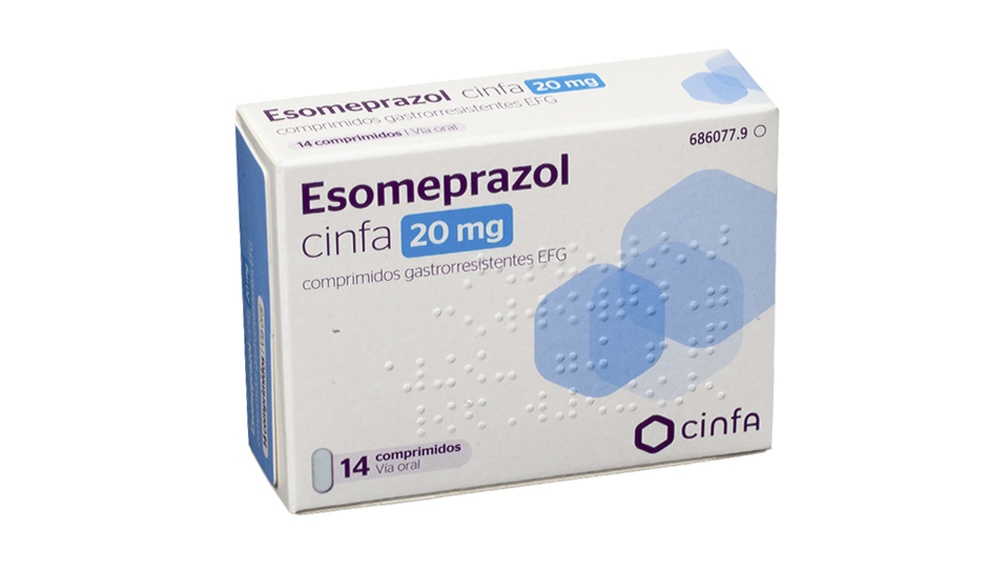
- Country of registration
- Dosage formTABLET, 20 mg
- ATC codeA02BC05
- Average pharmacy price6.28 EUR
- Active substance
- Prescription requiredYes
- Manufacturer
- CompositionMONOESTEARATO DE GLICEROL (14,590 mg mg), POLISORBATO 80 (2,907 mg mg), POLISORBATO 80 (1,815 mg mg), FUMARATO DE ESTEARILO Y SODIO (3,967 mg mg), LAURILSULFATO DE SODIO (0,552 mg mg)
- This information is for reference only and does not constitute medical advice. Always consult a doctor before taking any medication. Oladoctor is not responsible for medical decisions based on this content.
- Alternatives to ESOMEPRAZOL CINFA 20 mg GASTRO-RESISTANT TABLETSDosage form: TABLET, 20 mg esomeprazoleActive substance: esomeprazoleManufacturer: Grünenthal Pharma S.A.Prescription requiredDosage form: TABLET, 40 mg esomeprazoleActive substance: esomeprazoleManufacturer: Grünenthal Pharma S.A.Prescription requiredDosage form: CAPSULE, 20 mgActive substance: esomeprazoleManufacturer: Krka D.D. Novo MestoPrescription not required
Online doctors for ESOMEPRAZOL CINFA 20 mg GASTRO-RESISTANT TABLETS
Discuss questions about ESOMEPRAZOL CINFA 20 mg GASTRO-RESISTANT TABLETS, including use, safety considerations and prescription review, subject to medical assessment and local regulations.









Get ESOMEPRAZOL CINFA 20 mg GASTRO-RESISTANT TABLETS Prescription Online
Fill in a 2-min form
Tell us your symptoms, history, and what medicine you're requesting.
Pick a doctor or let us assign
Choose a specialist or we'll match you with the next available doctor.
Doctor reviews your case
Usually within 30 minutes. They may ask follow-up questions via chat.
Collect from any pharmacy
Electronic prescription sent to your email — valid across Spain.
Frequently Asked Questions
ESOMEPRAZOL CINFA 20 mg GASTRO-RESISTANT TABLETS requires a prescription in Spain. You can check with a doctor online whether this medicine may be appropriate for your situation.
The active ingredient in ESOMEPRAZOL CINFA 20 mg GASTRO-RESISTANT TABLETS is esomeprazole. This information helps identify medicines with the same composition but different brand names.
The average pharmacy price for ESOMEPRAZOL CINFA 20 mg GASTRO-RESISTANT TABLETS is around 6.28 EUR. Prices may vary depending on the manufacturer and dosage form.
ESOMEPRAZOL CINFA 20 mg GASTRO-RESISTANT TABLETS is manufactured by Laboratorios Cinfa S.A.. Pharmacy brands and packaging may differ depending on the distributor.
Doctors such as Family doctors, Psychiatrists, Dermatologists, Cardiologists, Endocrinologists, Gastroenterologists, Pulmonologists, Nephrologists, Rheumatologists, Hematologists, Infectious disease physicians, Allergists, Geriatricians, Paediatricians, Oncologists may assess whether ESOMEPRAZOL CINFA 20 mg GASTRO-RESISTANT TABLETS is appropriate, depending on your situation and local regulations. You can book an online consultation to discuss your symptoms and possible next steps.
Spain has a well-developed healthcare infrastructure across major cities such as Madrid, Barcelona, Valencia, and Seville. Pharmacies are widely available and operate under strict regulations, ensuring access to prescribed medications.
You can buy ESOMEPRAZOL CINFA 20 mg GASTRO-RESISTANT TABLETS in Madrid, Barcelona, Seville, or Valencia at any local pharmacy with a valid prescription.
To obtain a prescription, you can use Oladoctor:
Other medicines with the same active substance (esomeprazole) include AXIAGO 20 mg GASTRO-RESISTANT TABLETS, AXIAGO 40 mg GASTRO-RESISTANT TABLETS, EMANERA 20 mg GASTRO-RESISTANT HARD CAPSULES. These may have different brand names or formulations but contain the same therapeutic ingredient. Always consult a doctor before switching or starting a new medicine.
