


EMPRESSIN 40 I.U./2 ml CONCENTRATE FOR PERFUSION SOLUTION
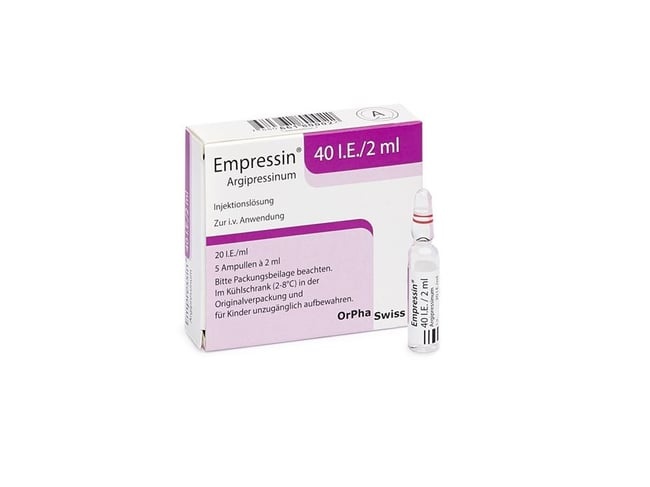



How to use EMPRESSIN 40 I.U./2 ml CONCENTRATE FOR PERFUSION SOLUTION
Translated with AI
This page provides general information and does not replace a doctor’s consultation. Always consult a doctor before taking any medication. Seek urgent medical care if symptoms are severe.
Show originalContents of the leaflet
Introduction
Package Leaflet: Information for the User
Empressin 40 U.I./2 ml concentrate for solution for infusion
argipressin
Read all of this leaflet carefully before you start using this medicine because it contains important information for you.
- Keep this leaflet, you may need to read it again.
- If you have any further questions, ask your doctor or pharmacist.
- This medicine has been prescribed for you only. Do not pass it on to others. It may harm them, even if their signs of illness are the same as yours.
- If you get any side effects, talk to your doctor or pharmacist. This includes any possible side effects not listed in this leaflet. See section 4.
Contents of the package leaflet
- What is Empressin and what is it used for
- What you need to know before you use Empressin
- How to use Empressin
- Possible side effects
- Storage of Empressin
- Contents of the pack and other information
1. What is Empressin and what is it used for
Empressin is an artificially produced active substance equivalent to the natural hormone vasopressin. It regulates the hydroelectrolytic balance in the body and reduces urine excretion. Empressin is used in septic shock states when other suitable methods to achieve the desired blood pressure values set by the treating physician have failed.

2. What you need to know before you use Empressin
Do not use Empressin:
- if you are allergic to argipressin or any of the other ingredients of this medicine (listed in section 6).
Warnings and precautions
Special precautions for use of Empressin are mandatory:
- if used to increase blood pressure in shock cases after using other methods. Administration should be carried out under close surveillance of vital parameters.
- if used in patients with cardiovascular diseases.
- if administered to patients with epilepsy, migraine, asthma, heart failure, or with a condition where a rapid increase in extracellular fluid represents a risk.
- if the patient suffers from chronic nephritis.
Children and adolescents
The use of Empressin in children and newborns is contraindicated.
Other medicines and Empressin
Empressin should be administered with caution together with carbamazepine, chlorpropamide, clofibrate, urea, fludrocortisone, or tricyclic antidepressants, as these drugs may increase the effect of Empressin. Empressin should be administered with caution together with demeclocycline, noradrenaline, lithium, heparin, or alcohol, as these substances may reduce its effects. Concomitant use of Empressin with medicines that alter blood pressure may increase or reduce the blood pressure elevation caused by Empressin. Tell your doctor or pharmacist if you are taking/using or have recently taken/used any other medicines, including medicines obtained without a prescription.
Using Empressin with food and drinks
Empressin should not be used in combination with alcohol.
Pregnancy and breastfeeding
Empressin may cause uterine contractions and an increase in intrauterine pressure during pregnancy, and may reduce uterine perfusion. Empressin should not be used during pregnancy unless clearly necessary.
It is unknown whether Empressin is transferred to breast milk.
The use of Empressin is not recommended during pregnancy and breastfeeding.
Ask your doctor or pharmacist for advice before taking any medicine.
Driving and using machines
No studies on the effects on the ability to drive and use machines have been performed.
Important information about some excipients of Empressin
This medicine contains less than 1 mmol of sodium (23 mg) per dose, i.e., it is essentially "sodium-free".
3. How to use Empressin
Empressin will be administered by a doctor.
Empressin will only be used in addition to conventional treatment. Initially, 0.01 U.I. of Empressin per minute will be administered by infusion. This dose may be increased every 15-20 minutes up to 0.03 U.I. of Empressin per minute. Higher doses will only be used in case of emergency.
Empressin is administered as a prolonged infusion and should be diluted with a physiological solution.
Use in children and adolescents
Empressin has been used to treat certain shock conditions in children, infants, and neonates in intensive care units and in the operating room. The use of Empressin for this indication in children and newborns is not recommended.
If you use more Empressin than you should
This medicine will be administered by a doctor. If you think you have been given too high a dose of this medicine, talk to your doctor immediately.
If you stop treatment with Empressin
Treatment with this medicine should be stopped gradually, which means that treatment should not be stopped abruptly. If you think the medicine has been stopped too early, talk to your doctor immediately. If you have any further questions on the use of this medicine, ask your doctor or pharmacist.

4. Possible side effects
Like all medicines, this medicine can cause side effects, although not everybody gets them.
Common (may affect up to 1 in 10 people):
- abnormal heartbeat
- chest tightness
- circulatory disorders in the myocardium, intestine, or fingertips
- peripheral narrowing of blood vessels
- tissue death
- colic
- pallor around the mouth
- skin tissue death
Uncommon (may affect up to 1 in 100 people):
- low sodium levels in the blood
- tremor
- dizziness
- headache
- decreased cardiac output
- potentially life-threatening change in heartbeat
- cardiac arrest
- breathing difficulties caused by narrowing of the airways
- nausea
- vomiting
- flatulence
- intestinal tissue death
- sweating
- skin rash
- changes in certain blood test values
Rare (may affect up to 1 in 1,000 people):
- severe allergic reaction, potentially life-threatening
Unknown (frequency cannot be estimated from the available data):
- hyperhydration
- diabetes insipidus after treatment discontinuation
Reporting of side effects
If you experience any side effects, talk to your doctor or pharmacist. This includes any possible side effects not listed in this leaflet. You can also report side effects directly via the Spanish Medicines Surveillance System for Human Use: www.notificaRAM.es. By reporting side effects, you can help provide more information on the safety of this medicine.
5. Storage of Empressin
Keep this medicine out of the sight and reach of children.
Store in a refrigerator (2°C - 8°C).
Do not use this medicine after the expiry date which is stated on the label and carton. The expiry date is the last day of the month stated.
Once opened, dilute and use the product immediately.
Medicines should not be disposed of via wastewater or household waste. Ask your pharmacist how to dispose of medicines no longer required. This will help protect the environment.
6. Contents of the pack and other information
Composition of Empressin
The active substance is argipressin.
One ampoule with 2 ml of concentrate for solution for infusion contains argipressin acetate in a quantity corresponding to 40 U.I. of argipressin (equivalent to 133 micrograms).
The other excipients are: sodium chloride, glacial acetic acid for pH adjustment, and water for injectable preparations.
Appearance and pack contents
Empressin is a clear and colorless concentrate for solution for infusion.
Each pack contains 5 or 10 ampoules.
Not all pack sizes may be marketed.
Marketing authorisation holder
Orpha-Devel Handels und Vertriebs GmbH
Wintergasse 85/1B
3002 Purkersdorf
Austria
You can request more information about this medicine from the local representative of the marketing authorisation holder:
AOP Orphan Pharmaceuticals Iberia S.L.U.
Calle de Cólquide nº6, Edif. Prisma – Portal 2, 1º F
28231, Las Rozas, Madrid
Spain
Manufacturer
AOP Orphan Pharmaceuticals GmbH
Leopold-Ungar-Platz 2,
1190 Vienna
Austria
This medicine is authorised in the Member States of the European Economic Area under the following names:
Austria Empesin 40 I.E./2 ml Konzentrat zur Herstellung einer Infusionslösung
Belgium Reverpleg 40 I.E./2 ml concentraat voor oplossing voor infusie
Bulgaria ???????? 40 IU/2ml ?????????? ?? ?????????? ???????
Croatia Empressin 40 IU/2ml koncentrat za otopinu za infuziju
Czech Republic Embesin
Germany Empressin 40 I.E./2 ml Konzentrat zur Herstellung einer Infusionslösung
Denmark Empressin
Estonia Empesin
Greece Empressin 40 I.U./2 ml Πυκν? δι?λυμα για παρασκευ? διαλ?ματος προς ?γχυση
Spain Empressin 40 U.I./2 ml concentrado para solución para perfusión
Finland Empressin 40 I.U./2 ml infuusiokonsentraatti, liuosta varten
France Reverpleg 40 U.I./2 ml solution à diluer pour perfusion
Hungary Embesyn 40 N.E./2 ml koncentrátum oldatos infúzióhoz
Ireland Embesin 40 I.U./2 ml concentrate for solution for infusion
Italy Empressin 40 U.I./2 ml concentrato per soluzione per infusione
Lithuania Empesin 40 TV/ 2ml koncentratas infuziniam tirpalui
Luxembourg Reverpleg 40 I.U./2 ml solution à diluer pour perfusion
Latvia Empesin 40 SV/2 ml koncentrats infuziju škiduma pagatavošanai
Netherlands Empressine 40 I.E./2ml, concentraat voor oplossing voor infusie
Norway Empressin
Poland Empesin
Portugal Empressin, 40 U.I./2ml, concentrado para solução para perfusão
Romania Reverpleg 40 U.I./2 ml concentrat pentru solutie perfuzabila
Sweden Empressin 40 I.E./2 ml Koncentrat till infusionsvätska, lösning
Slovenia Empesin 40 i.e./2 ml koncentrat za raztopino za infundiranje
Slovakia Embesin 40 IU/2 ml infúzny koncentrát
Date of last revision of this leaflet:11/2023
This information is intended only for healthcare professionals:
Posology and method of administration
Treatment with argipressin in patients with catecholamine-resistant hypotension should preferably be initiated within the first six hours after the onset of septic shock, or within 3 hours after the onset in patients receiving high doses of catecholamines (see section 5.1 of the SmPC).
Argipressin should be administered by continuous intravenous infusion of 0.01 U.I. per minute using an infusion pump or a mechanical infusion pump. Depending on the clinical response, the dose may be increased every 15-20 minutes up to 0.03 U.I. per minute. For patients in intensive care, the desired blood pressure is usually 65-75 mmHg. Argipressin should only be administered together with conventional vasopressor treatment with catecholamines. Doses above 0.03 U.I. per minute should only be administered as emergency treatment, as they may cause skin and intestinal necrosis and increase the risk of cardiac arrest (see section 4.4 of the SmPC). The duration of treatment should be chosen according to the individual clinical picture, but should preferably last at least 48 hours. Treatment with argipressin should not be stopped abruptly, but should be gradually reduced according to the patient's clinical evolution. The overall duration of treatment with argipressin will be at the discretion of the treating physician.
Prepare an infusion solution by diluting 2 ml of the concentrate in 48 ml of sodium chloride 9 mg/ml (0.9%) solution (which corresponds to 0.8 U.I. of argipressin per ml). The total volume after dilution should be 50 ml.
Infusion rates according to the recommended doses:
Dose of Empressin/min | Dose of Empressin/hour | Infusion rate |
0.01 U.I. | 0.6 U.I. | 0.75 ml/hour |
0.02 U.I. | 1.2 U.I. | 1.50 ml/hour |
0.03 U.I. | 1.8 U.I. | 2.25 ml/hour |
Pediatric population
Argipressin has been used to treat vasodilatory shock in children and infants in intensive care units and during surgical procedures. Since argipressin compared to conventional treatment did not result in improved survival and showed higher rates of adverse events, its use is not recommended in children and infants.
Contraindications
Hypersensitivity to the active substance or to any of the excipients listed in section 6.1 of the SmPC.
Special warnings and precautions for use
This product should not be exchanged with other medicines containing argipressin with different concentration units (e.g., pressor units, PU).
Argipressin should not be administered as a rapid intravenous injection for the treatment of catecholamine-resistant shock.
Argipressin should only be administered under close and continuous surveillance of hemodynamic and organ parameters.
Treatment with argipressin should only be initiated if sufficient perfusion pressure cannot be maintained despite adequate volume replacement and the application of catecholaminergic vasopressors.
Argipressin should be used with special caution in patients with heart or vascular diseases. It has been observed that administration of high doses of argipressin for other indications causes intestinal and myocardial ischemia, myocardial and intestinal infarction, and reduces perfusion in the extremities.
It is very rare that argipressin causes hyperhydration. The initial signs of somnolence, lethargy, and headache should be recognized in time to avoid terminal coma and convulsions.
Argipressin should be used with caution in case of epilepsy, migraine, asthma, heart failure, or any condition where a rapid increase in extracellular fluid may pose a risk to an already compromised organism.
In the pediatric population, it has not been demonstrated that the risk-benefit ratio is positive. The use of argipressin for this indication in children and newborns is not recommended (see section 5.1 of the SmPC).
- Country of registration
- Dosage formINJECTABLE PERFUSION, 20 IU/ml
- ATC codeH01BA01
- Active substance
- Prescription requiredYes
- Manufacturer
- This information is for reference only and does not constitute medical advice. Always consult a doctor before taking any medication. Oladoctor is not responsible for medical decisions based on this content.
- Alternatives to EMPRESSIN 40 I.U./2 ml CONCENTRATE FOR PERFUSION SOLUTIONDosage form: ORAL SOLUTION/SUSPENSION, 360mcg/ml desmopressin (anhydrous base)Active substance: desmopressinManufacturer: Laboratorio Reig Jofre, S.A.Prescription requiredDosage form: SUBLINGUAL TABLET, 120 microgramsActive substance: desmopressinManufacturer: Aristo Pharma GmbhPrescription requiredDosage form: SUBLINGUAL TABLET, 240 microgramsActive substance: desmopressinManufacturer: Aristo Pharma GmbhPrescription required

Online doctors for EMPRESSIN 40 I.U./2 ml CONCENTRATE FOR PERFUSION SOLUTION
Discuss questions about EMPRESSIN 40 I.U./2 ml CONCENTRATE FOR PERFUSION SOLUTION, including use, safety considerations and prescription review, subject to medical assessment and local regulations.



Frequently Asked Questions
