



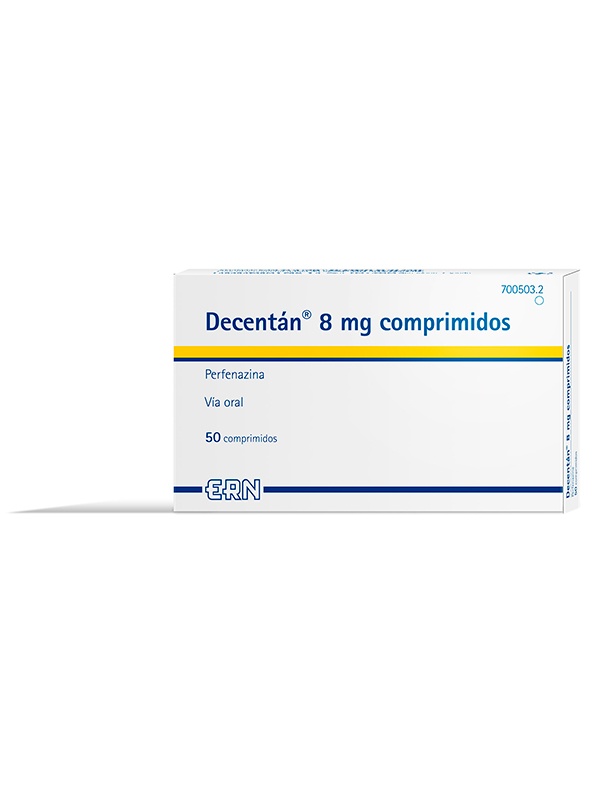
DECENTAN 8 mg Tablets

Prescription review online
A doctor will review your case and decide whether a prescription is medically appropriate.

Talk to a doctor about this medicine
Discuss your symptoms and possible next steps in a quick online consultation.



How to use DECENTAN 8 mg TABLETS
Contents of the leaflet
- Introduction
- What is Decentán and what is it used for
- What you need to know before you take Decentán
- How to take Decentán
- Possible Adverse Effects
- Conservation of Decentán
- Packaging Content and Additional Information
Introduction
Package Leaflet: Information for the User
Decentán 8 mg Tablets
Perphenazine
Read all of this leaflet carefully before you start taking this medicine because it contains important information for you.
- Keep this leaflet, you may need to read it again.
- If you have any further questions, ask your doctor or pharmacist.
- This medicine has been prescribed for you only. Do not pass it on to others. It may harm them, even if their signs of illness are the same as yours.
- If you get any side effects, talk to your doctor or pharmacist. This includes any possible side effects not listed in this leaflet. See section 4.
Contents of the pack:
- What is Decentán and what is it used for
- What you need to know before you take Decentán
- How to take Decentán
- Possible side effects
- Storing Decentán
- Contents of the pack and other information
1. What is Decentán and what is it used for
Decentán is a medicine whose active ingredient is perphenazine, a phenothiazine derivative, which belongs to the group of medicines called antipsychotics.
It is indicated for the treatment of acute psychotic syndromes, catatonic syndromes, delirium, and other exogenous psychotic syndromes, and psychomotor agitation.

Not sure if this medicine is right for you?
Discuss your symptoms and treatment with a doctor online.
2. What you need to know before you take Decentán
Do not takeDecentán
- If you are allergic or have had an allergic reaction to perphenazine or any of the other components of this medicine (listed in section 6).
- If you have severe depression.
- In case of comatose states.
- In case of alcoholic and/or hypnotic, tranquilizing, and antidepressant poisoning.
- If you have severe blood cell disorders (e.g., decreased white blood cells) or bone marrow disorders.
- If you have severe liver disease.
- If you have heart disease, slow heart rate, certain electrocardiogram alterations, or other heart disorders (congenital long QT interval syndrome, coronary disease, conduction disorders-arrhythmias-).
- If you are taking other medicines that also cause electrocardiogram alterations (prolongation of the QT interval).
Warnings and precautions
- If you have low potassium levels in the blood. If you are taking other medicines that cause low potassium levels in the blood and/or increase perphenazine levels in the blood.
- If you have severe low blood pressure or circulatory problems (related to sudden changes in position).
- If you have any disease related to blood production.
- In the case of patients at risk of suffering from venous thromboembolism (disease of the blood vessels related to the formation of a clot that obstructs them).
- If you take high doses of Decentán and are particularly sensitive to this medicine, as you may suffer from certain types of arrhythmias.
- If you have kidney disease.
- If you have been diagnosed with a breast tumor.
- If you have pheochromocytoma (a type of kidney tumor).
- If you have liver disease.
- If you have thyroid disease.
- If you have chronic respiratory problems and asthma.
- If you have gastrointestinal stenosis (narrowing at any point in the esophagus, stomach, or intestines).
- If you have angle-closure glaucoma (eye disease that causes increased pressure inside the eyes).
- If you have prostate problems.
- Elderly patients with significant general deterioration. Note that Decentán is not indicated for the treatment of behavioral disorders associated with dementia (cerebral disorder that causes memory loss, affects language, and attention, among others) and caution should be exercised, especially in elderly patients with dementia (possibility of increased risk of death).
- Cautious use is recommended if Decentán is administered to patients with risk factors related to adverse cerebrovascular events (e.g., cerebral vascular disease or embolism) and especially if they have dementia.
- If you have any brain disorder or damage (e.g., Parkinson's disease).
- If you have or have had epilepsy.
- If you suffer from depression.
- If you experience fever and muscle stiffness while taking Decentán, contact your doctor immediately.
- If you have a disease that causes muscle weakness (myasthenia gravis).
Decentán should be used under strict medical control.
Children and adolescents
Administration in children should only be done exceptionally and with extreme caution due to the risk of neurological adverse effects.
Other medicines and Decentán
Tell your doctor or pharmacist if you are taking or have recently taken or may need to take any other medicine.
- The use of Decentán with medicines that also act on the central nervous system (psychotropics, hypnotics, some analgesics, narcotics) or other medicines such as antihistamines may make the effects of these medicines stronger than expected.
- Decentán may increase the adverse effects caused by some antidepressants (e.g., delirium).
- If you take Decentán with selective serotonin reuptake inhibitors (e.g., fluoxetine or paroxetine), your doctor may need to reduce the dose of Decentán you take, as these medicines increase Decentán levels in the blood.
- Do not take Decentán with medicines that alter the electrocardiogram, such as antiarrhythmics, macrolide antibiotics, antimalarial medicines, antihistamines, antidepressants, or other neuroleptics, with medicines that lower potassium levels in the blood (e.g., specific diuretics), or with medicines that decrease the metabolism of Decentán in the liver (e.g., certain antidepressants (monoamine oxidase inhibitors and selective serotonin reuptake inhibitors), antimycotics such as imidazole).
- The effects of Decentán may decrease if you take biperiden (a medicine used to treat Parkinson's disease), if you take medicines for epilepsy (e.g., barbiturics, carbamazepine).
- If you take Decentán with medicines that lower blood pressure, you may experience dizziness, vision of "black spots," and increased heart rate.
- Also, the blood pressure-lowering effect of guanethidine, clonidine, and alpha-methyldopa may be weaker if you take Decentán.
- It is not recommended to take Decentán and reserpine-containing medicines together.
- For the treatment of hypotension (low blood pressure), adrenaline (epinephrine) should not be administered with Decentán, as adrenaline administration may lead to a greater decrease in blood pressure.
- The concomitant use of Decentán and anticonvulsant medicines such as barbiturics or carbamazepine increases the metabolism of phenothiazines.
- The concomitant use of Decentán and phenytoin may cause an increase in phenytoin levels in the blood and reach toxic levels.
- The concomitant use of Decentán and clozapine may cause blood disorders.
- The concomitant use of Decentán and propranolol produces an increase in the levels of both medicines in the blood.
- Decentán decreases the effect of medicines for the treatment of Parkinson's disease, such as bromocriptine, amantadine, levodopa, while increasing the effect of antiemetic and antinausea medicines of the type: metoclopramide, bromopride, alizapride.
- The concomitant use of Decentán and pentetrazol may cause epileptic seizures.
- The concomitant use of Decentán and piperazine-containing medicines increases the risk of suffering from adverse effects related to involuntary mobility (tonicity disorders of a tissue or muscle), chorea (convulsions), as well as the concomitant use of Decentán and lithium salts, although in this case, it may also cause an increase in lithium salt levels in the blood and, very rarely, reach toxic levels for the nervous system.
- Decentán increases the effect of oral anticoagulants.
- Caffeine is thought to counteract the antipsychotic effects of Decentán.
- Decentán may potentiate the respiratory depression caused by some antibiotics such as capreomycin, colistin, and polymyxin B.
- Decentán may cause a decrease in the effect of gonadorelin.
- In the case of diabetic patients treated with insulin and taking Decentán (especially at high doses), they may become destabilized and may require appropriate dietary measures and treatment with other medicines or an adequate adjustment of antidiabetic agents.
- Alcohol consumption should be avoided during treatment with Decentán.
Pregnancy, breastfeeding, and fertility
If you are pregnant or breastfeeding, think you may be pregnant, or are planning to have a baby, ask your doctor or pharmacist for advice before taking this medicine.
Pregnancy
Decentán should not be used in the first trimester of pregnancy. In the second and third trimesters of pregnancy, your doctor should only prescribe Decentán if it is strictly necessary, taking into account the risk it may pose to the mother and the child. If therapy with Decentán is essential, you should be aware that Decentán may intensify constipation, which is a typical condition during pregnancy. Also, the effect on the mother's blood pressure may affect placental circulation. Decentán should not be used during the last ten days of pregnancy to avoid extrapyramidal symptoms (movement disorders) or withdrawal symptoms in newborns.
If you wish to become pregnant or think you may be pregnant, contact your doctor immediately.
Breastfeeding
Women who are breastfeeding should consult their doctor before taking this medicine, as perphenazine passes into breast milk. In the event that the doctor considers treatment with this medicine essential, breastfeeding should be discontinued.
Fertility
Decentán may increase the levels of a hormone called prolactin, which could affect fertility in both men and women. Consult your doctor if you have any doubts about this.
Warning
Avoid exposure to the sun (even on cloudy days) and ultraviolet (UVA) lamps while using this medicine.
Driving and using machines
This medicine may cause symptoms such as drowsiness, dizziness, or vision changes, and may reduce your reaction ability. These effects, as well as the disease itself, may impair your ability to drive vehicles or operate machinery. Therefore, do not drive, operate machinery, or engage in other activities that require special attention until your doctor assesses your response to this medicine.
Similarly, the effect is even greater if combined with alcohol. Therefore, it is recommended not to take perphenazine and alcohol simultaneously.
Decentán contains lactose
If your doctor has told you that you have an intolerance to some sugars, consult them before taking this medicine.
Effect on laboratory tests
Decentán may give a false positive result in the pregnancy test.
3. How to take Decentán
Follow exactly the administration instructions of Decentán indicated by your doctor. Your doctor will indicate the duration of the treatment and the dose according to the characteristics of your disease and your individual response. In case of doubt, consult your doctor or pharmacist again.
Generally, an initial dose of 1-3 tablets per day is recommended. The dose should be adjusted individually based on the response achieved.
It is recommended to take Decentán after meals with a little liquid.
If you take more Decentán than you should
In case of overdose or accidental ingestion, consult your doctor or pharmacist immediately or call the Toxicology Information Service, phone: 91 562 04 20, indicating the medicine and the amount used.
Generally, symptoms of Decentán poisoning only occur at very high doses (above 1,000 mg).
Symptoms of poisoning range from drowsiness to coma, occasionally: excitement and delirium, confusion, more rarely epileptic seizures, fever, decrease in body temperature (hypothermia), decrease in blood pressure, tachycardia (increased heart rate), electrocardiogram alterations, arrhythmia, heart and circulatory failure (rapidly in case of severe poisoning), acute dyskinetic symptoms (involuntary abnormal movements: tremors, tics, etc.), tongue protrusion (abnormal tongue advancement), ocular spasms, laryngeal or pharyngeal spasms, blurred vision, glaucoma (eye disease characterized by increased intraocular pressure), intestinal paralysis, urinary retention, cyanosis (blue discoloration of the skin and mucous membranes), respiratory depression, (broncho) pneumonia (inflammation of the lungs that causes cough, fever, and difficulty breathing).
Treatment of poisoning should be done through gastric lavage and administration of diuretics, analgesics, antiparkinsonian medication, and maintenance of vital functions.

Started taking the medicine and have questions?
Discuss your symptoms and treatment with a doctor online.
4. Possible Adverse Effects
Like all medications, Decentán can produce adverse effects, although not all people suffer from them.
The following are adverse reactions classified by organs and systems and by frequencies. The frequencies are defined as: infrequent (between 1 and 100 out of 1,000 patients), rare (between 1 and 1 out of 10,000 patients) or very rare (up to 1 in 10,000 people).
Disorders of the Nervous System and Psychiatry
Decentán may cause physical symptoms in hypersensitive patients or if the dose is too high; these symptoms are mostly presented as movement disorders (extrapyramidal motor disorders).
At the start of treatment, the following may occur:
- so-called "early dyskinesias" (muscle spasms in the face/mouth, neck, and arms (e.g., torticollis).
- symptoms similar to those produced by Parkinson's disease (e.g., lack of facial expression, hypokinesia (motor weakness, decreased movement), muscle rigidity, tremors).
- difficulty falling asleep: this effect can be avoided if the last dose is taken before 5 pm.
After a long period of treatment, the following may occur:
- akathisia (difficulty staying still and compulsion to move).
- so-called "late dyskinesias" (constant movement disorders such as facial tics or involuntary body movements).
With the exception of late dyskinesias, the movement disorders that Decentán can produce are normally reversible or can be remedied by reducing the dose or with the additional administration of a medication for Parkinson's disease. In individual cases, late dyskinesias persist after long-term therapy.
Patients who are predisposed may suffer from seizures when taking Decentán.
Treatment with Decentán may temporarily cause drowsiness.
In addition, treatment with Decentán may produce: agitation, excitement, dizziness, headaches, depression, deep and prolonged sleep, delirium syndromes.
A very rare adverse reaction is "malignant neuroleptic syndrome" which causes: fever, muscle rigidity, lack of movement, sweating, excessive salivation, alterations in consciousness, and coma, which requires interrupting treatment with Decentán and immediate hospitalization.
Disorders of the Blood and Lymphatic System
The risk of suffering from blood cell disorders (e.g., agranulocytosis) cannot be ruled out, especially in long-term treatments. Therefore, your doctor should perform regular blood tests on you.
Disorders of Metabolism and Nutrition
Infrequent: weight gain, glucose metabolism disorders.
Ocular Disorders
Infrequent: difficulty focusing vision, increased pressure inside the eye (angle-closure glaucoma).
Very rare: pigment deposits in the cornea and lens (during long-term treatment with high doses).
Cardiac Disorders
Conduction disorders (arrhythmias), increased heart rate, increased or decreased blood pressure.
Vascular Disorders
Cases of venous thromboembolism (disease of the blood vessels related to the formation of a clot that blocks them) have been reported, including cases of pulmonary embolism (disease due to obstruction in the blood vessels of the lung) and cases of deep vein thrombosis (disease due to the formation of a blood clot in a deep vein of the body, usually in the legs) with the use of antipsychotic medications (frequency not known).
Respiratory, Thoracic, and Mediastinal Disorders
Laryngeal inflammation, asthma.
Gastrointestinal Disorders
Infrequent: dry mouth, constipation.
Rare: gastrointestinal discomfort (e.g., nausea and vomiting, especially after abrupt interruption of treatment).
Very rare: intestinal paralysis (paralytic ileus).
Hepatobiliary Disorders
Rare: liver disorders (e.g., increased liver enzymes; bile accumulation).
Disorders of the Skin and Subcutaneous Tissue
Rare: hypersensitivity reactions such as: skin reactions, skin discoloration when exposed to light (increased sensitivity to light) and photosensitivity ("sun allergy"), sweating.
Very rare: autoimmune disease of the connective tissue.
Renal and Urinary Disorders
Infrequent: urinary dysfunction.
Endocrine Disorders
Infrequent: hormonal disorders (e.g., galactorrhea (excessive milk secretion), menstrual alterations, sexual dysfunction).
If you consider that any of the adverse effects you are suffering from is serious or if you notice any adverse effect mentioned in this prospectus, inform your doctor or pharmacist.
Adverse Effect Reporting
If you experience any type of adverse effect, consult your doctor or pharmacist, even if it is a possible adverse effect that does not appear in this prospectus. You can also report them directly through the Spanish Pharmacovigilance System for Human Use Medicines: www.notificaram.es. By reporting adverse effects, you can contribute to providing more information on the safety of this medication.
5. Conservation of Decentán
Keep this medication out of sight and reach of children.
Do not use Decentán after the expiration date that appears on the packaging after CAD. The expiration date is the last day of the month indicated.
Store below 30°C and in the original packaging to protect it from light.
If you notice a slight darkening of the tablets caused by exposure to light, it does not alter the validity period of the same.
Medications should not be thrown down the drain or into the trash. Deposit the packaging and medications you no longer need in the SIGRE Point of the pharmacy. In case of doubt, ask your pharmacist how to dispose of the packaging and medications you no longer need. This way, you will help protect the environment.
6. Packaging Content and Additional Information
Composition of Decentán
- The active ingredient is perphenazine. Each tablet contains 8 mg of perphenazine.
- The other components are: lactose monohydrate, powdered cellulose, cornstarch, anhydrous colloidal silica, sodium carmellose, and magnesium stearate.
Appearance of the Product and Packaging Content
Decentán is presented in the form of white-yellowish, round, and convex tablets with a beveled edge, with a cross engraving that crosses one face and an oval on the other.
Decentán is presented in packages with 25, 50, or 500 tablets, in aluminum-PVC blisters.
Marketing Authorization Holder
LABORATORIOS ERN, S.A.
Perú, 228
08020 Barcelona
Spain
Manufacturer
Merck, S.L.
Merck Industrial Estate
08100 Mollet del Vallés (Barcelona)
Spain
O
CYNDEA PHARMA, S.L.
Emiliano Revilla Sanz Industrial Estate
Ágreda Avenue, 31 - 42110 Ólvega (Soria)
O
LABORATORIOS ERN, S.A.
Gorgs Lladó, 188
08210 Barberá del Vallés, Barcelona, Spain
Date of the Last Revision of this Prospectus:April 2018
Detailed and updated information on this medication is available on the website of the Spanish Agency for Medicines and Health Products (AEMPS) http://www.aemps.gob.es/.
- Country of registration
- Dosage formTABLET, 8 mg perphenazine
- ATC codeN05AB03
- Average pharmacy price3.59 EUR
- Active substance
- Prescription requiredYes
- Manufacturer
- CompositionCARMELOSA SODICA (1.00 mg mg), LACTOSA MONOHIDRATO (76.00 mg mg)
- This information is for reference only and does not constitute medical advice. Always consult a doctor before taking any medication. Oladoctor is not responsible for medical decisions based on this content.
- Alternatives to DECENTAN 8 mg TABLETSDosage form: ORAL SOLUTION/SUSPENSION, 1 mg/mlActive substance: aripiprazoleManufacturer: Kern Pharma S.L.Prescription requiredDosage form: ORALLY DISINTEGRATING TABLET/LIOTAB, 10 mgActive substance: aripiprazoleManufacturer: Kern Pharma S.L.Prescription requiredDosage form: TABLET, 10 mgActive substance: aripiprazoleManufacturer: Kern Pharma S.L.Prescription required
Online doctors for DECENTAN 8 mg TABLETS
Discuss questions about DECENTAN 8 mg TABLETS, including use, safety considerations and prescription review, subject to medical assessment and local regulations.







Get DECENTAN 8 mg TABLETS Prescription Online
Fill in a 2-min form
Tell us your symptoms, history, and what medicine you're requesting.
Pick a doctor or let us assign
Choose a specialist or we'll match you with the next available doctor.
Doctor reviews your case
Usually within 30 minutes. They may ask follow-up questions via chat.
Collect from any pharmacy
Electronic prescription sent to your email — valid across Spain.
Frequently Asked Questions
DECENTAN 8 mg TABLETS requires a prescription in Spain. You can check with a doctor online whether this medicine may be appropriate for your situation.
The active ingredient in DECENTAN 8 mg TABLETS is perphenazine. This information helps identify medicines with the same composition but different brand names.
The average pharmacy price for DECENTAN 8 mg TABLETS is around 3.59 EUR. Prices may vary depending on the manufacturer and dosage form.
DECENTAN 8 mg TABLETS is manufactured by Laboratorios Ern S.A.. Pharmacy brands and packaging may differ depending on the distributor.
Doctors such as Family doctors, Psychiatrists, Dermatologists, Cardiologists, Endocrinologists, Gastroenterologists, Pulmonologists, Nephrologists, Rheumatologists, Hematologists, Infectious disease physicians, Allergists, Geriatricians, Paediatricians, Oncologists may assess whether DECENTAN 8 mg TABLETS is appropriate, depending on your situation and local regulations. You can book an online consultation to discuss your symptoms and possible next steps.
Spain has a well-developed healthcare infrastructure across major cities such as Madrid, Barcelona, Valencia, and Seville. Pharmacies are widely available and operate under strict regulations, ensuring access to prescribed medications.
You can buy DECENTAN 8 mg TABLETS in Madrid, Barcelona, Seville, or Valencia at any local pharmacy with a valid prescription.
To obtain a prescription, you can use Oladoctor:
Other medicines with the same active substance (perphenazine) include ABIK 1 mg/ml ORAL SOLUTION, ABIK 10 mg ORALLY DISINTEGRATING TABLETS, ABIK 10 mg TABLETS. These may have different brand names or formulations but contain the same therapeutic ingredient. Always consult a doctor before switching or starting a new medicine.
