


CYSTADANE 1 g ORAL POWDER



How to use CYSTADANE 1 g ORAL POWDER
Translated with AI
This page provides general information and does not replace a doctor’s consultation. Always consult a doctor before taking any medication. Seek urgent medical care if symptoms are severe.
Show originalContents of the leaflet
Introduction
Package Leaflet: Information for the Patient
Cystadane 1 g Oral Powder
Betaine Anhydrous
Read all of this leaflet carefully before you start taking this medicine because it contains important information for you.
- Keep this leaflet, you may need to read it again.
- If you have any further questions, ask your doctor or pharmacist.
- This medicine has been prescribed for you only. Do not pass it on to others. It may harm them, even if their signs of illness are the same as yours.
- If you get any side effects, talk to your doctor or pharmacist. This includes any possible side effects not listed in this leaflet. See section 4.
Contents of the Package Leaflet
- What is Cystadane and what is it used for
- What you need to know before you take Cystadane
- How to take Cystadane
- Possible side effects
- Storage of Cystadane
- Contents of the pack and further information
1. What is Cystadane and what is it used for
Cystadane contains betaine anhydrous, which is indicated as a complementary treatment for homocystinuria, a hereditary (genetic) disease in which the body is unable to fully break down the amino acid methionine.
Methionine is present in the proteins of normal foods (e.g., meat, fish, milk, cheese, eggs). It is converted into homocysteine, which is then usually converted into cysteine during digestion. Homocystinuria is a disease caused by the accumulation of homocysteine that is not converted into cysteine and is characterized by the formation of blood clots in the veins, bone weakness, and skeletal and lens anomalies. The use of Cystadane, along with other treatments such as vitamin B6, vitamin B12, folate, and a specific diet, aims to reduce high levels of homocysteine in your body.

2. What you need to know before you take Cystadane
Do not take Cystadane
If you are allergic to betaine anhydrous.
Warnings and precautions
Consult your doctor or pharmacist before starting to take Cystadane.
If you notice side effects such as headaches, vomiting, or changes in vision and you have the subtype of homocystinuria known as CBS (cystathionine beta-synthase deficiency), contact your doctor immediately, as they may be signs of brain inflammation (cerebral edema). In this case, your doctor will monitor the level of methionine in your body and may review your diet. It may be necessary to interrupt treatment with Cystadane.
If you are being treated with Cystadane and an amino acid mixture, and if you need to use other medications at the same time, wait 30 minutes between doses (see section "Other medications and Cystadane").
Other medications and Cystadane
Tell your doctor if you are taking, have recently taken, or might take any other medications.
If you are using an amino acid mixture or medications such as vigabatrin or GABA analogs (medications used to treat epilepsy), inform your doctor, as they may interact with your Cystadane treatment.
Pregnancy and breastfeeding
If you are pregnant or breastfeeding, think you may be pregnant, or plan to become pregnant, consult your doctor before using this medication. Your doctor will decide whether you can use the medication during pregnancy and breastfeeding.
Driving and using machines
Cystadane has no significant influence on the ability to drive and use machines.
3. How to take Cystadane
The use of this medication will be supervised by a doctor with experience in treating patients with homocystinuria.
Follow the administration instructions for this medication exactly as indicated by your doctor or pharmacist. If you are unsure, consult your doctor or pharmacist again.
The recommended dose in children and adults is 100 mg/kg/day in two doses per day. In some patients, doses higher than 200 mg/kg/day may be necessary to achieve therapeutic goals. Your doctor may adjust the dose based on laboratory values.
You will therefore need to have blood tests performed periodically to determine the correct daily dose.
You must take Cystadane orally (by mouth).
To measure the dose:
- Gently shake the bottle before opening it
- Take the appropriate measuring spoon:
- The small spoon provides 100 mg of betaine anhydrous powder;
- The medium spoon provides 150 mg of betaine anhydrous powder;
- The large spoon provides 1 g of betaine anhydrous powder.
- Remove a heaped spoonful of powder from the bottle
- Level the spoon with the flat part of a knife
- The powder that remains in the spoon is one spoonful
- Remove the correct number of spoonfuls of powder from the bottle
Mix the measured dose of powder with water, juice, milk, infant formula, or food until it is completely dissolved, and take it immediately after mixing.
If you take more Cystadane than you should
If you accidentally take too much Cystadane, inform a doctor or pharmacist immediately.
If you forget to take Cystadane:
Do not take a double dose to make up for forgotten doses. If you forget to take a dose, take it as soon as you remember, and continue with the next dose as scheduled.
If you stop taking Cystadane
Do not stop treatment without consulting your doctor. Consult your doctor or pharmacist before stopping treatment.
If you have any further questions about the use of this medication, ask your doctor or pharmacist.

4. Possible side effects
Like all medications, this medication can cause side effects, although not everyone gets them.
The most common side effect when taking Cystadane, which may affect more than 1 in 10 people (very common), is the presence of high levels of methionine in the blood.
The level of methionine may be related to brain inflammation (cerebral edema), which may affect up to 1 in 100 people (uncommon). If you experience morning headaches with vomiting and/or visual disturbances, consult your doctor immediately (they may be signs of cerebral inflammation).
Gastrointestinal disorders such as diarrhea, nausea, vomiting, stomach discomfort, and tongue inflammation may occur uncommonly (affecting up to 1 in 100 people).
Other uncommon side effects (affecting up to 1 in 100 people) may include decreased appetite (anorexia), agitation, irritability, hair loss, hives, abnormal skin odor, and loss of bladder control (urinary incontinence).
Reporting side effects
If you experience any side effects, talk to your doctor or pharmacist. This includes any possible side effects not listed in this leaflet. You can also report side effects directly through the national reporting system listed in Appendix V. By reporting side effects, you can help provide more information on the safety of this medication.
5. Storage of Cystadane
Keep this medication out of the sight and reach of children.
Do not use this medication after the expiration date stated on the label and carton after EXP. The expiration date is the last day of the month indicated.
Do not store above 25°C.
Keep the bottle tightly closed to protect it from moisture.
Once the bottle is opened, the medication must be used within 3 months.
Medications should not be disposed of via wastewater or household waste. Ask your pharmacist how to dispose of the packaging and any unused medication. This will help protect the environment.
6. Contents of the pack and further information
Composition of Cystadane
- The active substance is betaine anhydrous. 1 g of oral powder contains 1 g of betaine anhydrous.
- There are no other ingredients.
Appearance of Cystadane and pack contents
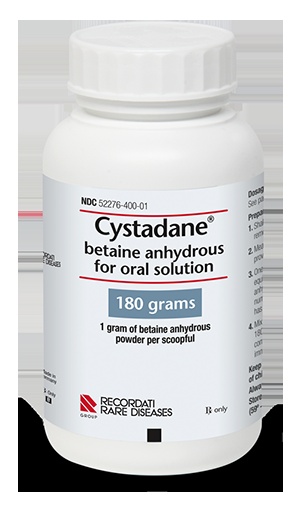
Cystadane is a white crystalline powder with free flow. It is available in child-resistant bottles. Each bottle contains 180 g of powder. Each carton contains one bottle and three measuring spoons.
Marketing authorization holder
Recordati Rare Diseases
Immeuble “Le Wilson”
70, Avenue du General de Gaulle
F-92 800 Puteaux
France
Manufacturer
Recordati Rare Diseases
Immeuble “Le Wilson”
70, Avenue du General de Gaulle
F-92 800 Puteaux
France
or
Recordati Rare Diseases
Eco River Parc
30, rue des Peupliers
F-92000 Nanterre
France
You can obtain further information on this medication by contacting the local representative of the marketing authorization holder.
|
| ||||
|
| ||||
|
| ||||
|
| ||||
|
| ||||
|
| ||||
|
| ||||
|
| ||||
|
| ||||
|
| ||||
|
| ||||
|
| ||||
|
| ||||
|
| ||||
|
|
Date of last revision of this leaflet
Detailed information on this medication is available on the European Medicines Agency website http://www.emea.europa.eu/. There are also links to other websites on rare diseases and orphan medicines.
- Country of registration
- Dosage formORAL SOLUTION/SUSPENSION, 1 g
- ATC codeA16AA06
- Active substance
- Prescription requiredYes
- Manufacturer
- This information is for reference only and does not constitute medical advice. Always consult a doctor before taking any medication. Oladoctor is not responsible for medical decisions based on this content.
- Alternatives to CYSTADANE 1 g ORAL POWDERDosage form: TABLET, 200 mgActive substance: carglumic acidManufacturer: Laboratorios Tillomed Spain S.L.UPrescription requiredDosage form: TABLET, 200 mgActive substance: carglumic acidManufacturer: Waymade B.V.Prescription required

Online doctors for CYSTADANE 1 g ORAL POWDER
Discuss questions about CYSTADANE 1 g ORAL POWDER, including use, safety considerations and prescription review, subject to medical assessment and local regulations.









Frequently Asked Questions
