



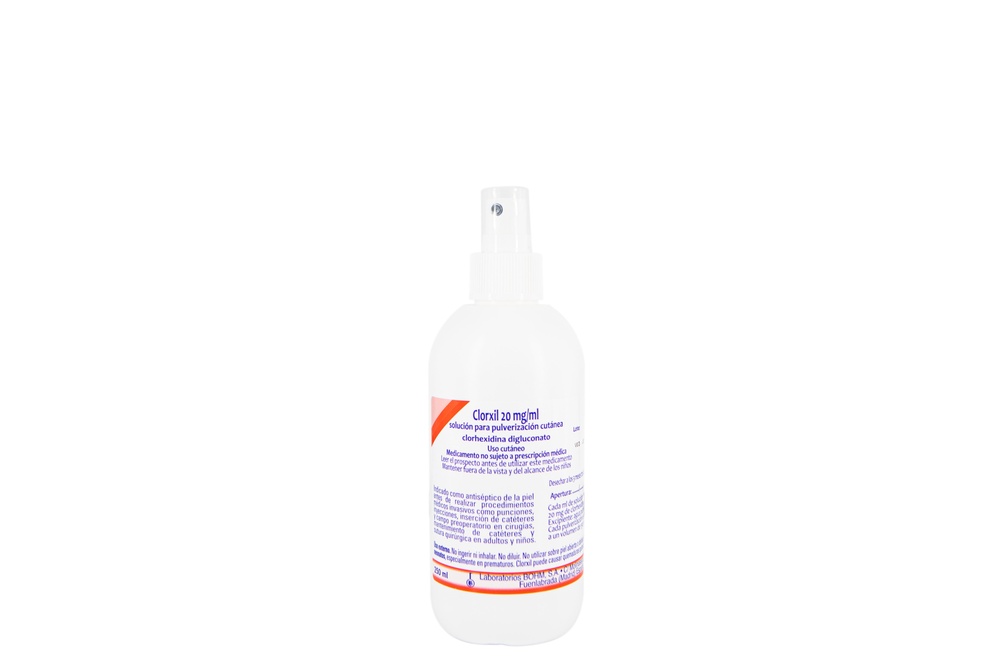
CLORXIL 20 mg /Ml Topical Solution

Prescription review online
A doctor will review your case and decide whether a prescription is medically appropriate.

Talk to a doctor about this medicine
Discuss your symptoms and possible next steps in a quick online consultation.



How to use CLORXIL 20 mg/ml CUTANEOUS SPRAY SOLUTION
Contents of the leaflet
- Introduction
- What Clorxil is and what it is used for
- What you need to know before starting to use Clorxil
- How to use Clorxil
- Possible side effects
- Conservation of Clorxil
- Contents of the package and additional information
Introduction
Leaflet: information for the user
Clorxil 20 mg/ml solution for cutaneous spraying
chlorhexidine digluconate
Read the entire leaflet carefully before starting to use this medicine, as it contains important information for you.
- Keep this leaflet, as you may need to read it again.
- If you need advice or more information, consult your pharmacist.
- If you experience side effects, consult your doctor or nurse, even if they are side effects not listed in this leaflet. See section 4.
- You should consult a doctor if it worsens or does not improve
Contents of the leaflet
- What Clorxil is and what it is used for
- What you need to know before starting to use Clorxil
- How to use Clorxil
- Possible side effects
5 Conservation of Clorxil
- Contents of the package and additional information
1. What Clorxil is and what it is used for
Clorxil contains chlorhexidine digluconate, used as a skin antiseptic.
It is indicated as a skin antiseptic before performing invasive medical procedures, such as punctures, injections, catheter insertion, and preoperative field in surgeries, catheter maintenance, and surgical suturing in adults and children.

Not sure if this medicine is right for you?
Discuss your symptoms and treatment with a doctor online.
2. What you need to know before starting to use Clorxil
Do not use Clorxil
- If you are allergic (hypersensitive) to chlorhexidine digluconate or to any of the other components of this medicine (listed in section 6).
Warnings and precautions
Consult your doctor or pharmacist before starting to use Clorxil
This medicine is for external use only. Do not ingest or inhale.
Do not use excessive amounts and avoid accumulating the solution in skin folds, under the patient, or soaking bedding or other materials in direct contact with the patient. Do not let the solution stagnate.
This medicine may, in rare cases, cause severe allergic reactions leading to a decrease in blood pressure and even loss of consciousness. The first symptoms of a severe allergic reaction may be skin rash or asthma. If you notice these symptoms, stop using this medicine and contact your doctor as soon as possible (see section 4: "Possible side effects").
Avoid prolonged contact with the skin.
This medicine should not be applied:
- Near sensitive areas (mucous membranes), as it may cause irritation, pain, redness, and chemical burns. In case of accidental contact with the mucous membranes of the body's entry points, the affected area should be washed immediately with plenty of water.
- Clorxil should not come into contact with the eyes due to the risk of visual damage. If it comes into contact with the eyes, wash immediately and abundantly with water. In case of irritation, redness, or pain in the eyes, or visual disturbances, consult a doctor immediately.
Severe cases of persistent corneal injury (injury to the surface of the eye) that could require a corneal transplant have been reported when similar products have accidentally come into contact with the eyes during surgical interventions in patients under general anesthesia (deep sleep induced without pain).
- On open wounds.
- On the inner part of the ear (middle ear).
- In direct contact with neural tissue (e.g., brain and spinal cord).
- Clothing that has come into contact with Clorxil should not be washed with bleach or other hypochlorites, as it would produce a brownish discoloration on the tissues, but with domestic detergents based on sodium perborate.
This medicine should only be applied gently to the skin. If the solution is applied too vigorously to fragile or sensitive skin, or after repeated use, a local skin reaction may occur with erythema, inflammation, itching, dry skin, and/or peeling and localized pain in the administration area. At the first sign of any of these reactions, administration of this medicine should be stopped.
Children
Use with caution in neonates, especially in premature babies. Clorxil can cause chemical burns to the skin.
This medicine should only be used under medical prescription in children under 30 months.
Other medicines and Clorxil
Inform your doctor or pharmacist if you are using, have recently used, or may need to use any other medicine.
Inform your doctor or nurse if you have recently been administered a vaccine or an injection for a skin test (epicutaneous tests to detect allergies).
The simultaneous or successive use of other antiseptics should be avoided to minimize the risk of possible interference between them.
The product is incompatible with anionic derivatives (soaps), so the skin should be rinsed well after cleaning.
Pregnancy, breastfeeding, and fertility
If you are pregnant or breastfeeding, think you may be pregnant, or plan to become pregnant, consult your doctor before using this medicine.
It is unknown whether chlorhexidine digluconate is excreted in breast milk. Since many medicines are excreted in breast milk, caution should be exercised when administering Clorxil to breastfeeding women.
Driving and using machines
Clorxil does not affect the ability to drive or operate machines.
3. How to use Clorxil
Apply the product gently to the area of skin that needs to be prepared. Spray as many times as necessary depending on the medical procedure. Each spray is equivalent to a volume of 130 microliters. Do not dilute.
The product should be applied directly to the area to be treated and allowed to dry before any procedure.
In case of doubt, ask your doctor or nurse.
If you use more Clorxil than you should
In case of overdose or accidental ingestion, consult your doctor or pharmacist immediately or call the Toxicology Information Service, phone: 91 562 0420, indicating the medicine and the amount ingested.

Started taking the medicine and have questions?
Discuss your symptoms and treatment with a doctor online.
4. Possible side effects
Like all medicines, this medicine can cause side effects, although not everyone gets them.
The very rare side effects (less than 1 in 10,000 people) observed in the skin and subcutaneous tissue are:
Skin irritation, including: erythema, rash, urticaria, pruritus, and blisters or vesicles in the administration area. Other local symptoms may be: burning sensation on the skin, pain, and inflammation.
Other side effects with an unknown frequency (cannot be estimated from the available data) are:
-Allergic reactions including anaphylactic shock.
-Corneal injury (injury to the surface of the eye) and permanent eye injury, including permanent vision loss (after accidental eye exposure during surgical interventions in the head, face, and neck) in patients under general anesthesia (deep sleep induced without pain).
-Pain, hyperemia, and chemical burns in cases of accidental contact.
-Dermatitis, eczema, urticaria, skin irritation, blisters.
-Chemical burns in neonates.
Stop using Clorxil and seek medical attention immediately if you experience any of the following reactions: swelling of the face, lips, tongue, or throat; red and itchy skin rash; wheezing or difficulty breathing; feeling of fainting and dizziness; strange metallic taste in the mouth; collapse. You may be having an allergic reaction.
Reporting side effects
If you experience any type of side effect, consult your doctor or pharmacist, even if it is a possible side effect not listed in this leaflet. You can also report them directly through the Spanish Medicines and Health Products Agency (AEMPS) http://www.notificaram.es. By reporting side effects, you can contribute to providing more information on the safety of this medicine.
5. Conservation of Clorxil
Keep this medicine out of the sight and reach of children.
Do not use this medicine after the expiration date shown on the label after Cad. The expiration date is the last day of the month indicated.
No special storage conditions are required
Medicines should not be thrown down the drain or into the trash. Ask your pharmacist how to dispose of the packaging and medicines you no longer need. This will help protect the environment.
6. Contents of the package and additional information
Composition of Clorxil
Per ml of solution:
The active ingredient is: chlorhexidine digluconate 20 mg.
The excipient is purified water.
Each ml of solution contains: 20 mg of chlorhexidine digluconate.
Appearance of the product and contents of the package
Transparent and colorless solution presented in white HDPE plastic bottles
with a white PP/PE spray valve. It is presented in:
- Clinical package of 50 bottles of 60 ml
- Clinical package of 50 bottles of 100 ml
- Clinical package of 50 bottles of 250 ml
- Package of 1 bottle of 100 ml
Marketing authorization holder and manufacturer
LABORATORIOS BOHM, S.A.
C/ Molinaseca 23-25. Polígono Industrial Cobo Calleja.
28947 Fuenlabrada (Madrid)
Phone: 91 642 18 18
Fax: 91 642 0572
Email: [email protected]
Date of the last revision of thisleaflet:
April 2023
Detailed information about this medicine is available on the website of the Spanish Agency for Medicines and Health Products (AEMPS) http://www.aemps.gob.es/)
- Country of registration
- Dosage formTOPICAL SOLUTION, 20 mg/ml
- ATC codeD08AC02
- Active substance
- Prescription requiredNo
- Manufacturer
- This information is for reference only and does not constitute medical advice. Always consult a doctor before taking any medication. Oladoctor is not responsible for medical decisions based on this content.
- Alternatives to CLORXIL 20 mg/ml CUTANEOUS SPRAY SOLUTIONDosage form: TOPICAL SOLUTION, 20 mg/mlActive substance: chlorhexidineManufacturer: Vesismin S.L.U.Prescription not requiredDosage form: EMULSION, 20 mg/mlActive substance: chlorhexidineManufacturer: Vesismin S.L.U.Prescription not requiredDosage form: TOPICAL SOLUTION, 20 MG/MLActive substance: chlorhexidineManufacturer: Lainco S.A.Prescription not required
Online doctors for CLORXIL 20 mg/ml CUTANEOUS SPRAY SOLUTION
Discuss questions about CLORXIL 20 mg/ml CUTANEOUS SPRAY SOLUTION, including use, safety considerations and prescription review, subject to medical assessment and local regulations.









Get CLORXIL 20 mg/ml CUTANEOUS SPRAY SOLUTION Prescription Online
Fill in a 2-min form
Tell us your symptoms, history, and what medicine you're requesting.
Pick a doctor or let us assign
Choose a specialist or we'll match you with the next available doctor.
Doctor reviews your case
Usually within 30 minutes. They may ask follow-up questions via chat.
Collect from any pharmacy
Electronic prescription sent to your email — valid across Spain.
Frequently Asked Questions
CLORXIL 20 mg/ml CUTANEOUS SPRAY SOLUTION does not require a prescription in Spain. You can check with a doctor online whether this medicine may be appropriate for your situation.
The active ingredient in CLORXIL 20 mg/ml CUTANEOUS SPRAY SOLUTION is chlorhexidine. This information helps identify medicines with the same composition but different brand names.
CLORXIL 20 mg/ml CUTANEOUS SPRAY SOLUTION is manufactured by Laboratorios Bohm S.A.. Pharmacy brands and packaging may differ depending on the distributor.
Doctors such as Family doctors, Psychiatrists, Dermatologists, Cardiologists, Endocrinologists, Gastroenterologists, Pulmonologists, Nephrologists, Rheumatologists, Hematologists, Infectious disease physicians, Allergists, Geriatricians, Paediatricians, Oncologists may assess whether CLORXIL 20 mg/ml CUTANEOUS SPRAY SOLUTION is appropriate, depending on your situation and local regulations. You can book an online consultation to discuss your symptoms and possible next steps.
Spain has a well-developed healthcare infrastructure across major cities such as Madrid, Barcelona, Valencia, and Seville. Pharmacies are widely available and operate under strict regulations, ensuring access to prescribed medications.
You can buy CLORXIL 20 mg/ml CUTANEOUS SPRAY SOLUTION in Madrid, Barcelona, Seville, or Valencia at any local pharmacy with a valid prescription.
To obtain a prescription, you can use Oladoctor:
Other medicines with the same active substance (chlorhexidine) include AQUASEPTIC PHARMA 20 mg/ml CUTANEOUS SOLUTION, AQUASEPTIC PHARMA ORANGE 20 mg/mL CUTANEOUS SOLUTION, CHLORHEXLAN 20 mg/ml CUTANEOUS SPRAY SOLUTION. These may have different brand names or formulations but contain the same therapeutic ingredient. Always consult a doctor before switching or starting a new medicine.
