



CINACALCET 60 mg Film-Coated Tablets

Prescription review online
A doctor will review your case and decide whether a prescription is medically appropriate.

Talk to a doctor about this medicine
Discuss your symptoms and possible next steps in a quick online consultation.



How to use CINACALCET ZENTIVA 60 mg FILM-COATED TABLETS
Contents of the leaflet
- Introduction
- What Cinacalcet Zentiva is and what it is used for
- What you need to know before you take Cinacalcet Zentiva
- How to take Cinacalcet Zentiva
- Possible side effects
- Storing Cinacalcet Zentiva
- Contents of the pack and other information
Introduction
Package Leaflet: Information for the User
CinacalcetZentiva60 mg film-coated tablets EFG
cinacalcet
Read all of this leaflet carefully before you start taking this medicine because it contains important information for you.
- Keep this leaflet, you may need to read it again.
- If you have any further questions, ask your doctor, pharmacist, or nurse.
- This medicine has been prescribed for you only. Do not pass it on to others. It may harm them, even if their signs of illness are the same as yours.
- If you get any side effects, talk to your doctor, pharmacist, or nurse. This includes any possible side effects not listed in this leaflet. See section 4.
Contents of the pack
- What Cinacalcet Zentiva is and what it is used for
- What you need to know before you take Cinacalcet Zentiva
- How to take Cinacalcet Zentiva
- Possible side effects
- Storing Cinacalcet Zentiva
- Contents of the pack and other information
1. What Cinacalcet Zentiva is and what it is used for
Cinacalcet works by controlling the levels of parathyroid hormone (PTH), calcium, and phosphorus in your body, and is used to treat disorders of the parathyroid glands. The parathyroid glands are four small glands located in the neck, near the thyroid gland, which produce parathyroid hormone (PTH).
Cinacalcet is used in adults:
- to treat secondary hyperparathyroidism in adults with severe kidney disease who need dialysis to remove waste products from their blood.
- to reduce high levels of calcium in the blood (hypercalcemia) in adult patients with parathyroid cancer.
- to reduce high levels of calcium in the blood (hypercalcemia) in adult patients with primary hyperparathyroidism when removal of the parathyroid glands is not possible.
In primary and secondary hyperparathyroidism, the parathyroid glands produce too much PTH. The term "primary" means that the hyperparathyroidism is not caused by any other disease, and "secondary" means that the hyperparathyroidism is caused by another disease, such as kidney disease. Both primary and secondary hyperparathyroidism can cause calcium to be lost from the bones, which can lead to bone pain and fractures, blood vessel and heart problems, kidney stones, mental illness, and coma.

Not sure if this medicine is right for you?
Discuss your symptoms and treatment with a doctor online.
2. What you need to know before you take Cinacalcet Zentiva
Do not take Cinacalcet Zentiva
- if you are allergic to cinacalcet or any of the other ingredients of this medicine (listed in section 6);
- if you have low levels of calcium in your blood. Your doctor will monitor your blood calcium levels.
Warnings and precautions
Talk to your doctor, pharmacist, or nurse before you start taking Cinacalcet Zentiva.
Before you start taking cinacalcet, tell your doctor if you have or have had:
- seizures (fits or convulsions). The risk of having seizures is higher in people who have already had them;
- liver problems;
- heart failure.
Cinacalcet reduces calcium levels. In adults and children treated with cinacalcet, life-threatening and fatal events associated with low calcium levels (hypocalcemia) have been reported.
Tell your doctor if you experience any of the following symptoms that may indicate low calcium levels: muscle spasms, contractions, or cramps, or numbness or tingling in the fingers, toes, or around the mouth, or seizures, confusion, or loss of consciousness while taking cinacalcet.
Low calcium levels can affect your heart rhythm. Tell your doctor if you experience unusually strong or fast heartbeats, if you have heart rhythm problems, or if you are taking medicines that can cause heart rhythm problems while taking cinacalcet.
For more information, see section 4.
During treatment with cinacalcet, tell your doctor:
- if you start or stop smoking, as this may affect the effect of cinacalcet.
Children and adolescents
Children under 18 years should not take this medicine.
If you are being treated for secondary hyperparathyroidism, your doctor should monitor your calcium levels before starting treatment with cinacalcet and during treatment with cinacalcet. You should tell your doctor if you experience any of the symptoms related to low calcium levels described above.
It is important that you take your dose of cinacalcet as directed by your doctor.
Using Cinacalcet Zentiva with other medicines
Tell your doctor or pharmacist if you are taking, have recently taken, or might take any other medicines.
Medicines known to reduce serum calcium.
You should not receive cinacalcet with etelcalcetide, as there is a higher risk of a condition called hypocalcemia when cinacalcet is taken with medicines known to reduce calcium levels in your blood. Tell your doctor if you are taking the following medicines.
Medicines that may alter the action of cinacalcet:
- medicines used to treat skinand fungal infections(ketoconazole, itraconazole, and voriconazole);
- medicines used to treat bacterial infections(telithromycin, rifampicin, and ciprofloxacin);
- a medicine used to treat HIVand AIDS(ritonavir);
- a medicine used to treat depression(fluvoxamine).
Cinacalcet may alter the action of medicines such as:
- medicines used to treat depression(amitriptyline, desipramine, nortriptyline, and clomipramine);
- a medicine used to relieve cough(dextromethorphan);
- medicines used to treat heart rhythm disorders(flecainide and propafenone);
- a medicine used to treat high blood pressure(metoprolol).
Taking Cinacalcet Zentiva with food and drink
Cinacalcet should be taken with food or shortly after eating.
Pregnancy, breastfeeding, and fertility
If you are pregnant or breastfeeding, think you may be pregnant, or are planning to have a baby, ask your doctor or pharmacist for advice before taking this medicine.
Cinacalcet has not been studied in pregnant women. If you become pregnant, your doctor may decide to change your treatment, as cinacalcet may harm the unborn baby.
It is not known if cinacalcet passes into breast milk. Your doctor will advise you whether to stop breastfeeding or stop taking cinacalcet.
Driving and using machines
In patients taking cinacalcet, cases of dizziness and seizures have been reported. If you experience these effects, do not drive or use machines.
Cinacalcet Zentiva contains lactose and sodium
If your doctor has told you that you have an intolerance to some sugars, consult your doctor before taking this medicine.
This medicine contains less than 23 mg of sodium (1mmol) per tablet; this is essentially "sodium-free".
3. How to take Cinacalcet Zentiva
Take this medicine exactly as your doctor or pharmacist has told you. If you are not sure, ask your doctor or pharmacist again. Your doctor will tell you how much cinacalcet to take.
Cinacalcet should be taken orally, with food or shortly after eating. The tablets should be swallowed whole and not chewed, crushed, or divided.
Your doctor will regularly perform blood tests during treatment to monitor your progress and, if necessary, adjust the dose you receive.
If you are being treated for secondary hyperparathyroidism
The usual starting dose of cinacalcet in adults is 30 mg (one tablet) once a day.
If you are being treated for parathyroid cancer or primary hyperparathyroidism
The usual starting dose of cinacalcet in adults is 30 mg (one tablet) twice a day.
If you take more Cinacalcet Zentiva than you should
If you have taken more cinacalcet than you should, contact your doctor immediately. Possible signs of overdose include numbness or tingling around the mouth, muscle pain or cramps, and seizures.
In case of overdose or accidental ingestion, contact your doctor or pharmacist immediately or call the Toxicology Information Service, telephone 91 562 04 20, indicating the medicine and the amount taken.
If you forget to take Cinacalcet Zentiva
Do not take a double dose to make up for forgotten doses.
If you have forgotten to take a dose of cinacalcet, take the next dose at the usual time.
If you have any further questions on the use of this medicine, ask your doctor, pharmacist, or nurse.

Started taking the medicine and have questions?
Discuss your symptoms and treatment with a doctor online.
4. Possible side effects
Like all medicines, this medicine can cause side effects, although not everybody gets them.
Tell your doctor immediately:
- If you notice numbness or tingling around the mouth, muscle pain or cramps, and seizures. These may be symptoms of low calcium levels (hypocalcemia).
- If you notice swelling of the face, lips, mouth, tongue, or throat that may cause difficulty swallowing or breathing (angioedema).
Very common: may affect more than 1 in 10 people
- nausea and vomiting. These side effects are usually mild and temporary.
Common: may affect up to 1 in 10 people
- dizziness
- numbness or tingling (paresthesia)
- loss (anorexia) or decreased appetite
- muscle pain (myalgia)
- weakness (asthenia)
- rash
- decreased testosterone levels
- high potassium levels in the blood (hyperkalemia)
- allergic reactions (hypersensitivity)
- headache
- seizures (fits or convulsions)
- low blood pressure (hypotension)
- upper respiratory tract infections
- difficulty breathing (dyspnea)
- cough
- stomach upset (dyspepsia)
- diarrhea
- abdominal pain, upper abdominal pain
- constipation
- muscle spasms
- back pain
- low calcium levels in the blood (hypocalcemia).
Not known: frequency cannot be estimated from the available data
- Hives (urticaria)
- Swelling of the face, lips, mouth, tongue, or throat that may cause difficulty swallowing or breathing (angioedema)
- Unusually fast or strong heartbeat that may be associated with low calcium levels in your blood (QT prolongation and ventricular arrhythmia secondary to hypocalcemia).
In a small number of patients with heart failure, their disease and/or low blood pressure (hypotension) worsened after taking cinacalcet.
Reporting of side effects
If you experience any side effects, talk to your doctor, pharmacist, or nurse. This includes any possible side effects not listed in this leaflet. You can also report side effects directly via the Spanish Medicines Agency's website https://www.notificaRAM.es
By reporting side effects, you can help provide more information on the safety of this medicine.
5. Storing Cinacalcet Zentiva
Keep this medicine out of the sight and reach of children.
Do not use this medicine after the expiry date which is stated on the outer packaging and blister after "EXP". The expiry date is the last day of the month shown.
This medicine does not require any special storage conditions.
Medicines should not be disposed of via wastewater or household waste. Ask your pharmacist how to dispose of medicines no longer required. These measures will help protect the environment.
6. Contents of the pack and other information
Composition of Cinacalcet
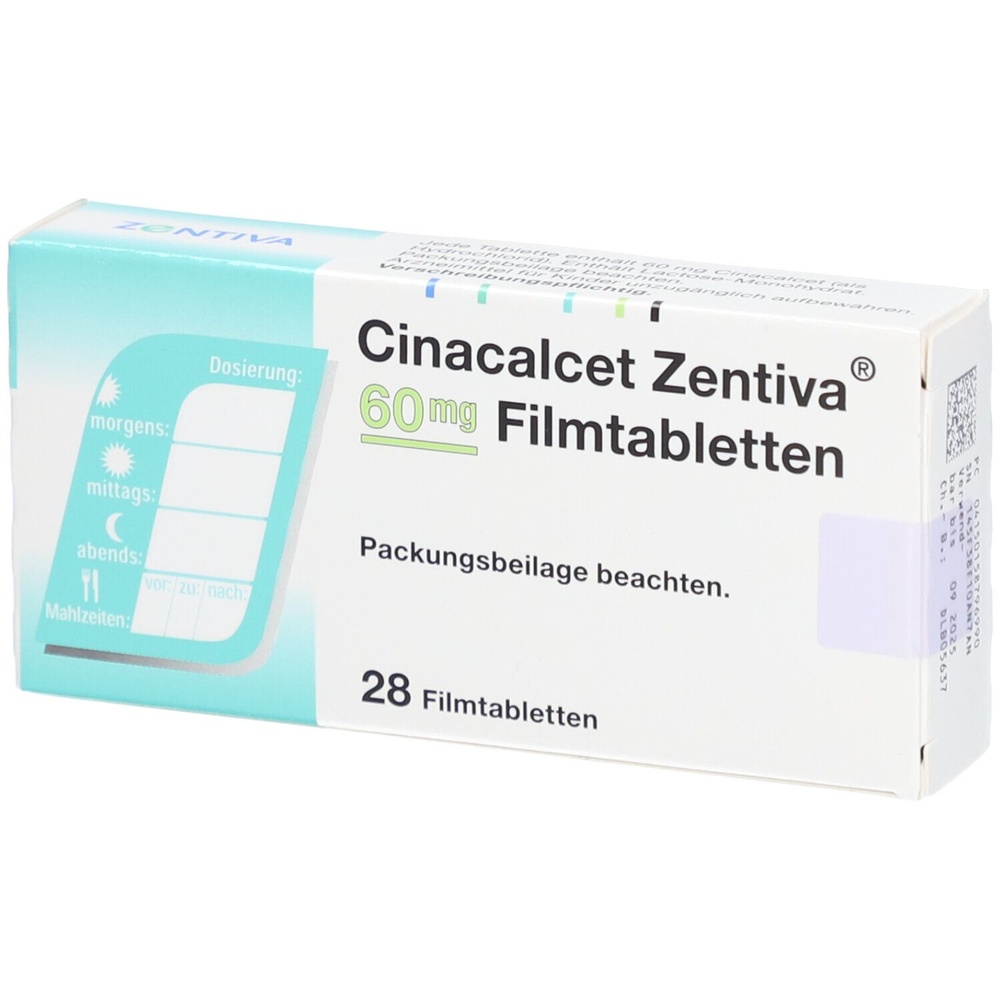
The active substance is cinacalcet. Each film-coated tablet contains 60 mg of cinacalcet.
The other ingredients are:
Core of the tablet: pregelatinized corn starch, crospovidone, microcrystalline cellulose, anhydrous colloidal silica, sodium stearyl fumarate.
Coating:hypromellose, lactose monohydrate, titanium dioxide (E171), triacetin, macrogol.
Appearance and packaging
Cinacalcet is a white to off-white film-coated tablet. They are oval in shape and marked "60" on one side and measure approximately 12.5 mm in length and 7.9 mm in width.
Cinacalcet is available in blister packs of 60 mg film-coated tablets. Each carton contains 28, 30, or 84 tablets.
Not all pack sizes may be marketed.
Marketing authorization holder and manufacturer
Zentiva k.s.,
U kabelovny 130,
Dolní Mecholupy,
102 37 Prague 10
Czech Republic
For further information on this medicine, please contact the local representative of the marketing authorization holder:
Zentiva Spain S.L.U.
Avenida de Europa, 19, Edificio 3, Planta 1.
28224 Pozuelo de Alarcón, Madrid
Spain
This medicine is authorized in the Member States of the European Economic Area under the following names:
Netherlands Cinacalcet Aristo 60 mg, film-coated tablets
Austria Cinacalcet Aristo 60 mg film-coated tablets
Czech Republic Cinacalcet Aristo
Germany Cinacalcet Aristo 60 mg film-coated tablets
Denmark Cinacalcet Aristo
Spain Cinacalcet Zentiva 60 mg film-coated tablets EFG
Finland Cinacalcet Aristo 60 mg film-coated tablets
Italy Cinacalcet Aristo
Norway Cinacalcet Aristo
Poland Cinacalcet Aristo
Portugal Cinacalcet Aristo
Romania Cinacalcet Aristo 60 mg film-coated tablets
Sweden Cinacalcet Aristo 60 mg film-coated tablets
Slovakia Cinacalcet Aristo 60 mg film-coated tablets
United Kingdom Cinacalcet Aristo 60 mg film-coated tablets
Date of last revision of this leaflet:March 2020
Detailed and up-to-date information on this medicine is available on the website of the Spanish Agency for Medicines and Health Products (AEMPS) http://www.aemps.gob.es/
- Country of registration
- Dosage formTABLET, 60 mg
- ATC codeH05BX01
- Active substance
- Prescription requiredYes
- Manufacturer
- CompositionFUMARATO DE ESTEARILO Y SODIO (1.80 mg mg)
- This information is for reference only and does not constitute medical advice. Always consult a doctor before taking any medication. Oladoctor is not responsible for medical decisions based on this content.
- Alternatives to CINACALCET ZENTIVA 60 mg FILM-COATED TABLETSDosage form: TABLET, 30 mgActive substance: cinacalcetManufacturer: Accord Healthcare S.L.U.Prescription requiredDosage form: TABLET, 60 mgActive substance: cinacalcetManufacturer: Accord Healthcare S.L.U.Prescription requiredDosage form: TABLET, 90 mgActive substance: cinacalcetManufacturer: Accord Healthcare S.L.U.Prescription required
Online doctors for CINACALCET ZENTIVA 60 mg FILM-COATED TABLETS
Discuss questions about CINACALCET ZENTIVA 60 mg FILM-COATED TABLETS, including use, safety considerations and prescription review, subject to medical assessment and local regulations.

Get CINACALCET ZENTIVA 60 mg FILM-COATED TABLETS Prescription Online
Fill in a 2-min form
Tell us your symptoms, history, and what medicine you're requesting.
Pick a doctor or let us assign
Choose a specialist or we'll match you with the next available doctor.
Doctor reviews your case
Usually within 30 minutes. They may ask follow-up questions via chat.
Collect from any pharmacy
Electronic prescription sent to your email — valid across Spain.
Frequently Asked Questions
CINACALCET ZENTIVA 60 mg FILM-COATED TABLETS requires a prescription in Spain. You can check with a doctor online whether this medicine may be appropriate for your situation.
The active ingredient in CINACALCET ZENTIVA 60 mg FILM-COATED TABLETS is cinacalcet. This information helps identify medicines with the same composition but different brand names.
CINACALCET ZENTIVA 60 mg FILM-COATED TABLETS is manufactured by Zentiva K.S.. Pharmacy brands and packaging may differ depending on the distributor.
Doctors such as Family doctors, Psychiatrists, Dermatologists, Cardiologists, Endocrinologists, Gastroenterologists, Pulmonologists, Nephrologists, Rheumatologists, Hematologists, Infectious disease physicians, Allergists, Geriatricians, Paediatricians, Oncologists may assess whether CINACALCET ZENTIVA 60 mg FILM-COATED TABLETS is appropriate, depending on your situation and local regulations. You can book an online consultation to discuss your symptoms and possible next steps.
Spain has a well-developed healthcare infrastructure across major cities such as Madrid, Barcelona, Valencia, and Seville. Pharmacies are widely available and operate under strict regulations, ensuring access to prescribed medications.
You can buy CINACALCET ZENTIVA 60 mg FILM-COATED TABLETS in Madrid, Barcelona, Seville, or Valencia at any local pharmacy with a valid prescription.
To obtain a prescription, you can use Oladoctor:
Other medicines with the same active substance (cinacalcet) include CINACALCET ACCORDPHARMA 30 mg FILM-COATED TABLETS, CINACALCET ACCORDPHARMA 60 mg FILM-COATED TABLETS, CINACALCET ACCORDPHARMA 90 mg FILM-COATED TABLETS. These may have different brand names or formulations but contain the same therapeutic ingredient. Always consult a doctor before switching or starting a new medicine.
