



CINACALCET 30 mg Film-Coated Tablets

Prescription review online
A doctor will review your case and decide whether a prescription is medically appropriate.

Talk to a doctor about this medicine
Discuss your symptoms and possible next steps in a quick online consultation.



How to use CINACALCET SANDOZ 30 mg FILM-COATED TABLETS
Contents of the leaflet
- Introduction
- What is Cinacalcet Sandoz and what is it used for
- What you need to know before taking Cinacalcet Sandoz
- How to take Cinacalcet Sandoz
- Possible side effects
- Conservation of Cinacalcet Sandoz
- Contents of the pack and additional information
Introduction
Leaflet:information for the patient
Cinacalcet Sandoz 30 mg film-coated tablets EFG
Cinacalcet Sandoz 60 mg film-coated tablets EFG
Cinacalcet Sandoz 90 mg film-coated tablets EFG
Read the entire leaflet carefully before starting to take this medication,as it contains important information for you.
- Keep this leaflet, as you may need to read it again.
- If you have any questions, consult your doctor or pharmacist.
- This medication has been prescribed to you only, and you should not give it to others, even if they have the same symptoms as you, as it may harm them.
- If you experience side effects, consult your doctor or pharmacist, even if they are not listed in this leaflet. See section 4.
Contents of the leaflet
- What is Cinacalcet Sandoz and what is it used for
- What you need to know before taking Cinacalcet Sandoz
- How to take Cinacalcet Sandoz
- Possible side effects
5 Conservation of Cinacalcet Sandoz
- Contents of the pack and additional information
1. What is Cinacalcet Sandoz and what is it used for
Cinacalcet Sandoz works by controlling the levels of parathyroid hormone (PTH), calcium, and phosphorus in your body. It is used to treat disorders of the parathyroid glands. The parathyroid glands are four small glands located in the neck, near the thyroid gland, which produce parathyroid hormone (PTH).
Cinacalcet Sandoz is used in adults:
- to treat secondary hyperparathyroidism in adults with severe kidney disease who require dialysis to remove waste products from their blood.
- to reduce high levels of calcium in the blood (hypercalcemia) in adult patients with parathyroid cancer.
- to reduce high levels of calcium in the blood (hypercalcemia) in adult patients with primary hyperparathyroidism when removal of the parathyroid glands is not possible.
Cinacalcet Sandoz is used in children between 3 years and less than 18 years:
- to treat secondary hyperparathyroidism in patients with severe kidney disease who require dialysis to remove waste products from their blood, and whose disease is not controlled with other treatments.
In primary and secondary hyperparathyroidism, the parathyroid glands produce too much PTH. The term "primary" means that the hyperparathyroidism is not caused by any other disease, and "secondary" means that the hyperparathyroidism is caused by another disease, such as kidney disease. Both primary and secondary hyperparathyroidism can cause calcium loss from the bones, which can lead to bone pain and fractures, problems in the blood vessels and heart, kidney stones, mental illness, and coma.

Not sure if this medicine is right for you?
Discuss your symptoms and treatment with a doctor online.
2. What you need to know before taking Cinacalcet Sandoz
Do not take Cinacalcet Sandozif you are allergic to cinacalcet or any of the other ingredients of this medication (listed in section 6).
Do not take Cinacalcet Sandozif you have low levels of calcium in your blood. Your doctor will monitor your blood calcium levels.
Warnings and precautions
Consult your doctor, pharmacist, or nurse before starting to take Cinacalcet Sandoz.
Before starting to take cinacalcet, inform your doctor if you have or have ever had:
- seizures(attacks or crises). The risk of having seizures is higher in people who have had them before;
- liver problems;
- heart failure.
Cinacalcet reduces calcium levels. In adults and children treated with cinacalcet, life-threatening and fatal events associated with low calcium levels (hypocalcemia) have been reported.
Inform your doctor if you experience any of the following symptoms that may indicate low calcium levels: muscle spasms, contractions, or cramps, or numbness or tingling in the fingers, toes, or around the mouth, or seizures, confusion, or loss of consciousness while taking cinacalcet.
Low calcium levels can affect your heart rhythm. Inform your doctor if you experience unusually strong or fast heartbeats, if you have problems with your heart rhythm, or if you take medications that cause problems with your heart rhythm, while taking cinacalcet.
For additional information, see section 4.
During treatment with cinacalcet, inform your doctor:
- if you start or stop smoking, as it may affect the effect of cinacalcet.
Children and adolescents
Children under 18 years with parathyroid cancer or primary hyperparathyroidism should not take cinacalcet.
If you are being treated for secondary hyperparathyroidism, your doctor should monitor your calcium levels before starting treatment with cinacalcet and during treatment with cinacalcet. You should inform your doctor if you experience any of the symptoms related to low calcium levels described above.
It is essential that you take your dose of cinacalcet as directed by your doctor.
Other medications and Cinacalcet Sandoz
Inform your doctor or pharmacist if you are taking, have recently taken, or may need to take any other medication, particularly etelcalcetide or any other medication that reduces calcium levels in the blood.
You should not receive cinacalcet with etelcalcetide.
Inform your doctor if you are taking the following medications.
Medications such as the following may alter the effect of cinacalcet:
- medications used to treat skinand fungal infections(ketoconazole, itraconazole, and voriconazole);
- medications used to treat bacterial infections(telithromycin, rifampicin, and ciprofloxacin);
- a medication used to treat HIVand AIDS(ritonavir);
- a medication used to treat depression(fluvoxamine).
Cinacalcet may alter the effect of medications such as:
- medications used to treat depression (amitriptyline, desipramine, nortriptyline, and clomipramine);
- a medication used to relieve cough(dextromethorphan);
- medications used to treat heart rhythm disorders(flecainide and propafenone);
- a medication used to treat high blood pressure(metoprolol).
Taking Cinacalcet Sandoz with food and drinks
Cinacalcet should be taken with food or shortly after eating.
Pregnancy, breastfeeding, and fertility
If you are pregnant or breastfeeding, think you may be pregnant, or plan to become pregnant, consult your doctor or pharmacist before using this medication.
Cinacalcet has not been studied in pregnant women. In case of pregnancy, your doctor may decide to change your treatment, as cinacalcet may harm the unborn baby.
It is not known if cinacalcet passes into breast milk. Your doctor will advise you whether to interrupt breastfeeding or treatment with cinacalcet.
Driving and using machines
In patients taking cinacalcet, cases of dizziness and seizures have been reported. If you experience these effects, do not drive or use machines.
Cinacalcet Sandoz contains lactose
This medication contains lactose. If your doctor has told you that you have an intolerance to certain sugars, consult with them before taking this medication.
3. How to take Cinacalcet Sandoz
Follow the instructions for administration of this medication indicated by your doctor or pharmacist. If in doubt, consult your doctor or pharmacist again. Your doctor will tell you how much cinacalcet to take.
Cinacalcet should be taken orally, with food or shortly after eating. The tablets should be swallowed whole to ensure that you receive the correct dose and should not be chewed, crushed, or broken.
Cinacalcet is also available as a granule in capsules for opening. Children who require doses below 30 mg or who cannot swallow tablets should receive cinacalcet granules.
Your doctor will perform regular blood tests during treatment to monitor your progress and, if necessary, adjust the dose you receive.
If the treatment is for secondary hyperparathyroidism
The usual initial dose of cinacalcet in adults is 30 mg (one tablet) once a day.
The usual initial dose of cinacalcet in children between 3 years and less than 18 years should not exceed 0.20 mg/kg body weight per day.
If the treatment is for parathyroid cancer or primary hyperparathyroidism
The usual initial dose of cinacalcet in adults is 30 mg (one tablet) twice a day.
If you take moreCinacalcet Sandozthan you should
If you have taken more cinacalcet than you should, consult your doctor immediately. Possible signs of overdose include numbness or tingling around the mouth, muscle pain or cramps, and seizures.
In case of overdose or accidental ingestion, consult your doctor or pharmacist immediately or call the Toxicology Information Service, phone 91 562 04 20, indicating the medication and the amount ingested.
If you forget to takeCinacalcet Sandoz
Do not take a double dose to make up for forgotten doses.
If you have forgotten to take a dose of cinacalcet, you should take the next dose at the usual time.
If you have any other questions about the use of this medication, ask your doctor, pharmacist, or nurse.

Started taking the medicine and have questions?
Discuss your symptoms and treatment with a doctor online.
4. Possible side effects
Like all medications, this medication can cause side effects, although not everyone gets them.
Tell your doctor immediately:
- If you start to feel numbness or tingling around the mouth, muscle pain or cramps, and seizures. These may be signs that your calcium levels are too low (hypocalcemia).
- If you experience swelling in the face, lips, mouth, tongue, or throat that can cause difficulty swallowing or breathing (angioedema).
Very common: may affect more than 1 in 10 people
- nausea and vomiting. These side effects are usually mild and temporary.
Common: may affect up to 1 in 10 people
- dizziness
- feeling of numbness or tingling (paresthesia)
- loss (anorexia) or decreased appetite
- muscle pain (myalgia)
- weakness (asthenia)
- rash
- decreased testosterone levels
- high potassium levels in the blood (hyperkalemia)
- allergic reactions (hypersensitivity)
- headache
- seizures (crises or attacks)
- low blood pressure (hypotension)
- upper respiratory tract infections
- difficulty breathing (dyspnea)
- cough
- stomach upset (dyspepsia)
- diarrhea
- abdominal pain, upper abdominal pain
- constipation
- muscle spasms
- back pain
- low calcium levels in the blood (hypocalcemia).
Not known: frequency cannot be estimated from the available data
- hives (urticaria)
- swelling of the face, lips, mouth, tongue, or throat that can cause difficulty swallowing or breathing (angioedema)
- unusually fast or strong heartbeat that may be associated with low calcium levels in your blood (prolongation of the QT interval and secondary ventricular arrhythmia due to hypocalcemia).
In a small number of patients with heart failure, their disease and/or low blood pressure (hypotension) worsened after taking cinacalcet.
Reporting of side effects
If you experience any side effects, consult your doctor or pharmacist, even if they are not listed in this leaflet. You can also report them directly through the Spanish Pharmacovigilance System for Human Use Medicines: https://www.notificaram.es. By reporting side effects, you can help provide more information on the safety of this medication.
5. Conservation of Cinacalcet Sandoz
Keep this medication out of the sight and reach of children.
Do not use this medication after the expiration date shown on the carton and blister after CAD/EXP. The expiration date is the last day of the month indicated.
No special storage conditions are required.
Medications should not be disposed of through wastewater or household waste. Deposit the containers and medications you no longer need at the SIGRE point in the pharmacy. If in doubt, ask your pharmacist how to dispose of containers and medications you no longer need. This will help protect the environment.
6. Contents of the pack and additional information
Composition ofCinacalcet Sandoz
- The active ingredient is cinacalcet. Each film-coated tablet contains 30 mg, 60 mg, or 90 mg of cinacalcet (as hydrochloride).
- The other ingredients are:
- Lactose monohydrate
- Microcrystalline cellulose (E-460)
- Crospovidone
- Colloidal silicon dioxide
- Magnesium stearate (E-572)
- The tablets are coated with:
- Hypromellose 6cPs
- Lactose monohydrate
- Triacetin
- Titanium dioxide (E-171)
- Yellow iron oxide (E-172)
- Aluminum lake blue FD&C No. 2
Appearance of the product and contents of the pack
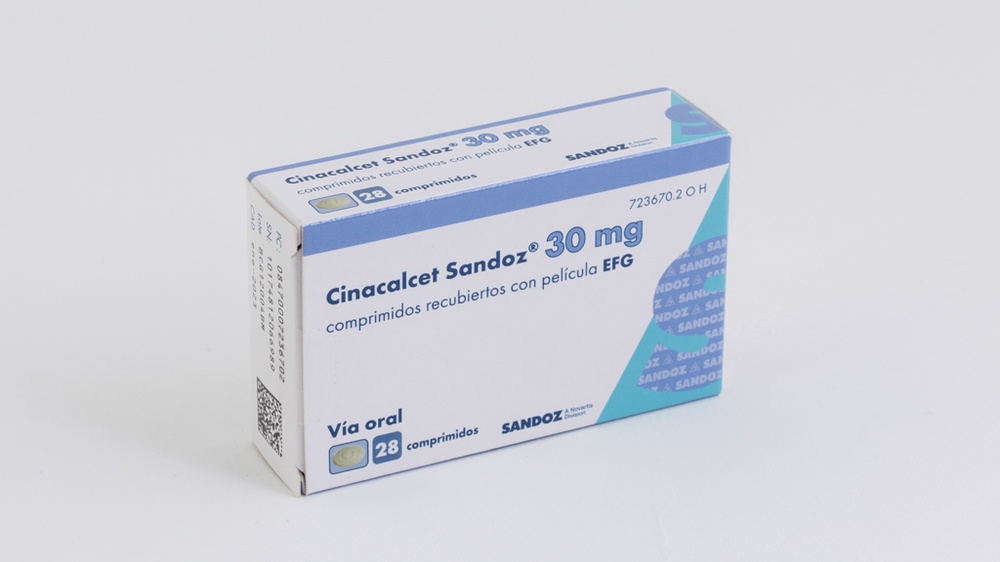
30 mg: Film-coated tablets, light green in color, oval, biconvex, engraved with 'L83' on one side and smooth on the other side (approximate size 9.8 x 6.2 mm).
60 mg: Film-coated tablets, light green in color, oval, biconvex, engraved with 'L84' on one side and smooth on the other side (approximate size 12.4 x 7.8 mm).
90 mg: Film-coated tablets, light green in color, oval, biconvex, engraved with 'L85' on one side and smooth on the other side (approximate size 14.1 x 8.9 mm).
Cinacalcet Sandoz is available in blisters.
Package size: 28, 30, and 84 film-coated tablets.
Not all package sizes may be available.
Marketing authorization holder and manufacturer
Marketing authorization holder
Sandoz Farmacéutica, S.A.
Centro Empresarial Parque Norte
Edificio Roble
C/ Serrano Galvache, 56
28033 Madrid
Spain
Manufacturer
Salutas Pharma GmbH,
Otto-von-Guericke-Allee 1,
Barleben, Sachsen-Anhalt,
39179, Germany
Synoptis Industrial Sp. z o.o.
Ul. Rabowicka 15, Swarzedz
Poland
Date of the last revision of thisleaflet:January 2020.
Detailed information about this medication is available on the website of the Spanish Agency for Medicines and Health Products (AEMPS) (http://www.aemps.gob.es/)
- Country of registration
- Dosage formTABLET, 30 mg
- ATC codeH05BX01
- Active substance
- Prescription requiredYes
- Manufacturer
- CompositionLACTOSA MONOHIDRATO (76.467 mg mg), LACTOSA MONOHIDRATO (0,24 mg mg)
- This information is for reference only and does not constitute medical advice. Always consult a doctor before taking any medication. Oladoctor is not responsible for medical decisions based on this content.
- Alternatives to CINACALCET SANDOZ 30 mg FILM-COATED TABLETSDosage form: TABLET, 30 mgActive substance: cinacalcetManufacturer: Accord Healthcare S.L.U.Prescription requiredDosage form: TABLET, 60 mgActive substance: cinacalcetManufacturer: Accord Healthcare S.L.U.Prescription requiredDosage form: TABLET, 90 mgActive substance: cinacalcetManufacturer: Accord Healthcare S.L.U.Prescription required
Online doctors for CINACALCET SANDOZ 30 mg FILM-COATED TABLETS
Discuss questions about CINACALCET SANDOZ 30 mg FILM-COATED TABLETS, including use, safety considerations and prescription review, subject to medical assessment and local regulations.

Get CINACALCET SANDOZ 30 mg FILM-COATED TABLETS Prescription Online
Fill in a 2-min form
Tell us your symptoms, history, and what medicine you're requesting.
Pick a doctor or let us assign
Choose a specialist or we'll match you with the next available doctor.
Doctor reviews your case
Usually within 30 minutes. They may ask follow-up questions via chat.
Collect from any pharmacy
Electronic prescription sent to your email — valid across Spain.
Frequently Asked Questions
CINACALCET SANDOZ 30 mg FILM-COATED TABLETS requires a prescription in Spain. You can check with a doctor online whether this medicine may be appropriate for your situation.
The active ingredient in CINACALCET SANDOZ 30 mg FILM-COATED TABLETS is cinacalcet. This information helps identify medicines with the same composition but different brand names.
CINACALCET SANDOZ 30 mg FILM-COATED TABLETS is manufactured by Sandoz Farmaceutica S.A.. Pharmacy brands and packaging may differ depending on the distributor.
Doctors such as Family doctors, Psychiatrists, Dermatologists, Cardiologists, Endocrinologists, Gastroenterologists, Pulmonologists, Nephrologists, Rheumatologists, Hematologists, Infectious disease physicians, Allergists, Geriatricians, Paediatricians, Oncologists may assess whether CINACALCET SANDOZ 30 mg FILM-COATED TABLETS is appropriate, depending on your situation and local regulations. You can book an online consultation to discuss your symptoms and possible next steps.
Spain has a well-developed healthcare infrastructure across major cities such as Madrid, Barcelona, Valencia, and Seville. Pharmacies are widely available and operate under strict regulations, ensuring access to prescribed medications.
You can buy CINACALCET SANDOZ 30 mg FILM-COATED TABLETS in Madrid, Barcelona, Seville, or Valencia at any local pharmacy with a valid prescription.
To obtain a prescription, you can use Oladoctor:
Other medicines with the same active substance (cinacalcet) include CINACALCET ACCORDPHARMA 30 mg FILM-COATED TABLETS, CINACALCET ACCORDPHARMA 60 mg FILM-COATED TABLETS, CINACALCET ACCORDPHARMA 90 mg FILM-COATED TABLETS. These may have different brand names or formulations but contain the same therapeutic ingredient. Always consult a doctor before switching or starting a new medicine.
