


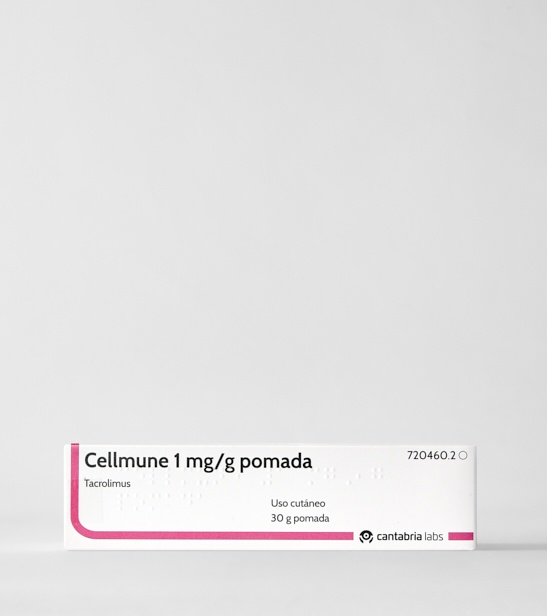
Cellmune 1 mg/g pomada

Prescription review online
A doctor will review your case and decide whether a prescription is medically appropriate.

Talk to a doctor about this medicine
Discuss your symptoms and possible next steps in a quick online consultation.



How to use CELLMUNE 1 mg/g OINTMENT
Contents of the leaflet
- Introduction
- PACKAGE LEAFLET
- What is Cellmune and what is it used for
- What you need to know before you use Cellmune
- Do not use Cellmune
- How to use Cellmune
- Possible side effects
- Storing Cellmune
- Contents of the pack and other information
- Composition of Cellmune
Introduction
PACKAGE LEAFLET
Cellmune 1 mg/g ointment
Tacrolimus
Read all of this leaflet carefully before you start using this medicine because it contains important information for you
- Keep this leaflet, you may need to read it again.
- If you have any further questions, ask your doctor or pharmacist.
- This medicine has been prescribed for you only. Do not pass it on to others. It may harm them, even if their signs of illness are the same as yours.
- If you get any side effects, talk to your doctor or pharmacist. This includes any possible side effects not listed in this leaflet. See section 4.
Contents of the pack
- What is Cellmune and what is it used for
- What you need to know before you use Cellmune
- How to use Cellmune
- Possible side effects
- Storing Cellmune
- Contents of the pack and other information

Not sure if this medicine is right for you?
Discuss your symptoms and treatment with a doctor online.
1. What is Cellmune and what is it used for
The active substance in Cellmune, tacrolimus monohydrate, is an immunomodulating agent.
Cellmune is used to treat moderate to severe atopic dermatitis (eczema) in adults who do not respond adequately to or are intolerant of conventional treatments, such as topical corticosteroids.
Once the moderate to severe atopic dermatitis has disappeared or almost disappeared after up to 6 weeks of treatment for a flare, and if you have frequent flares (i.e., 4 or more per year), you can prevent flares from coming back or prolong the time without flares by using Cellmune twice a week.
In atopic dermatitis, the skin's excessive immune reaction causes skin inflammation (itching, redness, dryness). Cellmune modifies the abnormal immune response and relieves skin inflammation and itching.
2. What you need to know before you use Cellmune

Started taking the medicine and have questions?
Discuss your symptoms and treatment with a doctor online.
Do not use Cellmune
- If you are allergic (hypersensitive) to tacrolimus or any of the other ingredients of Cellmune (listed in section 6), or to macrolide antibiotics (e.g., azithromycin, clarithromycin, erythromycin).
Warnings and precautions
Consult your doctor if:
- you have liver failure.
- you have any skin malignancy(tumors) or if you have a weakened immune system(immunocompromised), regardless of the cause.
- you have a hereditary skin barrier disease, such as Netherton syndrome, lamellar ichthyosis (widespread scaling of the skin due to thickening of the outer layer of the skin), if you have an inflammatory skin disease such as pyoderma gangrenosum or if you suffer from generalized erythroderma(inflammatory redness and scaling of the entire skin).
- you have a skin graft-versus-host disease (an immune reaction of the skin, which is a common complication in patients who have undergone a bone marrow transplant).
- you have inflamed lymph nodesat the start of treatment. If your lymph nodes become inflamed during treatment with Cellmune, consult your doctor.
- if you have infected lesions. Do not apply the ointment to infected lesions.
- if you notice any change in the appearance of your skin; please inform your doctor.
- The safety of using tacrolimus for a long period of time is unknown. A very small number of people who have used tacrolimus ointment have had malignant diseases (e.g., skin or lymphoma). However, it has not been confirmed or ruled out, according to the available evidence, whether there is a relationship with tacrolimus treatment.
- Avoid prolonged exposure of your skin to sunlight or artificial light, such as tanning beds. If you stay outdoors after applying Cellmune, use a sunscreen and wear loose clothing that protects your skin from the sun. Also, consult your doctor for other suitable methods to protect yourself from the sun. If you are prescribed light therapy, inform your doctor that you are using Cellmune, as it is not recommended to use Cellmune and light therapy at the same time.
- If your doctor tells you to use Cellmune twice a week to maintain the disappearance of your atopic dermatitis, your condition should be reviewed by your doctor at least every 12 months, even if it remains controlled. In children, maintenance treatment should be discontinued after 12 months to assess whether there is still a need for continued treatment.
- Patients should be informed not to bathe, shower, or swim immediately after applying the ointment; water may remove the medication.
Children
- Cellmune 1 mg/g ointment is not authorized for children under 16 years of age. Therefore, it should not be used in this age group. Please consult your doctor.
- The effect of treatment with Cellmune on the development of the immune system in children, especially in younger children, has not been established.
Using Cellmune with other medicines and cosmetics
Tell your doctor or pharmacist if you are taking or using or have recently taken or used any other medicines, including those obtained without a prescription.
You can use moisturizing creams and lotions during treatment with Cellmune, but you should not use them during the 2 hours before and 2 hours after applying Cellmune.
The use of Cellmune at the same time as other topical preparations or while taking oral corticosteroids (e.g., cortisone) or oral immunosuppressive medications has not been studied.
Using Cellmune with alcohol
While using Cellmune, alcohol consumption may cause redness or flushing of the skin or face and a feeling of warmth.
Pregnancy and breastfeeding
Do not use Cellmune if you are pregnant or breastfeeding.
Consult your doctor or pharmacist before using any medicine.
3. How to use Cellmune
Follow your doctor's instructions for using Cellmune exactly. If you are unsure, consult your doctor or pharmacist.
- Apply Cellmune as a thin layer to the affected areas of your skin.
- Cellmune can be used on most parts of the body, including the face and neck and in the folds of the elbows and knees.
- Avoid using the ointment inside your nose or mouth, or in your eyes. If ointment gets into any of these areas, you should remove it by gently rubbing and/or rinsing with water.
- Do not cover the treated skin with bandages or other wound dressings.
- Wash your hands after applying Cellmune, unless your hands are also being treated.
- Before applying Cellmune after a bath or shower, make sure your skin is completely dry.
- Do not bathe, shower, or swim immediately after applying the ointment. Water may remove the medication.
Adults (16 years of age and older)
For adult patients (16 years of age and older), two doses of tacrolimus ointment are available (tacrolimus 0.3 mg/g ointment and tacrolimus 1 mg/g ointment). Your doctor will decide which dose is most suitable for you.
Typically, treatment is started with Cellmune 1 mg/g ointment twice a day, once in the morning and once in the evening, until the eczema disappears. Depending on the response of your eczema, your doctor will decide if the application frequency can be reduced or if the lower dose, tacrolimus 0.3 mg/g ointment, can be used.
Treat each affected area of your skin until the eczema has disappeared. Improvement is usually seen within a week. If you do not see any improvement after two weeks, consult your doctor about other possible treatments.
Your doctor may tell you to use Cellmune 1 mg/g ointment twice a week once your atopic dermatitis has disappeared or almost disappeared. Cellmune 1 mg/g ointment should be applied once a day, twice a week (e.g., Monday and Thursday) to the areas of your body that are usually affected by atopic dermatitis. There should be 2-3 days without treatment with Cellmune between applications. If symptoms come back, you should use Cellmune twice a day, as previously indicated, and go see your doctor to review your treatment.
If you accidentally ingest some ointment
If you accidentally ingest the ointment, consult your doctor or pharmacist as soon as possible. Do not try to induce vomiting.
If you forget to use Cellmune
If you forget to apply the ointment at the scheduled time, do so as soon as you remember and then continue as before.
If you have any other questions about using this medicine, ask your doctor or pharmacist.
4. Possible side effects
Like all medicines, Cellmune can cause side effects, although not everybody gets them.
Very common (may affect more than 1 in 10 people):
- burning sensation and itching
Usually, these symptoms are mild to moderate and generally disappear within a week of using tacrolimus.
Common (may affect up to 1 in 10 people):
- redness
- feeling of warmth
- pain
- increased sensitivity of the skin (especially to heat and cold)
- tingling and skin irritation
- rash
- local skin infections, regardless of their specific cause, including but not limited to: inflamed or infected hair follicles, cold sores, generalized herpes simplex infections
- also common is redness of the face or skin irritation after drinking alcohol
- hypersensitivity at the application site
Uncommon (may affect up to 1 in 100 people):
- acne
In adults, infections at the application site have been reported after treatment twice a week.
Post-marketing experience has also reported rosacea (facial redness), rosacea-like dermatitis, lentigo (presence of flat brown spots on the skin), edema at the application site, and herpes infections in the eyes.
Since its marketing, a very small number of people who have used tacrolimus ointment have had malignant diseases (e.g., lymphoma, including skin lymphoma and other skin tumors). However, it has not been confirmed or ruled out, according to the available evidence, whether there is a relationship with tacrolimus ointment treatment.
Reporting of side effects
If you experience any side effects, talk to your doctor or pharmacist, even if it is possible side effects not listed in this leaflet. You can also report side effects directly through the Spanish Pharmacovigilance System for Human Use Medicines: www.notificaRAM.es. By reporting side effects, you can help provide more information on the safety of this medicine.
5. Storing Cellmune
Keep this medicine out of the sight and reach of children.
Do not use Cellmune after the expiry date which is stated on the tube and carton, after EXP. The expiry date is the last day of the month stated.
Do not store above 25°C.
Discard opened tubes after 90 days from first opening, even if not empty. They should not be stored for future use.
Medicines should not be disposed of via wastewater or household waste. Return the containers and any unused medicine to a pharmacy for disposal. If you are unsure, ask your pharmacist how to dispose of the containers and any unused medicine. This will help protect the environment.
6. Contents of the pack and other information
Composition of Cellmune
- The active substance is tacrolimus monohydrate.
One gram of Cellmune contains 1 mg of tacrolimus (as tacrolimus monohydrate).
- The other ingredients are soft white paraffin, liquid paraffin, propylene carbonate, white beeswax, and hard paraffin.
Appearance and packaging
Cellmune is a white to slightly yellowish ointment.
It is available in tubes containing 10, 30, or 60 grams of ointment.
Not all pack sizes may be marketed.
Marketing Authorization Holder
Industrial Farmacéutica Cantabria, S.A.
Barrio Solía 30
La Concha de Villaescusa
39690 Cantabria (Spain)
Manufacturer
Laboratori Fundació Dau
Pol. Ind. Consorci Zone Franca, c/C, 12-14
08040 Barcelona (Spain)
This medicine is authorized in the Member States of the European Economic Area under the following names:
Spain: Cellmune 1 mg/g ointment
Portugal: Tacrolímus Cantabria 1 mg/g ointment
Italy: Carelimus 0.1% ointment
Date of last revision of this leaflet:March 2024
Detailed information on this medicine is available on the website of the Spanish Agency for Medicines and Health Products (AEMPS) (http://www.aemps.gob.es/)
- Country of registration
- Dosage formOINTMENT, 1 mg/g
- ATC codeD11AH01
- Average pharmacy price23.37 EUR
- Active substance
- Prescription requiredYes
- Manufacturer
- CompositionCERA BLANCA DE ABEJAS (20 mg mg)
- This information is for reference only and does not constitute medical advice. Always consult a doctor before taking any medication. Oladoctor is not responsible for medical decisions based on this content.
- Alternatives to CELLMUNE 1 mg/g OINTMENTDosage form: OINTMENT, 0.3 mg/gActive substance: tacrolimusManufacturer: Industrial Farmaceutica Cantabria S.A.Prescription requiredDosage form: OINTMENT, 0.3 mg/gActive substance: tacrolimusManufacturer: Leo Pharma A/SPrescription requiredDosage form: OINTMENT, 0.3 mg/gActive substance: tacrolimusManufacturer: Leo Pharma A/SPrescription required
Online doctors for CELLMUNE 1 mg/g OINTMENT
Discuss questions about CELLMUNE 1 mg/g OINTMENT, including use, safety considerations and prescription review, subject to medical assessment and local regulations.



Frequently Asked Questions
CELLMUNE 1 mg/g OINTMENT requires a prescription in Spain. You can check with a doctor online whether this medicine may be appropriate for your situation.
The active ingredient in CELLMUNE 1 mg/g OINTMENT is tacrolimus. This information helps identify medicines with the same composition but different brand names.
The average pharmacy price for CELLMUNE 1 mg/g OINTMENT is around 23.37 EUR. Prices may vary depending on the manufacturer and dosage form.
CELLMUNE 1 mg/g OINTMENT is manufactured by Industrial Farmaceutica Cantabria S.A.. Pharmacy brands and packaging may differ depending on the distributor.
Doctors such as Family doctors, Psychiatrists, Dermatologists, Cardiologists, Endocrinologists, Gastroenterologists, Pulmonologists, Nephrologists, Rheumatologists, Hematologists, Infectious disease physicians, Allergists, Geriatricians, Paediatricians, Oncologists may assess whether CELLMUNE 1 mg/g OINTMENT is appropriate, depending on your situation and local regulations. You can book an online consultation to discuss your symptoms and possible next steps.
The prescription is issued by a doctor after assessing your health. In Spain, CELLMUNE 1 mg/g OINTMENT is then dispensed in pharmacies with that prescription. An online consultation does not guarantee that a prescription will be issued: the decision always rests with the doctor.
To request a review, you can use Oladoctor:
Other medicines with the same active substance (tacrolimus) include CELLMUNE 0.3 mg/g OINTMENT, PROTOPIC 0.03% OINTMENT, PROTOPIC 0.03% OINTMENT. These may have different brand names or formulations but contain the same therapeutic ingredient. Always consult a doctor before switching or starting a new medicine.
