



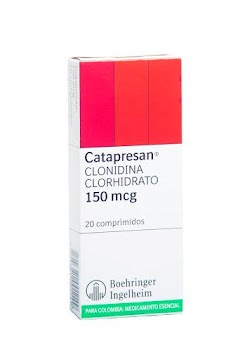
CATAPRESAN 0.150 mg Tablets

Prescription review online
A doctor will review your case and decide whether a prescription is medically appropriate.

Talk to a doctor about this medicine
Discuss your symptoms and possible next steps in a quick online consultation.



How to use CATAPRESAN 0.150 mg TABLETS
Contents of the leaflet
- Introduction
- What is Catapresan and what is it used for
- What you need to know before you take Catapresan
- How to take Catapresan
- Possible side effects
- Storage of Catapresan
- Contents of the pack and other information
Introduction
Package Leaflet: Information for the Patient
Catapresan 0.150 mg Tablets
Clonidine Hydrochloride
Read this package leaflet carefully before you start taking this medicine, because it contains important information for you.
- Keep this package leaflet, you may need to read it again.
- If you have any further questions, ask your doctor or pharmacist.
- This medicine has been prescribed for you only. Do not pass it on to others. It may harm them, even if their symptoms are the same as yours.
- If you experience any side effects, talk to your doctor or pharmacist. This includes any possible side effects not listed in this package leaflet. See section 4.
Contents of the Package Leaflet
- What is Catapresan and what is it used for
- What you need to know before you take Catapresan
- How to take Catapresan
- Possible side effects
- Storage of Catapresan
- Contents of the pack and other information
1. What is Catapresan and what is it used for
Catapresan contains an active substance called clonidine, which belongs to a group of medicines known as imidazoline receptor agonists (medicines that lower blood pressure).
Catapresan is used to treat high blood pressure in all its forms.

Not sure if this medicine is right for you?
Discuss your symptoms and treatment with a doctor online.
2. What you need to know before you take Catapresan
Do not take Catapresan:
- if you are allergic to clonidine hydrochloride or any of the other ingredients of this medicine (listed in section 6)
- if you have severe bradycardia (slow heart rate).
Warnings and precautions
Talk to your doctor or pharmacist before taking Catapresan:
- if you have mild or moderate bradycardia (slow heart rate)
- if you have cerebral or peripheral circulatory disorders
- if you have depression
- if you have polyneuropathy (a type of nervous system disorder)
- if you have constipation
- if you have kidney problems (see section 3)
- if you are considering stopping treatment (see section 3)
- if your treatment is associated with a beta-blocker (a medicine used to treat high blood pressure and heart problems). In this case, you should follow your doctor's instructions to stop treatment
- if you have heart problems such as heart failure or severe coronary artery disease. In this case, as with other medicines used to treat high blood pressure, you should be under close medical supervision
- if you wear contact lenses, as this medicine may reduce tear production.
It is not expected that clonidine will have any therapeutic effect if you have hypertension caused by pheochromocytoma (a disease that can lead to high blood pressure).
Children and adolescents
Do not give Catapresan to children and adolescents. In particular, if used off-label in combination with methylphenidate (a medicine to treat attention deficit hyperactivity disorder (ADHD) in children), serious adverse reactions have been observed, including death.
Taking Catapresan with other medicines
Tell your doctor or pharmacist if you are taking, have recently taken, or might take any other medicines.
In particular, tell your doctor if you are taking any of the following types of medicines:
- Other medicines to lower blood pressure: the blood pressure-lowering effect of this medicine may be enhanced.
- Non-steroidal anti-inflammatory medicines: the effect of this medicine may be reduced.
- Medicines with alpha-2 blocking properties, such as phentolamine or tolazoline: the effect of this medicine may be cancelled.
- Beta-blockers and digitalis derivatives (medicines to treat high blood pressure and heart problems) may cause or increase bradycardia (slow heart rate) when given at the same time as clonidine. Also, beta-blockers may cause or worsen peripheral circulation disorders.
- Tricyclic antidepressants (used to treat depression) or neuroleptics (used to treat some mental illnesses): taking them with this medicine may cause or worsen orthostatic regulation disorders (blood pressure changes when changing position) and may also reduce or cancel the blood pressure-lowering effect of clonidine.
Clonidine may enhance the effects of central nervous system depressants (also known as sedatives or tranquilizers).
Taking Catapresan with food, drinks, and alcohol
Clonidine may enhance the effects of alcohol.
Pregnancy, breastfeeding, and fertility
If you are pregnant or breastfeeding, think you may be pregnant, or plan to become pregnant, consult your doctor or pharmacist before using this medicine.
During pregnancy, clonidine should only be used in case of extreme necessity, with careful monitoring of the mother and the child, as clonidine may reduce fetal heart rate and cause a transient increase in blood pressure in the newborn after birth.
There is no adequate experience regarding the long-term effects of prenatal exposure.
Breastfeeding is not recommended while using this medicine, as there is not enough information available.
There are no data on the effect of clonidine on fertility.
Driving and using machines
Catapresan may cause sedation, drowsiness, and accommodation disorders (difficulty focusing the eyes). Therefore, caution is recommended when driving or operating machinery.
Catapresan contains lactose.
If your doctor has told you that you have an intolerance to some sugars, consult them before taking this medicine.
3. How to take Catapresan
Follow exactly the administration instructions of this medicine given by your doctor or pharmacist. If you are unsure, consult your doctor or pharmacist again.
Treatment of hypertension requires regular medical supervision.
The dose of Catapresan will be determined according to the blood pressure response of each patient.
Most mild and moderate hypertension responds to a medium dose of 2 tablets per day, one in the morning and one at night before bed. It is recommended to start treatment with 1 tablet at night and after 10-15 days continue with one in the morning and one at night.
If necessary, the dose can be increased after a period of 2-4 weeks until the desired response is achieved, preferably at night.
In cases of severe hypertension, it may be necessary to further increase the dose of each intake up to 2 tablets (0.3 mg); this dose can be repeated up to four times a day (8 tablets = 1.2 mg).
The tablets should be taken with a little liquid.
The tablet can be divided into equal doses.
Kidney problems
The dose should be determined according to:
- the individual anti-hypertensive response, which may vary significantly in patients with kidney problems
- the degree of kidney impairment
In both cases, close monitoring is required.
Since only a minimal amount of clonidine is eliminated during routine hemodialysis, it is not necessary to administer a supplementary dose of clonidine after dialysis.
If you take more Catapresan than you should
Symptoms due to overdose include decreased pupil diameter, lethargy, slow heart rate, low blood pressure, decreased body temperature, sleep (including coma), and decreased respiratory rate.
Additionally, an increase in blood pressure may occur.
If you take more Catapresan than you should, consult your doctor, pharmacist, or call the Toxicology Information Service at 91 562 04 20 immediately.
If you forget to take Catapresan
Do not take a double dose to make up for forgotten doses.
If you stop taking Catapresan
Do not stop treatment abruptly without consulting your doctor first, as after prolonged treatment at high doses, restlessness, palpitations, rapid increase in blood pressure, nervousness, tremors, headaches, or nausea may occur.
If you are taking treatment in combination with a beta-blocker, you should follow your doctor's instructions to stop treatment.
If you have any further questions on the use of this medicine, ask your doctor or pharmacist.

Started taking the medicine and have questions?
Discuss your symptoms and treatment with a doctor online.
4. Possible side effects
Like all medicines, this medicine can cause side effects, although not everybody gets them.
Side effects are usually mild and tend to decrease as treatment continues.
Very common side effects (occurring in more than 1 in 10 patients) are dizziness, sedation, decrease in blood pressure when changing from a sitting to a standing position (orthostatic hypotension), and dry mouth.
Common side effects (occurring in between 1 and 10 in 100 patients) are depression, sleep disorders, headache, constipation, nausea, vomiting, pain in the salivary gland, difficulty achieving or maintaining an erection, and fatigue.
Uncommon side effects (occurring in between 1 and 10 in 1,000 patients) are delirium, hallucinations, nightmares, tingling sensation in the skin (paresthesia), slow heart rate (sinus bradycardia), blockage of blood circulation that causes pain and color changes, especially in the fingers and toes (Raynaud's phenomenon), itching, rash, hives, and malaise.
Rare side effects (occurring in between 1 and 10 in 10,000 patients) include increased breast size (gynecomastia), reduced tear production, heart block (atrioventricular block), nasal dryness, generalized disorder of intestinal movements (pseudo-obstruction of the colon), hair loss, and increased blood sugar levels.
Side effects of unknown frequency are confusion, decreased sexual desire, difficulty focusing the eyes, and slow heart rate (bradyarrhythmia).
If you experience any side effects, talk to your doctor or pharmacist, even if they are not listed in this package leaflet.
Reporting of side effects:
If you experience any side effects, talk to your doctor or pharmacist. This includes any possible side effects not listed in this package leaflet. You can also report side effects directly through the Spanish Pharmacovigilance System for Human Use Medicines: https://www.notificaram.es. By reporting side effects, you can help provide more information on the safety of this medicine.
5. Storage of Catapresan
No special storage conditions are required.
Keep this medicine out of the sight and reach of children.
Do not use this medicine after the expiry date stated on the pack. The expiry date is the last day of the month stated.
Medicines should not be disposed of via wastewater or household waste. Ask your pharmacist how to dispose of medicines no longer required. These measures will help protect the environment.
6. Contents of the pack and other information
Composition of Catapresan
- The active substance is clonidine hydrochloride. Each tablet contains 0.150 mg of clonidine hydrochloride.
- The other ingredients are lactose, calcium phosphate, cornstarch, soluble cornstarch, colloidal silicon dioxide, povidone, and stearic acid.
Appearance of the product and pack contents
Catapresan are white, round, and beveled-edge tablets on both sides. One side has the engraving 15C/15C or N/150 and a score line.
Pack of 30 tablets.
Marketing Authorization Holder
Glenwood GmbH Pharmazeutische Erzeugnisse
Arabellastr.17
81925 Munich
Germany
Manufacturer
Delpharm Reims S.A.S.
10 rue Colonel Charbonneaux
51100 Reims
France
Date of the last revision of this package leaflet: July 2013
Detailed and up-to-date information on this medicine is available on the website of the Spanish Agency for Medicines and Health Products (AEMPS) http://www.aemps.gob.es/
- Country of registration
- Dosage formTABLET, 0.150 mg clonidine hydrochloride
- ATC codeC02AC01
- Average pharmacy price3.11 EUR
- Active substance
- Prescription requiredYes
- Manufacturer
- CompositionLACTOSA (36,050 mg mg)
- This information is for reference only and does not constitute medical advice. Always consult a doctor before taking any medication. Oladoctor is not responsible for medical decisions based on this content.
- Alternatives to CATAPRESAN 0.150 mg TABLETSDosage form: MODIFIED-RELEASE TABLET, 1 mgActive substance: guanfacineManufacturer: Takeda Pharmaceuticals International Ag Ireland BranchPrescription requiredDosage form: MODIFIED-RELEASE TABLET, 2 mgActive substance: guanfacineManufacturer: Takeda Pharmaceuticals International Ag Ireland BranchPrescription requiredDosage form: MODIFIED-RELEASE TABLET, 3 mgActive substance: guanfacineManufacturer: Takeda Pharmaceuticals International Ag Ireland BranchPrescription required
Online doctors for CATAPRESAN 0.150 mg TABLETS
Discuss questions about CATAPRESAN 0.150 mg TABLETS, including use, safety considerations and prescription review, subject to medical assessment and local regulations.
Get CATAPRESAN 0.150 mg TABLETS Prescription Online
Fill in a 2-min form
Tell us your symptoms, history, and what medicine you're requesting.
Pick a doctor or let us assign
Choose a specialist or we'll match you with the next available doctor.
Doctor reviews your case
Usually within 30 minutes. They may ask follow-up questions via chat.
Collect from any pharmacy
Electronic prescription sent to your email — valid across Spain.
Frequently Asked Questions
CATAPRESAN 0.150 mg TABLETS requires a prescription in Spain. You can check with a doctor online whether this medicine may be appropriate for your situation.
The active ingredient in CATAPRESAN 0.150 mg TABLETS is clonidine. This information helps identify medicines with the same composition but different brand names.
The average pharmacy price for CATAPRESAN 0.150 mg TABLETS is around 3.11 EUR. Prices may vary depending on the manufacturer and dosage form.
CATAPRESAN 0.150 mg TABLETS is manufactured by Glenwood Gmbh Pharmazeutische Erzeugnisse. Pharmacy brands and packaging may differ depending on the distributor.
Doctors such as Family doctors, Psychiatrists, Dermatologists, Cardiologists, Endocrinologists, Gastroenterologists, Pulmonologists, Nephrologists, Rheumatologists, Hematologists, Infectious disease physicians, Allergists, Geriatricians, Paediatricians, Oncologists may assess whether CATAPRESAN 0.150 mg TABLETS is appropriate, depending on your situation and local regulations. You can book an online consultation to discuss your symptoms and possible next steps.
Spain has a well-developed healthcare infrastructure across major cities such as Madrid, Barcelona, Valencia, and Seville. Pharmacies are widely available and operate under strict regulations, ensuring access to prescribed medications.
You can buy CATAPRESAN 0.150 mg TABLETS in Madrid, Barcelona, Seville, or Valencia at any local pharmacy with a valid prescription.
To obtain a prescription, you can use Oladoctor:
Other medicines with the same active substance (clonidine) include Intuniv 1mg prolonged-release tablets, Intuniv 2mg prolonged-release tablets, Intuniv 3mg prolonged-release tablets. These may have different brand names or formulations but contain the same therapeutic ingredient. Always consult a doctor before switching or starting a new medicine.
