



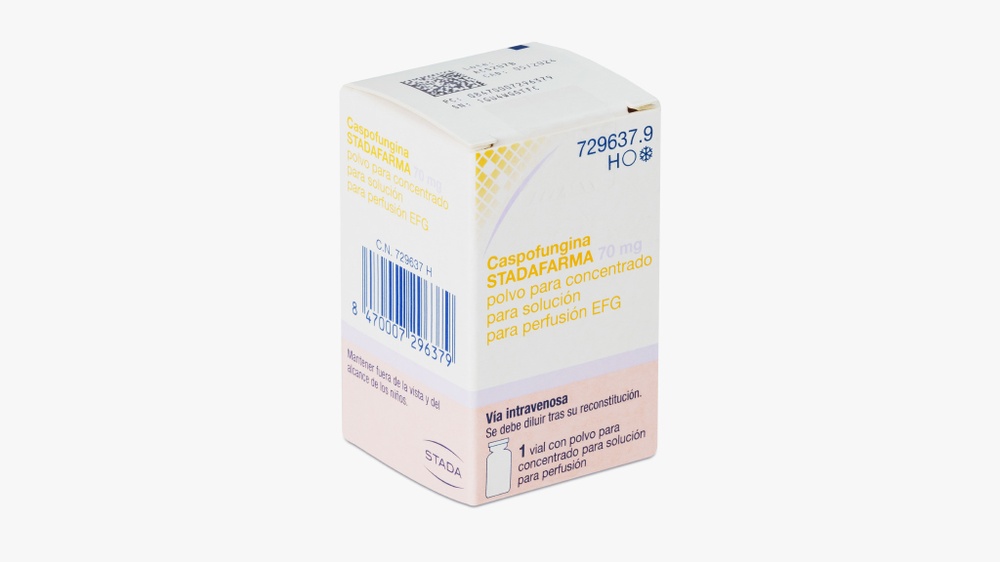
CASPOFUNGINA 70 mg Injectable Perfusion

Prescription review online
A doctor will review your case and decide whether a prescription is medically appropriate.

Talk to a doctor about this medicine
Discuss your symptoms and possible next steps in a quick online consultation.



How to use CASPOFUNGINA STADAFARMA 70 mg POWDER FOR CONCENTRATE FOR SOLUTION FOR INFUSION
Contents of the leaflet
- Introduction
- What is Caspofungin Stadafarma and what is it used for
- What you need to know before you start using Caspofungin Stadafarma
- How to use Caspofungina Stadafarma
- Possible side effects
- Conservation of Caspofungina Stadafarma
- Container Content and Additional Information
Introduction
Package Leaflet: Information for the User
CaspofunginStadafarma70 mg powder for concentrate for solution for infusion EFG
Read all of this leaflet carefully before you or your child start using this medicine because it contains important information for you.
- Keep this leaflet, you may need to read it again.
- If you have any further questions, ask your doctor, pharmacist, or nurse.
- If you experience any side effects, talk to your doctor, pharmacist, or nurse, even if they are not listed in this leaflet. See section 4.
Contents of the pack
- What is Caspofungin Stadafarma and what is it used for
- What you need to know before you start using Caspofungin Stadafarma
- How to use Caspofungin Stadafarma
- Possible side effects
5 Conservation of Caspofungina Stadafarma
- Contents of the pack and additional information
1. What is Caspofungin Stadafarma and what is it used for
What is caspofungin
Caspofungin belongs to a group of medicines called antifungals.
What is caspofungin used for
Caspofungin is used to treat the following infections in children, adolescents, and adults:
- severe fungal infections in their tissues or organs (called "invasive candidiasis"). This infection is caused by fungal cells (yeast) called Candida. People who may suffer from this type of infection include those who have just undergone surgery or those whose immune system is weakened. Fever and chills that do not respond to antibiotic treatment are the most common symptoms of this type of infection.
- fungal infections in their nose, sinuses, or lungs (called "invasive aspergillosis") if other antifungal treatments have not worked or have caused side effects. This infection is caused by molds called Aspergillus.
People who may suffer from this type of infection include those who are receiving chemotherapy, those who have undergone a transplant, and those whose immune system is weakened.
- presumed fungal infections if they have a fever and a low white blood cell count, which have not improved with antibiotic treatment. People who are at risk of suffering from a fungal infection include those who have just undergone surgery or those whose immune system is weakened.
How caspofungin works
Caspofungin makes fungal cells fragile and prevents the fungus from growing properly. This prevents the infection from spreading and gives the body's natural defenses the opportunity to completely eliminate the infection.

Not sure if this medicine is right for you?
Discuss your symptoms and treatment with a doctor online.
2. What you need to know before you start using Caspofungin Stadafarma
Do not use caspofungin
if you are allergic to caspofungin or any of the other ingredients of this medicine (listed in section 6).
If you are not sure, talk to your doctor, pharmacist, or nurse before starting to use your medicine.
Warnings and precautions
Talk to your doctor, pharmacist, or nurse before starting to use caspofungin if:
you are allergic to any other medicine
you have ever had liver problems; you may need a different dose of this medicine
you are already taking cyclosporin (which is used to prevent organ transplant rejection or to cause suppression of your immune system), as your doctor will probably need to perform additional blood tests during treatment
you have ever had any other medical problem.
If any of the above applies to you (or you are not sure), talk to your doctor, pharmacist, or nurse before starting to use caspofungin.
Caspofungin can also cause severe skin reactions, such as Stevens-Johnson syndrome (SJS) and toxic epidermal necrolysis (TEN).
Other medicines and Caspofungina Stadafarma
Tell your doctor, pharmacist, or nurse if you are using, have recently used, or might use any other medicines. This includes medicines obtained without a prescription, including herbal medicines. This is because caspofungin can affect how other medicines work. Other medicines can also affect how caspofungin works.
Tell your doctor, pharmacist, or nurse if you are taking any of the following medicines:
cyclosporin or tacrolimus (which are used to prevent organ transplant rejection or to cause suppression of your immune system), as your doctor will probably need to perform additional blood tests during treatment
some anti-HIV medicines such as efavirenz or nevirapine
phenytoin or carbamazepine (which are used to treat seizures)
dexamethasone (a steroid)
rifampicin (an antibiotic).
If any of the above applies to you (or you are not sure), talk to your doctor, pharmacist, or nurse before starting to use caspofungin.
Pregnancy and breastfeeding
If you are pregnant or breastfeeding, think you may be pregnant, or are planning to have a baby, ask your doctor for advice before taking this medicine.
caspofungin has not been studied in pregnant women. It should only be used during pregnancy if the potential benefit justifies the potential risk to the developing baby.
women who use caspofungin must not breastfeed.
Driving and using machines
There is no information to suggest that caspofungin affects the ability to drive or use machines.
Caspofungina Stadafarma contains sodium
This medicine contains less than 23 mg of sodium (1mmol) per vial; this is essentially "sodium-free".
3. How to use Caspofungina Stadafarma
Caspofungina Stadafarma will always be prepared and administered by a healthcare professional. You will be given caspofungin:
- once a day.
- by slow injection into a vein (intravenous infusion).
- for about 1 hour.
Your doctor will decide how long you will need to use caspofungin and how much you will need each day. Your doctor will monitor whether the effect of the medicine is adequate. If you weigh more than 80 kg, you may need a different dose.
Children and adolescents
The dose for children and adolescents may be different from the dose for adults.
If you use more Caspofungina Stadafarma than you should
Your doctor will decide how much caspofungin you need and for how long each day. If you are concerned that you may have been given too much caspofungin, tell your doctor or nurse immediately.
In case of overdose or accidental ingestion, consult your doctor or pharmacist immediately or call the Toxicology Information Service, phone: 91 562 04 20, indicating the medicine and the amount taken.
If you have any further questions on the use of this medicine, ask your doctor, pharmacist, or nurse.

Started taking the medicine and have questions?
Discuss your symptoms and treatment with a doctor online.
4. Possible side effects
Like all medicines, this medicine can cause side effects, although not everybody gets them.
Tell your doctor or nurse immediately if you notice any of the following side effects – you may need urgent medical treatment:
- rash, itching, feeling of heat, swelling of your face, lips, or throat, or difficulty breathing: you may be having a histamine reaction to the medicine.
- difficulty breathing with wheezing or worsening of a rash that already exists: you may be having an allergic reaction to the medicine.
- cough, severe breathing difficulties: if you are an adult and have invasive aspergillosis, you may experience a severe respiratory problem that could lead to respiratory failure.
- rash, skin peeling, blisters on the mucous membrane, hives, large areas of skin peeling
As with any prescription medicine, some side effects can be serious. Ask your doctor for more information.
Other side effects in adults include:
Common: may affect up to 1 in 10 people:
- decrease in hemoglobin (decrease in the substance that carries oxygen in the blood), decrease in white blood cells.
- decrease in albumin (a type of protein) in your blood, decrease in potassium or low potassium levels in the blood.
- headache.
- vein inflammation.
- shortness of breath.
- diarrhea, nausea, or vomiting.
- changes in some laboratory blood tests (such as increased values of some liver tests).
- itching, rash, redness of the skin, or excessive sweating.
- joint pain.
- chills, fever.
- itching at the injection site.
Uncommon: may affect up to 1 in 100 people:
- changes in some laboratory blood tests (including blood coagulation disorders, platelets, red blood cells, and white blood cells).
- loss of appetite, increase in body fluid, imbalance of body salts, high blood sugar, low calcium levels in the blood, high calcium levels in the blood, low magnesium levels in the blood, increase in the level of acids in the blood.
- disorientation, feeling nervous, inability to sleep.
- feeling dizzy, decrease in sensations or sensitivity (especially in the skin), agitation, feeling sleepy, change in the way things taste, tingling or numbness.
- blurred vision, increased tearing, swollen eyelid, yellowing of the white part of the eyes.
- feeling of rapid or irregular heartbeats, rapid heartbeat, irregular heartbeat, abnormal heart rhythm, heart failure.
- flushing, hot flashes, high blood pressure, low blood pressure, redness along a vein that is very sensitive to touch.
- tightness in the muscle bands around the airways leading to wheezing or cough, rapid breathing rate, shortness of breath that wakes you up, lack of oxygen in the blood, abnormal breathing sounds, crackling sounds in the lungs, wheezing, nasal congestion, cough, sore throat.
- abdominal pain, pain in the upper abdomen, swelling, constipation, difficulty swallowing, dry mouth, indigestion, gas, stomach upset, swelling due to fluid accumulation around the abdomen.
- decrease in bile flow, increase in liver size, yellowing of the skin and/or the white part of the eyes, liver injury caused by a drug or chemical, liver disorder.
- abnormal skin tissue, generalized itching, hives, rash of varying appearance, abnormal skin, red spots, often with itching, on arms and legs and sometimes on the face and the rest of the body.
- back pain, pain in an arm or leg, bone pain, muscle pain, muscle weakness.
- loss of kidney function, sudden loss of kidney function.
- pain at the catheter site, symptoms at the injection site (redness, hard lump, pain, swelling, irritation, rash, hives, leakage of fluid from the catheter into the tissue), vein inflammation at the injection site.
- increase in blood pressure and changes in some laboratory blood tests (such as kidney electrolyte tests and coagulation tests), increase in levels of medicines you are taking that weaken the immune system.
- chest discomfort, chest pain, feeling of change in body temperature, feeling unwell, general pain, swelling of the face, swelling of the ankles, hands, or feet, swelling, pain when touched, feeling tired
Other side effects in children and adolescents
Very common: may affect more than 1 in 10 people:
- fever.
Common: may affect up to 1 in 10 people:
- headache.
- rapid heartbeat.
- flushing, low blood pressure.
- changes in some laboratory blood tests (increased values of some liver tests).
- itching, rash.
- pain at the catheter site.
- chills.
- changes in some laboratory blood tests.
Reporting of side effects:
If you experience any side effects, talk to your doctor or pharmacist, even if they are not listed in this leaflet. You can also report side effects directly through the Spanish Medicines Monitoring System for Human Use: https://www.notificaram.es. By reporting side effects, you can help provide more information on the safety of this medicine.
5. Conservation of Caspofungina Stadafarma
Keep this medicine out of the sight and reach of children.
Do not use this medicine after the expiry date which is stated on the carton and vial after EXP (the first two numbers are the month; the next four numbers are the year). The expiry date is the last day of the month shown.
Store in a refrigerator (between 2 °C and 8 °C).
Once caspofungin has been prepared, it should be used immediately. This is because it does not contain any ingredient to prevent the growth of bacteria. Only a trained healthcare professional who has read the complete instructions should prepare the medicine (see "Instructions for reconstitution and dilution of Caspofungina Stadafarma" below).
If the solution is not used immediately, it can be used for up to 24 hours when stored at a temperature of 25 °C or below, or for up to 48 hours when the bag (vial) is stored in a refrigerator (2 to 8 °C) and diluted in 9 mg/ml (0.9%) or 4.5 mg/ml (0.45%) or 2.25 mg/ml (0.225%) of sodium chloride solution for infusion, or with lactated Ringer's solution. If not used immediately, the in-use storage times and conditions before use are the responsibility of the user and should not exceed 24 hours between 2 and 8 °C, unless the reconstitution and dilution have taken place in controlled and validated aseptic conditions.
Do not use this medicine if you notice any signs of discoloration or particles in suspension.
Medicines should not be disposed of via wastewater or household waste. Ask your pharmacist how to dispose of medicines no longer required. This will help protect the environment.
6. Container Content and Additional Information
Composition of Caspofungina Stadafarma
- The active ingredient is caspofungin. Each vial of Caspofungina Stadafarma contains 70 mg of caspofungin (as acetate).
- The other components are sucrose, mannitol, concentrated hydrochloric acid (for pH adjustment), sodium hydroxide (for pH adjustment), and carbon dioxide (for pH adjustment).
Appearance of the Product and Container Content
Caspofungina Stadafarma is a compact, sterile, white to off-white powder.
The reconstituted solution is transparent.
Caspofungina Stadafarma is available in 10 ml glass vials with a bromobutyl stopper and an aluminum seal with an orange plastic "flip-off" top cap.
Each container contains one vial of powder.
Marketing Authorization Holder and Manufacturer
Marketing Authorization Holder
Laboratory STADA, S.L.
Frederic Mompou, 5
08960 Sant Just Desvern (Barcelona)
Spain
Manufacturer
Pharmadox Healthcare, Ltd.
KW20A Kordin Industrial Park
Paola
PLA 3000
Malta
or
SAG Manufacturing S.L.U
Ctra. N-I, Km 36. San Agustín de Guadalix
28750, Madrid
Spain
or
Galenicum Health S.L.U
Sant Gabriel, 50
08950 Esplugues de Llobregat (Barcelona)
Spain
or
STADA Arzneimittel AG
Stadastrasse 2-18
61118 Bad Vilbel
Germany
or
Centrafarm Services B.V.
Van de Reijstraat 31-E
4814 NE Breda
Netherlands
or
Hikma Italia S.p.A.
Viale Certosa, 10,
27100 Pavia
Italy
Date of Last Revision of this Prospectus:May 2023
Detailed and updated information on this medicinal product is available on the website of the Spanish Agency for Medicines and Health Products (AEMPS) http://www.aemps.gob.es/
This information is intended solely for doctors or healthcare professionals:
Instructions for reconstituting and diluting Caspofungina Stadafarma:
Reconstitution of Caspofungina
DO NOT USE DILUENTS CONTAINING GLUCOSE, as caspofungina is not stable in diluents containing glucose. DO NOT MIX OR INFUSE CASPOFUNGINA WITH ANY OTHER MEDICAMENT, as there are no data available on the compatibility of caspofungina with other substances, additives, or pharmaceutical specialties for intravenous use. The reconstituted solution is transparent. The infusion solution should be inspected visually for particulate matter or a change in color.
INSTRUCTIONS FOR USE IN ADULT PATIENTS
Step 1 Reconstitution of the Vials
To reconstitute the powder, bring the vial to room temperature and add aseptically 10.5 ml of water for injection. The concentration of the reconstituted vial will be 7.2 mg/ml.
The compact, lyophilized, white to off-white powder will dissolve completely. Mix gently until a transparent solution is obtained. The reconstituted solutions should be inspected visually for particulate matter or a change in color. The reconstituted solution may be stored for a maximum of 24 hours at a temperature of 25 °C or below.
Step 2 Addition of Reconstituted Caspofungina to the Infusion Solution for the Patient
The diluents for the final infusion solution are: sodium chloride injection solution or lactated Ringer's solution. The infusion solution is prepared by adding aseptically the appropriate amount of the reconstituted concentrate (as shown in the following table) to a 250 ml infusion bag or bottle. Reduced volume infusions of 100 ml may be used, if medically necessary, for daily doses of 50 mg or 35 mg. Do not use if the solution is turbid or has precipitated.
PREPARATION OF THE INFUSION SOLUTION FOR ADULTS
DOSE* | Volume of Reconstituted Caspofungina to Transfer to an Intravenous Bag or Bottle | Standard Preparation(reconstituted caspofungina added to 250 ml) final concentration | Reduced Volume Infusion(reconstituted caspofungina added to 100 ml) final concentration |
70 mg | 10 ml | 0.28 mg/ml | Not recommended |
70 mg (from two 50 mg vials)** | 14 ml | 0.28 mg/ml | Not recommended |
35 mg for moderate hepatic impairment (from a 70 mg vial) | 5 ml | 0.14 mg/ml | 0.34 mg/ml |
*10.5 ml should be used for the reconstitution of all vials
**If the 70 mg vial is not available, the 70 mg dose can be prepared from two 50 mg vials
INSTRUCTIONS FOR USE IN PEDIATRIC PATIENTS
Calculation of Body Surface Area (BSA) for Pediatric Dosing
Before preparing the infusion, calculate the body surface area (BSA) of the patient using the following formula: (Mosteller formula)

Preparation of the 70 mg/m2Infusion for Pediatric Patients >3 months (using a 70 mg vial)
- Determine the actual loading dose to be used in the pediatric patient using the patient's BSA (as calculated above) and the following equation:
BSA (m2) x 70 mg/m2 = loading dose
- The maximum loading dose on day 1 should not exceed 70 mg, regardless of the calculated dose for the patient.
- Wait for the refrigerated caspofungina vial to reach room temperature.
- Aseptically add 10.5 ml of water for injectable preparations. This reconstituted solution can be stored for up to 24 hours at a temperature of 25 °C or below. This will result in a final concentration of caspofungina in the vial of 7.2 mg/ml.
- Withdraw from the vial a volume of the medication equal to the calculated loading dose (Step 1). Transfer aseptically this volume (ml) of reconstituted caspofungina to an intravenous bag or bottle containing 250 ml of 0.9%, 0.45%, or 0.225% sodium chloride injection solution, or lactated Ringer's solution. Alternatively, the volume (ml) of reconstituted caspofungina can be added to a reduced volume of sodium chloride injection solution or lactated Ringer's solution, without exceeding a final concentration of 0.5 mg/ml. This infusion solution should be used within 24 hours if stored at a temperature of 25 °C or below, or within 48 hours if stored refrigerated between 2 and 8 °C.
Preparation of the 50 mg/m2Infusion for Pediatric Patients >3 months (using a 70 mg vial)
- Determine the actual daily maintenance dose to be used in the pediatric patient using the patient's BSA (as calculated above) and the following equation:
BSA (m2) x 50 mg/m2 = daily maintenance dose
The daily maintenance dose should not exceed 70 mg, regardless of the calculated dose for the patient.
- Wait for the refrigerated caspofungina vial to reach room temperature.
- Aseptically add 10.5 ml of water for injectable preparations. This reconstituted solution can be stored for up to 24 hours at a temperature of 25 °C or below. This will result in a final concentration of caspofungina in the vial of 7.2 mg/ml.
- Withdraw from the vial a volume of the medication equal to the calculated daily maintenance dose (Step 1). Transfer aseptically this volume (ml) of reconstituted caspofungina to an intravenous bag or bottle containing 250 ml of 0.9%, 0.45%, or 0.225% sodium chloride injection solution, or lactated Ringer's solution. Alternatively, the volume (ml) of reconstituted caspofungina can be added to a reduced volume of sodium chloride injection solution or lactated Ringer's solution, without exceeding a final concentration of 0.5 mg/ml. This infusion solution should be used within 24 hours if stored at a temperature of 25 °C or below, or within 48 hours if stored refrigerated between 2 and 8 °C.
Preparation Notes:
|
- Country of registration
- Dosage formINJECTABLE PERFUSION, 70 mg
- ATC codeJ02AX04
- Active substance
- Prescription requiredYes
- Manufacturer
- CompositionSACAROSA (50 mg mg), MANITOL (E-421) (33,3 mg mg), HIDROXIDO DE SODIO (E 524) (0-0,23 ml mg)
- This information is for reference only and does not constitute medical advice. Always consult a doctor before taking any medication. Oladoctor is not responsible for medical decisions based on this content.
- Alternatives to CASPOFUNGINA STADAFARMA 70 mg POWDER FOR CONCENTRATE FOR SOLUTION FOR INFUSIONDosage form: INJECTABLE INFUSION, UnknownActive substance: caspofunginManufacturer: Merck Sharp & Dohme B.V.Prescription requiredDosage form: INJECTABLE PERFUSION, UnknownActive substance: caspofunginManufacturer: Merck Sharp & Dohme B.V.Prescription requiredDosage form: INJECTABLE PERFUSION, 50 mgActive substance: caspofunginManufacturer: Demo S.A. Pharmaceutical IndustryPrescription required
Online doctors for CASPOFUNGINA STADAFARMA 70 mg POWDER FOR CONCENTRATE FOR SOLUTION FOR INFUSION
Discuss questions about CASPOFUNGINA STADAFARMA 70 mg POWDER FOR CONCENTRATE FOR SOLUTION FOR INFUSION, including use, safety considerations and prescription review, subject to medical assessment and local regulations.









Get CASPOFUNGINA STADAFARMA 70 mg POWDER FOR CONCENTRATE FOR SOLUTION FOR INFUSION Prescription Online
Fill in a 2-min form
Tell us your symptoms, history, and what medicine you're requesting.
Pick a doctor or let us assign
Choose a specialist or we'll match you with the next available doctor.
Doctor reviews your case
Usually within 30 minutes. They may ask follow-up questions via chat.
Collect from any pharmacy
Electronic prescription sent to your email — valid across Spain.
Frequently Asked Questions
CASPOFUNGINA STADAFARMA 70 mg POWDER FOR CONCENTRATE FOR SOLUTION FOR INFUSION requires a prescription in Spain. You can check with a doctor online whether this medicine may be appropriate for your situation.
The active ingredient in CASPOFUNGINA STADAFARMA 70 mg POWDER FOR CONCENTRATE FOR SOLUTION FOR INFUSION is caspofungin. This information helps identify medicines with the same composition but different brand names.
CASPOFUNGINA STADAFARMA 70 mg POWDER FOR CONCENTRATE FOR SOLUTION FOR INFUSION is manufactured by Laboratorio Stada S.L.. Pharmacy brands and packaging may differ depending on the distributor.
Doctors such as Family doctors, Psychiatrists, Dermatologists, Cardiologists, Endocrinologists, Gastroenterologists, Pulmonologists, Nephrologists, Rheumatologists, Hematologists, Infectious disease physicians, Allergists, Geriatricians, Paediatricians, Oncologists may assess whether CASPOFUNGINA STADAFARMA 70 mg POWDER FOR CONCENTRATE FOR SOLUTION FOR INFUSION is appropriate, depending on your situation and local regulations. You can book an online consultation to discuss your symptoms and possible next steps.
Spain has a well-developed healthcare infrastructure across major cities such as Madrid, Barcelona, Valencia, and Seville. Pharmacies are widely available and operate under strict regulations, ensuring access to prescribed medications.
You can buy CASPOFUNGINA STADAFARMA 70 mg POWDER FOR CONCENTRATE FOR SOLUTION FOR INFUSION in Madrid, Barcelona, Seville, or Valencia at any local pharmacy with a valid prescription.
To obtain a prescription, you can use Oladoctor:
Other medicines with the same active substance (caspofungin) include CANCIDAS 50 mg POWDER FOR CONCENTRATE FOR INFUSION SOLUTION, CANCIDAS 70 mg POWDER FOR CONCENTRATE FOR INFUSION SOLUTION, CASPOFUNGINA DEMO 50 mg POWDER FOR CONCENTRATE FOR INFUSION SOLUTION EFG. These may have different brand names or formulations but contain the same therapeutic ingredient. Always consult a doctor before switching or starting a new medicine.
