



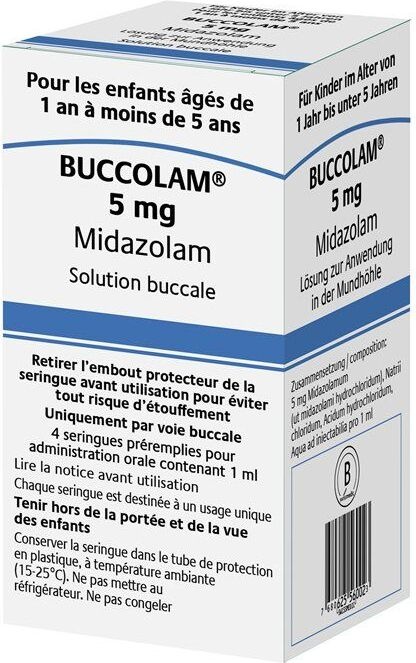
BUCCOLAM 5 mg Oral Solution Gel/Paste/Oral Liquid

Prescription review online
A doctor will review your case and decide whether a prescription is medically appropriate.

Talk to a doctor about this medicine
Discuss your symptoms and possible next steps in a quick online consultation.



How to use BUCCOLAM 5 mg ORAL SOLUTION
Contents of the leaflet
- Introduction
- What is BUCCOLAM and what is it used for
- What you need to know before you give BUCCOLAM
- How to give BUCCOLAM
- Possible side effects
- Storing BUCCOLAM
- Container contents and additional information
Introduction
Package Leaflet:Information for the user
BUCCOLAM 2.5mg buccal solution
For children from 3 months to less than 1 year
BUCCOLAM 5mg buccal solution
For children from 1 year to less than 5 years
BUCCOLAM 7.5mg buccal solution
For children from 5 years to less than 10 years
BUCCOLAM 10mg buccal solution
For children from 10 years to less than 18 years
Midazolam
Read all of this leaflet carefully before you start giving this medicine because it contains important information for you.
- Keep this leaflet, you may need to read it again.
- If you have any further questions, ask your doctor or pharmacist.
- This medicine has been prescribed for your child, do not give it to others, even if their symptoms are the same as your child's, as it may harm them.
- If you get any side effects, talk to your doctor or pharmacist, even if you think they might be unrelated to the medicine. See section 4.
Contents of the pack
- What is BUCCOLAM and what is it used for
- What you need to know before you give BUCCOLAM
- How to give BUCCOLAM
- Possible side effects
- Storing BUCCOLAM
- Contents of the pack and other information
1. What is BUCCOLAM and what is it used for
BUCCOLAM contains a medicine called midazolam. Midazolam belongs to a group of medicines known as benzodiazepines. BUCCOLAM is used to stop a prolonged seizure in infants, children, and adolescents (from 3 months to less than 18 years).
In infants from 3 months to less than 6 months, treatment should only be given in a hospital where the patient can be monitored and where resuscitation equipment is available.
This medicine should only be used by parents/caregivers when epilepsy has been diagnosed in the child.

Not sure if this medicine is right for you?
Discuss your symptoms and treatment with a doctor online.
2. What you need to know before you give BUCCOLAM
Do not give BUCCOLAM if the patient:
- is allergic to midazolam, benzodiazepines (such as diazepam) or any of the other ingredients of this medicine (listed in section 6);
- has a nerve and muscle disease that causes muscle weakness (myasthenia gravis);
- has serious breathing difficulties at rest (BUCCOLAM may make breathing difficulties worse);
- has a disease that causes frequent interruptions of breathing while sleeping (sleep apnoea syndrome);
- has severe liver problems.
Warnings and precautions
Talk to your doctor or pharmacist before giving BUCCOLAM if the patient:
- has a kidney, liver, or heart condition;
- has a lung condition that causes breathing difficulties from time to time.
This medicine can make people forget what happened after they have been given it. Patients should be closely watched after being given this medicine.
This medicine should be avoided in patients with a history of alcohol or drug abuse.
It is more likely that life-threatening incidents will occur in patients with breathing difficulties or heart problems, especially when higher doses of BUCCOLAM are given.
Children under 3 months: BUCCOLAM should not be given to children under 3 months due to lack of information in this age group.
If you are unsure about any of the above, talk to your doctor or pharmacist before giving this medicine.
Using BUCCOLAM with other medicines
Tell your doctor or pharmacist if the patient is taking, has recently taken, or might take any other medicines. If you are unsure about any medicine the patient is taking that may affect the use of BUCCOLAM, talk to your doctor or pharmacist.
This is especially important because using more than one medicine at the same time can increase or decrease the effect of the medicines.
The effects of BUCCOLAM can be increased by the following medicines:
- anti-epileptics (for treating epilepsy), e.g. phenytoin
- antibiotics, e.g. erythromycin, clarithromycin
- antifungals, e.g. ketoconazole, voriconazole, fluconazole, itraconazole, posaconazole
- medicines for ulcers, e.g. cimetidine, ranitidine, and omeprazole
- medicines used to treat blood pressure, e.g. diltiazem, verapamil
- certain medicines used to treat HIV and AIDS, e.g. saquinavir, lopinavir/ritonavir combination
- narcotic painkillers (strong pain relievers), e.g. fentanyl
- medicines used to lower blood fat, e.g. atorvastatin
- medicines used to treat nausea, e.g. nabilone
- sleeping pills (medicines to induce sleep)
- sedating antidepressants (medicines for depression that cause sleepiness)
- sedatives (medicines to help relax)
- anaesthetics (medicines to relieve pain)
- antihistamines (medicines for allergies)
The effects of BUCCOLAM can be reduced by the following medicines:
- rifampicin (used to treat tuberculosis)
- xanthines (used to treat asthma)
- St John's Wort (a herbal medicine). This should be avoided in patients taking BUCCOLAM.
BUCCOLAM may increase the effect of some muscle relaxants, e.g. baclofen (causing increased sleepiness). This medicine may also make some medicines not work as well, e.g. levodopa (a medicine used to treat Parkinson's disease).
Talk to your doctor or pharmacist for more information about medicines that the patient should avoid while taking BUCCOLAM.
Using BUCCOLAM with food and drink
The patient should not drink alcohol while taking BUCCOLAM. Alcohol may increase the sedative effects of this medicine and cause excessive sleepiness.
The patient should not drink grapefruit juice while taking BUCCOLAM. Grapefruit juice may increase the sedative effects of this medicine and cause excessive sleepiness.
Pregnancy
If the patient who is to receive this medicine is pregnant or breastfeeding, thinks they may be pregnant, or plans to become pregnant, they should talk to their doctor before using this medicine.
Giving high doses of BUCCOLAM during the last 3 months of pregnancy may cause abnormal heart rhythms in the baby. Babies born after the mother has been given this medicine during delivery may also have difficulty feeding, breathing difficulties, and low muscle tone at birth.
Breastfeeding
Tell the doctor if the patient is breastfeeding. Although small amounts of BUCCOLAM may pass into breast milk, it may not be necessary to stop breastfeeding. The doctor will advise whether the patient should breastfeed the baby after receiving this medicine.
Driving and using machines
BUCCOLAM may make the patient feel sleepy, forgetful, or affect their concentration and coordination. This may interfere with performing tasks that require skill, such as driving, cycling, or using machines.
After receiving this medicine, the patient should not drive, cycle, or use machines until they have fully recovered. Ask the doctor if you need more information.
3. How to give BUCCOLAM
Follow the instructions for giving this medicine exactly as your doctor has told you. If you are unsure, talk to your doctor or pharmacist again.
Dose
Your doctor will prescribe the correct dose of BUCCOLAM for your child, usually based on the child's age. Each dose has a different colour, which is shown on the box, tube, and syringe that contains the medicine.
Your child will receive one of the following specific doses for their age in a colour-coded pack:
3 months to less than 1 year: 2.5 mg – pack with yellow label
1 year to less than 5 years: 5 mg – pack with blue label
5 years to less than 10 years: 7.5 mg – pack with purple label
10 years to less than 18 years: 10 mg – pack with orange label
An oral syringe contains a complete dose. Do not give more than one dose.
Infants from 3 months to less than 6 months should only receive treatment in a hospital where the patient can be monitored and where resuscitation equipment is available.
Preparing to give this medicine
If the child has a seizure, let their body move freely, do not try to hold them down. Only move them if they are in danger, for example, near deep water, fire, or sharp objects.
Support the child's head on a soft object, such as a cushion or your lap.
Check that the medicine contains the correct dose for your child, specific to their age.
How to give this medicine
Ask a doctor, pharmacist, or nurse to show you how to take or give this medicine. If you are unsure, always ask your doctor, pharmacist, or nurse.
Information on how to give this medicine is also on the label of the tube.
BUCCOLAMshould not be injected. Do not put a needle in the syringe.
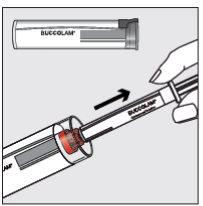
Step 1
| Hold the plastic tube, break the seal at one end, and remove the cap. Take the syringe out of the tube. |
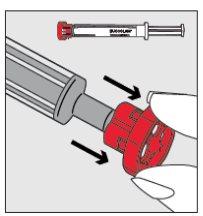
Step 2
| Remove the red cap from the tip of the syringe and dispose of it safely. |
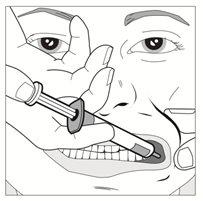
Step 3
| With the help of your index finger and thumb, gently pinch and pull back the child's cheek. Place the tip of the syringe in the back of the space between the inside of the cheek and the lower gum. |
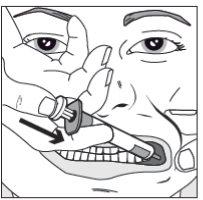
Step 4
| Slowly press the plunger of the syringe until it stops. Slowly put all of the solution into the space between the gum and the cheek (buccal cavity). If prescribed by your doctor (for larger volumes and/or smaller patients), you can give about half of the dose on one side of the mouth and then the other half on the other side of the child's mouth. |
When to call an ambulance Always follow the treatment recommendations provided by the patient's doctor or as advised by the healthcare professional. If you are unsure, seek urgent medical help if:
Keep the syringe to show to the ambulance staff or doctor. Do not give more medicine than prescribed by the doctor for the patient. |
If the child vomits
- Do not give the patient another dose of BUCCOLAM.
- If the seizure does not stop within 10 minutes, call an ambulance.
If you have any other questions about using this medicine, ask your doctor or pharmacist.

Started taking the medicine and have questions?
Discuss your symptoms and treatment with a doctor online.
4. Possible side effects
Like all medicines, this medicine can cause side effects, although not everybody gets them.
Serious side effects
Seek immediate medical attention or call for an ambulance if the patient experiences the following side effects:
- Severe breathing difficulties, e.g. slow or shallow breathing or blue lips. In very rare cases, breathing may stop.
- Heart attack. Signs may include chest pain that may radiate to the neck and shoulders and extend to the left arm.
- Swelling of the face, lips, tongue, or throat that makes it difficult to swallow or breathe.
Other side effects
If the patient experiences any side effects, talk to your doctor, pharmacist, or nurse, even if you think they might be unrelated to the medicine.
Common side effects (may affect up to 1 in 10 people):
- Nausea and vomiting
- Sleepiness or being less conscious
Uncommon side effects (may affect up to 1 in 100 people):
- Rash, hives (itchy rash), itching
Rare side effects (may affect up to 1 in 10,000 people):
- Agitation, restlessness, hostility, anger, or aggression, excitement, confusion, euphoria (excessive feeling of happiness or excitement), or hallucinations (seeing and possibly hearing things that are not really there)
- Muscle spasms and muscle tremors (trembling of the muscles that cannot be controlled)
- Reduced level of alertness
- Headache
- Dizziness
- Difficulty coordinating muscles
- Seizures (fits)
- Temporary loss of memory. The duration depends on the amount of BUCCOLAM given.
- Low blood pressure, slow heart rate, or reddening of the face and neck (flushing)
- Laryngospasm (contraction of the vocal cords that causes difficulty breathing and noise when breathing)
- Constipation
- Dry mouth
- Fatigue
- Hiccups
Reporting side effects
If you get any side effects, talk to your doctor, pharmacist, or nurse. This includes any possible side effects not listed in this leaflet. You can also report side effects directly via the national reporting system listed in Appendix V. By reporting side effects, you can help provide more information on the safety of this medicine.
5. Storing BUCCOLAM
Keep this medicine out of the sight and reach of children.
Do not give this medicine after the expiry date which is stated on the carton and on the labels of the tube and oral syringe after EXP. The expiry date is the last day of the month shown.
Do not refrigerate or freeze.
Keep the oral syringe in the protective plastic tube.
Do not use this medicine if the pack is open or damaged.
Disposal of oral syringes
Medicines should not be disposed of via wastewater or household waste. Ask your pharmacist how to dispose of medicines no longer required. This will help protect the environment.
6. Container contents and additional information
Composition of BUCCOLAM
- The active ingredient is midazolam
- Each 2.5 mg oral syringe contains 2.5 mg of midazolam (as hydrochloride) in 0.5 ml of solution.
- Each 5 mg oral syringe contains 5 mg of midazolam (as hydrochloride) in 1 ml of solution.
- Each 7.5 mg oral syringe contains 7.5 mg of midazolam (as hydrochloride) in 1.5 ml of solution.
- Each 10 mg oral syringe contains 10 mg of midazolam (as hydrochloride) in 2 ml of solution.
The other ingredients are sodium chloride, water for injection, hydrochloric acid, and sodium hydroxide (for pH adjustment).
Appearance of the product and container contents
3 months to less than 1 year: 2.5 mg – packaging with yellow label
1 year to less than 5 years: 5 mg – packaging with blue label
5 years to less than 10 years: 7.5 mg – packaging with purple label
10 years to less than 18 years: 10 mg – packaging with orange label
BUCCOLAM oral solution is a clear, colorless liquid. It is supplied in a single-use, amber-colored oral syringe. Each oral syringe is individually packaged in a protective plastic tube. BUCCOLAM is available in boxes containing 4 single-use oral syringes/tubes (of the same dose).
Marketing authorization holder
Laboratorios Lesvi, S.L.
Avda. Barcelona, 69
08970 Sant Joan Despí - Barcelona
Spain
Tel: +34 93 602 24 21
E-mail: [email protected]
Manufacturer
Shire Pharmaceuticals Ireland Limited
Block 2 & 3 Miesian Plaza
50 – 58 Baggot Street Lower
Dublin 2
Ireland
Laboratorios Lesvi, S.L.
Avda. Barcelona, 69
08970 Sant Joan Despí - Barcelona
Spain
For further information about this medicinal product, please contact the local representative of the marketing authorization holder:
Belgium Neuraxpharm France Tel: +32 474 62 24 24 | Lithuania Laboratorios Lesvi, S.L. Tel: +34 93 602 24 21 |
Bulgaria Laboratorios Lesvi, S.L. Tel: +34 93 602 24 21 | Luxembourg Neuraxpharm France Tel: +32 474 62 24 24 |
Czech Republic Neuraxpharm Bohemia s.r.o. Tel: +420 495 736 145 | Hungary Neuraxpharm Bohemia s.r.o. Tel: +36 (30) 542 2071 |
Denmark Laboratorios Lesvi, S.L. Tel: +34 93 602 24 21 | Malta Laboratorios Lesvi, S.L. Tel: +34 93 602 24 21 |
Germany Neuraxpharm Arzneimittel GmbH Tel: +49 2173 1060 0 | Netherlands Laboratorios Lesvi, S.L. Tel: +34 93 602 24 21 |
Estonia Laboratorios Lesvi, S.L. Tel: +34 93 602 24 21 | Norway Laboratorios Lesvi, S.L. Tel: +34 93 602 24 21 |
Greece Laboratorios Lesvi, S.L. Tel: +34 93 602 24 21 | Austria Neuraxpharm Austria GmbH Tel: +43 2236 389836 |
Spain Neuraxpharm Spain, S.L.U. Tel: +34 93 602 24 21 | Poland Neuraxpharm Polska Sp. z.o.o. Tel: +48 505 499 420 |
France Neuraxpharm France Tel: +33 1.53.62.42.90 | Portugal Neuraxpharm Portugal, Unipessoal Lda Tel: +351 910 259 536 |
Croatia Laboratorios Lesvi, S.L. Tel: +34 93 602 24 21 Ireland Laboratorios Lesvi, S.L. Tel: +34 93 602 24 21 | Romania Laboratorios Lesvi, S.L. Tel: +34 93 602 24 21 Slovenia Laboratorios Lesvi, S.L. Tel: +34 93 602 24 21 |
Iceland Laboratorios Lesvi, S.L. Tel: +34 93 602 24 21 | Slovakia Neuraxpharm Bohemia s.r.o. Tel: +421 255 425 562 |
Italy Neuraxpharm Italy S.p.A. Tel: +39 0736 980619 | Finland Laboratorios Lesvi, S.L. Tel: +34 93 602 24 21 |
Cyprus Laboratorios Lesvi, S.L. Tel: +34 93 602 24 21 | Sweden Laboratorios Lesvi, S.L. Tel: +34 93 602 24 21 |
Latvia Laboratorios Lesvi, S.L. Tel: +34 93 602 24 21 | United Kingdom (Northern Ireland) Laboratorios Lesvi, S.L. Tel: +34 93 602 24 21 |
Date of last revision of this leaflet:
Detailed information on this medicinal product is available on the European Medicines Agency website: http://www.ema.europa.eu.
- Country of registration
- Dosage formGEL/PASTE/ORAL LIQUID, 5 mg midazolam hydrochloride
- ATC codeN05CD08
- Average pharmacy price86.8 EUR
- Active substance
- Prescription requiredYes
- Manufacturer
- CompositionCLORURO DE SODIO (8,036 mg mg), HIDROXIDO DE SODIO (E 524) (AJUSTE PH - mg)
- This information is for reference only and does not constitute medical advice. Always consult a doctor before taking any medication. Oladoctor is not responsible for medical decisions based on this content.
- Alternatives to BUCCOLAM 5 mg ORAL SOLUTIONDosage form: GEL/PASTE/ORAL LIQUID, 10 mg midazolam hydrochlorideActive substance: midazolamManufacturer: Neuraxpharm Pharmaceuticals S.L.Prescription requiredDosage form: GEL/PASTE/ORAL LIQUID, 2.5 mg midazolam hydrochlorideActive substance: midazolamManufacturer: Neuraxpharm Pharmaceuticals S.L.Prescription requiredDosage form: GEL/PASTE/ORAL LIQUID, 7.5 mg midazolam hydrochlorideActive substance: midazolamManufacturer: Neuraxpharm Pharmaceuticals S.L.Prescription required
Online doctors for BUCCOLAM 5 mg ORAL SOLUTION
Discuss questions about BUCCOLAM 5 mg ORAL SOLUTION, including use, safety considerations and prescription review, subject to medical assessment and local regulations.






Get BUCCOLAM 5 mg ORAL SOLUTION Prescription Online
Fill in a 2-min form
Tell us your symptoms, history, and what medicine you're requesting.
Pick a doctor or let us assign
Choose a specialist or we'll match you with the next available doctor.
Doctor reviews your case
Usually within 30 minutes. They may ask follow-up questions via chat.
Collect from any pharmacy
Electronic prescription sent to your email — valid across Spain.
Frequently Asked Questions
BUCCOLAM 5 mg ORAL SOLUTION requires a prescription in Spain. You can check with a doctor online whether this medicine may be appropriate for your situation.
The active ingredient in BUCCOLAM 5 mg ORAL SOLUTION is midazolam. This information helps identify medicines with the same composition but different brand names.
The average pharmacy price for BUCCOLAM 5 mg ORAL SOLUTION is around 86.8 EUR. Prices may vary depending on the manufacturer and dosage form.
BUCCOLAM 5 mg ORAL SOLUTION is manufactured by Neuraxpharm Pharmaceuticals S.L.. Pharmacy brands and packaging may differ depending on the distributor.
Doctors such as Family doctors, Psychiatrists, Dermatologists, Cardiologists, Endocrinologists, Gastroenterologists, Pulmonologists, Nephrologists, Rheumatologists, Hematologists, Infectious disease physicians, Allergists, Geriatricians, Paediatricians, Oncologists may assess whether BUCCOLAM 5 mg ORAL SOLUTION is appropriate, depending on your situation and local regulations. You can book an online consultation to discuss your symptoms and possible next steps.
Spain has a well-developed healthcare infrastructure across major cities such as Madrid, Barcelona, Valencia, and Seville. Pharmacies are widely available and operate under strict regulations, ensuring access to prescribed medications.
You can buy BUCCOLAM 5 mg ORAL SOLUTION in Madrid, Barcelona, Seville, or Valencia at any local pharmacy with a valid prescription.
To obtain a prescription, you can use Oladoctor:
Other medicines with the same active substance (midazolam) include BUCCOLAM 10 mg ORAL SOLUTION, BUCCOLAM 2.5 mg ORAL SOLUTION, BUCCOLAM 7.5 mg ORAL SOLUTION. These may have different brand names or formulations but contain the same therapeutic ingredient. Always consult a doctor before switching or starting a new medicine.
