






How to use BOI-K ASPARTIC ACID EFFERVESCENT TABLETS
Translated with AI
This page provides general information and does not replace a doctor’s consultation. Always consult a doctor before taking any medication. Seek urgent medical care if symptoms are severe.
Show originalContents of the leaflet
Introduction
Leaflet: INFORMATION FOR THE USER
BOI-K aspartic effervescent tablets
Potassium hydrogen carbonate / Ascorbic acid / Aspartic acid
Read the entire leaflet carefully before starting to take the medicine.
- Keep this leaflet, as you may need to read it again.
- If you have any doubts, consult your doctor or pharmacist.
- This medicine has been prescribed to you and should not be given to others, even if they have the same symptoms, as it may harm them.
- If you consider that any of the adverse effects you are suffering from is serious or if you notice any adverse effect not mentioned in this leaflet, inform your doctor or pharmacist.
Contents of the leaflet:
- What BOI-K aspartic effervescent tabletsare and what they are used for
- Before taking Boi-kaspartic effervescent tablets
- How to take Boi-kasparticeffervescent tablets
- Possible adverse effects
- Storage of Boi-kasparticeffervescent tablets
- Additional information
1. What BOI-K aspartic effervescent tablets are and what they are used for
Boi-k aspartic belongs to a group of medicines called "mineral supplements".
BOI-K aspartic is indicated in the following situations:
Treatment and prophylaxis of hypokalemia (potassium deficiency) in situations such as:
- Potassium losses caused by treatment with diuretics (medicines that increase urine elimination), corticosteroids, and derivatives (medicines that reduce inflammation).
- Potassium losses caused by vomiting, diarrhea, kidney problems, hyperaldosteronism (excessive production of the hormone aldosterone), and intense sweating (due to climate or physical exercise).
- Situations where there is a deficit in potassium intake, such as malnutrition, deficient diets.
Situations where an additional intake of vitamin C is necessary.

2. Before taking BOI-K aspartic effervescent tablets
Do not take BOI-K aspartic effervescent tablets
- If you are allergic (hypersensitive) to potassium hydrogen carbonate, ascorbic acid, aspartic acid, or any of the other components of BOI-K aspartic.
- If you have high potassium levels in the blood (hyperkalemia).
- If you have any of the following gastrointestinal diseases (stomach and intestine): intestinal obstruction, stenosis in the digestive tract, paralytic ileus, or any other process that hinders or prevents passage through the stomach or intestine.
- If you have a peptic ulcer or gastrointestinal bleeding, as excessive potassium can cause gastrointestinal perforation.
- If you have severe kidney failure, as potassium can accumulate in the kidney.
- If you have any disease that causes a decrease in urine production.
- If you have Addison's disease (a disease in which the production of hormones such as cortisol and aldosterone decreases).
Be careful withBoi-kaspartic effervescent tablets
- If you have had kidney stones or gout.
- During treatment, your doctor should monitor your potassium levels in the blood, especially in the case of the elderly, patients with heart disease, or kidney failure.
- If you are being treated with amiloride, triamterene, or spironolactone, which are types of diuretics (medicines that increase urine elimination), hyperkalemia (high potassium levels in the blood) may occur.
- If you are being treated with digitalis (medicines for heart problems), BOI-K aspartic can increase the toxicity of digitalis.
- If you have had a peptic ulcer, as oral administration of potassium (a component of BOI-K aspartic) can cause irritation to the gastrointestinal mucosa.
If you take more than 1 g of vitamin C (ascorbic acid) per day, you may experience diarrhea, kidney stones, and abdominal cramps. There is also a risk of forming stones and precipitating acute gout attacks in individuals who are prone to them.
During treatment, your doctor will assess whether you need to undergo periodic electrocardiogram reviews, as if there are any alterations, the administration of potassium should be suspended.
Use in elderly people
Your doctor should monitor your potassium levels in the blood to rule out kidney failure.
In any of these situations, inform your doctor before taking BOI-K aspartic.
Use of other medicines
Inform your doctor or pharmacist if you are using or have recently used any other medicine, including those purchased without a prescription, homeopathic medicines, herbal remedies, and other health-related products, as it may be necessary to interrupt treatment or adjust the dose.
Consult your doctor if you take Boi-k aspartic with any of the following medicines:
- Amiloride, triamterene, or spironolactone (medicines that increase urine elimination), ACE inhibitors (medicines for high blood pressure), angiotensin II receptor antagonists (medicines for high blood pressure), NSAIDs (non-steroidal anti-inflammatory medicines), beta-blockers (medicines used for heart rhythm disorders and high blood pressure), cyclosporine (a medicine used in transplants), heparin (to prevent blood coagulation). These medicines can promote potassium accumulation and lead to hyperkalemia (high potassium levels in the blood).
- Laxatives, corticosteroids, amphotericin B (an antifungal antibiotic), aminoglycosides (gentamicin), penicillins (penicillin, carbenicillin, mezlocillin, piperacillin, ticarcillin), or polymyxin B (all of which are antibiotics). These medicines can lead to increased potassium elimination, potentially causing hypokalemia (low potassium levels in the blood).
- Digitalis (medicines for heart problems), BOI-K aspartic can increase their toxicity.
- Parenteral calcium salts, as cardiac rhythm disorders may occur.
- Insulin or bicarbonate, as they can cause hypokalemia (low potassium levels in the blood).
- Vitamin C (ascorbic acid) at high doses can alter the action of the following medicines: antidepressants, anticoagulants, high doses of salicylates, sulfonamides, trimethoprim/sulfamethoxazole, or hormonal contraceptives.
Never take another medicine on your own initiative without your doctor's recommendation, as some combinations should be avoided and in other cases, it may be necessary to adjust the treatment dose.
Interference with diagnostic tests
If you are going to undergo any diagnostic test (blood test, urine test, etc., including tests with reactive strips), inform your doctor that you are being treated with Boi-k aspartic, as it may alter the results.
Pregnancy and breastfeeding
Consult your doctor or pharmacist before using any medicine.
Inform your doctor if you are pregnant, trying to become pregnant, or are breastfeeding.
Pregnancy
BOI-K aspartic is not expected to cause adverse reactions in the mother or fetus, provided that the recommended daily intake of potassium and vitamin C is not exceeded.
It is not recommended to administer potassium or vitamin C at high doses during pregnancy unless it is strictly necessary.
Breastfeeding
The effect of high doses of potassium is unknown, so its administration at high doses is not recommended unless it is strictly necessary.
Driving and using machines
BOI-K aspartic does not affect the ability to drive or operate machinery.
Important information about some of the components of BOI-K aspartic effervescent tablets
This medicine contains lactose and sucrose. If your doctor has told you that you have an intolerance to certain sugars, consult with them before taking this medicine.
Patients with low-sodium diets should note that this medicine contains 51.1 mg (2.2 mmol) of sodium per tablet.
3. How to take BOI-K aspartic effervescent tablets
Follow the administration instructions of BOI-K aspartic indicated by your doctor. Consult your doctor or pharmacist if you have any doubts.
BOI-K aspartic is administered orally.
The normal dose is:
Adults:
2 to 4 tablets per day.
Patient with kidney failure:
It may be necessary to adjust the dose to be taken based on the degree of kidney failure.
Guidelines for correct administration:
It is recommended to administer the dose in 2 or 3 divided doses, coinciding with meals or after them, to reduce stomach damage.
The effervescent tablet should be dissolved in a little water and taken alone or mixed with fruit juices, broth, etc., preferably coinciding with meals or after them.
If you take moreBoi-kaspartic effervescent tablets than you should
If you have taken more BOI-K aspartic than you should, consult your doctor or pharmacist immediately or the Toxicology Information Service (Telephone: 91 562 04 20) and take the package with the remaining medicine, so the doctor knows what you have taken.
Among the symptoms of potassium salt overdose are: abdominal pain, nausea and vomiting, diarrhea and ulcers, chest tightness, hyperkalemia (excessive potassium in the blood), difficulty breathing, and heart failure.
Treatment in patients with an overdose of an oral potassium supplement is usually symptomatic and may be limited to temporary suspension of treatment.
If you forget to takeBoi-kasparticeffervescent tablets
If you forget to take a dose, take it as soon as you remember, unless it is almost time to take the next dose. Do not take a double dose to make up for forgotten doses.
If you have any other doubts about the use of this product, ask your doctor or pharmacist.

4. Possible adverse effects
Like all medicines, BOI-K aspartic can cause adverse effects, although not everyone will experience them.
If you consider that any of the adverse effects you are suffering from is serious or if you notice any adverse effect not mentioned in this leaflet, inform your doctor or pharmacist.
The frequency terminology used below is based on the following definitions: Very common (?1/10), common (?1/100, <1>
The adverse effects of the product are, in general, mild and transient. The adverse effects are:
- Very common: nausea, vomiting, diarrhea, flatulence (excess gas), abdominal pain, and gastric hyperacidity.
- Common: presence of peptic ulcers, gastrointestinal bleeding, intestinal obstruction, or intestinal perforation.
- Rare: exanthematic eruptions (skin irritation) may appear.
- Frequency not known: severe hyperkalemia (excessive potassium in the blood) may occur.
If you take more than 1 g of vitamin C (ascorbic acid) per day, you may experience diarrhea, kidney stones, and abdominal cramps. There is also a risk of forming stones and precipitating acute gout attacks in individuals who are prone to them.
If you consider that any of the adverse effects you are suffering from is serious or if you notice any adverse effect not mentioned in this leaflet, inform your doctor or pharmacist.
5. Storage of BOI-K aspartic effervescent tablets
Keep Boi-k aspartic out of the reach and sight of children.
Expiration date
Do not use Boi-k aspartic after the expiration date shown on the package after CAD. The expiration date is the last day of the month indicated.
No special storage conditions are required. Store in the original package.
Medicines should not be disposed of through wastewater or household waste. Deposit the packages and medicines you no longer need at the SIGRE point in the pharmacy. If in doubt, ask your pharmacist how to dispose of packages and medicines you no longer need. This will help protect the environment.
6. Additional information
Composition ofBoi-kaspartic effervescent tablets
The active ingredients are potassium hydrogen carbonate, ascorbic acid, and aspartic acid.
Each tablet contains:
Potassium hydrogen carbonate, 2.502.5 mg
Ascorbic acid, 500 mg
Aspartic acid, 350 mg
The other components are: anhydrous citric acid, sodium benzoate (E-211), macrogol 6000, sodium saccharin, sucrose, lemon flavor, lactose monohydrate.
Appearance of the product and package contents
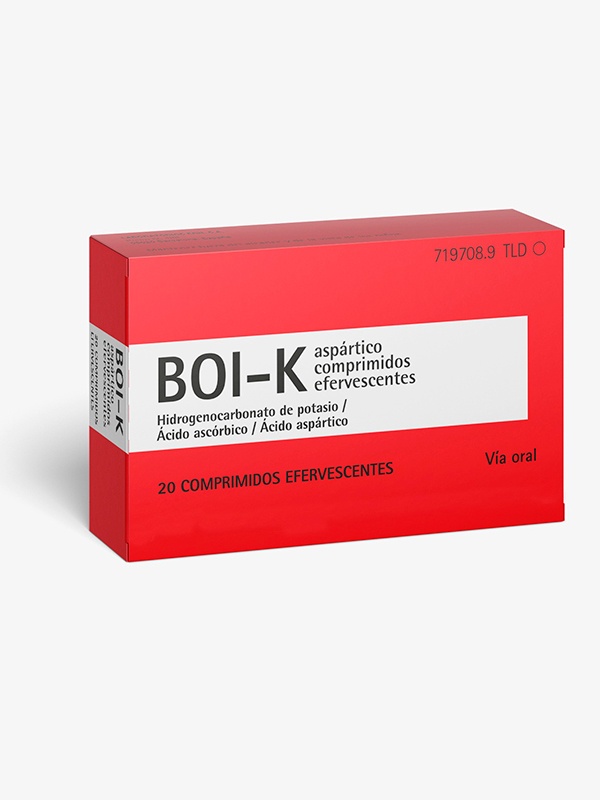
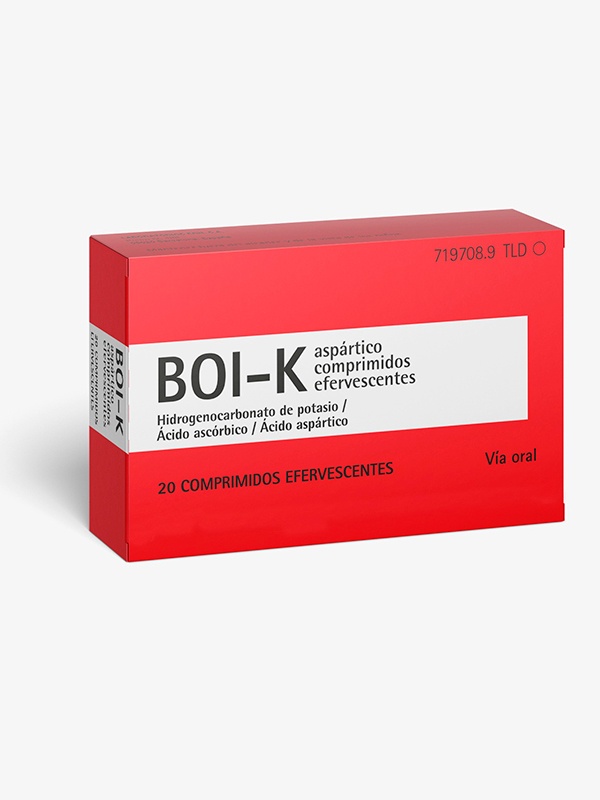
Boi-k aspartic is presented in boxes containing 20 tablets.
If the tablets appear with a yellowish color, this does not mean a loss of their therapeutic potassium activity.
Marketing authorization holder
IONFARMA, S.L.U.
Perú, 228
08020 Barcelona, Spain.
Manufacturer
Laboratorios ERN, S.A.
Gorgs Lladó, 188
08210 Barberá del Vallés – Barcelona, Spain
This leaflet was approved in April 2012.
Detailed and updated information about this medicine is available on the website of the Spanish Agency for Medicines and Health Products (AEMPS) http://www.aemps.gob.es/
-

- Country of registration
- Dosage formEFFERVESCENT TABLET, 2502.5 mg; 500 mg; 350 mg
- ATC codeA12BA30
- Average pharmacy price5.12 EUR
- Active substance
- Prescription requiredYes
- Manufacturer
- This information is for reference only and does not constitute medical advice. Always consult a doctor before taking any medication. Oladoctor is not responsible for medical decisions based on this content.
- Alternatives to BOI-K ASPARTIC ACID EFFERVESCENT TABLETSDosage form: MODIFIED-RELEASE POWDER/GRANULATE, 24 mEqActive substance: potassium (different salts in combination)Manufacturer: AdvicennePrescription requiredDosage form: MODIFIED-RELEASE POWDER/GRANULATE, 8 mEqActive substance: potassium (different salts in combination)Manufacturer: AdvicennePrescription requiredDosage form: EFFERVESCENT TABLET, 1001mg potassium bicarbonate; 250mg ascorbic acidActive substance: potassium hydrogencarbonateManufacturer: Ionfarma S.L.Prescription required

Online doctors for BOI-K ASPARTIC ACID EFFERVESCENT TABLETS
Discuss questions about BOI-K ASPARTIC ACID EFFERVESCENT TABLETS, including use, safety considerations and prescription review, subject to medical assessment and local regulations.









Get BOI-K ASPARTIC ACID EFFERVESCENT TABLETS Prescription Online
Fill in a 2-min form
Tell us your symptoms, history, and what medicine you're requesting.
Pick a doctor or let us assign
Choose a specialist or we'll match you with the next available doctor.
Doctor reviews your case
Usually within 30 minutes. They may ask follow-up questions via chat.
Collect from any pharmacy
Electronic prescription sent to your email — valid across Spain.
Frequently Asked Questions
BOI-K ASPARTIC ACID EFFERVESCENT TABLETS requires a prescription in Spain. You can check with a doctor online whether this medicine may be appropriate for your situation.
The active ingredient in BOI-K ASPARTIC ACID EFFERVESCENT TABLETS is potassium (different salts in combination). This information helps identify medicines with the same composition but different brand names.
The average pharmacy price for BOI-K ASPARTIC ACID EFFERVESCENT TABLETS is around 5.12 EUR. Prices may vary depending on the manufacturer and dosage form.
BOI-K ASPARTIC ACID EFFERVESCENT TABLETS is manufactured by Ionfarma S.L.. Pharmacy brands and packaging may differ depending on the distributor.
Doctors such as Family doctors, Psychiatrists, Dermatologists, Cardiologists, Endocrinologists, Gastroenterologists, Pulmonologists, Nephrologists, Rheumatologists, Hematologists, Infectious disease physicians, Allergists, Geriatricians, Paediatricians, Oncologists may assess whether BOI-K ASPARTIC ACID EFFERVESCENT TABLETS is appropriate, depending on your situation and local regulations. You can book an online consultation to discuss your symptoms and possible next steps.
Spain has a well-developed healthcare infrastructure across major cities such as Madrid, Barcelona, Valencia, and Seville. Pharmacies are widely available and operate under strict regulations, ensuring access to prescribed medications.
You can buy BOI-K ASPARTIC ACID EFFERVESCENT TABLETS in Madrid, Barcelona, Seville, or Valencia at any local pharmacy with a valid prescription.
To obtain a prescription, you can use Oladoctor:
Other medicines with the same active substance (potassium (different salts in combination)) include SIBNAYAL 24 mEq PROLONGED-RELEASE GRANULES, SIBNAYAL 8 mEq PROLONGED-RELEASE GRANULES, BOI-K EFFERVESCENT TABLETS. These may have different brand names or formulations but contain the same therapeutic ingredient. Always consult a doctor before switching or starting a new medicine.
