



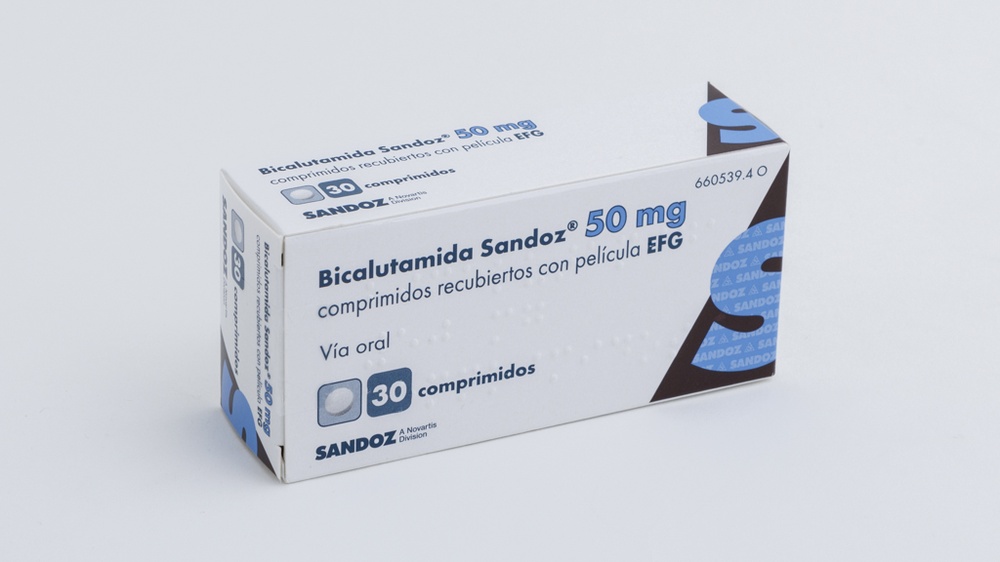
BICALUTAMIDA 50 mg Film-Coated Tablets

Prescription review online
A doctor will review your case and decide whether a prescription is medically appropriate.

Talk to a doctor about this medicine
Discuss your symptoms and possible next steps in a quick online consultation.



How to use BICALUTAMIDE SANDOZ 50 mg FILM-COATED TABLETS
Contents of the leaflet
- Introduction
- What is Bicalutamide Sandoz and what is it used for
- What you need to know before taking Bicalutamide Sandoz
- How to take Bicalutamide Sandoz
- Possible side effects
- Storage of Bicalutamide Sandoz
- Contents of the pack and further information
Introduction
Leaflet: information for the patient
Bicalutamide Sandoz 50 mg film-coated tablets EFG
Read the entire leaflet carefully before starting to take this medicine, as it contains important information for you.
- Keep this leaflet, as you may need to read it again.
- If you have any questions, ask your doctor or pharmacist.
- This medicine has been prescribed to you only, and you should not give it to others, even if they have the same symptoms as you, as it may harm them.
- If you experience side effects, consult your doctor or pharmacist, even if they are side effects not listed in this leaflet. See section 4.
Contents of the leaflet
- What is Bicalutamide Sandoz and what is it used for
- What you need to know before taking Bicalutamide Sandoz
- How to take Bicalutamide Sandoz
- Possible side effects
- Storage of Bicalutamide Sandoz
- Contents of the pack and further information
1. What is Bicalutamide Sandoz and what is it used for
Bicalutamide Sandoz belongs to a group of medicines called antiandrogens. It interferes with some of the actions of male sex hormones.
Bicalutamide Sandoz is used to treat prostate cancer. It is also used as:
- monotherapy in tumor stages called "locally advanced" or as
- combination therapy in tumor stages called "advanced", and is used in conjunction with other treatments such as surgical castration or medications that reduce the body's androgen levels.

Not sure if this medicine is right for you?
Discuss your symptoms and treatment with a doctor online.
2. What you need to know before taking Bicalutamide Sandoz
Do not take Bicalutamide Sandoz
- if you are allergic to bicalutamide or any of the other components of this medicine (listed in section 6),
- if you are a woman, child, or adolescent,
- if you are taking other medicines that contain terfenadine, astemizole, or cisapride (see "Taking Bicalutamide Sandoz with other medicines" below).
Warnings and precautions
Consult your doctor or pharmacist before starting to take bicalutamide:
- if you have any liver problems. Bicalutamide levels in your blood may increase. Your liver function may be monitored periodically,
- if you have diabetes,
- if you have any cardiovascular disease, including heart rhythm problems (arrhythmias), or are being treated with medicines for these diseases. The risk of heart rhythm problems may increase with bicalutamide treatment,
- if you are taking bicalutamide, you and/or your partner should use a contraceptive method while you are being treated with bicalutamide and for 130 days after the end of treatment. Consult your doctor if you have any questions about contraceptive methods.
Taking Bicalutamide Sandoz with other medicines
Tell your doctor or pharmacist if you are taking, have recently taken, or might take any other medicines.
If you are taking any of the following medicines, it is especially important to mention it:
- terfenadine or astemizole (for hay fever or allergies) or cisapride (for stomach disorders). See the "Do not take Bicalutamide Sandoz" section,
- oral medicines to prevent blood clotting (oral anticoagulants),
- cyclosporine (used to suppress the immune system to prevent and treat organ or bone marrow transplant rejection),
- calcium channel blockers (to treat high blood pressure or certain heart diseases),
- cimetidine (to treat stomach ulcers),
- ketoconazole (used to treat fungal infections of the skin and nails),
- oral medicines to prevent blood clots (oral anticoagulants). Anticoagulants or medicines to prevent blood clots. Your doctor may perform blood tests before and during your treatment with bicalutamide.
Bicalutamide Sandoz may interfere with some medicines used to treat heart rhythm problems (e.g., quinidine, procainamide, amiodarone, and sotalol) or may increase the risk of heart rhythm problems when used with other medicines (e.g., methadone (used to alleviate pain and as part of drug addiction detoxification treatment), moxifloxacin (an antibiotic), antipsychotics used for severe mental illnesses).
Pregnancy, breastfeeding, and fertility
Bicalutamide is not used in women. Therefore, Bicalutamide Sandoz should not be taken by women, including pregnant or breastfeeding women.
Bicalutamide may lead to limited or impaired fertility for a period of time.
Driving and using machines
These tablets may make you feel dizzy or drowsy. If you are affected in this way, do not drive or use machines.
Bicalutamide Sandoz contains lactose
If your doctor has told you that you have an intolerance to certain sugars, consult with them before taking this medicine.
Bicalutamide Sandoz contains sodium
This medicine contains less than 1 mmol of sodium (23 mg) per tablet; it is essentially "sodium-free".
3. How to take Bicalutamide Sandoz
Follow the administration instructions for this medicine exactly as indicated by your doctor. Consult your doctor or pharmacist if you have any doubts.
Depending on your overall health, the usual dose in adults is one 50 mg tablet per day (combination therapy) or three 50 mg tablets once a day (monotherapy).
- Swallow the tablets whole with water.
- You can take these tablets with or without food.
- Try to take the tablets at the same time each day.
If you take more Bicalutamide Sandoz than you should
If you have taken more bicalutamide than you should, consult your doctor or go to the nearest hospital immediately, or call the Toxicology Information Service. Phone: 91 562 04 20, indicating the medicine and the amount taken.
If you forget to take Bicalutamide Sandoz
If you forget to take the medicine, take the dose when you remember and then take the next dose at the usual time. Do not take a double dose to make up for forgotten doses.
If you stop taking Bicalutamide Sandoz
Do not stop taking your tablets, even if you feel well, unless your doctor tells you to.
If you have any other questions about the use of this medicine, ask your doctor or pharmacist.

Started taking the medicine and have questions?
Discuss your symptoms and treatment with a doctor online.
4. Possible side effects
Like all medicines, this medicine can cause side effects, although not everybody gets them.
Serious side effects:
You should contact your doctor immediately if you notice any of the following serious side effects.
Common serious side effects(may affect up to 1 in 10 patients):
- yellowing of the skin or the whites of the eyes due to liver problems or liver failure in rare cases (may affect up to 1 in 1,000 patients).
Uncommon serious side effects(may affect up to 1 in 100 patients):
- severe allergic reactions that cause swelling of the face or throat or severe itching of the skin with the appearance of lumps,
- severe difficulty breathing or sudden worsening of breathing difficulties, possibly with cough or fever. Some patients taking Bicalutamide Sandoz develop a lung disease called interstitial lung disease.
Frequency not known (cannot be estimated from available data):
- changes in the ECG (QT interval).
Other side effects:
The frequency of some side effects depends on whether bicalutamide is used in combination therapy or monotherapy.
Very common side effects(may affect more than 1 in 10 patients):
- breast tenderness or enlargement,
- weakness,
- skin rashes, very common in monotherapy although common (less than 1 in 10 patients) in combination therapy,
- reduction of red blood cells that can lead to paleness of the skin and cause weakness or shortness of breath.
Very common in combination therapy although common in monotherapy, we can find:
- hot flashes,
- dizziness,
- abdominal pain, constipation, nausea (feeling of discomfort),
- edema,
- presence of blood in the urine.
Common side effects(may affect up to 1 in 10 patients):
- loss of appetite,
- decreased libido,
- erectile dysfunction,
- depression,
- drowsiness,
- indigestion, flatulence (gas),
- hair loss, excessive body hair,
- dry skin, itching,
- weight gain,
- changes in blood tests related to liver function,
- heart attack, heart failure,
- chest pain.
Rare side effects(may affect up to 1 in 1,000 patients)
- increased sensitivity of the skin to sunlight.
Reporting side effects
If you experience any side effects, consult your doctor or pharmacist, even if they are side effects not listed in this leaflet. You can also report them directly through the Spanish Medicines Agency's website: https://www.notificaram.es.
By reporting side effects, you can help provide more information on the safety of this medicine.
5. Storage of Bicalutamide Sandoz
Keep this medicine out of the sight and reach of children.
Do not use this medicine after the expiration date stated on the packaging and blister after EXP. The expiration date is the last day of the month indicated.
Do not store above 25°C.
Medicines should not be disposed of via wastewater or household waste. Return the packaging and any unused medicine to a pharmacy for proper disposal. If you have any questions, ask your pharmacist. By doing so, you will help protect the environment.
6. Contents of the pack and further information
Composition of Bicalutamide Sandoz
- The active substance is bicalutamide. Each film-coated tablet contains 50 mg of bicalutamide.
- The other ingredients are:
- Tablet core:lactose monohydrate, sodium carboxymethyl starch (type A) (derived from potato starch), povidone K 30 (E1201), corn starch, and magnesium stearate (E572).
- Tablet coating:methylcellulose, titanium dioxide (E171), and glycerol triacetate (E1518).
Appearance of the product and pack contents
White, round, film-coated tablet with an approximate diameter of 7mm.
The cardboard boxes with PVC/Aclar/Al blisters may contain 10, 28, 30, 56, 84, 90, or 100 film-coated tablets.
The cardboard boxes with unit dose PVC/Aclar/Al blisters may contain 100 film-coated tablets.
Not all pack sizes may be marketed.
Marketing authorization holder and manufacturer
Marketing authorization holder
Sandoz Farmacéutica, S.A.
Centro Empresarial Parque Norte
Edificio Roble
C/ Serrano Galvache, 56
28033 Madrid
Spain
Manufacturer
Salutas Pharma GmbH
Otto-von-Guericke-Allee 1
39179 Barleben
Germany
or
Lek Pharmaceuticals d.d.
Verovskova 57
1526 Ljubljana
Slovenia
This medicine is authorized in the Member States of the European Economic Area under the following names:
Austria: Bicalutamid "Hexal" 50 mg - Filmtabletten
Denmark: Bicalutamid HEXAL
Finland: Bicalutamid Hexal
France: BICALUTAMIDE GNR 50 mg, comprimé pelliculé
Germany: Bicalutamid HEXAL 50 mg Filmtabletten
Ireland: Biluta 50 mg Film-Coated Tablets
Italy: BICALUTAMIDE HEXAL 50 mg compresse rivestite con film
Luxembourg: Bicalutamid HEXAL 50 mg Filmtabletten
Netherlands: Bicalutamide 50 mg, filmomhulde tabletten
Poland: BicaHEXAL 50
Spain: Bicalutamida Sandoz 50 mg comprimidos recubiertos con película EFG
Date of last revision of this leaflet:February 2019
Detailed and updated information on this medicine is available on the website of the Spanish Agency for Medicines and Health Products (AEMPS) http://www.aemps.gob.es/
- Country of registration
- Dosage formTABLET, 50 mg
- ATC codeL02BB03
- Average pharmacy price42.37 EUR
- Active substance
- Prescription requiredYes
- Manufacturer
- CompositionLACTOSA MONOHIDRATO (60.15 mg mg), CARBOXIMETILALMIDON SODICO (8.40 mg mg)
- This information is for reference only and does not constitute medical advice. Always consult a doctor before taking any medication. Oladoctor is not responsible for medical decisions based on this content.
- Alternatives to BICALUTAMIDE SANDOZ 50 mg FILM-COATED TABLETSDosage form: TABLET, 50 mgActive substance: bicalutamideManufacturer: Accord Healthcare S.L.U.Prescription requiredDosage form: TABLET, 50 mgActive substance: bicalutamideManufacturer: Almus Farmaceutica S.A.U.Prescription requiredDosage form: TABLET, 150 mgActive substance: bicalutamideManufacturer: Eugia Pharma (Malta) LimitedPrescription required
Online doctors for BICALUTAMIDE SANDOZ 50 mg FILM-COATED TABLETS
Discuss questions about BICALUTAMIDE SANDOZ 50 mg FILM-COATED TABLETS, including use, safety considerations and prescription review, subject to medical assessment and local regulations.


Get BICALUTAMIDE SANDOZ 50 mg FILM-COATED TABLETS Prescription Online
Fill in a 2-min form
Tell us your symptoms, history, and what medicine you're requesting.
Pick a doctor or let us assign
Choose a specialist or we'll match you with the next available doctor.
Doctor reviews your case
Usually within 30 minutes. They may ask follow-up questions via chat.
Collect from any pharmacy
Electronic prescription sent to your email — valid across Spain.
Frequently Asked Questions
BICALUTAMIDE SANDOZ 50 mg FILM-COATED TABLETS requires a prescription in Spain. You can check with a doctor online whether this medicine may be appropriate for your situation.
The active ingredient in BICALUTAMIDE SANDOZ 50 mg FILM-COATED TABLETS is bicalutamide. This information helps identify medicines with the same composition but different brand names.
The average pharmacy price for BICALUTAMIDE SANDOZ 50 mg FILM-COATED TABLETS is around 42.37 EUR. Prices may vary depending on the manufacturer and dosage form.
BICALUTAMIDE SANDOZ 50 mg FILM-COATED TABLETS is manufactured by Sandoz Farmaceutica S.A.. Pharmacy brands and packaging may differ depending on the distributor.
Doctors such as Family doctors, Psychiatrists, Dermatologists, Cardiologists, Endocrinologists, Gastroenterologists, Pulmonologists, Nephrologists, Rheumatologists, Hematologists, Infectious disease physicians, Allergists, Geriatricians, Paediatricians, Oncologists may assess whether BICALUTAMIDE SANDOZ 50 mg FILM-COATED TABLETS is appropriate, depending on your situation and local regulations. You can book an online consultation to discuss your symptoms and possible next steps.
Spain has a well-developed healthcare infrastructure across major cities such as Madrid, Barcelona, Valencia, and Seville. Pharmacies are widely available and operate under strict regulations, ensuring access to prescribed medications.
You can buy BICALUTAMIDE SANDOZ 50 mg FILM-COATED TABLETS in Madrid, Barcelona, Seville, or Valencia at any local pharmacy with a valid prescription.
To obtain a prescription, you can use Oladoctor:
Other medicines with the same active substance (bicalutamide) include BICALUTAMIDE ACCORD 50 mg FILM-COATED TABLETS, BICALUTAMIDE ALMUS 50 mg FILM-COATED TABLETS, BICALUTAMIDE AUROVITAS 150 mg FILM-COATED TABLETS. These may have different brand names or formulations but contain the same therapeutic ingredient. Always consult a doctor before switching or starting a new medicine.
