



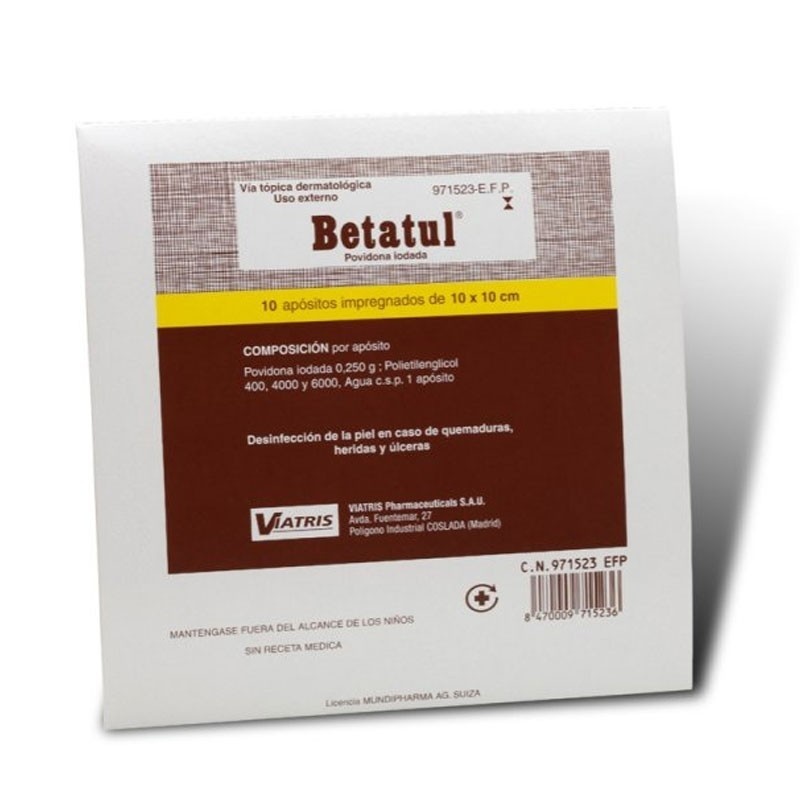
BETATUL 250 mg Impregnated Dressing

Prescription review online
A doctor will review your case and decide whether a prescription is medically appropriate.

Talk to a doctor about this medicine
Discuss your symptoms and possible next steps in a quick online consultation.



How to use BETATUL 250 MG IMPREGNATED DRESSING
Contents of the leaflet
- Introduction
- What is Betatul and what is it used for
- What you need to know before starting to use Betatul
- How to Use Betatul
- Possible Side Effects
- Storage of Betatul
- Package Contents and Additional Information
Introduction
Package Leaflet: Information for the User
Betatul 250 mg Impregnated Dressing
Povidone Iodine
Read the entire package leaflet carefully before starting to use this medication, as it contains important information for you.
Follow the administration instructions for the medication contained in this package leaflet or as indicated by your doctor, pharmacist, or nurse.
- Keep this package leaflet, as you may need to read it again.
- If you need advice or more information, consult your pharmacist.
- If you experience side effects, consult your doctor, pharmacist, or nurse, even if they are side effects not listed in this package leaflet. See section 4.
- You should consult a doctor if it worsens or does not improve.
Contents of the Package Leaflet
- What is Betatul and what is it used for
- What you need to know before starting to use Betatul
- How to use Betatul
- Possible side effects
- Storage of Betatul
- Package Contents and Additional Information
1. What is Betatul and what is it used for
The active ingredient of this medication, povidone iodine, is an antiseptic (which destroys germs that cause infections) that contains iodine.
Betatul is indicated as a general skin antiseptic for small wounds and superficial cuts, minor burns, and abrasions.

Not sure if this medicine is right for you?
Discuss your symptoms and treatment with a doctor online.
2. What you need to know before starting to use Betatul
Do not use Betatul
- If you are allergic to povidone iodine or any of the other components of this medication (listed in section 6).
- If you have hyperthyroidism or other acute thyroid diseases.
- Before, during, and after the administration of radioactive iodine.
- With products that contain mercury due to the formation of a substance that can damage the skin.
- In children under 1 year of age.
Warnings and Precautions
Consult your doctor, pharmacist, or nurse before starting to use Betatul.
External use only. Do not ingest. Avoid contact with eyes, ears, and other mucous membranes. Consult your doctor if symptoms persist or worsen.
Patients with goiter, thyroid nodules, or other non-acute thyroid diseases are at risk of developing hyperthyroidism with the administration of high amounts of iodine. In these patients, it should not be applied for prolonged periods or to extensive skin areas unless strictly indicated. Even after treatment, be alert for early symptoms of possible hyperthyroidism and, if necessary, monitor thyroid function.
It should not be used before or after a radioactive iodine scan or treatment of thyroid carcinoma with radioactive iodine.
Thyroid function tests should be performed in case of prolonged use.
Children
Newborns and young children are at greater risk of developing hypothyroidism. If used in children, it is essential to monitor the thyroid.
Use in children under 1 year of age is not recommended.
Using Betatul with Other Medications
Inform your doctor or pharmacist if you are using, have recently used, or may need to use any other medication.
Do not use with mercurial derivatives, silver, hydrogen peroxide, or taurolidine (antiseptics).
Continuous use should be avoided in patients undergoing simultaneous therapy with lithium (used in psychiatry).
When used simultaneously or after antiseptics with octenidine, transient dark discoloration of the involved areas may occur.
Interaction with diagnostic tests: the use of povidone iodine may lead to errors in tests with toluidine or guaiacol to determine hemoglobin or glucose in feces or urine. It may also interfere with thyroid tests and treatments with radioactive iodine.
Inform your doctor when you need to undergo any diagnostic test.
Inform your doctor if:
- Symptoms do not improve or worsen
- You have received radioactive iodine treatments in the last 4 weeks.
- You have an allergy or skin irritation such as redness, small blisters, itching, or rash that may appear immediately.
Pregnancy, Breastfeeding, and Fertility
If you are pregnant or breastfeeding, think you may be pregnant, or plan to become pregnant, consult your doctor or pharmacist before using this medication.
Use only if strictly indicated; its use should be kept to a minimum. Avoid continuous use.
Its use could produce transient hypothyroidism in fetuses and newborns. Thyroid monitoring may be necessary in children.
You should consult your doctor about use in children between 1 and 2 years of age.
Driving and Using Machines
Betadine does not affect the ability to drive or use machinery.
3. How to Use Betatul
Follow the administration instructions for the medication contained in this package leaflet or as indicated by your doctor, pharmacist, or nurse. In case of doubt, ask your doctor, pharmacist, or nurse.
Topical use. After washing and drying, apply directly to the affected area. Cover with a gauze or cotton swab. Secure with a bandage.
Change every day or every 2 days.
If you use more Betatul than you should
In case of excessive application of the product and skin irritation, wash the affected area with plenty of water, suspend treatment, and if irritation continues, consult a doctor.
Symptoms could be abdominal pain, anuria (suppression or decreased urine output), circulatory, respiratory, and metabolic problems. Excess iodine can cause goiter, hypothyroidism, and hyperthyroidism.
In case of accidental ingestion, go to a medical center or call the Toxicology Information Service, phone: 91 562 04 20, indicating the product and the amount ingested.
If you have any other doubts about using this medication, ask your doctor, pharmacist, or nurse.

Started taking the medicine and have questions?
Discuss your symptoms and treatment with a doctor online.
4. Possible Side Effects
Like all medications, this medication can cause side effects, although not everyone will experience them.
In rare cases where skin irritation or allergy occurs, suspend treatment and wash the affected area with water.
Rare side effects (may affect between 1 and 10 out of 10,000 people) are hypersensitivity and contact dermatitis, which manifests with red skin, small blisters, and itching.
Very rare side effects (may affect less than 1 in 10,000 people) include anaphylactic reactions (severe allergic reaction), hyperthyroidism with tachycardia and agitation, and angioedema (swelling caused by allergy).
Other side effects of unknown frequency include hypothyroidism, electrolyte imbalance, metabolic acidosis, acute renal failure, abnormal blood osmolarity, exfoliative dermatitis, dry skin, skin discoloration, and chemical burns to the skin.
If you consider any of the side effects you are experiencing to be serious or if you notice any side effect not mentioned in this package leaflet, inform your doctor or pharmacist.
Reporting Side Effects
If you experience any type of side effect, consult your doctor, pharmacist, or nurse, even if it is a possible side effect not listed in this package leaflet. You can also report them directly through the Spanish Medication Surveillance System for Human Use (https://www.notificaram.es). By reporting side effects, you can contribute to providing more information on the safety of this medication.
5. Storage of Betatul
Keep this medication out of sight and reach of children.
Store below 30°C in its original packaging to protect it from light and moisture.
Do not use this medication after the expiration date shown on the packaging after CAD or EXP. The expiration date is the last day of the month indicated.
Medications should not be disposed of through wastewater or household waste. Deposit the packaging and medications you no longer need at the SIGRE Point in the pharmacy. If in doubt, ask your pharmacist how to dispose of the packaging and medications you no longer need. This will help protect the environment.
6. Package Contents and Additional Information
Composition of Betatul
The active ingredient is povidone iodine. Each 10 x 10 cm impregnated gel dressing contains 250 mg of povidone iodine. The other components (excipients) are: polyethylene glycol 400, polyethylene glycol 4000, polyethylene glycol 6000, purified water, and hydrophilic gauze.
Appearance of the Product and Package Contents
Package containing 10 polypropylene sachets with 1 impregnated dressing each.
Marketing Authorization Holder and Manufacturer
Marketing Authorization Holder
Cooper Consumer Health B.V.
Verrijn Stuartweg 60,
1112 AX Diemen,
Netherlands
Manufacturer
MEDA Manufacturing, Bordeaux
Av. Pdt. J. F. Kennedy. BP 100
Merignac – Cedex
F-33700
France
You can request more information about this medication by contacting the local representative of the Marketing Authorization Holder:
Vemedia Pharma Hispania, S.A.
C/ Aragón, 182, 5th floor
08011 Barcelona
Spain
Date of the Last Revision of this Package Leaflet:August 2022
Detailed and updated information about this medication is available on the website of the Spanish Agency for Medicines and Health Products (AEMPS) https://www.aemps.gob.es/
- Country of registration
- Dosage formDRESSING, 0.250 g povidone iodine
- ATC codeD09AA09
- Active substance
- Prescription requiredNo
- Manufacturer
- This information is for reference only and does not constitute medical advice. Always consult a doctor before taking any medication. Oladoctor is not responsible for medical decisions based on this content.
- Alternatives to BETATUL 250 MG IMPREGNATED DRESSINGDosage form: DRESSING, 0.350 gActive substance: povidone-iodineManufacturer: Cooper Consumer Health B.V.Prescription not requiredDosage form: DRESSING, 0.185 mg / 1.678 mgActive substance: Soft paraffin dressingsManufacturer: Alfasigma Espana S.L.Prescription not required
Online doctors for BETATUL 250 MG IMPREGNATED DRESSING
Discuss questions about BETATUL 250 MG IMPREGNATED DRESSING, including use, safety considerations and prescription review, subject to medical assessment and local regulations.



Get BETATUL 250 MG IMPREGNATED DRESSING Prescription Online
Fill in a 2-min form
Tell us your symptoms, history, and what medicine you're requesting.
Pick a doctor or let us assign
Choose a specialist or we'll match you with the next available doctor.
Doctor reviews your case
Usually within 30 minutes. They may ask follow-up questions via chat.
Collect from any pharmacy
Electronic prescription sent to your email — valid across Spain.
Frequently Asked Questions
BETATUL 250 MG IMPREGNATED DRESSING does not require a prescription in Spain. You can check with a doctor online whether this medicine may be appropriate for your situation.
The active ingredient in BETATUL 250 MG IMPREGNATED DRESSING is povidone-iodine. This information helps identify medicines with the same composition but different brand names.
BETATUL 250 MG IMPREGNATED DRESSING is manufactured by Cooper Consumer Health B.V.. Pharmacy brands and packaging may differ depending on the distributor.
Doctors such as Family doctors, Psychiatrists, Dermatologists, Cardiologists, Endocrinologists, Gastroenterologists, Pulmonologists, Nephrologists, Rheumatologists, Hematologists, Infectious disease physicians, Allergists, Geriatricians, Paediatricians, Oncologists may assess whether BETATUL 250 MG IMPREGNATED DRESSING is appropriate, depending on your situation and local regulations. You can book an online consultation to discuss your symptoms and possible next steps.
Spain has a well-developed healthcare infrastructure across major cities such as Madrid, Barcelona, Valencia, and Seville. Pharmacies are widely available and operate under strict regulations, ensuring access to prescribed medications.
You can buy BETATUL 250 MG IMPREGNATED DRESSING in Madrid, Barcelona, Seville, or Valencia at any local pharmacy with a valid prescription.
To obtain a prescription, you can use Oladoctor:
Other medicines with the same active substance (povidone-iodine) include BETADINE 350 MG IMPREGNATED DRESSING, LINITUL CICATRIZANTE IMPREGNATED DRESSING. These may have different brand names or formulations but contain the same therapeutic ingredient. Always consult a doctor before switching or starting a new medicine.
