



ATOSIBAN 37.5 mg/5 ml Injectable Perfusion

Prescription review online
A doctor will review your case and decide whether a prescription is medically appropriate.

Talk to a doctor about this medicine
Discuss your symptoms and possible next steps in a quick online consultation.



How to use Atosiban SUN 37.5 mg/5 ml concentrate for infusion solution
Contents of the leaflet
- Introduction
- What is Atosiban SUN and what is it used for
- What you need to know before you are given Atosiban SUN
- How you will be given Atosiban SUN
- Possible side effects
- Storage of Atosiban SUN
- Contents of the pack and other information
Introduction
Package Leaflet: Information for the User
Atosiban SUN 37.5 mg/5 ml concentrate for solution for infusion EFG
atosiban
Read all of this leaflet carefully before you start taking this medicine because it contains important information for you.
- Keep this leaflet, you may need to read it again.
- If you have any further questions, ask your doctor, midwife or pharmacist.
- If you get any side effects, talk to your doctor, pharmacist or nurse. This includes any possible side effects not listed in this leaflet. See section 4.
Contents of the pack
- What is Atosiban SUN and what is it used for
- What you need to know before you are given Atosiban SUN
- How you will be given Atosiban SUN
- Possible side effects
- Storage of Atosiban SUN
- Contents of the pack and other information
1. What is Atosiban SUN and what is it used for
Atosiban SUN contains atosiban. Atosiban SUN is used to delay premature birth of your baby. Atosiban SUN is used in pregnant women from the 24th week to the 33rd week of pregnancy.
Atosiban SUN works by making the contractions of your uterus (womb) less strong. It also makes the contractions happen less often. This happens because it prevents the natural hormone called "oxytocin", which causes the womb to contract, from working.

Not sure if this medicine is right for you?
Discuss your symptoms and treatment with a doctor online.
2. What you need to know before you are given Atosiban SUN
You should not be given Atosiban SUN
- If you are allergic to atosiban or any of the other ingredients of this medicine (listed in section 6).
- If you are less than 24 weeks pregnant.
- If you are more than 33 weeks pregnant.
- If your waters have broken (premature rupture of membranes) and you are 30 weeks pregnant or more.
- If your baby (fetus) has an abnormal heart beat.
- If you are bleeding from the vagina and your doctor wants you to go into labour so that your baby can be born immediately.
- If you have something called "severe pre-eclampsia" and your doctor wants you to go into labour so that your baby can be born immediately. Severe pre-eclampsia is when you have very high blood pressure, fluid retention and/or protein in the urine.
- If you have something called "eclampsia" which is similar to "severe pre-eclampsia" but you also have fits. This means that labour should be started so that your baby can be born immediately.
- If your baby has died.
- If you have or may have an infection in the womb (uterus).
- If your placenta is blocking the birth canal.
- If your placenta is separating from the wall of your womb.
- If you or your baby have other conditions that could be dangerous to continue with the pregnancy.
Do not use Atosiban SUN if you are affected by any of these situations. If you are not sure, tell your doctor, midwife or pharmacist before you are given Atosiban SUN.
Warnings and precautions
Tell your doctor, midwife or pharmacist before you are given Atosiban SUN:
- If you think your waters have broken (premature rupture of membranes).
- If you have kidney or liver problems.
- If you are between 24 and 27 weeks pregnant.
- If you are pregnant with more than one baby.
- If you have contractions again, treatment with Atosiban SUN can be repeated up to three times more.
- If your baby is small for the duration of the pregnancy.
- Your womb may not be able to contract after the birth of your baby. This can cause bleeding.
- If you are pregnant with more than one baby and/or are taking medicines that may delay the birth of your baby, such as medicines used for high blood pressure. This can increase the risk of fluid in the lungs (pulmonary oedema).
If you have any of these conditions (or are unsure), tell your doctor, midwife or pharmacist before you are given Atosiban SUN.
Children and adolescents
Atosiban SUN has not been studied in pregnant women under 18 years of age.
Using Atosiban SUN with other medicines
Tell your doctor, midwife or pharmacist if you are taking, have recently taken or might take any other medicines.
Pregnancy and breast-feeding
If you are pregnant and breast-feeding a baby, you should stop breast-feeding during treatment with Atosiban SUN.
3. How you will be given Atosiban SUN
Atosiban SUN will be given to you in a hospital by a doctor, nurse or midwife. They will decide how much you need. They will also make sure that the solution is clear and free of particles.
Atosiban SUN is given into a vein (intravenously) in three stages:
- A first intravenous injection of 6.75 mg in 0.9 ml is given slowly into a vein over one minute.
- Then, a continuous infusion (drip) of 18 mg per hour is given for 3 hours.
- Then, a continuous infusion (drip) of 6 mg per hour is given for up to 45 hours, or until the uterine contractions have stopped.
The total duration of treatment should not be more than 48 hours.
More treatments with Atosiban SUN can be given if you have contractions again. Treatment with Atosiban SUN can be repeated up to three times more.
During treatment with Atosiban SUN, your contractions and your baby's heart rate can be monitored.
It is recommended not to repeat treatment more than three times during a pregnancy.

Started taking the medicine and have questions?
Discuss your symptoms and treatment with a doctor online.
4. Possible side effects
Like all medicines, this medicine can cause side effects, although not everybody gets them. The side effects seen in mothers were generally mild. There are no known side effects on the fetus or newborn.
The following side effects may happen with this medicine:
Very common (affect more than 1 in 10 people)
- Feeling sick (nausea).
Common (affect less than 1 in 10 people)
- Headache.
- Feeling dizzy.
- Flushes.
- Being sick (vomiting).
- Fast heart rate.
- Low blood pressure. The signs can include feeling dizzy or faint.
- Reaction at the injection site.
- Increased blood sugar.
Uncommon (affect less than 1 in 100 people)
- Increased temperature (fever).
- Difficulty sleeping (insomnia).
- Itching.
- Rash.
Rare (affect less than 1 in 1,000 people)
- Your womb may not be able to contract after the birth of your baby. This can cause bleeding.
- Allergic reactions.
You may experience difficulty breathing or fluid in the lungs (pulmonary oedema), especially if you are pregnant with more than one baby and/or are taking other medicines that may delay the birth of your baby, such as medicines used for high blood pressure.
Reporting of side effects
If you get any side effects, talk to your doctor, pharmacist or nurse. This includes any possible side effects not listed in this leaflet. You can also report side effects directly via the national reporting system listed in Appendix V. By reporting side effects you can help provide more information on the safety of this medicine.
5. Storage of Atosiban SUN
Keep this medicine out of the sight and reach of children.
Do not use this medicine after the expiry date which is stated on the label after EXP. The expiry date is the last day of the month shown.
Store in a refrigerator (2°C - 8°C). The intravenous infusions should be used within 24 hours of preparation.
Store in the original package to protect from light.
Do not use this medicine if you notice particles or discolouration of the contents before administration.
Medicines should not be disposed of via wastewater or household waste. Ask your pharmacist how to dispose of medicines no longer required. This will help protect the environment.
6. Contents of the pack and other information
What is in Atosiban SUN
- The active substance is atosiban.
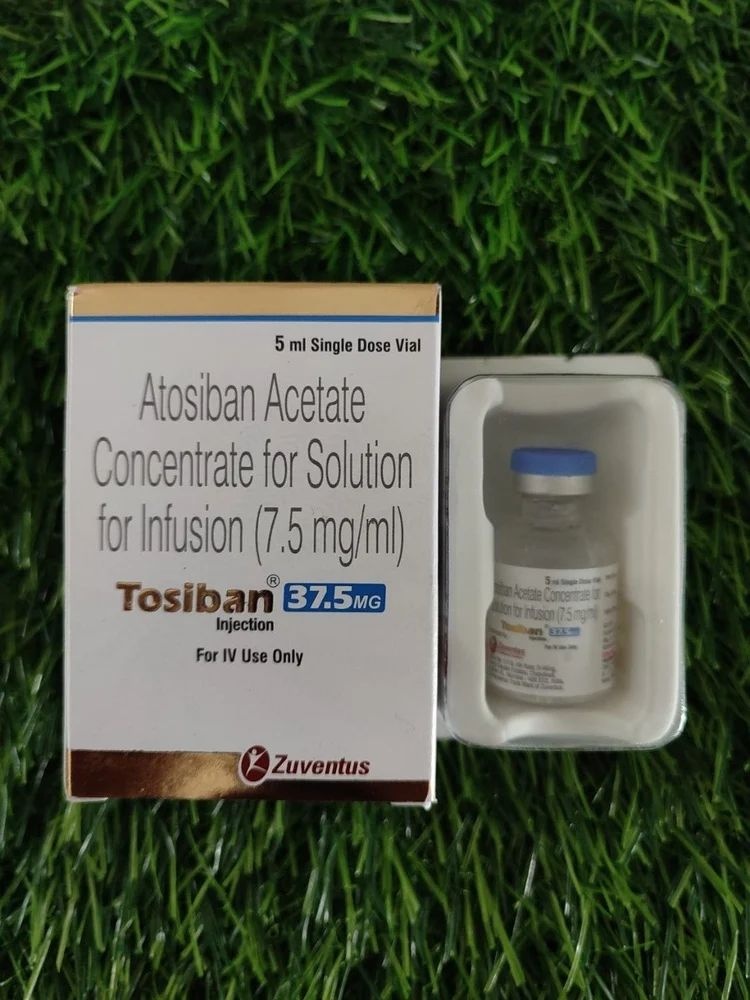
- Each vial of Atosiban SUN 37.5 mg/5 ml concentrate for solution for infusion contains atosiban acetate equivalent to 37.5 mg of atosiban in 5 ml.
- The other ingredients are mannitol, hydrochloric acid 1M and water for injections.
Appearance and packaging
Atosiban SUN 37.5 mg/5 ml concentrate for solution for infusion is a clear, colourless solution without particles.
One pack contains one vial containing 5 ml of solution.
Marketing authorisation holder and manufacturer
Sun Pharmaceutical Industries Europe B.V.
Polarisavenue 87
2132 JH Hoofddorp
Netherlands
You can get more information about this medicine from the local representative of the marketing authorisation holder.
Germany
Sun Pharmaceuticals Germany GmbH
Hemmelrather Weg 201
51377 Leverkusen
Germany
tel. +49 214 403 990
Spain
Sun Pharma Laboratorios, S.L.
Rambla de Catalunya 53-55
08007 Barcelona
Spain
tel. +34 93 342 78 90
France
Sun Pharma France
31 Rue des Poissonniers
92200 Neuilly-Sur-Seine
France
tel. +33 1 41 44 44 50
Italy
Sun Pharma Italia Srl
Viale Giulio Richard, 3
20143 Milano
Italy
tel. +39 02 33 49 07 93
Poland
Ranbaxy (Poland) Sp. z o.o.
ul. Idzikowskiego 16
00-710 Warszawa
Poland
tel. +48 22 642 07 75
Romania
Terapia S.A.
Str. Fabricii nr 124
Cluj-Napoca, Judetul Cluj
Romania
tel. +40 (264) 501 500
United Kingdom (Northern Ireland)
Ranbaxy UK Ltd
a Sun Pharma Company
Millington Road 11
Hyde Park, Hayes 3
5th Floor
UB3 4AZ HAYES
United Kingdom
tel. +44 (0) 208 848 8688
Date of last revision of this leaflet:
Other sources of information
Detailed information on this medicine is available on the European Medicines Agency web site: http://www.ema.europa.eu.
Information intended for healthcare professionals only
This information is intended for healthcare professionals only: (See also section 3).
Instructions for use:
Before using Atosiban SUN, the solution should be examined to ensure it is clear and free of particles.
Atosiban SUN is administered intravenously in three successive stages:
- A first intravenous injection of 6.75 mg in 0.9 ml is given slowly into a vein over one minute.
- A continuous infusion is given for 3 hours at a rate of 24 ml/hour.
- A continuous infusion is given for up to 45 hours, or until the uterine contractions have stopped, at a rate of 8 ml/hour.
The total duration of treatment should not be more than 48 hours. New cycles of treatment with Atosiban SUN can be given if contractions start again. It is recommended not to repeat treatment more than three times during a pregnancy.
Preparation of the intravenous infusion
The intravenous infusion is prepared by diluting Atosiban SUN 37.5 mg/5 ml, concentrate for solution for infusion in a solution of sodium chloride 9 mg/ml (0.9%) for injection, in a solution of Ringer's lactate, or in a solution of glucose 5% w/v. This is achieved by withdrawing 10 ml of solution from a 100 ml infusion bag and replacing it with 10 ml of Atosiban SUN 37.5 mg/5 ml, concentrate for solution for infusion from two 5 ml vials to obtain a concentration of atosiban of 75 mg in 100 ml. If an infusion bag with a different volume is used, a proportional calculation should be made for preparation.
Atosiban SUN should not be mixed with other medicines in the infusion bag.
- Country of registration
- Dosage formINJECTABLE PERFUSION, 37.5 mg / 5 ml
- ATC codeG02CX01
- Availability in pharmaciesSupply issue reported
- Active substance
- Prescription requiredYes
- Manufacturer
- CompositionMANITOL (E-421) (250 mg mg)
- This information is for reference only and does not constitute medical advice. Always consult a doctor before taking any medication. Oladoctor is not responsible for medical decisions based on this content.
- Alternatives to Atosiban SUN 37.5 mg/5 ml concentrate for infusion solutionDosage form: INJECTABLE PERFUSION, 7.5 mg/mlActive substance: atosibanManufacturer: Altan Pharmaceuticals SaPrescription requiredDosage form: INJECTABLE, 7.5 mg/mlActive substance: atosibanManufacturer: Altan Pharmaceuticals SaPrescription requiredDosage form: INJECTABLE PERFUSION, 7.5 mg/mlActive substance: atosibanManufacturer: Ever Valinject GmbhPrescription required
Online doctors for Atosiban SUN 37.5 mg/5 ml concentrate for infusion solution
Discuss questions about Atosiban SUN 37.5 mg/5 ml concentrate for infusion solution, including use, safety considerations and prescription review, subject to medical assessment and local regulations.
Get Atosiban SUN 37.5 mg/5 ml concentrate for infusion solution Prescription Online
Fill in a 2-min form
Tell us your symptoms, history, and what medicine you're requesting.
Pick a doctor or let us assign
Choose a specialist or we'll match you with the next available doctor.
Doctor reviews your case
Usually within 30 minutes. They may ask follow-up questions via chat.
Collect from any pharmacy
Electronic prescription sent to your email — valid across Spain.
Frequently Asked Questions
Atosiban SUN 37.5 mg/5 ml concentrate for infusion solution requires a prescription in Spain. You can check with a doctor online whether this medicine may be appropriate for your situation.
The active ingredient in Atosiban SUN 37.5 mg/5 ml concentrate for infusion solution is atosiban. This information helps identify medicines with the same composition but different brand names.
Atosiban SUN 37.5 mg/5 ml concentrate for infusion solution is manufactured by Sun Pharmaceutical Industries (Europe) B.V.. Pharmacy brands and packaging may differ depending on the distributor.
Doctors such as Family doctors, Psychiatrists, Dermatologists, Cardiologists, Endocrinologists, Gastroenterologists, Pulmonologists, Nephrologists, Rheumatologists, Hematologists, Infectious disease physicians, Allergists, Geriatricians, Paediatricians, Oncologists may assess whether Atosiban SUN 37.5 mg/5 ml concentrate for infusion solution is appropriate, depending on your situation and local regulations. You can book an online consultation to discuss your symptoms and possible next steps.
Spain has a well-developed healthcare infrastructure across major cities such as Madrid, Barcelona, Valencia, and Seville. Pharmacies are widely available and operate under strict regulations, ensuring access to prescribed medications.
You can buy Atosiban SUN 37.5 mg/5 ml concentrate for infusion solution in Madrid, Barcelona, Seville, or Valencia at any local pharmacy with a valid prescription.
To obtain a prescription, you can use Oladoctor:
Other medicines with the same active substance (atosiban) include ATOSIBAN ALTAN 37.5 mg/5 ml CONCENTRATE FOR INFUSION SOLUTION, ATOSIBAN ALTAN 6.75 mg/0.9 mL Injectable Solution, ATOSIBAN EVER PHARMA 37.5 mg/5 ml CONCENTRATE FOR INFUSION SOLUTION. These may have different brand names or formulations but contain the same therapeutic ingredient. Always consult a doctor before switching or starting a new medicine.
