



ATORVASTATINA 20 mg Film-Coated Tablets

Prescription review online
A doctor will review your case and decide whether a prescription is medically appropriate.

Talk to a doctor about this medicine
Discuss your symptoms and possible next steps in a quick online consultation.



How to use ATORVASTATIN VIATRIS 20 mg FILM-COATED TABLETS
Contents of the leaflet
- Introduction
- What is Atorvastatin Viatris and what is it used for
- What you need to know before you take Atorvastatin Viatris
- How to take Atorvastatin Viatris
- Possible side effects
- Storage of Atorvastatin Viatris
- Container Content and Additional Information
Introduction
Patient Information Leaflet
Atorvastatin Viatris 20 mg film-coated tablets EFG
Read this leaflet carefully before you start taking this medicine because it contains important information for you.
- Keep this leaflet, you may need to read it again.
- If you have any further questions, ask your doctor or pharmacist.
- This medicine has been prescribed for you only. Do not pass it on to others. It may harm them, even if their signs of illness are the same as yours.
- If you get any side effects, talk to your doctor or pharmacist. This includes any possible side effects not listed in this leaflet. See section 4.
Contents of the pack
- What is Atorvastatin Viatris and what is it used for
- What you need to know before you take Atorvastatin Viatris
- How to take Atorvastatin Viatris
- Possible side effects
- Storage of Atorvastatin Viatris
- Contents of the pack and other information
1. What is Atorvastatin Viatris and what is it used for
Atorvastatin Viatris belongs to a group of medicines known as statins, which are lipid-modifying medicines.
Atorvastatin is used to lower lipid levels such as cholesterol and other fats (triglycerides) in the blood when a low-fat diet and lifestyle changes on their own have not worked. If you are at high risk of heart disease, Atorvastatin Viatris can be used to reduce this risk even if your cholesterol levels are normal.
During treatment, you should follow a standard cholesterol-lowering diet.

Not sure if this medicine is right for you?
Discuss your symptoms and treatment with a doctor online.
2. What you need to know before you take Atorvastatin Viatris
Do not take Atorvastatin Viatris:
- If you are allergic to atorvastatin or to any other similar medicine used to lower blood lipid levels or to any of the other ingredients of this medicine (listed in section 6).
- If you are taking the combination of glecaprevir/pibrentasvir in the treatment of hepatitis C.
- If you have or have had liver disease.
- If you have or have had unexplained abnormal blood test results indicating liver function.
- If you are a woman able to have children and are not using adequate contraceptive measures.
- If you are pregnant or trying to become pregnant.
- If you are breast-feeding.
Warnings and precautions
Consult your doctor or pharmacist before taking Atorvastatin Viatris:
-If you have or have had muscular dystrophy (a disease characterized by generalized muscle weakness that can affect the muscles used for breathing) or ocular myasthenia (a disease that causes weakness of the eye muscles), as statins can sometimes worsen the disease or cause myasthenia to appear (see section 4).
- If you have severe respiratory failure.
- If you have had a previous stroke or transient ischaemic attack (TIA), or a haemorrhagic stroke, or have small fluid-filled areas in the brain from previous strokes.
- If you have kidney problems.
- If you have an underactive thyroid gland (hypothyroidism).
- If you have repeated or unexplained muscle pain, personal or family history of muscle problems.
- If you have had muscle problems while taking other lipid-lowering medicines (e.g. other statins or fibrates).
- If you regularly drink large amounts of alcohol.
- If you have a history of liver problems.
- If you are over 70 years old.
- If you are taking or have taken in the last 7 days a medicine containing fusidic acid (used to treat bacterial infections) orally or by injection. The combination of fusidic acid and atorvastatin can cause serious muscle problems (rhabdomyolysis).
In any of these cases, your doctor may indicate that you should have a blood test before and possibly during treatment with atorvastatin to predict the risk of muscle-related side effects. It is known that the risk of muscle-related side effects (e.g. rhabdomyolysis) increases when certain medicines are taken at the same time (see section 2, "Other medicines and Atorvastatin Viatris").
While taking this medicine, your doctor will monitor you if you have diabetes or are at risk of developing it. You are likely to be at risk of developing diabetes if you have high levels of sugar and fat in your blood, are overweight, and have high blood pressure.
Also, inform your doctor or pharmacist if you experience constant muscle weakness. Further tests and medication may be necessary to diagnose and treat this problem.
Other medicines and Atorvastatin Viatris
Tell your doctor or pharmacist if you are taking, have recently taken, or might take any other medicines.
There are some medicines that can affect the proper functioning of atorvastatin or the effects of these medicines may be altered by atorvastatin. This type of interaction can decrease the effect of one or both medicines. Alternatively, this combined use can increase the risk or severity of side effects, including serious muscle damage, known as rhabdomyolysis, described in section 4:
- Medicines used to modify the functioning of your immune system, e.g. ciclosporin.
- Certain antibiotics or antifungal medicines, e.g. erythromycin, clarithromycin, telithromycin, ketoconazole, itraconazole, voriconazole, fluconazole, posaconazole, rifampicin.
- Other medicines for regulating lipid levels, e.g. gemfibrozil, other fibrates, colestipol, niacin.
- Certain calcium channel blockers used to treat angina or high blood pressure, e.g. amlodipine, diltiazem; medicines for regulating your heart rhythm, e.g. digoxin, verapamil, amiodarone.
- Letermovir, a medicine that helps prevent you from getting sick with cytomegalovirus.
- Medicines used to treat AIDS, e.g. ritonavir, lopinavir, atazanavir, indinavir, darunavir, delavirdine, efavirenz, saquinavir, the combination of tipranavir/ritonavir, nelfinavir, fosamprenavir, etc.
- Certain medicines used to treat hepatitis C, e.g. telaprevir, boceprevir, and the combination of elbasvir/grazoprevir, ledipasvir/sofosbuvir.
- Other medicines that are known to interact with atorvastatin include ezetimibe (which lowers cholesterol), warfarin (which reduces blood clotting), oral contraceptives, stiripentol (an anticonvulsant for treating epilepsy), cimetidine (used for heartburn and peptic ulcers), phenazone (a pain reliever), colchicine (used to treat gout), and antacids (indigestion products containing aluminium or magnesium).
- Medicines obtained without a prescription: St. John's Wort.
- If you need to take oral fusidic acid to treat a bacterial infection, you will have to stop taking this medicine temporarily. Your doctor will tell you when you can restart treatment with atorvastatin. Taking atorvastatin in combination with fusidic acid can rarely cause muscle weakness, pain on palpation, or pain (rhabdomyolysis). For more information on rhabdomyolysis, see section 4.
- Daptomycin (a medicine used to treat skin and skin structure infections with complications and bacteria present in the blood).
Taking Atorvastatin Viatris with food, drinks, and alcohol
Grapefruit juice
Do not take more than one or two small glasses of grapefruit juice per day, as large quantities of grapefruit juice can alter the effects of atorvastatin.
Alcohol
Avoid drinking too much alcohol while taking this medicine. See section 2 "Warnings and precautions".
Pregnancy, breast-feeding, and fertility
Do not take atorvastatin if you are pregnant or if you are trying to become pregnant. Do not take atorvastatin if you can become pregnant, unless you use adequate contraceptive measures.
Do not take atorvastatin if you are breast-feeding.
The safety of atorvastatin during pregnancy and breast-feeding has not been established. Consult your doctor or pharmacist before using this medicine.
Driving and using machines
Normally, this medicine does not affect your ability to drive or use machines. However, do not drive if this medicine affects your ability to drive. Do not use tools or machines if this medicine affects your ability to use them.
Atorvastatin Viatris contains lactose and sodium
This medicine contains lactose. If your doctor has told you that you have an intolerance to some sugars, consult them before taking this medicine.
This medicine contains less than 1 mmol of sodium (23 mg) per tablet; this is essentially "sodium-free".
3. How to take Atorvastatin Viatris
Follow the instructions for administration of this medicine exactly as indicated by your doctor or pharmacist. In case of doubt, consult your doctor or pharmacist again.
Before starting treatment, your doctor will put you on a cholesterol-lowering diet, which you should also follow during treatment with atorvastatin.
The initial recommended dose of atorvastatin is 10 mg once a day in adults and children from 10 years of age. Your doctor may increase it if necessary until you reach the dose you need. Your doctor will adjust the dose at intervals of 4 weeks or more. The maximum dose of atorvastatin is 80 mg once a day.
The atorvastatin tablets should be swallowed whole with a glass of water and can be taken at any time of day, with or without food. However, try to take your tablet at the same time every day. The tablet can be divided into equal doses.
Your doctor will decide the duration of treatment with atorvastatin:
Ask your doctor if you think the effect of atorvastatin is too strong or too weak.
If you take more Atorvastatin Viatris than you should
In case of overdose or accidental ingestion, consult your doctor or pharmacist immediately or call the Toxicology Information Service, telephone 91 562 04 20, indicating the medicine and the amount ingested.
If you forget to take Atorvastatin Viatris
If you forget to take a dose, take the next scheduled dose at the correct time. Do nottake a double dose to make up for forgotten doses.
If you stop taking Atorvastatin Viatris
If you have any further questions on the use of this medicine or wish to stop treatment, ask your doctor or pharmacist.

Started taking the medicine and have questions?
Discuss your symptoms and treatment with a doctor online.
4. Possible side effects
Like all medicines, this medicine can cause side effects, although not everybody gets them.
If you notice any of the following serious side effects or symptoms, stop taking these tablets and inform your doctor immediately or go to the emergency department of the nearest hospital:
Uncommon side effects(may affect up to 1 in 100 people)
- Pancreatitis (inflammation of the pancreas that causes severe stomach pain, which can radiate to the back).
- Hepatitis (inflammation of the liver).
Rare side effects(may affect up to 1 in 1,000 people)
- Severe allergic reaction, symptoms can include sudden wheezing, chest pain or tightness, swelling of the eyelids, face, lips, mouth, tongue, or throat, difficulty breathing, collapse.
- Severe skin disease with severe scaling and inflammation of the skin; blisters on the skin, mouth, eyes, genitals, and fever. Rash with pink-red spots, especially on the palms of the hands or soles of the feet, which can form blisters.
- Muscle weakness, pain on palpation, rupture, or brownish discoloration of the urine, and especially if you also have malaise or have a high fever, may be due to abnormal muscle breakdown (rhabdomyolysis). Abnormal muscle breakdown does not always go away, even after you stop taking atorvastatin, and can be fatal and cause kidney problems.
- Bile duct obstruction (cholestasis) that can include signs such as yellowing of the skin or eyes, pain in the upper right abdomen, loss of appetite.
Very rare side effects(may affect up to 1 in 10,000 people)
- If you experience upper abdominal pain, abdominal swelling, and yellowing of the skin and eyes, this may suggest a liver problem. You should consult your doctor as soon as possible.
- Lupus-like syndrome (which includes skin rash, joint disorders, and effects on blood cells).
Frequency not known(cannot be estimated from the available data)
- Constant muscle weakness.
- Severe myasthenia (a disease that causes generalized muscle weakness that can affect the muscles used for breathing).
- Ocular myasthenia (a disease that causes weakness of the eye muscles).
Consult your doctor if you experience weakness in your arms or legs that worsens after periods of activity, double vision, or drooping eyelids, difficulty swallowing, or difficulty breathing.
Other possible side effects with atorvastatin:
Common side effects(may affect up to 1 in 10 people)
- Nasal inflammation, sore throat, nosebleeds.
- Allergic reactions.
- Increased blood sugar levels (if you are diabetic, monitor your blood sugar levels), increased creatine kinase in the blood.
- Headache.
- Nausea, constipation, gas, indigestion, diarrhea.
- Pain in the joints, muscle pain, back pain, muscle spasms.
- Blood test results that may show abnormal liver function.
Uncommon side effects(may affect up to 1 in 100 people)
- Anorexia (loss of appetite), weight gain, decreased blood sugar levels (if you are diabetic, you should continue to carefully monitor your blood sugar levels).
- Nightmares, insomnia.
- Dizziness, numbness or tingling in the fingers of the hands and feet, reduced sensitivity to pain or touch, changes in taste, memory loss.
- Blurred vision.
- Ringing in the ears and/or head.
- Vomiting, belching, upper and lower abdominal pain.
- Rash, skin rash, and itching, hives, hair loss.
- Neck pain, muscle fatigue.
- Fatigue, feeling unwell, weakness, chest pain, swelling, especially in the ankles (edema), increased temperature.
- Positive urine tests for white blood cells.
Rare side effects(may affect up to 1 in 1,000 people)
- Changes in vision.
- Unexpected bleeding or bruising.
- Tendon injury.
- Drug-induced skin rash or mouth ulcers (lichenoid drug reaction).
- Purple-colored skin lesions (signs of inflammation of the blood vessels, vasculitis).
Very rare side effects(may affect up to 1 in 10,000 people)
- Hearing loss.
- Gynaecomastia (breast enlargement in men).
Other possible side effects reported with some statins (medicines of the same type):
- Sexual difficulties.
- Depression.
- Respiratory problems such as persistent cough and/or difficulty breathing or fever.
- Diabetes:
It is more likely if you have high levels of sugar and fat in your blood, are overweight, and have high blood pressure. Your doctor will monitor you while you are taking this medicine.
Reporting of side effects:
If you experience any side effects, consult your doctor or pharmacist, even if it is a possible side effect not listed in this leaflet. You can also report them directly through the Spanish Pharmacovigilance System for Human Use Medicines: https://www.notificaram.es. By reporting side effects, you can help provide more information on the safety of this medicine.
5. Storage of Atorvastatin Viatris
Keep this medicine out of the sight and reach of children.
Store in the original packaging to protect it from moisture. This medicine does not require any special storage temperature.
Do not use this medicine after the expiry date which is stated on the carton, label, and blister after CAD or EXP. The expiry date is the last day of the month indicated.
Medicines should not be disposed of via wastewater or household waste. Dispose of the packaging and any unused medicine in the pharmacy's SIGRE collection point. If in doubt, ask your pharmacist how to dispose of the packaging and any unused medicine. This will help protect the environment.
6. Container Content and Additional Information
Composition of Atorvastatina Viatris
- The active ingredient is atorvastatin.
Each film-coated tablet contains 20 mg of atorvastatin as atorvastatin calcium trihydrate.
- The other components of the tablet core are anhydrous colloidal silica, sodium carbonate, microcrystalline cellulose (E-460), L-arginine, lactose, sodium croscarmellose, hydroxypropylcellulose (E-463), and magnesium stearate (E-470B). The coating contains polyvinyl alcohol, titanium dioxide (E-171), talc (E-553B), and macrogol.
Appearance of the Product and Container Content
The film-coated tablets are round and white to off-white in color. The tablets are marked with '20' on one side and have a score line on the other side.
Atorvastatina Viatris is available in opaque plastic bottles of 10, 14, 28, 30, 50, 56, 60, 90, 100, 200, 250, and 500 tablets.
Atorvastatina Viatris is also available in blisters of 10, 14, 28, 30, 50, 56, 60, 84, 90, 98, and 100 tablets, calendar blisters of 28 tablets, and a multiple pack of 98 tablets consisting of 2 wallets (each containing 49 tablets).
Only some pack sizes may be marketed.
Marketing Authorization Holder and Manufacturer
Marketing Authorization Holder:
Viatris Limited
Damastown Industrial Park
Mulhuddart, Dublin 15
Dublin
Ireland
Manufacturer:
Mylan Hungary Kft
H-2900 Komárom, Mylan út.1
Hungary
or
Logiters, Logistica, Portugal, S.A.
Estrada dos Arneiros, 4
Azambuja, 2050-306
Portugal
or
Viatris UK Healthcare Limited
Building 20, Station Close, Potters Bar
EN6 1TL
United Kingdom
Further information about this medicinal product can be obtained from the local representative of the marketing authorization holder:
Viatris Pharmaceuticals, S.L.U.
C/ General Aranaz, 86
28027 - Madrid
Spain
This medicinal product is authorized in the Member States of the European Economic Area and in the United Kingdom (Northern Ireland) under the following names:
Belgium: Atorvastatine Viatris 20 mg filmomhulde tabletten
Bulgaria: Atorgen 20 mg Film-coated tablets
Cyprus: Atorvastatin Mylan 20 mg film-coated tablets
Denmark: Atorvastatin Viatris 20 mg
Spain: Atorvastatina Viatris 20 mg comprimidos recubiertos con película EFG
Greece: Atorvastatin/Mylan 20 mg film-coated tablets
Ireland: Atorvastatin Viatris 20 mg
Netherlands: Atorvastatine Mylan 20 mg filmomhulde tabletten
Poland: ATORVAGEN
Portugal: Atorvastatina Mylan 20 mg
United Kingdom (Northern Ireland): Atorvastatin 20 mg Film-coated Tablets
Czech Republic: Atorvastatin Viatris 20 mg
Slovak Republic: Atorvastatin Viatris 20 mg Filmom obalené tableta
Sweden: Atorvastatin Viatris 20 mg
Date of the last revision of this leaflet:September 2024
Detailed information on this medicinal product is available on the website of the Spanish Agency for Medicines and Health Products (AEMPS) https://www.aemps.gob.es/
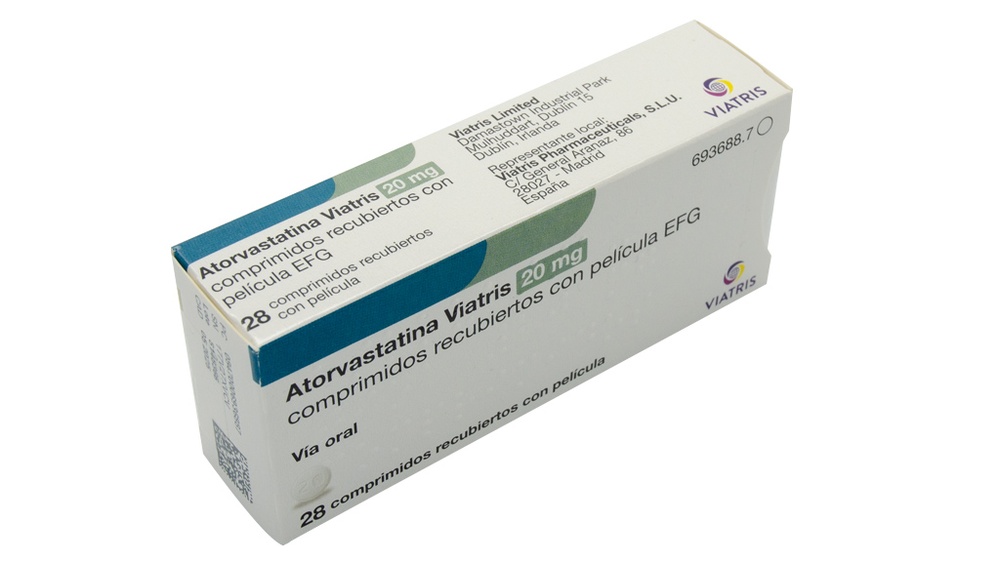
- Country of registration
- Dosage formTABLET, 20 mg
- ATC codeC10AA05
- Average pharmacy price7.2 EUR
- Availability in pharmaciesSupply issue reported
- Active substance
- Prescription requiredYes
- Manufacturer
- CompositionCARBONATO DE SODIO ANHIDRO (2.00 mg mg), LACTOSA ANHIDRA (85.00 mg mg), CROSCARMELOSA SODICA (12.00 mg mg), LECITINA DE SOJA (2.000 Porcentaje peso/peso mg)
- This information is for reference only and does not constitute medical advice. Always consult a doctor before taking any medication. Oladoctor is not responsible for medical decisions based on this content.
- Alternatives to ATORVASTATIN VIATRIS 20 mg FILM-COATED TABLETSDosage form: TABLET, 20 mgActive substance: atorvastatinManufacturer: Krka D.D. Novo MestoPrescription requiredDosage form: TABLET, 30 mgActive substance: atorvastatinManufacturer: Krka D.D. Novo MestoPrescription requiredDosage form: TABLET, 80 mgActive substance: atorvastatinManufacturer: Krka D.D. Novo MestoPrescription required
Online doctors for ATORVASTATIN VIATRIS 20 mg FILM-COATED TABLETS
Discuss questions about ATORVASTATIN VIATRIS 20 mg FILM-COATED TABLETS, including use, safety considerations and prescription review, subject to medical assessment and local regulations.
Get ATORVASTATIN VIATRIS 20 mg FILM-COATED TABLETS Prescription Online
Fill in a 2-min form
Tell us your symptoms, history, and what medicine you're requesting.
Pick a doctor or let us assign
Choose a specialist or we'll match you with the next available doctor.
Doctor reviews your case
Usually within 30 minutes. They may ask follow-up questions via chat.
Collect from any pharmacy
Electronic prescription sent to your email — valid across Spain.
Frequently Asked Questions
ATORVASTATIN VIATRIS 20 mg FILM-COATED TABLETS requires a prescription in Spain. You can check with a doctor online whether this medicine may be appropriate for your situation.
The active ingredient in ATORVASTATIN VIATRIS 20 mg FILM-COATED TABLETS is atorvastatin. This information helps identify medicines with the same composition but different brand names.
The average pharmacy price for ATORVASTATIN VIATRIS 20 mg FILM-COATED TABLETS is around 7.2 EUR. Prices may vary depending on the manufacturer and dosage form.
ATORVASTATIN VIATRIS 20 mg FILM-COATED TABLETS is manufactured by Viatris Limited. Pharmacy brands and packaging may differ depending on the distributor.
Doctors such as Family doctors, Psychiatrists, Dermatologists, Cardiologists, Endocrinologists, Gastroenterologists, Pulmonologists, Nephrologists, Rheumatologists, Hematologists, Infectious disease physicians, Allergists, Geriatricians, Paediatricians, Oncologists may assess whether ATORVASTATIN VIATRIS 20 mg FILM-COATED TABLETS is appropriate, depending on your situation and local regulations. You can book an online consultation to discuss your symptoms and possible next steps.
Spain has a well-developed healthcare infrastructure across major cities such as Madrid, Barcelona, Valencia, and Seville. Pharmacies are widely available and operate under strict regulations, ensuring access to prescribed medications.
You can buy ATORVASTATIN VIATRIS 20 mg FILM-COATED TABLETS in Madrid, Barcelona, Seville, or Valencia at any local pharmacy with a valid prescription.
To obtain a prescription, you can use Oladoctor:
Other medicines with the same active substance (atorvastatin) include ATORIS 20 mg FILM-COATED TABLETS, ATORIS 30 mg FILM-COATED TABLETS, ATORIS 80 mg FILM-COATED TABLETS. These may have different brand names or formulations but contain the same therapeutic ingredient. Always consult a doctor before switching or starting a new medicine.
