



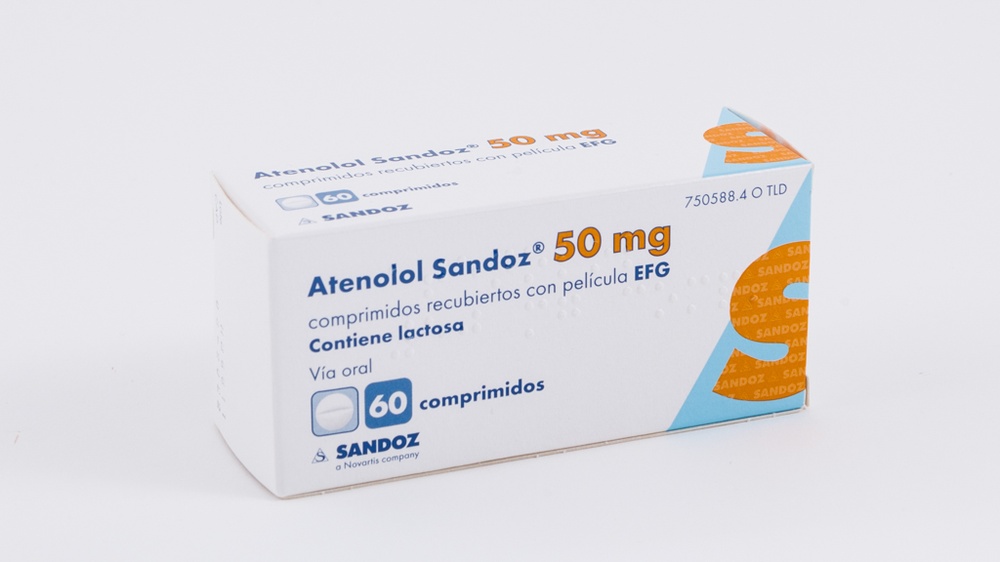
ATENOLOL 50 mg Film-Coated Tablets

Prescription review online
A doctor will review your case and decide whether a prescription is medically appropriate.

Talk to a doctor about this medicine
Discuss your symptoms and possible next steps in a quick online consultation.



How to use ATENOLOL SANDOZ 50 mg FILM-COATED TABLETS
Contents of the leaflet
- Introduction
- What is Atenolol Sandoz and what is it used for
- What you need to know before taking Atenolol Sandoz
- How to take Atenolol Sandoz
- Possible side effects
- Storage of Atenolol Sandoz
- Contents of the pack and further information
Introduction
Package Leaflet: Information for the Patient
Atenolol Sandoz 50 mg Film-Coated Tablets EFG
Atenolol Sandoz 100 mg Film-Coated Tablets EFG
Read the entire package leaflet carefully before you start taking this medicine, as it contains important information for you.
- Keep this package leaflet, as you may need to read it again.
- If you have any further questions, ask your doctor or pharmacist.
- This medicine has been prescribed to you only, and you should not pass it on to others. It may harm them, even if their symptoms are the same as yours.
- If you experience any side effects, talk to your doctor or pharmacist. This includes any possible side effects not listed in this package leaflet. See section 4.
Contents of the Package Leaflet
- What is Atenolol Sandoz and what is it used for
- What you need to know before taking Atenolol Sandoz
- How to take Atenolol Sandoz
- Possible side effects
- Storage of Atenolol Sandoz
Contents of the pack and further information
1. What is Atenolol Sandoz and what is it used for
Atenolol Sandoz contains a medicine called atenolol. This belongs to a group of medicines called beta-blockers.
Atenolol Sandoz is used for:
- treatment of high blood pressure (hypertension),
- helping to prevent chest pain (angina pectoris),
- ensuring regular heartbeats,
- protecting the heart during and after a heart attack.

Not sure if this medicine is right for you?
Discuss your symptoms and treatment with a doctor online.
2. What you need to know before taking Atenolol Sandoz
Do not take Atenolol Sandoz:
- if you are allergic to atenolol or any of the other ingredients of this medicine (listed in section 6),
- if you have or have had any of the following heart problems:
- uncontrolled heart failure (this usually causes shortness of breath and swelling of the ankles),
- second or third degree heart block (a condition that can be treated with a pacemaker),
- very slow or irregular heartbeats, very low blood pressure or very poor circulation (circulatory failure),
- if you have cardiogenic shock. This means that the heart is not pumping blood around the body well enough. The signs can include confusion, sweating, fast heartbeats and paleness,
- if you have an untreated tumour of the adrenal glands called phaeochromocytoma.
- if you have been fasting
- if your doctor has told you that you have excessive acidity of the blood (metabolic acidosis),
Do not take Atenolol Sandoz in any of the above situations. If you are not sure, consult your doctor or pharmacist before taking this medicine.
Warnings and precautions
Talk to your doctor or pharmacist before starting to take Atenolol Sandoz if:
- you have asthma, wheezing or other respiratory problems, or have allergic reactions, for example to insect bites. If you have ever had asthma or wheezing, do not take this medicine without talking to your doctor,
- you have a type of chest pain called Prinzmetal's angina,
- you have first degree heart block,
- you have diabetes. Atenolol may change your normal response to low blood sugar (hypoglycaemia), which usually involves an increase in heart rate. You should closely monitor your blood sugar levels,
- you have thyrotoxicosis (a condition caused by an overactive thyroid gland). Your medicine could mask the symptoms of thyrotoxicosis,
- you have kidney problems. You may need to have regular check-ups while you are taking this medicine,
- you have a skin problem called psoriasis,
- you may notice that your pulse is slower while taking these tablets. This is normal, but if it worries you, tell your doctor.,
- you are elderly,
- you are pregnant, think you might be pregnant or are breast-feeding. See “Pregnancy and breast-feeding”,
- you have ever had an allergic reaction to anything, for example to an insect bite,
- if you are going to hospital for an operation, tell the anaesthetist or the medical staff that you are taking atenolol. This is because you may have a low blood pressure (hypotension) if you are given certain anaesthetics, or substances containing iodine (called “contrast media”) for X-rays, while you are taking atenolol.
If you think any of the above applies to you, or if you are not sure, consult your doctor or pharmacist before taking this medicine.
Using Atenolol Sandoz with other medicines
Tell your doctor or pharmacist if you are taking, have recently taken or might take any other medicines, including those obtained without a prescription, herbal remedies, and other health products, as it may be necessary to stop treatment or adjust the dose of one of them.
Some medicines can affect the action of others.
Tell your doctor or pharmacist if you are taking any of the following medicines:
- clonidine (for hypertension or migraine). If you are taking clonidine and atenolol together, do not stop taking clonidine unless your doctor tells you to. If you need to stop taking clonidine, your doctor will give you detailed instructions on how to do it,
- verapamil, diltiazem and nifedipine (for high blood pressure and chest pain),
- disopyramide, quinidine, amiodarone and any other medicine for irregular heartbeats,
- digoxin (for heart failure), adrenaline, also known as epinephrine (medicines that stimulate the heart),
- ibuprofen or indomethacin (anti-inflammatory medicines for pain relief),
- insulin or other oral medicines for diabetes,
- ampicillin, for bacterial infections,
- barbiturates, for sleep problems and epilepsy,
- sulpiride and phenothiazines, for more serious mental health problems (psychosis),
- medicines from the groups called “tricyclic antidepressants” or “MAO inhibitors”,
- nasal decongestants or other medicines for colds or sinus blockage (including over-the-counter medicines),
- if you are going to hospital for an operation, tell the anaesthetist or the medical staff that you are taking atenolol. This is because you may have a low blood pressure (hypotension) if you are given certain anaesthetics, or substances containing iodine (called “contrast media”) for X-rays, while you are taking atenolol.
If you think any of the above applies to you, or if you are not sure, consult your doctor or pharmacist before taking this medicine.
Pregnancy and breast-feeding
If you are pregnant or breast-feeding, think you may be pregnant or are planning to have a baby, ask your doctor or pharmacist for advice before taking this medicine.
Pregnancy
There is not enough information on the safety of atenolol during the first month of pregnancy. Your doctor will decide whether treatment during the second and third trimester is beneficial for you.
Breast-feeding
Tell your doctor if you are being treated with atenolol during childbirth or breast-feeding, as your baby may be at risk of low blood sugar and slower heartbeats.
Women who are breast-feeding should consult their doctor before taking this medicine, as atenolol passes into breast milk.
Driving and using machines
- It is unlikely that this medicine will affect your ability to drive or use machines.
- However, it is better to wait and see how the medicine affects you before carrying out these activities.
- If you feel dizzy or tired while taking this medicine, do not drive or use tools or machines.
Use in athletes
This medicine contains atenolol, which may produce a positive result in doping tests.
Atenolol Sandoz contains lactose and sodium
This medicine contains lactose. If your doctor has told you that you have an intolerance to some sugars, consult them before taking this medicine.
This medicine contains less than 23 mg of sodium (1 mmol) per tablet; this is, essentially, “sodium-free”.
3. How to take Atenolol Sandoz
Always take this medicine exactly as your doctor or pharmacist has told you. If you are not sure, check with your doctor or pharmacist.
- Your doctor will tell you how many tablets to take each day and when to take them.
- Read the package to remind you of the information your doctor gave you.
- Try to take the tablets at the same time each day.
- Swallow the tablets whole with a glass of water. The score line is only there to help you break the tablet if you have difficulty swallowing it whole.
Adults
Your doctor will decide how many atenolol tablets you should take each day, depending on your illness.
Hypertension
- The usual initial dose is 25 mg daily.
- After that, you will usually take between 50 mg and 100 mg daily.
Chest pain
The usual dose is 50 to 100 mg daily. If you take 100 mg, your doctor may instruct you to take them in two separate doses, 50 mg in the morning and 50 mg at night.
Irregular heartbeat
The usual dose is 50 to 100 mg daily.
Protection after a heart attack
The usual dose is 100 mg daily. Your doctor may instruct you to take them in two separate doses, 50 mg in the morning and 50 mg at night.
Elderly
If you are an elderly patient, your doctor may decide to prescribe a lower dose, especially if you have kidney problems.
Patients with severe kidney problems
If you have severe kidney problems, your doctor may prescribe a lower dose of atenolol or tell you to take it less often.
Use in children
This medicine should not be given to children.
If you take more Atenolol Sandoz than you should
In case of overdose or accidental ingestion, consult your doctor or pharmacist immediately or call the Toxicology Information Service, telephone: 91 562 04 20, indicating the medicine and the amount taken.
- If you take more Atenolol Sandoz than you should, talk to a doctor or go to a hospital straight away.
- Take the medicine package with you, so the doctor can identify what you have taken.
- You may feel a slower pulse, dizziness due to low blood pressure and difficulty breathing. Also, your heart may have problems supplying blood to the rest of the body (acute heart failure).
If you forget to take Atenolol Sandoz
- If you forget to take a dose, take it as soon as you remember.
- However, if it is almost time for the next dose, do not take the missed dose.
- Do not take a double dose to make up for forgotten doses.
If you stop taking Atenolol Sandoz
Do not stop taking Atenolol Sandoz without talking to your doctor. Your doctor may need to reduce the dose gradually.
If you have any further questions on the use of this medicine, ask your doctor or pharmacist.

Started taking the medicine and have questions?
Discuss your symptoms and treatment with a doctor online.
4. Possible side effects
Like all medicines, this medicine can cause side effects, although not everybody gets them.
Stop taking Atenolol Sandoz and see a doctor or go to a hospital straight away if you notice any of the following serious side effects:
Rare (may affect up to 1 in 1,000 people)
- abnormal heartbeat, feeling of dizziness, tiredness or fainting. These could be signs of heart block,
- shortness of breath or swelling of the ankles. These could be signs of heart failure or worsening of heart failure,
- breathing problems, such as wheezing. These could be signs of worsening of your asthma,
- numbness or coldness in feet and toes.
Frequency not known (cannot be estimated from the available data)
- swelling of the face or throat, difficulty breathing or feeling of dizziness. These could be signs of a severe allergic reaction.
Stop taking Atenolol Sandoz and see a doctor or go to a hospital straight away if you notice any of the above side effects.
Other side effects include:
Common (may affect up to 1 in 10 people)
- feeling of cold or poor circulation in hands and feet,
- slower pulse. This is normal, but if it worries you, talk to your doctor,
- diarrhoea,
- constipation,
- digestive problems,
- feeling of dizziness or vomiting,
- feeling of tiredness,
- sweating.
Uncommon (may affect up to 1 in 100 people)
- sleep problems,
- high levels of an enzyme called “aminotransferase” (in blood tests).
Rare (may affect up to 1 in 1,000 people)
- purple spots on the skin,
- feeling of numbness or spasms in the fingers, followed by a feeling of heat and pain (“Raynaud's disease”),
- tingling or pinching in hands and feet,
- poor circulation (intermittent claudication) that can get worse when you start taking the medicine,
- low blood pressure that can cause dizziness, slight dizziness or fainting,
- headache,
- feeling of dizziness,
- mood changes, nightmares, feeling of confusion, anxiety or fear,
- nightmares,
- changes in personality (psychosis) or seeing or hearing things that do not exist (hallucinations),
- depression,
- dry mouth,
- hair loss,
- dry eyes,
- skin rash,
- dry, flaky skin (psoriasis) that can get worse when you start taking the medicine,
- vision problems,
- increased tendency to bruise or purple spots on the skin,
- impotence in men,
- changes in sex drive,
- yellowing of the skin or the whites of the eyes (jaundice),
- blood problems, such as changes in blood cells. Your doctor may take blood samples regularly to check if Atenolol Sandoz has affected your blood.
Frequency not known (cannot be estimated from the available data)
- allergic reactions (hypersensitivity) such as itchy skin rash,
- a syndrome similar to lupus (a disease in which the immune system produces antibodies that mainly attack the skin and joints)
Atenolol could mask the symptoms of “thyrotoxicosis” and hypoglycaemia (diabetes) (see “Section 2. What you need to know before taking Atenolol Sandoz”).
Reporting of side effects
If you experience any side effects, talk to your doctor or pharmacist. This includes any possible side effects not listed in this package leaflet. You can also report side effects directly via the Spanish Medicines Agency's website for the reporting of adverse reactions: https://www.notificaram.es. By reporting side effects, you can help provide more information on the safety of this medicine.
5. Storage of Atenolol Sandoz
Keep this medicine out of the sight and reach of children.
Do not use this medicine after the expiry date which is stated on the packaging and blister after EXP. The expiry date is the last day of the month stated.
Store below 30°C.
Keep the container in the outer carton to protect the tablets from light and moisture.
Medicines should not be disposed of via wastewater or household waste. Ask your pharmacist how to dispose of medicines no longer required. These measures will help protect the environment.
6. Contents of the pack and further information
Composition of Atenolol Sandoz 50 mg tablets:
The active substance is atenolol. Each tablet contains 50 mg of atenolol.
Composition of Atenolol Sandoz 100 mg tablets:
The active substance is atenolol. Each tablet contains 100 mg of atenolol.
The other ingredients are:
Core:
corn starch, sodium lauryl sulfate, heavy magnesium carbonate, magnesium stearate (E470b), gelatin.
Coating: lactose, hypromellose, titanium dioxide (E171), polyethylene glycol 4000.
Appearance of the product and packaging
White, round, film-coated tablets with a score line on one side. The score line is only there to help you break the tablet if you have difficulty swallowing it whole.
Atenolol Sandoz is available in Alu/PP blisters in packs containing 30, 60 and 500 tablets.
Not all pack sizes may be marketed.
Marketing authorisation holder and manufacturer
Marketing authorisation holder
Sandoz Farmacéutica, S.A. Centro Empresarial Parque Norte Edificio Roble C/ Serrano Galvache, 56 28033 Madrid Spain
Manufacturer
Salutas Pharma GmbH Otto-von-Guericke Allee 1 39179 Barleben Germany
or
Hexal AG Industriestrasse, 25 83607 Holzkirchen Germany
Date of last revision of this package leaflet: May 2020
Detailed information on this medicine is available on the website of the Spanish Agency for Medicines and Health Products (AEMPS) http://www.aemps.gob.es/
- Country of registration
- Dosage formTABLET, 50 mg
- ATC codeC07AB03
- Average pharmacy price2.5 EUR
- Active substance
- Prescription requiredYes
- Manufacturer
- CompositionLAURILSULFATO DE SODIO (3,3 mg mg), LACTOSA (2,88 mg mg)
- This information is for reference only and does not constitute medical advice. Always consult a doctor before taking any medication. Oladoctor is not responsible for medical decisions based on this content.
- Alternatives to ATENOLOL SANDOZ 50 mg FILM-COATED TABLETSDosage form: TABLET, 100 mgActive substance: atenololManufacturer: Laboratorios Alter S.A.Prescription requiredDosage form: TABLET, 50 mgActive substance: atenololManufacturer: Laboratorios Alter S.A.Prescription requiredDosage form: TABLET, 100 mgActive substance: atenololManufacturer: Aurovitas Spain, S.A.U.Prescription required
Online doctors for ATENOLOL SANDOZ 50 mg FILM-COATED TABLETS
Discuss questions about ATENOLOL SANDOZ 50 mg FILM-COATED TABLETS, including use, safety considerations and prescription review, subject to medical assessment and local regulations.
Get ATENOLOL SANDOZ 50 mg FILM-COATED TABLETS Prescription Online
Fill in a 2-min form
Tell us your symptoms, history, and what medicine you're requesting.
Pick a doctor or let us assign
Choose a specialist or we'll match you with the next available doctor.
Doctor reviews your case
Usually within 30 minutes. They may ask follow-up questions via chat.
Collect from any pharmacy
Electronic prescription sent to your email — valid across Spain.
Frequently Asked Questions
ATENOLOL SANDOZ 50 mg FILM-COATED TABLETS requires a prescription in Spain. You can check with a doctor online whether this medicine may be appropriate for your situation.
The active ingredient in ATENOLOL SANDOZ 50 mg FILM-COATED TABLETS is atenolol. This information helps identify medicines with the same composition but different brand names.
The average pharmacy price for ATENOLOL SANDOZ 50 mg FILM-COATED TABLETS is around 2.5 EUR. Prices may vary depending on the manufacturer and dosage form.
ATENOLOL SANDOZ 50 mg FILM-COATED TABLETS is manufactured by Sandoz Farmaceutica S.A.. Pharmacy brands and packaging may differ depending on the distributor.
Doctors such as Family doctors, Psychiatrists, Dermatologists, Cardiologists, Endocrinologists, Gastroenterologists, Pulmonologists, Nephrologists, Rheumatologists, Hematologists, Infectious disease physicians, Allergists, Geriatricians, Paediatricians, Oncologists may assess whether ATENOLOL SANDOZ 50 mg FILM-COATED TABLETS is appropriate, depending on your situation and local regulations. You can book an online consultation to discuss your symptoms and possible next steps.
Spain has a well-developed healthcare infrastructure across major cities such as Madrid, Barcelona, Valencia, and Seville. Pharmacies are widely available and operate under strict regulations, ensuring access to prescribed medications.
You can buy ATENOLOL SANDOZ 50 mg FILM-COATED TABLETS in Madrid, Barcelona, Seville, or Valencia at any local pharmacy with a valid prescription.
To obtain a prescription, you can use Oladoctor:
Other medicines with the same active substance (atenolol) include ATENOLOL ALTER 100 mg TABLETS, ATENOLOL ALTER 50 mg TABLETS, ATENOLOL AUROVITAS 100 mg FILM-COATED TABLETS. These may have different brand names or formulations but contain the same therapeutic ingredient. Always consult a doctor before switching or starting a new medicine.
