



ASACOL 800 mg Gastro-Resistant Tablets

Prescription review online
A doctor will review your case and decide whether a prescription is medically appropriate.

Talk to a doctor about this medicine
Discuss your symptoms and possible next steps in a quick online consultation.



How to use ASACOL 800 MG GASTRO-RESISTANT TABLETS
Contents of the leaflet
- Introduction
- What is Asacol and what is it used for
- Before you take Asacol
- How to take Asacol
- Possible side effects
- Storing Asacol
- Contents of the pack and further information
Introduction
Package Leaflet: Information for the User
Asacol 800 mg Gastro-Resistant Tablets
mesalazine
Read all of this leaflet carefully before you start taking this medicine because it contains important information for you.
- Keep this leaflet. You may need to read it again.
- If you have any further questions, ask your doctor or pharmacist.
- This medicine has been prescribed for you only. Do not pass it on to others. It may harm them, even if their signs of illness are the same as yours.
- If you get any side effects, talk to your doctor or pharmacist. This includes any possible side effects not listed in this leaflet. See section 4.
Contents of the pack:
1 What is Asacol and what is it used for
2 Before you take Asacol
3 How to take Asacol
4 Possible side effects
5 Storing Asacol
6 Contents of the pack and further information
1. What is Asacol and what is it used for
Asacol is indicated for:
- Treatment of acute phase of mild to moderate ulcerative colitis.
- Maintenance treatment of ulcerative colitis remission (including patients who do not tolerate sulfasalazine).
- Maintenance treatment of Crohn's disease remission.

Not sure if this medicine is right for you?
Discuss your symptoms and treatment with a doctor online.
2. Before you take Asacol
Do not take Asacol
- If you are allergic to mesalazine or any of the other ingredients of this medicine (listed in section 6).
- If you are allergic to salicylates (e.g. aspirin).
- If you have severe liver impairment.
- If you have severe kidney impairment.
Warnings and precautions
Consult your doctor before taking Asacol, especially if you:
- suffer from any lung disease, such as asthma.
- have had an allergy to sulfasalazine in the past.
- have ever had heart allergic reactions such as inflammation of the heart muscle or pericardium. If you have had previous suspicions of mesalazine-induced allergic reactions in the heart, then you should not take Asacol. Asacol can be used with caution if you have previously suffered a non-mesalazine-induced heart allergic reaction.
- If you have a stomach or intestinal ulcer, you should take Asacol with caution.
- If you have ever had a severe skin rash or skin peeling, blisters, or sores in the mouth after using mesalazine.
If you experience severe or recurrent headache, vision changes, or ringing or buzzing in the ears, contact your doctor immediately.
Kidney stones may occur with the use of mesalazine. Symptoms include pain in the sides of the abdomen and blood in the urine. Make sure to drink a sufficient amount of liquid during treatment with mesalazine.
Mesalazine may cause a discoloration of the urine to a reddish-brown color after contact with sodium hypochlorite bleach in the toilet water. This is a chemical reaction between mesalazine and bleach and is harmless.
Severe skin rashes, such as drug reaction with eosinophilia and systemic symptoms (DRESS), Stevens-Johnson syndrome (SSJ), and toxic epidermal necrolysis (TEN), have been observed with mesalazine treatment. Stop taking mesalazine and seek medical attention immediately if you observe any of the symptoms related to these severe skin rashes described in section 4.
Evaluation of your liver, kidney, and blood
Before and during the intake of Asacol, your doctor may want to evaluate you from time to time to check that your liver, kidneys, blood, and lungs are in good condition.
Tablets in the stool
There are some reports of intact tablets in the stool. What appears to be an intact tablet may sometimes be the remains of the tablet coating. If you frequently observe tablets or their coatings in the stool, you should consult your doctor.
Children and adolescents
The use of Asacol is only recommended in children from 6 years of age.
Elderly patients
Asacol should be used with caution, and the doctor will evaluate both renal and hepatic function before starting treatment.
Other medicines and Asacol
Tell your doctor or pharmacist if you are using or have recently used or might use any other medicines, such as:
- Medicines to prevent blood clotting (anticoagulants, e.g. warfarin).
- Medicines to reduce the activity of the immune system (e.g. azathioprine or 6-mercaptopurine or thioguanine).
Using Asacol with food, drinks, and alcohol
The consumption of food, drinks, and alcohol does not interfere with the use of Asacol.
Pregnancy and breastfeeding
If you are pregnant or breastfeeding, think you may be pregnant, or plan to become pregnant, consult your doctor or pharmacist before using this medicine.
There is limited experience with the use of mesalazine during pregnancy and breastfeeding.
Newborns may develop allergic reactions after breastfeeding, such as diarrhea. If the newborn presents with diarrhea, breastfeeding should be interrupted.
Driving and using machines
The influence of Asacol on the ability to drive and use machines is negligible or non-existent. However, if it affects you in any way, do not drive or use machines.
Asacol contains milk sugar (lactose)
This medicine contains lactose. If your doctor has told you that you have an intolerance to some sugars, consult them before taking this medicine.
3. How to take Asacol
Follow the administration instructions of this medicine exactly as indicated by your doctor. If in doubt, consult your doctor or pharmacist again.
Asacol should be taken orally.
The tablets should be swallowed whole and before meals.
The recommended dose is:
Adults
Ulcerative colitis, acute treatment of mild to moderate episodes: 2.4 g (3 tablets, divided into three doses per day).
Maintenance treatment of ulcerative colitis: 0.8 g (1 tablet) to 1.6 g (2 tablets in separate doses) per day.
Crohn's disease, maintenance treatment: individualized dose up to a maximum of 2.4 g per day (2 to 3 tablets distributed in several doses per day).
Elderly patients
The administration of Asacol in elderly patients should be done with caution and always limited to those patients with normal renal function.
Use in children
The efficacy and safety of Asacol in children under 5 years of age have not been established.
Information on the effect in children (between 6 and 18 years of age) is limited.
Children from 6 years of age
The general recommendation is that half the adult dose can be administered to children up to 40 kg in weight; and the normal adult dose to children over 40 kg. However, your doctor will indicate the appropriate dose to treat your disease.
If you take more Asacol than you should
In case of overdose or accidental ingestion, consult your doctor or pharmacist or go to the nearest hospital, or call the Toxicology Information Service. Telephone 91 562 04 20 (indicating the medicine and the amount ingested).
In case of massive ingestion of the tablets, treatment consists of gastric lavage, induction of vomiting, along with symptomatic and supportive measures. There is no specific antidote.
If you forget to take Asacol
If you have forgotten to take a dose, take it as soon as you remember, and then take the next dose at the usual time.
Do not take a double dose to make up for forgotten doses.
If you have any further questions on the use of this medicine, ask your doctor or pharmacist.

Started taking the medicine and have questions?
Discuss your symptoms and treatment with a doctor online.
4. Possible side effects
Like all medicines, this medicine can cause side effects, although not everybody gets them.
Adverse reactions have been reported in specific organs affecting the heart, lungs, liver, kidneys, pancreas, skin, and subcutaneous tissue.
Stop taking Asacol immediately and consult a doctor urgently if you develop unexplained bruising (without injury), bleeding, purple spots, or spots under the skin, anemia (feeling tired, weak, or pale, especially in the lips, nails, and inside the eyelids), fever (high temperature), sore throat, or unusual bleeding (e.g. nosebleeds), reddish patches, or circular or coin-shaped patches on the chest, often with central blisters, skin peeling, mouth ulcers, throat ulcers, nose ulcers, genital ulcers, eye ulcers, generalized rash, fever, and swollen lymph nodes. These severe skin rashes are often preceded by fever or flu-like symptoms.
Tell your doctor immediatelyif you experience severe or recurrent headache, vision changes, or ringing or buzzing in the ears. These could be symptoms of increased pressure inside your skull (idiopathic intracranial hypertension) (frequency not known [cannot be estimated from the available data]).
The following adverse reactions have been reported in the approximate frequencies shown:
Common(may affect up to 1 in 10 patients)
- Rash
- Indigestion
Uncommon(may affect up to 1 in 100 patients)
- Fever
- High number of white blood cells, called eosinophils
- Hives, itching of the skin
- Chest pain
Rare(may affect up to 1 in 1,000 patients)
- Headache
- Feeling of tingling, pinching, and numbness
- Dizziness
- Heart inflammation with signs such as chest pain and palpitations
- Diarrhea, nausea, stomach pain, flatulence, feeling of restlessness, and stomach discomfort, with nausea and vomiting.
- Increased sensitivity of the skin to sunlight and ultraviolet light (photosensitivity)
Very rare(may affect up to 1 in 10,000 patients)
- Severe reduction of blood cells that can cause weakness, bruising, increase the risk of infections, low white blood cell count, reduction of platelets which increases the risk of bleeding
- Allergic reactions such as rash and skin eruptions
- Fever that appears while taking the medicine and disappears when stopping it (drug fever)
- Ulcerative colitis that can include the entire large intestine
- Nerve damage or abnormal nerves causing numbness or tingling
- Lung disease (scarring of lung tissue, allergic reaction), resulting in difficulty breathing or wheezing and fluid accumulation in the lungs, pneumonia
- Pancreas inflammation (associated with pain in the upper abdomen and back and feeling of discomfort)
- Abnormal liver function test results, hepatitis (inflammation of the liver leading to flu-like symptoms and jaundice)
- Hair loss
- Muscle pain (myalgia) or joint pain (arthralgia)
- Kidney problems (such as inflammation and scarring of the kidney), kidney failure, which can be reversible if treatment is stopped early
- Reversible reduction of sperm production
- Cough
Frequency not known(cannot be estimated from the available data)
- Autoimmune disease (lupus-like syndrome) that can cause inflammation of the pericardium or the membranes surrounding the lungs and heart, rash, and/or joint pain
- Weight loss
- Abnormal laboratory test results
- Severe skin diseases (Erythema multiforme, Stevens-Johnson syndrome, and Toxic Epidermal Necrolysis)
- Acute chest pain and dry cough (inflammation of the membrane covering the lungs)
- Kidney stones and associated kidney pain (see also section 2)
Reporting of side effects
If you experience any side effects, talk to your doctor or pharmacist, even if it is possible side effects not listed in this leaflet. You can also report side effects directly through the Spanish Medicines and Healthcare Products Agency (AEMPS) website: www.notificaRAM.es. By reporting side effects, you can help provide more information on the safety of this medicine.
5. Storing Asacol
This medicine does not require any special storage conditions. Store in the original packaging.
Keep this medicine out of the sight and reach of children.
Do not use this medicine after the expiry date which is stated on the packaging after EXP. The expiry date is the last day of the month shown.
Medicines should not be disposed of via wastewater or household waste. Place the packaging and any unused medicine in the pharmacy's SIGRE collection point. If in doubt, ask your pharmacist how to dispose of the packaging and any unused medicine. This will help protect the environment.
6. Contents of the pack and further information
Composition of Asacol 800 mg Gastro-Resistant Tablets
- The active ingredient is mesalazine. Each tablet contains 800 mg of mesalazine.
- The other ingredients are lactose, potato starch, magnesium stearate, talc, povidone, methacrylic acid copolymer type B, triethyl citrate, yellow iron oxide (E172), red iron oxide (E172), and polyethylene glycol 6000.
Appearance of the product and pack contents
Reddish-brown, oblong, gastro-resistant tablets contained in PVC/aluminum blisters.
Available in packs of 60 or 90 gastro-resistant tablets.
Marketing authorization holder
TILLOTTS PHARMA SPAIN, S.L.U.
Travessera de Gràcia 58, 5º 3ª
08006 Barcelona
Spain
Manufacturer
HAUPT PHARMA WULFING GMBH
Bethelner Landstrasse, 18
Gronau D-31028
GERMANY
Date of last revision of this leaflet:May 2025
Detailed information on this medicine is available on the website of the Spanish Agency for Medicines and Healthcare Products (AEMPS) http://www.aemps.gob.es/
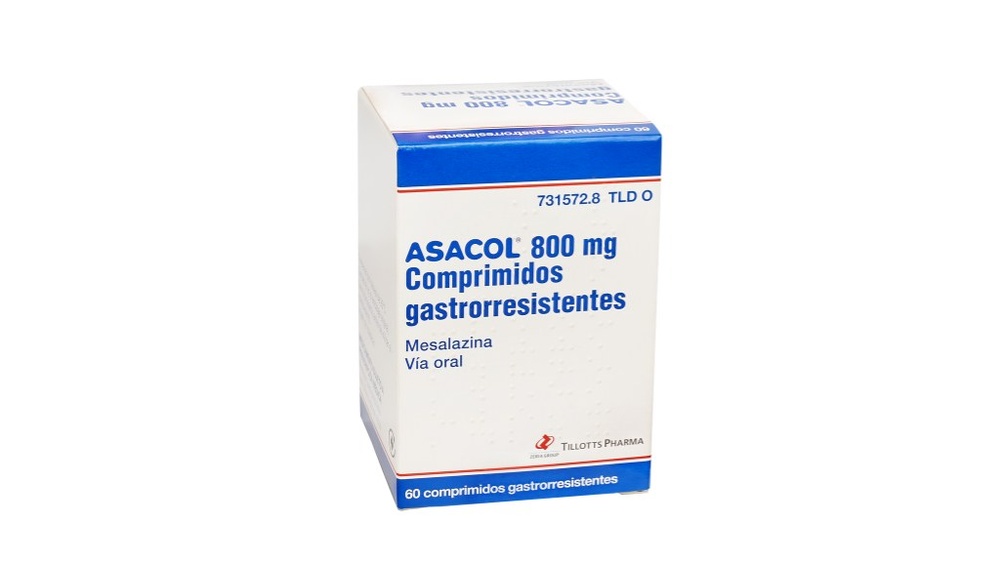
- Country of registration
- Dosage formTABLET, 800 mg
- ATC codeA07EC02
- Average pharmacy price35.36 EUR
- Active substance
- Prescription requiredYes
- Manufacturer
- CompositionLACTOSA MONOHIDRATO (152,80 mg mg), CARBOXIMETILALMIDON SODICO (36,60 mg mg)
- This information is for reference only and does not constitute medical advice. Always consult a doctor before taking any medication. Oladoctor is not responsible for medical decisions based on this content.
- Alternatives to ASACOL 800 MG GASTRO-RESISTANT TABLETSDosage form: SUPPOSITORY, 1 gActive substance: mesalazineManufacturer: Tillotts Pharma Spain S.L.U.Prescription requiredDosage form: TABLET, 1600 mgActive substance: mesalazineManufacturer: Tillotts Pharma Spain S.L.U.Prescription requiredDosage form: TABLET, 400 mgActive substance: mesalazineManufacturer: Tillotts Pharma Spain S.L.U.Prescription required
Online doctors for ASACOL 800 MG GASTRO-RESISTANT TABLETS
Discuss questions about ASACOL 800 MG GASTRO-RESISTANT TABLETS, including use, safety considerations and prescription review, subject to medical assessment and local regulations.









Get ASACOL 800 MG GASTRO-RESISTANT TABLETS Prescription Online
Fill in a 2-min form
Tell us your symptoms, history, and what medicine you're requesting.
Pick a doctor or let us assign
Choose a specialist or we'll match you with the next available doctor.
Doctor reviews your case
Usually within 30 minutes. They may ask follow-up questions via chat.
Collect from any pharmacy
Electronic prescription sent to your email — valid across Spain.
Frequently Asked Questions
ASACOL 800 MG GASTRO-RESISTANT TABLETS requires a prescription in Spain. You can check with a doctor online whether this medicine may be appropriate for your situation.
The active ingredient in ASACOL 800 MG GASTRO-RESISTANT TABLETS is mesalazine. This information helps identify medicines with the same composition but different brand names.
The average pharmacy price for ASACOL 800 MG GASTRO-RESISTANT TABLETS is around 35.36 EUR. Prices may vary depending on the manufacturer and dosage form.
ASACOL 800 MG GASTRO-RESISTANT TABLETS is manufactured by Tillotts Pharma Spain S.L.U.. Pharmacy brands and packaging may differ depending on the distributor.
Doctors such as Family doctors, Psychiatrists, Dermatologists, Cardiologists, Endocrinologists, Gastroenterologists, Pulmonologists, Nephrologists, Rheumatologists, Hematologists, Infectious disease physicians, Allergists, Geriatricians, Paediatricians, Oncologists may assess whether ASACOL 800 MG GASTRO-RESISTANT TABLETS is appropriate, depending on your situation and local regulations. You can book an online consultation to discuss your symptoms and possible next steps.
Spain has a well-developed healthcare infrastructure across major cities such as Madrid, Barcelona, Valencia, and Seville. Pharmacies are widely available and operate under strict regulations, ensuring access to prescribed medications.
You can buy ASACOL 800 MG GASTRO-RESISTANT TABLETS in Madrid, Barcelona, Seville, or Valencia at any local pharmacy with a valid prescription.
To obtain a prescription, you can use Oladoctor:
Other medicines with the same active substance (mesalazine) include ASACOL 1 G SUPPOSITORIES, ASACOL 1600 mg GASTRO-RESISTANT TABLETS, ASACOL 400 mg GASTRO-RESISTANT TABLETS. These may have different brand names or formulations but contain the same therapeutic ingredient. Always consult a doctor before switching or starting a new medicine.
