



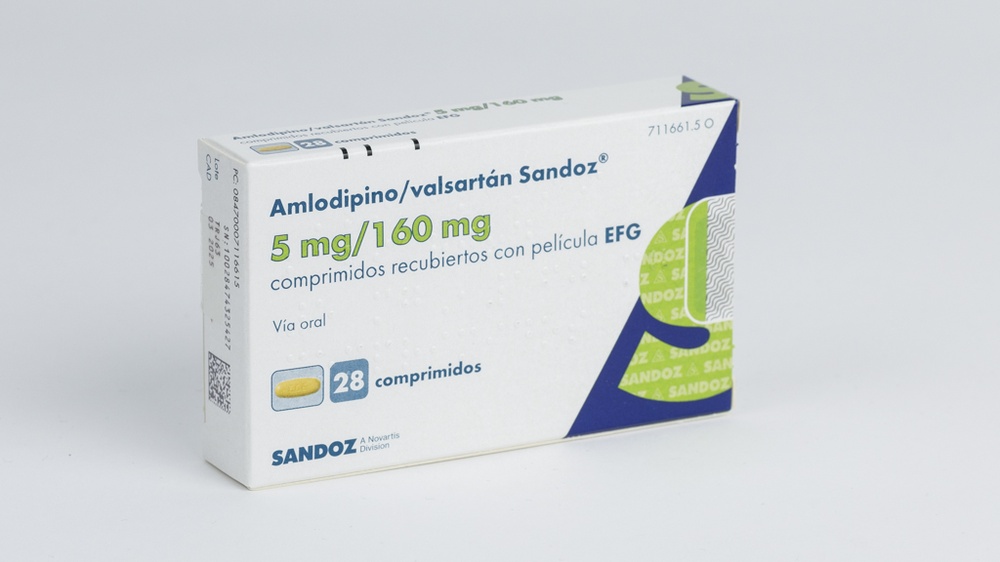
AMLODIPINO 5 mg/160 mg Film-Coated Tablets

Prescription review online
A doctor will review your case and decide whether a prescription is medically appropriate.

Talk to a doctor about this medicine
Discuss your symptoms and possible next steps in a quick online consultation.



How to use AMLODIPINE/VALSARTAN SANDOZ 5 mg/160 mg FILM-COATED TABLETS
Contents of the leaflet
- Introduction
- What is Amlodipine/valsartan Sandoz and what is it used for
- What you need to know before taking Amlodipine/valsartan Sandoz
- How to take Amlodipine/valsartan Sandoz
- Possible Adverse Effects
- Storage of Amlodipine/Valsartan Sandoz
- Package contents and additional information
Introduction
Leaflet:information for the user
Amlodipine/valsartan Sandoz 5 mg/160 mg film-coated tablets EFG
Amlodipine/valsartan Sandoz 10 mg/160 mg film-coated tablets EFG
Read the entire leaflet carefully before starting to take this medication,as it contains important information for you.
- Keep this leaflet, as you may need to read it again.
- If you have any questions, ask your doctor or pharmacist.
- This medication has been prescribed to you only, and you should not give it to others, even if they have the same symptoms as you, as it may harm them.
- If you experience side effects, consult your doctor or pharmacist, even if they are side effects not listed in this leaflet. See section 4.
Contents of the leaflet
- What is Amlodipine/valsartan Sandoz and what is it used for
- What you need to know before taking Amlodipine/valsartan Sandoz
- How to take Amlodipine/valsartan Sandoz
- Possible side effects
- Storage of Amlodipine/valsartan Sandoz
- Package contents and additional information
1. What is Amlodipine/valsartan Sandoz and what is it used for
Amlodipine/valsartan Sandoz tablets contain two substances called amlodipine and valsartan. Both substances help control high blood pressure.
- Amlodipinebelongs to a group of substances called "calcium channel blockers". Amlodipine prevents calcium from entering the blood vessel wall, which prevents the blood vessels from narrowing.
- Valsartanbelongs to a group of substances called "angiotensin II receptor blockers". Angiotensin II is produced by the body and causes blood vessels to narrow, thereby increasing blood pressure. Valsartan works by blocking the effect of angiotensin II.
This means that both substances help prevent the narrowing of blood vessels. As a result, the blood vessels relax and blood pressure decreases.
Amlodipine/valsartan Sandoz is used to treat high blood pressure in adults whose blood pressure is not adequately controlled with amlodipine or valsartan alone.

Not sure if this medicine is right for you?
Discuss your symptoms and treatment with a doctor online.
2. What you need to know before taking Amlodipine/valsartan Sandoz
Do not take Amlodipine/valsartan Sandoz
- if you are allergic to amlodipineor to any other calcium channel blocker. This may include itching, skin redness, or difficulty breathing,
- if you are allergic to valsartanor to any of the other ingredients of this medication (listed in section 6). If you think you may be allergic, inform your doctor before taking amlodipine/valsartan,
- if you have severe liver problemsor bile problemssuch as biliary cirrhosisor cholestasis,
- if you are pregnant for more than 3 months. (In any case, it is best to avoid taking this medication also at the start of your pregnancy, see section Pregnancy),
- if you have a severe decrease in blood pressure(hypotension),
- if you have an aortic valve narrowing(aortic stenosis) or cardiogenic shock(a situation in which your heart cannot supply enough blood to the body),
- if you have heart failure after a heart attack,
- if you have diabetesor kidney problemsand are being treated with a blood pressure medication that contains aliskiren.
Do not take amlodipine/valsartanand inform your doctor if any of the above cases apply to you.
Warnings and precautions
Consult your doctor before starting to take Amlodipine/valsartan Sandoz:
- if you have been ill (with vomitingor diarrhea),
- if you have liver or kidney problems,
- if you have had a kidney transplantor if you have been told that you have a narrowing of the renal arteries,
- if you have a disease that affects the adrenal glandscalled "primary hyperaldosteronism",
- if you have had heart failureor have had a heart attack.
Follow your doctor's instructions to carefully start the dosage. Your doctor may also check your kidney function,
- if your doctor has told you that you have a narrowing of the heart valves(so-called "aortic or mitral stenosis") or that the thickness of your heart muscle has increased abnormally(so-called "hypertrophic cardiomyopathy"),
- if you have experienced swelling, particularly in the face and throat, while taking other medications (including ACE inhibitors).
If you have these symptoms, stop taking amlodipine/valsartanand contact your doctor immediately. Never take amlodipine/valsartan again,
- if you are taking any of the following medications used to treat high blood pressure:
- an ACE inhibitor(e.g., enalapril, lisinopril, ramipril), especially if you have kidney problems related to diabetes,
- aliskiren.
Consult your doctor if you experience abdominal pain, nausea, vomiting, or diarrhea after taking amlodipine/valsartan. Your doctor will decide whether to continue treatment. Do not stop taking amlodipine/valsartan on your own.
Your doctor may regularly check your kidney function, blood pressure, and electrolyte levels (e.g., potassium) in blood tests.
See also the information under the heading "Do not take Amlodipine/valsartan Sandoz".
Tell your doctor before taking amlodipine/valsartan if any of the above cases apply to you.
Children and adolescents
The use of amlodipine/valsartan is not recommended in children and adolescents (under 18 years of age).
Other medications and Amlodipine/valsartan Sandoz
Tell your doctor or pharmacist if you are taking, have recently taken, or may take any other medication. Your doctor may need to adjust your dose and/or take other precautions. In some cases, you may need to stop taking one of the medications. This is especially applicable to the medications listed below:
- an ACE inhibitoror aliskiren(see also the information under the headings "Do not take Amlodipine/valsartan Sandoz" and "Warnings and precautions");
- diuretics(a type of medication that increases the amount of urine produced);
- lithium(a medication used to treat certain types of depression);
- potassium-sparing diuretics, potassium supplements, salt substitutes that contain potassium, and other substances that may increase potassium levels;
- a certain type of medications for treating paincalled non-steroidal anti-inflammatory drugs (NSAIDs) or selective cyclooxygenase-2 (COX-2) inhibitors. Your doctor may also check your kidney function;
- anticonvulsant agents(e.g., carbamazepine, phenobarbital, phenytoin, fosphenytoin, primidone);
- St. John's Wort;
- nitroglycerinand other nitrates, or other substances called "vasodilators";
- medications used to treat HIV/AIDS(e.g., ritonavir, indinavir, nelfinavir);
- medications used to treat fungal infections(e.g., ketoconazole, itraconazole);
- medications used to treat bacterial infections(such as rifampicin, erythromycin, clarithromycin, telithromycin);
- verapamil, diltiazem(heart medications);
- simvastatin(a medication used to control high cholesterol levels);
- dantrolene(in infusion for severe body temperature abnormalities);
- tacrolimus(used to control the body's immune response, allowing it to accept a transplanted organ);
- medications used to protect against rejection in a transplant(cyclosporine).
Taking Amlodipine/valsartan Sandoz with food and drinks
People taking amlodipine/valsartan should not consume grapefruit or grapefruit juice. This is because grapefruit and grapefruit juice can lead to an increase in the levels of the active ingredient amlodipine in the blood, which can cause an unpredictable increase in the blood pressure-lowering effects of amlodipine/valsartan.
Pregnancy and breastfeeding
Pregnancy
You should inform your doctor if you are pregnant (or might be). Your doctor will usually advise you to stop taking amlodipine/valsartan before you become pregnant or as soon as you find out you are pregnant, and will recommend that you take another blood pressure medication instead. Amlodipine/valsartan should not be used during the first trimester of pregnancy (first 3 months) and must not be used from the second trimester onwards, as it can cause serious harm to your baby.
Breastfeeding
Tell your doctor if you are about to start or are breastfeeding. It has been shown that amlodipine passes into breast milk in small amounts. Amlodipine/valsartan should not be given to women during breastfeeding, and your doctor may decide to give you a treatment that is more suitable if you want to breastfeed, especially to newborns or premature babies.
If you are pregnant or breastfeeding, think you might be pregnant, or plan to become pregnant, consult your doctor or pharmacist before using this medication.
Driving and using machines
This medication may make you feel dizzy. This can affect your ability to concentrate. Therefore, if you are not sure how this medication will affect you, do not drive, use machines, or perform other activities that require concentration.
3. How to take Amlodipine/valsartan Sandoz
Follow your doctor's instructions for taking this medication exactly. If you are unsure, consult your doctor again. This will help you get the best results and reduce the risk of side effects.
The recommended dose of amlodipine/valsartan is one tablet per day.
- It is best to take the medication at the same time every day.
- Swallow the tablets with a glass of water.
- You can take amlodipine/valsartan with or without food. Do not take amlodipine/valsartan with grapefruit or grapefruit juice.
Depending on your response to treatment, your doctor may suggest a higher or lower dose.
Do not exceed the prescribed dose.
Amlodipine/valsartan Sandoz and advanced age (65 years or older)
Your doctor should be cautious when increasing your dose.
If you have any further questions about the use of this medication, ask your doctor or pharmacist.
If you take more Amlodipine/valsartan Sandoz than you should
If you have taken too many amlodipine/valsartan tablets, or if someone else has taken your tablets, consult a doctor immediately.
If you have taken more amlodipine/valsartan than you should, consult your doctor, pharmacist, or call the Toxicology Information Service, phone: 91 562 04 20, stating the medication and the amount used.
Excess fluid may accumulate in the lungs (pulmonary edema) causing difficulty breathing, which can develop up to 24-48 hours after ingestion.
If you forget to take Amlodipine/valsartan Sandoz
If you forget to take this medication, take it as soon as you remember. Then take the next dose at the usual time. However, if it is almost time for the next dose, do not take the missed dose. Do not take a double dose to make up for missed doses.
If you stop taking Amlodipine/valsartan Sandoz
Stopping your treatment with amlodipine/valsartan may cause your condition to worsen. Do not stop taking your medication unless your doctor tells you to.

Started taking the medicine and have questions?
Discuss your symptoms and treatment with a doctor online.
4. Possible Adverse Effects
Like all medicines, this medicine can cause adverse effects, although not all people suffer from them.
Some adverse effects can be serious and require immediate medical attention:
A few patients have experienced these serious adverse effects (they can affect up to 1 in 1,000 patients).If you notice any of the following, inform your doctor immediately:
- allergic reaction with symptoms such as skin rash, itching, swelling of the face, lips or tongue, difficulty breathing, low blood pressure (feeling of fainting, dizziness).
Other possible adverse effects of amlodipine/valsartan:
Frequent (may affect up to 1 in 10 patients)
- flu,
- stuffy nose, sore throat and discomfort when swallowing,
- headache,
- swelling in the arms, hands, legs, ankles or feet,
- fatigue,
- asthenia (weakness),
- redness and warming of the face and/or neck.
Infrequent (may affect up to 1 in 100 patients)
- dizziness,
- nausea and abdominal pain,
- dry mouth,
- drowsiness, tingling or numbness of the hands or feet,
- vertigo,
- rapid heartbeat including palpitations,
- dizziness when standing up,
- cough,
- diarrhea,
- constipation,
- skin rash, skin redness,
- joint inflammation, back pain,
- joint pain.
Rare (may affect up to 1 in 1,000 patients)
- feeling of anxiety,
- ringing in the ears (tinnitus),
- fainting,
- increased urine output or urgent need to urinate,
- inability to achieve or maintain an erection,
- feeling of heaviness,
- low blood pressure with symptoms such as dizziness, lightheadedness,
- excessive sweating,
- skin rash all over the body,
- itching,
- muscle spasms.
Inform your doctor if you are severely affected by any of the mentioned cases.
Adverse effects reported with amlodipine or valsartan alone and not observed with amlodipine/valsartan or observed with a higher frequency than with amlodipine/valsartan:
Amlodipine
Consult your doctor immediately if you experience any of the following very rare, serious adverse effects after taking this medicine:
- sudden wheezing, chest pain, shortness of breath or difficulty breathing,
- swelling of the eyelids, face or lips,
- swelling of the tongue and throat that causes great difficulty breathing,
- severe skin reactions including intense skin rash, hives, skin redness all over the body, significant itching, blistering, peeling and skin inflammation, inflammation of the mucous membranes (Stevens-Johnson syndrome, toxic epidermal necrolysis) or other allergic reactions,
- heart attack, abnormal heartbeat,
- pancreatitis, which can cause severe abdominal pain and back pain accompanied by a great feeling of discomfort.
The following adverse effects have been reported. If any of these cause problems or last more than a week, consult your doctor.
Frequent (may affect up to 1 in 10 patients)
Dizziness, drowsiness, palpitations (feeling the heartbeat), hot flashes, swelling of the ankles (edema), abdominal pain, feeling of discomfort (nausea).
Infrequent (may affect up to 1 in 100 patients)
Mood changes, anxiety, depression, drowsiness, tremors, taste disturbances, fainting, loss of pain sensation, visual disturbances, impaired vision, ringing in the ears; decreased blood pressure, nasal congestion/runny nose caused by inflammation of the nasal mucosa (rhinitis), indigestion, vomiting (discomfort), hair loss, increased sweating, itching of the skin, skin discoloration, urinary disorders, increased need to urinate at night, increased frequency of urination, inability to achieve an erection, discomfort or enlargement of the breasts in men, pain, feeling of discomfort, muscle pain, muscle cramps; weight gain or loss.
Rare (may affect up to 1 in 1,000 patients)
Confusion.
Very rare (may affect up to 1 in 10,000 patients)
Decrease in the number of white blood cells, decrease in blood platelets that can cause easy bleeding or unusual bruising (red blood cell damage), high blood sugar (hyperglycemia), gum inflammation, abdominal swelling (gastritis), abnormal liver function, liver inflammation (hepatitis), yellowing of the skin (jaundice), increased liver enzymes that can affect some medical tests, increased muscle tension, inflammation of blood vessels often with skin rashes, sensitivity to light, disorders combining stiffness, tremors and/or movement disorders.
Valsartan
Very rare (may affect up to 1 in 10,000 patients)
Intestinal angioedema: swelling in the intestine that presents symptoms such as abdominal pain, nausea, vomiting, and diarrhea.
Frequency not known (cannot be estimated from the available data)
Decrease in the number of red blood cells, fever, sore throat or mouth ulcers due to infection, spontaneous bleeding or bruising, high potassium levels in the blood, abnormal liver function test results, decreased kidney function and severely decreased kidney function, swelling mainly of the face and throat, muscle pain, skin rash, purplish red spots, fever, itching, allergic reaction, blisters on the skin (sign of a disease called bullous dermatitis).
If you experience any of the mentioned cases, consult your doctor immediately.
Reporting of adverse effects
If you experience any type of adverse effect, consult your doctor or pharmacist, even if it is a possible adverse effect that is not listed in this prospectus. You can also report them directly through the Spanish Pharmacovigilance System for Human Use Medicines: https://www.notificaram.es. By reporting adverse effects, you can contribute to providing more information on the safety of this medicine.
5. Storage of Amlodipine/Valsartan Sandoz
Keep this medicine out of the sight and reach of children.
Do not use this medicine after the expiration date that appears on the box and blister after CAD. The expiration date is the last day of the month indicated.
Do not store at a temperature above 30°C.
Keep in the original packaging to protect it from moisture.
Do not use this medicine if you notice visible signs of deterioration.
Medicines should not be thrown away through wastewater or household waste. Deposit the packaging and medicines you no longer need at the SIGRE Point in the pharmacy. In case of doubt, ask your pharmacist how to dispose of the packaging and medicines you no longer need. This way, you will help protect the environment.
6. Package contents and additional information
Composition of Amlodipine/Valsartan Sandoz
- The active ingredients are amlodipine (as amlodipine besylate) and valsartan.
Each 5 mg/160 mg film-coated tablet contains 5 mg of amlodipine and 160 mg of valsartan.
Each 10 mg/160 mg film-coated tablet contains 10 mg of amlodipine and 160 mg of valsartan.
- The other ingredients are:
5 mg/160 mg film-coated tablets: microcrystalline cellulose, crospovidone, anhydrous colloidal silica, magnesium stearate, hypromellose, titanium dioxide (E171), yellow iron oxide (E172), macrogol 4000, and talc.
10 mg/160 mg film-coated tablets: microcrystalline cellulose, crospovidone, anhydrous colloidal silica, magnesium stearate, hypromellose, titanium dioxide (E171), yellow iron oxide (E172), red iron oxide (E172), macrogol 4000, and talc.
Appearance of the product and package contents
Amlodipine/Valsartan Sandoz 5 mg/160 mg are oval, dark yellow film-coated tablets with beveled edges and marked with the inscription “NVR” on one side and “ECE” on the other.
Approximate size: 14.2 mm x 5.7 mm.
Amlodipine/Valsartan Sandoz 10 mg/160 mg are oval, light yellow film-coated tablets with beveled edges and marked with the inscription “NVR” on one side and “UIC” on the other.
Approximate size: 14.2 mm x 5.7 mm.
Amlodipine/Valsartan Sandoz is available in packages containing 7, 14, 28, 30, 56, 90, 98, or 280 film-coated tablets and in multiple packages of 4 boxes containing 70 film-coated tablets each, or 20 boxes containing 14 film-coated tablets each. All packages are available with standard blisters; the packages of 56, 98, and 280 film-coated tablets are also available in perforated unit-dose blisters.
Only some package sizes may be marketed.
Marketing authorization holder and manufacturer
Marketing authorization holder
Sandoz Farmacéutica, S.A.
Centro Empresarial Parque Norte
Edificio Roble
C/ Serrano Galvache, 56
28033 Madrid
Spain
Manufacturer
Novartis Pharma GmbH
Roonstrasse 25
D-90429 Nürnberg
Germany
Novartis Farmaceutica S.A
Gran Vía Corts Catalanes, 764,
08013 Barcelona
Spain
Novartis Farma S.p.A.
Via Provinciale Schito 131
80058 Torre Annunziata (NA)
Italy
This medicine is authorized in the Member States of the European Economic Area under the following names:
Netherlands Amlodipine/Valsartan Sandoz 5 mg/160 mg, film-coated tablets
Amlodipine/Valsartan Sandoz 10 mg/160 mg, film-coated tablets
Austria Amlodipin / Valsartan Sandoz - 5 mg/160 mg film-coated tablets
Amlodipin / Valsartan Sandoz - 10 mg/160 mg film-coated tablets
Belgium Amlodipine/Valsartan Sandoz 5 mg/160 mg film-coated tablets
Amlodipine/Valsartan Sandoz 10 mg/160 mg film-coated tablets
Bulgaria ?????????/????????? ?????? 5 mg/160 mg ????????? ????????
?????????/????????? ?????? 10 mg/160 mg ????????? ????????
Czech Republic Amlodipin/Valsartan Sandoz 5 mg/160 mg
Amlodipin/Valsartan Sandoz 10 mg/160 mg
Germany Amlodipin/Valsartan - 1 A Pharma 5 mg/160 mg film-coated tablets
Amlodipin/Valsartan - 1 A Pharma 10 mg/160 mg film-coated tablets
Estonia Amlodipine /Valsartan Sandoz
Amlodipine /Valsartan Sandoz
Greece Amlodipine+Valsartan/Sandoz
France AMLODIPINE/VALSARTAN SANDOZ 5 mg/ 160 mg, film-coated tablet
AMLODIPINE/VALSARTAN SANDOZ 10 mg/ 160 mg, film-coated tablet
Croatia Amlodipin/ valsartan Sandoz 5 mg/160 mg film-coated tablets
Amlodipin/valsartan Sandoz 10 mg/160 mg film-coated tablets
Hungary Amlodipin/ Valsartan Sandoz 5 mg/160mg film-coated tablet
Amlodipin/ Valsartan Sandoz 10 mg/160mg film-coated tablet
Ireland Amlodipine/Valsartan Rowex 5 mg/160 mg, Film-coated tablets
Amlodipine/Valsartan Rowex 10 mg/160 mg, Film-coated tablets
Latvia Amlodipine/Valsartan Sandoz 5 mg/160 mg film-coated tablets
Amlodipine/Valsartan Sandoz 10 mg/160 mg film-coated tablets
Poland Amlodipine + Valsartan Sandoz
Amlodipine + Valsartan Sandoz
Portugal Amlodipina + Valsartan Sandoz
Romania AMLODIPINA/VALSARTAN SANDOZ 5 mg/160 mg film-coated tablets
AMLODIPINA/VALSARTAN SANDOZ 10 mg/160 mg film-coated tablets
Slovenia Amlodipin/valsartan Lek 5 mg/160 mg film-coated tablets
Amlodipin/valsartan Lek 10 mg/160 mg film-coated tablets
Slovakia Amlodipín/Valsartan Sandoz 5 mg/160 mg
Amlodipín/Valsartan Sandoz 10 mg/160 mg
Date of the last revision of this prospectus:May 2025
Detailed information about this medicine is available on the website of the Spanish Agency for Medicines and Health Products (AEMPS) http://www.aemps.gob.es/
- Country of registration
- Dosage formTABLET, 5 mg/160 mg
- ATC codeC09DB01
- Average pharmacy price13.27 EUR
- Active substance
- Prescription requiredYes
- Manufacturer
- This information is for reference only and does not constitute medical advice. Always consult a doctor before taking any medication. Oladoctor is not responsible for medical decisions based on this content.
- Alternatives to AMLODIPINE/VALSARTAN SANDOZ 5 mg/160 mg FILM-COATED TABLETSDosage form: TABLET, 10 mg/160 mgActive substance: valsartan and amlodipineManufacturer: Aurovitas Spain, S.A.U.Prescription requiredDosage form: TABLET, 5 mg/160 mgActive substance: valsartan and amlodipineManufacturer: Aurovitas Spain, S.A.U.Prescription requiredDosage form: TABLET, 10 mg/160 mgActive substance: valsartan and amlodipineManufacturer: Laboratorios Cinfa S.A.Prescription required
Online doctors for AMLODIPINE/VALSARTAN SANDOZ 5 mg/160 mg FILM-COATED TABLETS
Discuss questions about AMLODIPINE/VALSARTAN SANDOZ 5 mg/160 mg FILM-COATED TABLETS, including use, safety considerations and prescription review, subject to medical assessment and local regulations.
Get AMLODIPINE/VALSARTAN SANDOZ 5 mg/160 mg FILM-COATED TABLETS Prescription Online
Fill in a 2-min form
Tell us your symptoms, history, and what medicine you're requesting.
Pick a doctor or let us assign
Choose a specialist or we'll match you with the next available doctor.
Doctor reviews your case
Usually within 30 minutes. They may ask follow-up questions via chat.
Collect from any pharmacy
Electronic prescription sent to your email — valid across Spain.
Frequently Asked Questions
AMLODIPINE/VALSARTAN SANDOZ 5 mg/160 mg FILM-COATED TABLETS requires a prescription in Spain. You can check with a doctor online whether this medicine may be appropriate for your situation.
The active ingredient in AMLODIPINE/VALSARTAN SANDOZ 5 mg/160 mg FILM-COATED TABLETS is valsartan and amlodipine. This information helps identify medicines with the same composition but different brand names.
The average pharmacy price for AMLODIPINE/VALSARTAN SANDOZ 5 mg/160 mg FILM-COATED TABLETS is around 13.27 EUR. Prices may vary depending on the manufacturer and dosage form.
AMLODIPINE/VALSARTAN SANDOZ 5 mg/160 mg FILM-COATED TABLETS is manufactured by Sandoz Farmaceutica S.A.. Pharmacy brands and packaging may differ depending on the distributor.
Doctors such as Family doctors, Psychiatrists, Dermatologists, Cardiologists, Endocrinologists, Gastroenterologists, Pulmonologists, Nephrologists, Rheumatologists, Hematologists, Infectious disease physicians, Allergists, Geriatricians, Paediatricians, Oncologists may assess whether AMLODIPINE/VALSARTAN SANDOZ 5 mg/160 mg FILM-COATED TABLETS is appropriate, depending on your situation and local regulations. You can book an online consultation to discuss your symptoms and possible next steps.
Spain has a well-developed healthcare infrastructure across major cities such as Madrid, Barcelona, Valencia, and Seville. Pharmacies are widely available and operate under strict regulations, ensuring access to prescribed medications.
You can buy AMLODIPINE/VALSARTAN SANDOZ 5 mg/160 mg FILM-COATED TABLETS in Madrid, Barcelona, Seville, or Valencia at any local pharmacy with a valid prescription.
To obtain a prescription, you can use Oladoctor:
Other medicines with the same active substance (valsartan and amlodipine) include AMLODIPINE/VALSARTAN AUROVITAS 10 mg/160 mg FILM-COATED TABLETS, AMLODIPINE/VALSARTAN AUROVITAS 5 mg/160 mg FILM-COATED TABLETS, AMLODIPINE/VALSARTAN CINFAMED 10 mg/160 mg FILM-COATED TABLETS. These may have different brand names or formulations but contain the same therapeutic ingredient. Always consult a doctor before switching or starting a new medicine.
