



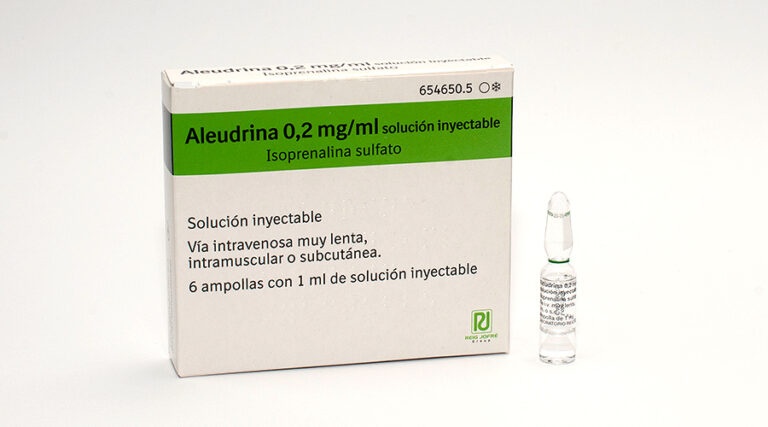
ALEUDRINA 0.2 mg/ml Injectable Solution

Prescription review online
A doctor will review your case and decide whether a prescription is medically appropriate.

Talk to a doctor about this medicine
Discuss your symptoms and possible next steps in a quick online consultation.



How to use ALEUDRINA 0.2 mg/ml INJECTABLE SOLUTION
Contents of the leaflet
- Introduction
- What is Aleudrina 0.2 mg/ml and what is it used for
- What you need to know before taking Aleudrina 0.2 mg/ml
- How to use Aleudrina 0.2 mg/ml
- Possible side effects
- Storage of Aleudrina 0.2mg/ml
- Contents of the pack and further information
Introduction
Package Leaflet: Information for the User
Aleudrina 0.2 mg/ml Solution for Injection
Isoprenaline Sulfate
Read all of this leaflet carefully before you start using this medicine because it contains important information for you.
- Keep this leaflet, you may need to read it again.
- If you have any further questions, ask your doctor or pharmacist.
- This medicine has been prescribed for you only. Do not pass it on to others. It may harm them, even if their symptoms are the same as yours.
- If you experience any side effects, talk to your doctor, pharmacist or nurse. This includes any possible side effects not listed in this leaflet.
Contents of the Package Leaflet:
- What is Aleudrina 0.2 mg/ml Solution for Injection and what is it used for
- What you need to know before you start taking Aleudrina 0.2 mg/ml Solution for Injection
- How to take Aleudrina 0.2 mg/ml Solution for Injection
- Possible side effects
- Storage of Aleudrina 0.2 mg/ml Solution for Injection
- Contents of the pack and further information
1. What is Aleudrina 0.2 mg/ml and what is it used for
Aleudrina belongs to a group of medicines known as beta-adrenergic agonists, which stimulate the frequency and force of heart contractions.
Aleudrina is used in the treatment of Morgagni-Stokes-Adams Syndrome (transient episodes of dizziness, loss of consciousness, and convulsions due to sudden reduction of cerebral blood flow), bradycardia (decreased heart rate), and cardiac blocks. It is also used in situations with insufficient cardiac output, such as cardiogenic shock (the heart is unable to pump the necessary blood) or after cardiac surgery.

Not sure if this medicine is right for you?
Discuss your symptoms and treatment with a doctor online.
2. What you need to know before taking Aleudrina 0.2 mg/ml
Do not use Aleudrina 0.2 mg/ml
- If you are allergic (hypersensitive) to isoprenaline or any of the other components of this medicine (listed in section 6).
- If you have hyperthyroidism (metabolic disorder with excess thyroid gland function).
- If you have had or have angina pectoris.
- If you suffer from tachycardic cardiac arrhythmias with increased heart rate.
- If you have decompensated heart disease (heart disease with insufficient cardiac contraction).
- If you have aortic stenosis (the aortic valve is narrowed).
- If you have had a recent myocardial infarction.
- If you have tachycardia (increased heart rate) or cardiac block (the cardiac stimulus is not propagated correctly) as a consequence of using digitalis (medicines for the treatment of heart failure and cardiac rhythm disorders obtained from digitalis).
- If you are taking other beta-1 agonists such as adrenaline, due to the risk of arrhythmias (see section Interaction of Aleudrina 0.2mg/ml with other medicines).
Warnings and precautions
Consult your doctor or pharmacist before starting to take Aleudrina:
- If you are elderly.
- If you are diabetic.
- If you have hyperthyroidism.
- If you have hyperreactivity to sympathomimetic drugs (stimulants of the sympathetic system), e.g. adrenaline.
- If you have cardiovascular diseases such as ischemic heart disease (not enough blood and oxygen reach the heart), arrhythmia (disorder of the heart rhythm), or tachycardia, occlusive vascular disease (the arteries narrow) including arteriosclerosis (hardening of the artery walls).
- If you are being treated with digitalis.
- If you are hypertensive.
- If you have aneurysms (enlargement of the artery walls).
- If you have prostate problems.
- If you have narrow-angle glaucoma (disorder with increased intraocular pressure).
- If you are pregnant and childbirth is imminent, as it inhibits uterine contractions.
- If you are breastfeeding.
- If you have liver disease.
- If you have kidney disease.
- If you have asthma.
- If you have epileptic seizures.
It should be used with caution when administered simultaneously with monoamine oxidase inhibitors (MAOIs) (type of antidepressant medication) (see section Use of other medicines).
In case of increased cardiac excitability (disorders of the heart rhythm) and tendency to extrasystoles (rapid contraction of the heart ventricles), your doctor will prescribe a particularly cautious dosage.
Use in athletes:
Athletes are informed that this medicine contains isoprenaline, which can give a positive result in doping tests.
Interaction of Aleudrina 0.2mg/ml with other medicines
Tell your doctor or pharmacist that you are taking, have recently taken, or might take any other medicines.
Aleudrina should not be administered simultaneously with sympathomimetic agents such as adrenaline, other sympathomimetic amines, or tricyclic antidepressants or MAOIs, as their combined effect may induce arrhythmias.
Isoprenaline increases the elimination of theophylline (bronchodilator) and may potentiate hypokalemia (low potassium levels), hyperglycemia (high sugar levels), tachycardia, and hypertension.
Beta-adrenergic blockers (medicines that help lower the heart rate) such as propranolol may counteract the effect of isoprenaline.
Aleudrina should be used with caution in patients who are administered halogenated anesthetics or cyclopropane (types of anesthetic gases), as arrhythmias may occur.
Fertility, pregnancy, and breastfeeding
It is not known whether it can affect reproductive capacity.
If you are pregnant or breastfeeding, or think you may be pregnant or are planning to have a baby, ask your doctor or pharmacist for advice before taking this medicine.
Due to its inhibitory effect on uterine contractions, it should be used with caution in the periods close to childbirth.
It is not known whether isoprenaline is excreted in breast milk, so the benefits of treatment should be weighed against the potential risk before administering this medicine.
Driving and using machines
This is not applicable, as Aleudrina is intended only for use in emergency situations.
Important information about some of the ingredients of Aleudrina 0.2mg/ml
This medicine may cause severe allergic reactions and bronchospasm (sudden feeling of suffocation) because it contains sodium metabisulfite (E 223).
This medicine contains less than 23 mg (1 mmol) of sodium per ampoule, so it is considered essentially "sodium-free".
3. How to use Aleudrina 0.2 mg/ml
Follow exactly the administration instructions of this medicine given by your doctor or pharmacist. If you are unsure, consult your doctor or pharmacist again.
The recommended dose is:
Adults:
For intravenous perfusion, dilute one ampoule (0.2 mg or 200 micrograms of isoprenaline sulfate) in 100 ml of perfusion fluid and administer at a rate of 20 drops (= 1 ml) per minute, giving 2 micrograms of Aleudrina (equivalent to 0.002 mg of aleudrina).
This is the dose administered when one ampoule is calculated to last approximately 1 1/2 hours.
Children:
Children are given 1/4 to 1/2 of the adult dose.
In special situations (Stokes-Adams, shock, or collapse) where intravenous perfusion cannot be performed, 1/2 to 1 ampoule of Aleudrina can be injected subcutaneously or, more rarely, intramuscularly.
In case of insufficient response, the possibility of a metabolic acidosis situation (pathology due to excess acid in tissues and blood) should be considered.
In such cases, administration of lactate or sodium bicarbonate perfusions or other buffer solutions is recommended to balance the alkaline reserve.
If you use more Aleudrina 0.2mg/ml than you should
In exceptional cases of administration of truly excessive doses, some of the following symptoms, characteristic of beta-adrenergic stimulant poisoning, may occur: facial flushing, hand tremors, restlessness, palpitations, tachycardia, extrasystoles (premature heartbeats), ventricular fibrillation (chaotic increase in heart rate), cardialgia (pain in the heart area), nausea.
Severe hypotension (low blood pressure) may occur, and symptoms similar to shock may develop.
Treatment:
Most toxic effects disappear when treatment is discontinued.
Medicines that block beta-adrenergic receptors will be used. Sedatives or tranquilizers will also be administered.
In case of overdose or accidental injection, consult your doctor, pharmacist, or nurse, or call the Toxicology Information Service, telephone 91 562 04 20, indicating the medicine and the amount injected.

Started taking the medicine and have questions?
Discuss your symptoms and treatment with a doctor online.
4. Possible side effects
Like all medicines, Aleudrina can cause side effects, although not everybody gets them.
The main adverse reactions include tachycardia, arrhythmias, palpitations, hypotension, tremors, headache, sweating, and flushing. Prolonged use has been associated with parotid gland edema.
Other adverse reactions that may occur are anxiety, fear, restlessness, insomnia, confusion, irritability, headache, and psychotic states. Dyspnea, weakness, anorexia, nausea, and vomiting are also common.
Paradoxically, in some patients, isoprenaline has precipitated Stokes-Adams attacks (transient cardiac arrest) during normal sinus rhythm or transient atrioventricular block.
If you experience any side effects, talk to your doctor, pharmacist, or nurse, even if they are not listed in this leaflet.
5. Storage of Aleudrina 0.2mg/ml
Keep in the refrigerator (between 2°C and 8°C).
Keep this medicine out of the sight and reach of children.
Do not use Aleudrina after the expiry date stated on the pack. The expiry date is the last day of the month stated.
Medicines should not be disposed of via wastewater or household waste. Return any unused medicine to a pharmacy for proper disposal. Ask your pharmacist how to dispose of medicines no longer required. This will help protect the environment.
6. Contents of the pack and further information
Composition of Aleudrina 0.2mg/ml
- The active substance is Isoprenaline sulfate.
- The other ingredients (excipients) are:
Sodium metabisulfite (E 223), disodium edetate, sodium chloride, hydrochloric acid, and water for injections.
Appearance of the product and pack contents
Clear, colorless solution.
Each 1 ml ampoule contains 0.2 mg of isoprenaline sulfate.
Marketing authorization holder and manufacturer
Laboratorio Reig Jofré
c/ Gran Capitán 10
08970 Sant Joan Despí
Barcelona
This leaflet was approved in January 2012
Detailed and up-to-date information on this medicine is available on the website of the Spanish Agency for Medicines and Health Products (AEMPS) http://www.aemps.gob.es/
- Country of registration
- Dosage formINJECTABLE, 0.2 mg
- ATC codeC01CA02
- Average pharmacy price7.76 EUR
- Availability in pharmaciesSupply issue reported
- Active substance
- Prescription requiredYes
- Manufacturer
- CompositionEDETATO DE DISODIO (1 mg mg), SODIO, METABISULFITO DE (E 223) (1 mg mg), CLORURO DE SODIO (5 mg mg)
- This information is for reference only and does not constitute medical advice. Always consult a doctor before taking any medication. Oladoctor is not responsible for medical decisions based on this content.
- Alternatives to ALEUDRINA 0.2 mg/ml INJECTABLE SOLUTIONDosage form: INJECTABLE PERFUSION, 0.2 mg/mLActive substance: isoprenalineManufacturer: Macure Healthcare LimitedPrescription requiredDosage form: INJECTABLE, 1 mg/10 mlActive substance: epinephrineManufacturer: Laboratoire AguettantPrescription requiredDosage form: INJECTABLE, Epinephrine base 1 mg/mlActive substance: epinephrineManufacturer: B Braun Medical S.A.Prescription required
Online doctors for ALEUDRINA 0.2 mg/ml INJECTABLE SOLUTION
Discuss questions about ALEUDRINA 0.2 mg/ml INJECTABLE SOLUTION, including use, safety considerations and prescription review, subject to medical assessment and local regulations.
Get ALEUDRINA 0.2 mg/ml INJECTABLE SOLUTION Prescription Online
Fill in a 2-min form
Tell us your symptoms, history, and what medicine you're requesting.
Pick a doctor or let us assign
Choose a specialist or we'll match you with the next available doctor.
Doctor reviews your case
Usually within 30 minutes. They may ask follow-up questions via chat.
Collect from any pharmacy
Electronic prescription sent to your email — valid across Spain.
Frequently Asked Questions
ALEUDRINA 0.2 mg/ml INJECTABLE SOLUTION requires a prescription in Spain. You can check with a doctor online whether this medicine may be appropriate for your situation.
The active ingredient in ALEUDRINA 0.2 mg/ml INJECTABLE SOLUTION is isoprenaline. This information helps identify medicines with the same composition but different brand names.
The average pharmacy price for ALEUDRINA 0.2 mg/ml INJECTABLE SOLUTION is around 7.76 EUR. Prices may vary depending on the manufacturer and dosage form.
ALEUDRINA 0.2 mg/ml INJECTABLE SOLUTION is manufactured by Laboratorio Reig Jofre, S.A.. Pharmacy brands and packaging may differ depending on the distributor.
Doctors such as Family doctors, Psychiatrists, Dermatologists, Cardiologists, Endocrinologists, Gastroenterologists, Pulmonologists, Nephrologists, Rheumatologists, Hematologists, Infectious disease physicians, Allergists, Geriatricians, Paediatricians, Oncologists may assess whether ALEUDRINA 0.2 mg/ml INJECTABLE SOLUTION is appropriate, depending on your situation and local regulations. You can book an online consultation to discuss your symptoms and possible next steps.
Spain has a well-developed healthcare infrastructure across major cities such as Madrid, Barcelona, Valencia, and Seville. Pharmacies are widely available and operate under strict regulations, ensuring access to prescribed medications.
You can buy ALEUDRINA 0.2 mg/ml INJECTABLE SOLUTION in Madrid, Barcelona, Seville, or Valencia at any local pharmacy with a valid prescription.
To obtain a prescription, you can use Oladoctor:
Other medicines with the same active substance (isoprenaline) include LABRYCOR 0.2 mg/ml CONCENTRATE FOR INFUSION SOLUTION, ADRENALINE AGUETTANT 0.1 mg/mL PRE-FILLED SYRINGE SOLUTION FOR INJECTION, ADRENALINE B. BRAUN 1 mg/ml INJECTABLE SOLUTION. These may have different brand names or formulations but contain the same therapeutic ingredient. Always consult a doctor before switching or starting a new medicine.
