



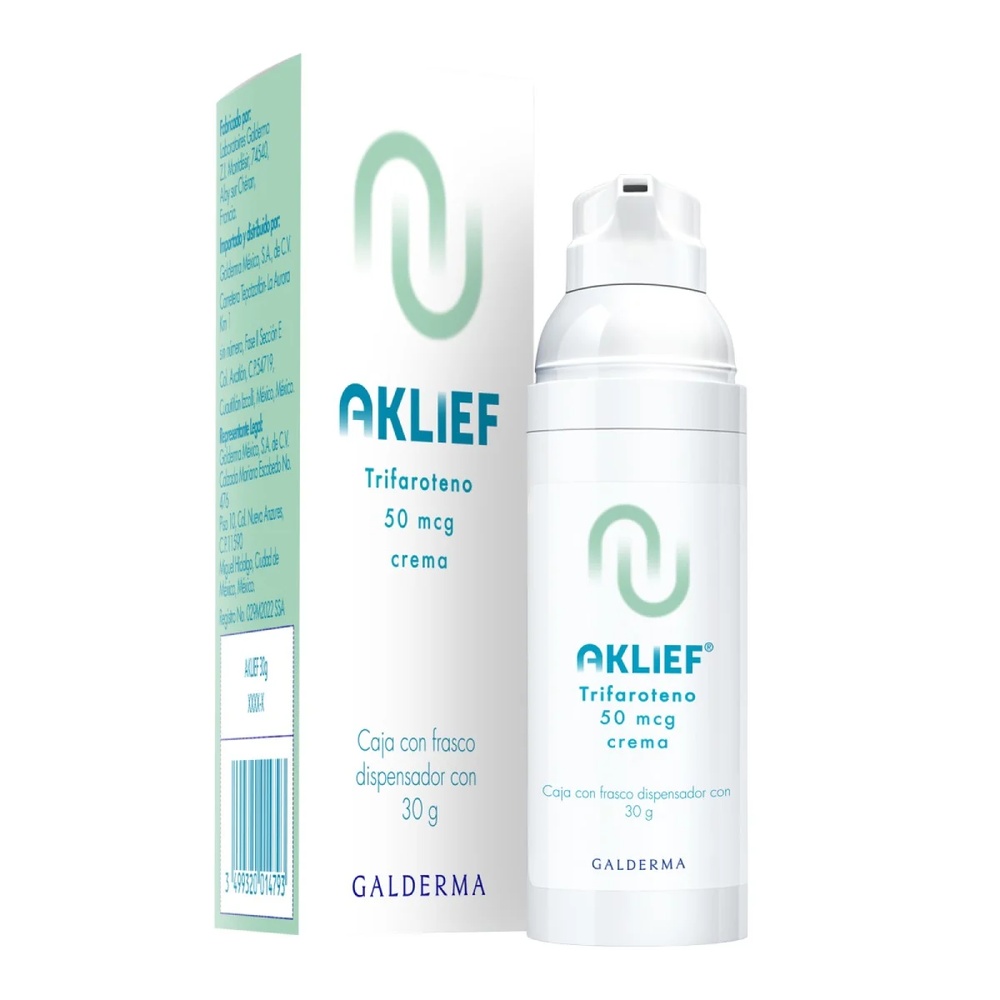
AKLIEF 50 µg/g Cream

Prescription review online
A doctor will review your case and decide whether a prescription is medically appropriate.

Talk to a doctor about this medicine
Discuss your symptoms and possible next steps in a quick online consultation.



How to use AKLIEF 50 micrograms/g cream
Contents of the leaflet
- Introduction
- What is Aklief and what is it used for
- What you need to know before you use Aklief
- How to use Aklief
- Possible side effects
- Storage of Aklief
- Contents of the pack and other information
Introduction
PATIENT INFORMATION LEAFLET
Patient Information Leaflet: Information for the Patient
Aklief 50 micrograms/g cream
trifarotene
This medicinal product is subject to additional monitoring, which will allow for the quick identification of new safety information. You can help by reporting any side effects you may get. The last section of section 4 will tell you how to report side effects.
Read all of this leaflet carefully before you start using this medicine because it contains important information for you.
- Keep this leaflet, you may need to read it again.
- If you have any further questions, ask your doctor or pharmacist.
- This medicine has been prescribed for you only. Do not pass it on to others. It may harm them, even if their signs of illness are the same as yours.
- If you get any side effects, talk to your doctor or pharmacist. This includes any possible side effects not listed in this leaflet. See section 4.
Contents of the pack
- What is Aklief and what is it used for
- What you need to know before you use Aklief
- How to use Aklief
- Possible side effects
- Storage of Aklief
- Contents of the pack and other information
1. What is Aklief and what is it used for
Aklief contains the active substance trifarotene, which belongs to a group of medicines known as retinoids.
This medicine is used for the cutaneous treatment of acne vulgaris on the face, chest and/or back in patients over 12 years of age, when they have many comedones (blackheads and whiteheads), numerous papules and pustules (inflamed spots).

Not sure if this medicine is right for you?
Discuss your symptoms and treatment with a doctor online.
2. What you need to know before you use Aklief
Do not use Aklief:
- If you are planning to become pregnant or if you are pregnant (see section Pregnancy and breast-feeding)
Warnings and precautions
- You may experience redness, flaking, dryness and burning/stinging with the use of Aklief cream (see section 4 "Possible side effects"). Consult your doctor if you experience these symptoms. Your doctor may recommend applying a moisturizer from the start of treatment that may help prevent such reactions. If symptoms appear, your doctor may advise you to use a moisturizer (if you have not already done so), to use the cream less frequently or to stop using it for a short period of time. If the symptoms persist despite these measures, your doctor may advise you to stop using it altogether.
- Aklief should not be used on areas where you have cuts, scratches, abrasions or eczema.
- Aklief should not come into contact with the eyes, eyelids, lips or mucous membranes. If the product accidentally gets into the eye, rinse immediately with plenty of warm water. Be careful when applying it to sensitive areas of the skin such as the neck or armpits.
- Caution should be exercised when applying Aklief cream at the same time as other products, including cosmetics (see section Other medicines and Aklief).
- Wax depilation should not be used as a hair removal method on skin treated with Aklief.
- If a reaction suggesting sensitivity to any component of the formula occurs, the use of Aklief should be discontinued.
Aklief should not be used on skin with sunburn. Excessive exposure to the sun, including sunlamps or phototherapy, should be avoided during treatment. The use of a sunscreen with a sun protection factor (SPF) of 30 or higher and protective clothing (such as a hat and shirt) over treated areas is recommended when sun exposure cannot be avoided. If, despite this, your face, chest, shoulders or back become sunburned, stop applying the medicine to the affected area until the skin has healed.
Other medicines and Aklief
Tell your doctor if you are using, have recently used or might use any other medicines.
Avoid using this medicine at the same time as cosmetics or acne medicines that are irritating, drying or exfoliating the skin during use, as they may produce additive irritating effects with this medicine. If you experience skin irritation, consult your doctor.
Pregnancy and breast-feeding
Pregnancy
DO NOT use Aklief if you are pregnant or planning to become pregnant. Your doctor may give you more information.
If you become pregnant during treatment, you should stop using this medicine and consult a doctor immediately.
Breast-feeding
When using Aklief, there is a risk that the active substance in the cream may pass into breast milk and the risk to the breast-fed child cannot be excluded. You and your doctor will have to decide whether to stop breast-feeding or stop Aklief treatment, taking into account the benefit of breast-feeding for the child and the benefit of treatment for the mother.
To avoid the risk of ingestion and/or contact exposure of a baby, breast-feeding women should not apply trifarotene cream to the chest or breast area.
Driving and using machines
The influence of this medicine on the ability to drive and use machines is negligible.
Aklief contains propylene glycol (E1520)
This medicine may cause skin irritation.
This product also contains 50 mg of alcohol (ethanol)per gram, which is equivalent to 5% w/w. This may cause a burning sensation on damaged skin.
3. How to use Aklief
Follow exactly the instructions of administration of this medicine given to you by your doctor. In case of doubt, consult your doctor or pharmacist again.
Important:Aklief is indicated in patients over 12 years of age for use on the skin of the face, chest and/or back. Do not use this medicine on other parts of the body. Do not ingest.
Keep this medicine out of the reach of children.
Method of administration
- Before using the pack for the first time, you must prepare it by pressing several times until a small amount of medicine is dispensed (up to 10 times maximum). The pack is now ready for use. Apply a thin layer of Aklief cream to the affected areas of the face (forehead, nose, chin and left and right cheeks) and to all affected areas of the trunk once a day, at night, on clean and dry skin:
- One (1) press should be enough to cover the entire face (e.g. forehead, cheeks, nose and chin).
- Two (2) presses should be enough to cover the upper trunk (e.g. upper back, shoulders and chest). One (1) additional press may be used for the middle and lower back, if acne is present.
- No more than four (4) presses per day are recommended.
- Avoid contact with the eyes, eyelids, lips and mucous membranes such as the inside of the nose or mouth. If cream accidentally gets into any of these areas, rinse them immediately with plenty of warm water.
- Wash your hands immediately after applying the cream.
It is recommended to use a moisturizer as frequently as necessary from the start of treatment with Aklief. The moisturizer can be used before or after applying Aklief, leaving enough time for the skin to dry between the application of the moisturizer and Aklief.
Your doctor will tell you how long you need to use Aklief. After three months of treatment, your doctor may need a new assessment to evaluate the improvement of your acne with treatment.
Use in children
This medicine should not be used in children under 12 years of age.
If you use more Aklief than you should
If you use more Aklief than you should on the skin, your acne will not be eliminated more quickly, but your skin may become irritated, flake and redden. Contact your doctor if you have used more Aklief than you should.
Contact your doctor or the health center if:
- a child has taken this medicine accidentally.
- you or someone else has taken this medicine accidentally
Your doctor will tell you what measures to take.
In case of overdose or accidental ingestion, consult your doctor or pharmacist immediately or call the Toxicology Information Service, phone: 91 562 04 20, indicating the medicine and the amount ingested.
If you forget to use Aklief
If you forget to apply Aklief at night, apply it the next night. Do not apply a double dose to make up for forgotten doses.
If you stop treatment with Aklief
Spots (spots, blackheads and whiteheads) will only be reduced after several applications of this medicine. It is important that you continue using Aklief for the time your doctor tells you.
If you have any other questions on the use of this medicine, ask your doctor or pharmacist.

Started taking the medicine and have questions?
Discuss your symptoms and treatment with a doctor online.
4. Possible side effects
Like all medicines, this medicine can cause side effects, although not everybody gets them.
You may often experience redness, flaking, dryness and burning/stinging with the use of Aklief cream. See section 2 "Warnings and precautions" for more information on what to do if you experience these symptoms.
Aklief may cause the following side effects:
Common side effects (may affect up to 1 in 10 people)
- irritation at the application site, pruritus (itching), sunburn
Uncommon side effects (may affect up to 1 in 100 people)
- skin pain
- skin dryness
- skin discoloration (change in skin color)
- erosion (skin loss)
- rash
- swelling
- skin irritation
- acne
- allergic dermatitis (skin allergy)
- erythema (redness)
Rare side effects (may affect up to 1 in 1,000 people)
- urticaria (hives)
- vesicles
- asteatotic eczema (dry skin with scales and cracks)
- seborrhoeic dermatitis (red, scaly and itchy skin)
- burning sensation on the skin
- skin cracks
- hyperpigmentation of the skin (darkening of skin pigmentation)
- exfoliation of the eyelids (exfoliation of the eyelid skin) or edema (swelling of the eyelid skin)
- chapped lips
- rubor (red face)
Reporting of side effects
If you experience any side effects, talk to your doctor or pharmacist, even if they are not listed in this leaflet. You can also report side effects directly through the Spanish Medicines Monitoring System for Human Use: https://www.notificaRAM.es. By reporting side effects, you can help provide more information on the safety of this medicine.
5. Storage of Aklief
Keep this medicine out of the sight and reach of children.
Do not use this medicine after the expiry date which is stated on the carton and tube/multidose container after EXP. The expiry date is the last day of the month shown.
Shelf life after first opening: 6 months.
This medicine does not require any special storage conditions.
Medicines should not be disposed of via wastewater or household waste. Ask your pharmacist how to dispose of medicines no longer required. These measures will help protect the environment.
6. Contents of the pack and other information
Composition of Aklief
- The active substance is trifarotene. One gram of cream contains 50 micrograms of trifarotene.
- The other ingredients are: allantoin, Simulgel 600 PHA (acrylamide/sodium acryloyldimethyltaurate copolymer, isohexadecane, polysorbate 80, sorbitan oleate), cyclomethicone, ethanol, phenoxyethanol, propylene glycol (E1520), medium-chain triglycerides and purified water.
Appearance and packaging
Aklief is a homogeneous white cream.
Aklief is available in 5 g tubes or in 15 g, 30 g or 75 g multidose containers. The containers will have a tube or a multidose container.
Not all pack sizes may be marketed.
Marketing authorisation holder and manufacturer
Marketing authorisation holder:
Laboratorios Galderma, S.A.
Serrano Galvache, 56
28033 Madrid
Spain
Manufacturer:
Laboratoires Galderma
Z.I. Montdésir
74540 Alby sur Chéran
France
This medicine is authorised in the Member States of the European Economic Area under the following names:
Belgium, Bulgaria, Croatia, Czech Republic, Denmark, Estonia, Finland, France, Hungary, Iceland, Ireland, Latvia, Lithuania, Luxembourg, Malta, Netherlands, Norway, Poland, Portugal, Slovakia, Spain, Romania, United Kingdom and Sweden: Aklief
Cyprus, Germany, Greece and Italy: Selgamis
Date of last revision of this leaflet:
Detailed and up-to-date information on this medicine is available on the website of the Spanish Agency for Medicines and Health Products (AEMPS) http://www.aemps.gob.es
- Country of registration
- Dosage formCREAM, 50 µg/g
- ATC codeD10AD06
- Active substance
- Prescription requiredYes
- Manufacturer
- CompositionPROPILENGLICOL (300 mg/g mg), ETANOL AL 96% (50 mg/g mg)
- This information is for reference only and does not constitute medical advice. Always consult a doctor before taking any medication. Oladoctor is not responsible for medical decisions based on this content.
- Alternatives to AKLIEF 50 micrograms/g creamDosage form: GEL, 1 mg/g + 25 mg/gActive substance: adapalene, combinationsManufacturer: Galenicum Derma S.L.U.Prescription requiredDosage form: GEL, 0.1%Active substance: adapaleneManufacturer: Laboratorios Galderma S.A.Prescription requiredDosage form: GEL, 0.1% Adapalene and 2.5% Benzoyl PeroxideActive substance: adapalene, combinationsManufacturer: Laboratorios Galderma S.A.Prescription required
Online doctors for AKLIEF 50 micrograms/g cream
Discuss questions about AKLIEF 50 micrograms/g cream, including use, safety considerations and prescription review, subject to medical assessment and local regulations.



Get AKLIEF 50 micrograms/g cream Prescription Online
Fill in a 2-min form
Tell us your symptoms, history, and what medicine you're requesting.
Pick a doctor or let us assign
Choose a specialist or we'll match you with the next available doctor.
Doctor reviews your case
Usually within 30 minutes. They may ask follow-up questions via chat.
Collect from any pharmacy
Electronic prescription sent to your email — valid across Spain.
Frequently Asked Questions
AKLIEF 50 micrograms/g cream requires a prescription in Spain. You can check with a doctor online whether this medicine may be appropriate for your situation.
The active ingredient in AKLIEF 50 micrograms/g cream is trifarotene. This information helps identify medicines with the same composition but different brand names.
AKLIEF 50 micrograms/g cream is manufactured by Laboratorios Galderma S.A.. Pharmacy brands and packaging may differ depending on the distributor.
Doctors such as Family doctors, Psychiatrists, Dermatologists, Cardiologists, Endocrinologists, Gastroenterologists, Pulmonologists, Nephrologists, Rheumatologists, Hematologists, Infectious disease physicians, Allergists, Geriatricians, Paediatricians, Oncologists may assess whether AKLIEF 50 micrograms/g cream is appropriate, depending on your situation and local regulations. You can book an online consultation to discuss your symptoms and possible next steps.
Spain has a well-developed healthcare infrastructure across major cities such as Madrid, Barcelona, Valencia, and Seville. Pharmacies are widely available and operate under strict regulations, ensuring access to prescribed medications.
You can buy AKLIEF 50 micrograms/g cream in Madrid, Barcelona, Seville, or Valencia at any local pharmacy with a valid prescription.
To obtain a prescription, you can use Oladoctor:
Other medicines with the same active substance (trifarotene) include ACNIDUO 1 mg/g + 25 mg/g GEL, DIFFERINE 1 mg/g GEL, EPIDUO 1 mg/g + 25 mg/g GEL. These may have different brand names or formulations but contain the same therapeutic ingredient. Always consult a doctor before switching or starting a new medicine.
