


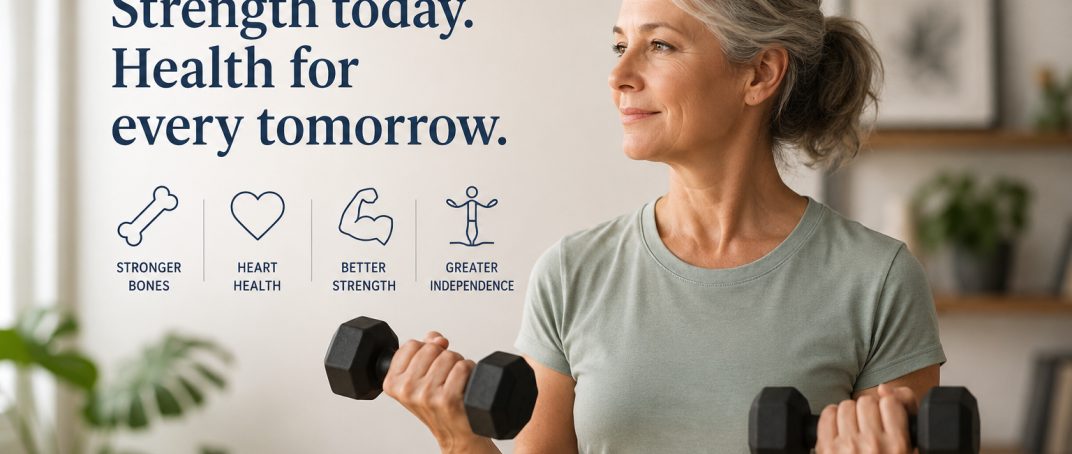
Twenty years ago, exercise advice for women revolved around burning calories. Cardio was the gold standard; weights were for athletes and bodybuilders. Over the past decade the medical picture has quietly changed — and the reason doctors now recommend resistance training has nothing to do with how anyone looks.
Muscle is an organ, not just a way to move
Skeletal muscle is usually thought of as the tissue that lets you walk, lift and climb stairs. It is also an active metabolic organ.
Healthy muscle helps regulate blood glucose, improves insulin sensitivity, stores glucose, supports immune function and produces signalling molecules called myokines that influence inflammation and communication between organs.
That is why maintaining muscle mass is associated with healthier ageing and a lower risk of several chronic conditions, including type 2 diabetes. And it matters throughout adulthood, not only in later life — what you build in your thirties is the foundation for your sixties.
Bone health starts long before it becomes a concern
Bone loss usually enters the conversation around menopause. The foundations are laid decades earlier.
Resistance training gives bone the mechanical stimulus it needs to maintain density. Unlike low-resistance activity, work with body weight, bands or weights encourages bone remodelling and helps preserve mineral density.
The evidence here has become solid. A 2025 systematic review and meta-analysis pooling 17 randomised controlled trials and 690 postmenopausal women found that resistance training significantly improved bone mineral density in the lumbar spine, femoral neck and total hip. The largest benefits came from programmes performed three times a week and maintained for 48 weeks or longer.
Strength training does not stop the hormonal process behind bone loss. It remains one of the most effective non-pharmacological ways to slow its consequences and to reduce the practical risk that follows osteoporosis — a fracture after an ordinary fall.
It supports the heart too
Cardiovascular health is instinctively associated with running and cycling, and aerobic exercise remains essential. But recent systematic reviews show that resistance training improves blood pressure, vascular function and several cardiometabolic risk factors in women, particularly in middle age and later.
Lifting is not only about muscle. It reaches the blood vessels as well.
The benefits that matter most are unglamorous
The best outcome of strength training is not visible in a mirror.
Carrying the shopping without discomfort.
Lifting a child, or a grandchild.
Getting up off the floor easily.
Climbing stairs without arriving out of breath.
Recovering more quickly after an illness.
Keeping your balance, and not falling at 75.
These ordinary things depend on muscle strength far more than most people realise. Across dozens of trials, women who did structured resistance training showed consistent improvements in lower-body strength, mobility and physical function compared with inactive controls — including women who had never exercised before.
What that translates into is not a number on a chart. It is staying independent.
You do not have to become an athlete
The most common misconception is that this means hours in a gym under a heavy barbell. The evidence says otherwise.
Meaningful benefit comes from two or three sessions a week using body weight, resistance bands, free weights or machines. The bone-density trials that worked best used moderate resistance performed consistently — not maximal effort.
The goal is progressive, regular loading that challenges the muscle safely. As with most health habits, consistency beats intensity, and a modest routine you actually keep beats an ambitious one you abandon in March.
What a doctor would add
“One of the biggest misconceptions I see in clinical practice is that strength training is only for athletes or people who want to change their appearance,” says Dr Andrei Popov, a general practitioner specialising in nutrition and physical rehabilitation. “In reality, resistance exercise is one of the most effective tools we have for supporting long-term health. Strong muscles help protect joints, improve metabolic health, maintain balance, support recovery after illness and contribute to a better quality of life at every age. You don't have to lift heavy weights or spend hours in the gym. Consistency matters much more than intensity.”
If you have a chronic condition, joint problems, osteoporosis or a long gap since you last trained, it is worth discussing where to start with a doctor rather than guessing — particularly about load, technique and what to avoid.
The point is not how you look
Not every woman enjoys running. Not everyone wants to compete. That is entirely fine.
What decades of research now point to is simpler than a fitness trend: maintaining muscle strength is one of the most valuable long-term investments in health available. Not to look a particular way — to stay capable, independent and well for as many years as possible.
This article is informational and does not replace medical advice. If you have a health condition or have not exercised for a long time, speak to a doctor before starting a new programme.

Comments
Be the first to comment on this article.
Sign in to leave a comment
Your comment will be visible to other readers after moderation.