


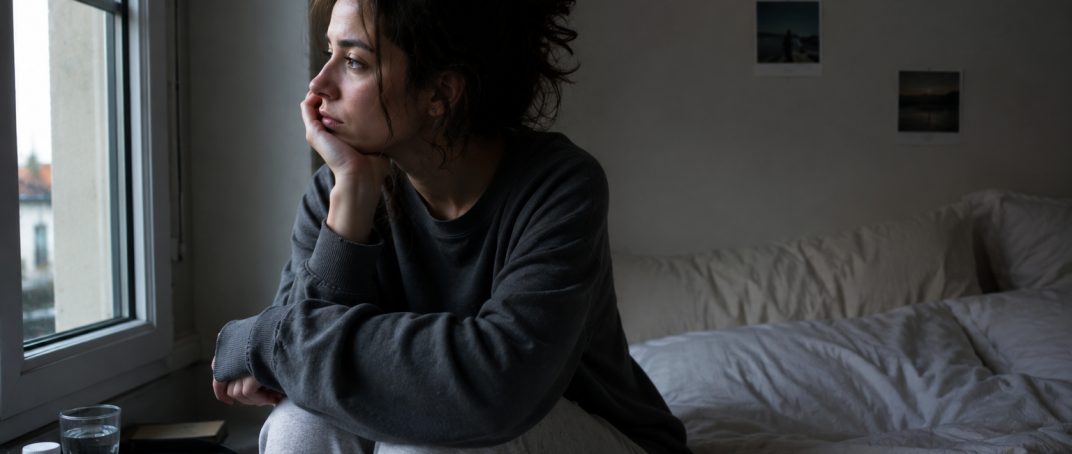
For years Victoria believed that the darkness arriving before every period was simply her character. It took therapy, a more regular cycle and months of paying attention before she saw the pattern — and learned that it had a name. Her name has been changed at her request.
When PMS stops being a difficult week
Victoria had lived with poor mental health since childhood. Depression, sensitivity, irritability, emotional overwhelm — all familiar, all seemingly permanent. Because these things had always been there, she never thought of them as symptoms, and certainly not as something tied to her menstrual cycle.
“I thought this was just who I was”, she says.
Her cycle gave her few clues. For years it was irregular, and she spent a long stretch on hormonal contraception. “I couldn't understand where my normal state began and ended.”
Then therapy started, her cycle became more regular, and something grew impossible to ignore. At roughly the same point every month, her mental health fell apart.
“Everything I already felt became a hundred times stronger”
In the days before menstruation, the insecurities Victoria normally carried stopped feeling like insecurities and started feeling like facts. She was useless. She was unwanted. The people closest to her did not really love her, and her partner would eventually leave.
At the worst moments her thoughts became very dark.
Work turned meaningless and concentration disappeared. Sleep grew restless. She withdrew from people while simultaneously needing to hear that she was not alone — and she would push her partner away precisely when she needed him most.
The pattern started around ten days before her period, and it did not always end when bleeding began. Sometimes the aftermath ran on for days.
For years she read all of this as a character flaw. “I thought I was simply unable to control myself. That I was unstable, that I could not get better, and that this was just part of me.”
What premenstrual dysphoric disorder actually is
Premenstrual dysphoric disorder, or PMDD, is a severe cyclical mood disorder tied to the menstrual cycle. Symptoms appear in the luteal phase — after ovulation, before menstruation — and ease once the period starts.
What separates it from ordinary premenstrual syndrome is not the list of symptoms. Irritability, sadness and physical discomfort appear in both. The difference is severity, the reliability of the timing, and how much of ordinary life the symptoms take away.
A 2024 systematic review and meta-analysis put the prevalence at roughly 3.2% of menstruating people when the diagnosis is based on symptoms recorded prospectively, though estimates shift depending on how the condition is measured.
Premenstrual syndrome | PMDD | |
Timing | Days before the period | Luteal phase, then clear improvement |
Main burden | Physical discomfort, low mood | Psychological symptoms |
Effect on life | Unpleasant, manageable | Work, relationships and daily functioning disrupted |
What it needs | Self-care, sometimes a GP | Prospective tracking and clinical assessment |
Symptoms may include severe mood swings, irritability, depression, anxiety, hopelessness, trouble concentrating, low energy, changed sleep and a sense of being overwhelmed. Physical symptoms occur too, but for many people it is the psychological ones that disable.
One thing matters more than any symptom list: PMDD should never be diagnosed from a single bad month, and never from an article. Clinical guidance asks for symptoms recorded daily across at least two cycles, then discussed with a professional.
When depression and the cycle overlap
Victoria's case is complicated by something common: she already lived with depression.
“Sometimes I cannot tell whether it is PMDD, another depressive episode or something else. Everything overlaps.”
That distinction is exactly what a clinician is for. In classic PMDD, symptoms stay largely inside the premenstrual phase and lift afterwards. In premenstrual exacerbation, an existing condition — depression, anxiety — becomes substantially worse before the period and does not disappear after it.
From the inside, the two feel nearly identical. Which is why self-diagnosis is least reliable in exactly the cases that need clarity most.
Similar symptoms can also come from thyroid disorders, medication effects and other conditions. Assessment may involve a GP, a gynaecologist, a psychiatrist or another mental health professional, depending on the picture.
What tracking can and cannot do
Recording symptoms daily is the single most useful thing to bring to that appointment. It shows when symptoms begin, when they lift, and whether there is a genuinely calmer stretch during the rest of the month.
Note the intensity of mood, sleep, energy and concentration, and mark the days of your cycle. Two full cycles is the minimum most guidance asks for.
A pattern is evidence. It is not a diagnosis, and it does not replace an examination.
Dark thoughts are not something to sit out
The most harmful idea about severe premenstrual symptoms is that a woman should simply wait for her period to arrive.
For some people the premenstrual phase brings intense hopelessness, worthlessness, or thoughts that turn frightening. Research has found a strong association between PMDD and serious mental health distress. Not everyone with PMDD experiences this — but severe cyclical deterioration deserves to be taken seriously rather than endured.
If you feel unsafe, if the thoughts are becoming persistent or hard to control, if you are withdrawing from everyone or beginning to think the people around you would be better off without you: seek help now, not after the period starts. The fact that the pattern follows a cycle makes it no less serious.
Treatment exists, but there is no single plan
Victoria is honest that treatment did not resolve everything. Medication reduced the intensity without removing the experience. In the stretches when she was not taking anything, she felt there was little to do but survive the worst days.
She had heard the standard advice — reduce stress, eat well, meditate, exercise, keep a routine. When depression and exhaustion are already in the room, even basic self-care can be out of reach.
That frustration deserves saying out loud. Lifestyle measures may support general wellbeing, but they do not replace medical assessment, and no one stays unwell because she failed to meditate enough.
Current guidance recommends an individual and often multimodal approach: psychological support, SSRIs, hormonal treatment, practical symptom management and, in severe cases, specialist care. A 2024 Cochrane review found that SSRIs probably reduce overall premenstrual symptoms; they may be taken continuously or, for some people, only during one phase of the cycle. They also carry side effects, and the right regimen depends on the whole clinical picture.
Hormonal treatment suits some patients and not others.
There is no universal plan that can be safely picked from an online checklist. Antidepressants, hormonal medication and supplements are all decisions to make with a clinician.
What changed for Victoria
Having a name for it did not make the difficult days disappear. What changed was quieter than that: she became less cruel to herself.
“I understood that some things were not completely under my control. It was not an excuse. It simply meant that I did not need to punish myself even more for being unable to pull myself together.”
Women are taught to distrust the emotions that arrive with their cycle. “It's just hormones” is used to wave away feelings, arguments, pain and legitimate concerns. But acknowledging a biological influence does not make an experience imaginary. Research suggests PMDD is not caused by abnormal hormone levels at all — rather, some people appear to have an unusually strong neurological response to entirely normal hormonal shifts.
Asked what she would say to a woman living the same ten days every month, Victoria did not offer anything polished.
“Hold on. And try not to isolate yourself.”
She knows how instinctive withdrawal feels, and how reliably it creates the worst possible conditions for getting through the episode. Her advice is not to pretend everything is fine. It is to keep one thread to the outside world: tell someone what is happening, stay in contact with a person you trust, and get professional support.
She would also like partners and families to know that pushing people away is rarely a message about them.
This article is informational and does not replace medical advice. If you recognise this pattern in yourself, discuss it with a doctor. If your thoughts feel unsafe, contact emergency services or a crisis line in your country.

Comments
Be the first to comment on this article.
Sign in to leave a comment
Your comment will be visible to other readers after moderation.