


For generations the story of female reproductive ageing sounded simple: a woman is born with a fixed number of eggs, loses them gradually, and reaches menopause when few remain. The broad outline still holds. What has changed is everything around it — and one number has been asked to carry far more weight than it can.
What “ovarian reserve” actually means
Ovarian reserve refers to the number of oocytes — immature egg cells — remaining in the ovaries.
The reserve forms before birth. Egg cells become enclosed in structures called primordial follicles, where they can stay inactive for years before either beginning to mature or naturally degenerating. Follicle numbers peak during fetal development and fall substantially before birth; the decline continues through childhood and adult life. Only a small fraction ever reach ovulation. Most are lost through a natural process called atresia.
But quantity is not quality.
Reserve describes how many follicles may remain. Egg quality describes an egg's ability to be fertilised, develop into an embryo and result in a healthy birth. Age is closely tied to quality, while reserve varies considerably between women of the same age.
Which is precisely why one blood test cannot forecast a fertile life.
AMH is useful. It is not a fertility score
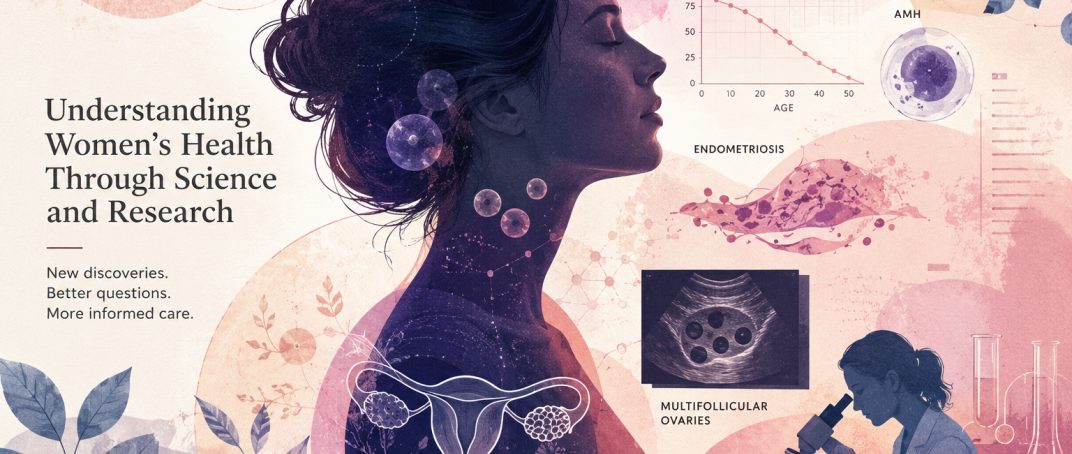
Anti-Müllerian hormone is produced by cells in small developing follicles, and is usually read alongside antral follicle count from an ultrasound to estimate reserve.
These tests carry real clinical information. They help estimate how ovaries are likely to respond to hormonal stimulation during IVF or egg freezing.
What they cannot do is reliably predict whether an otherwise healthy woman will conceive naturally. The American Society for Reproductive Medicine is explicit: AMH and antral follicle count are considerably better at predicting how many eggs may be retrieved during stimulation than at predicting pregnancy or live birth.
A low result does not mean natural conception is impossible. A high one does not guarantee fertility.
AMH has to be read alongside age, menstrual history, ultrasound findings, symptoms, medical conditions and, where relevant, the health of both partners. For most women the difficulty is not getting a number — it is understanding what the number does and does not mean.
So are women born with all their eggs?
The conventional position stands: the reserve is established before or around birth and is not meaningfully replenished in adult life.
Researchers continue to examine the details — how germ cells and their supporting cells organise into primordial follicles, and how reliable the very precise textbook figures actually are. A recent review pointed out how widely published estimates of fetal and newborn germ-cell numbers vary.
None of that means anyone has found a clinically proven way for adult ovaries to make a new lifetime supply. Claims that a treatment, supplement or lifestyle change can “create new eggs” deserve considerable caution.
The meaningful progress is elsewhere: in understanding how follicles are formed, activated, protected and lost, and how the ovarian environment affects them. The picture is becoming more detailed rather than being overturned.
What endometriosis is teaching researchers
Endometriosis occurs when tissue similar to the uterine lining grows outside the uterine cavity. When it affects the ovaries it can form cysts called endometriomas.
Recent reviews suggest that women with ovarian endometriosis — particularly with endometriomas on both ovaries, or after repeated ovarian surgery — may face a greater risk of reduced reserve. That is not the same as assuming every woman with endometriosis will have reduced fertility. Many do not.
Researchers are also studying whether the inflammatory environment around endometriosis affects oocyte development and embryo quality. Some studies report differences; others find outcomes comparable once age and reserve are accounted for.
That uncertainty is not a failure of research. It reflects the biological diversity of the disease. Two women with the same diagnosis can have very different lesion locations, surgical histories, symptoms and goals. There is not one endometriosis; there are many.
Multifollicular ovaries are not automatically PCOS
Few sentences in an ultrasound report cause more anxiety than “multifollicular ovaries”.
Multiple follicles do not, on their own, establish polycystic ovary syndrome. They can appear in healthy women, particularly at younger ages or during certain hormonal stages. The phrase describes an appearance on a screen, not a clinical syndrome.
PCOS is diagnosed through a combination of criteria — cycle irregularity, clinical or biochemical signs of raised androgens, and ovarian appearance — after other causes have been excluded. Medicine has become more careful about separating an imaging finding from a diagnosis, which is a small change that prevents a large amount of unnecessary fear.
The ovary is not only about fertility
It is worth remembering that the ovaries are endocrine organs. They are involved in hormonal balance, menstrual health, bone metabolism and cardiovascular health — which is why understanding them better also matters for women who are not trying to conceive, and why questions about ovarian function do not stop at menopause.
The most important progress is not a new test
Medicine celebrates technology, but the real shift here has been in perspective: away from hunting for a single number that explains everything, and towards looking at the whole person — age, symptoms, history, hormones, imaging, plans.
That sounds less dramatic than a test that predicts your reproductive future. It is considerably more likely to be useful.
If you have had an AMH result or an ultrasound report that worried you, the sensible next step is to have it interpreted in context by a gynaecologist rather than against what the internet says the number should be.
This article is informational and does not replace medical advice.

Comments
Be the first to comment on this article.
Sign in to leave a comment
Your comment will be visible to other readers after moderation.