


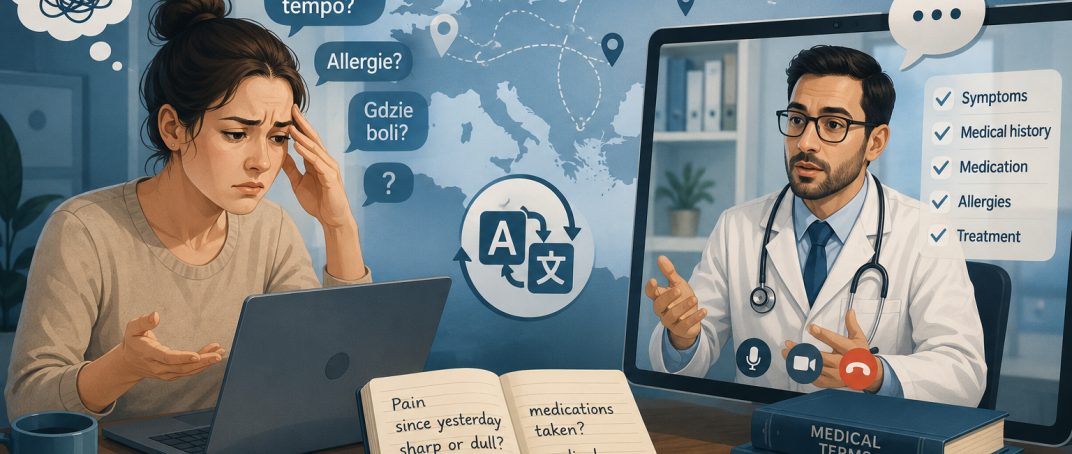
Millions of people move across Europe every year — to study, to work remotely, to retire somewhere warmer. The continent has become genuinely international. Healthcare, however, still largely runs inside national borders, and the first obstacle usually appears long before anyone asks about insurance.
The problem arrives before the paperwork
When people picture medical care abroad, they worry about insurance, waiting times and cost. In practice something else comes first: language.
Not everyday conversation. Describing pain, explaining a previous illness or understanding a treatment recommendation, during one of the more stressful hours of your life.
Try explaining, in a language you learned as an adult:
when the pain started;
whether it is sharp or dull;
which medications you already take;
whether you have any allergies;
what exactly happened just before the symptoms appeared.
People who are perfectly confident in English regularly struggle here — and more so when the consultation is happening in Spanish, Portuguese, Italian or Polish.
Doctors note the consequences: communication problems delay diagnosis, generate unnecessary anxiety and leave patients less confident about following the advice they were given. Healthcare is built on communication. When communication gets harder, so does everything else.
Translation apps are useful. They are not clinical tools
Modern translation has improved enormously. It is excellent for directions and dinner.
Medical conversation is a different task. Symptoms depend on context, and words that look equivalent can carry completely different clinical meaning.
A patient describes chest “pressure” when they mean muscular discomfort. Another uses one word for dizziness, weakness and nearly fainting — three things that point in three different directions. A translated sentence delivers the words. It does not deliver what the doctor actually needs, which is context.
That gap is where a consultation quietly loses accuracy.
What actually helps
Some of this is practical and costs nothing:
Write down your medications by their generic name, not the brand on the box. The same active ingredient is sold under different names in different countries.
Bring a short written timeline: when it started, what changed, what makes it better or worse.
Note allergies and previous surgery in advance, in the local language if you can, so the hardest part is not being improvised while you are in pain.
Say plainly when you have not understood something. A doctor would far rather repeat a sentence than treat a misunderstanding.
And where it is possible, the simplest fix is to remove the barrier entirely: a consultation in a language you actually think in. It is easier to describe a symptom accurately, and — the part people underestimate — easier to ask the follow-up question you would otherwise swallow.
Technology is changing access, not replacing doctors
Digital healthcare has made it considerably easier for people living abroad to reach a licensed clinician without travelling or waiting weeks. For international patients, being able to speak comfortably means explaining symptoms more precisely and asking the questions they might otherwise avoid.
“When patients fully understand both the questions they are being asked and the recommendations they receive, consultations become more productive for everyone involved,” says Dr Andrei Popov, a licensed physician providing online consultations in Spain.
None of this replaces in-person care. Examination, imaging and emergencies all require someone in the room. What it removes is the barrier that used to stop people from asking early — and asking early is usually the cheapest medicine there is.
Europe is getting more mobile, and healthcare is catching up
More people are studying abroad, working remotely and living outside their country of origin than at any point before. Health systems are adapting with digital consultations, electronic prescriptions and multilingual services.
The goal is not convenience. It is access.
Sometimes the hardest part of being ill abroad is not finding a doctor. It is finding one you can genuinely understand — and who can genuinely understand you. If that is the obstacle, choosing a doctor by language removes it before the consultation starts.
This article is informational and does not replace medical advice. In an emergency, call your local emergency number.

Comments
Be the first to comment on this article.
Sign in to leave a comment
Your comment will be visible to other readers after moderation.