


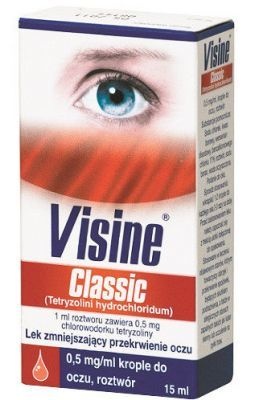



How to use Visine Classic
Package Leaflet: Information for the Patient
Visine Classic, 0.5 mg/ml, Eye Drops, Solution
Tetryzoline Hydrochloride
Read the Leaflet Carefully Before Using the Medication, as it Contains Important Information for the Patient.
This medication should always be used exactly as described in this patient leaflet or as advised by your doctor or pharmacist.
- Keep this leaflet, you may need to read it again.
- If you need advice or further information, consult your pharmacist.
- If you experience any side effects, including those not listed in this leaflet, tell your doctor or pharmacist. See section 4.
- If after 2 days there is no improvement or you feel worse, contact your doctor.
Table of Contents of the Leaflet
- 1. What is Visine Classic and what is it used for
- 2. Important information before using Visine Classic
- 3. How to use Visine Classic
- 4. Possible side effects
- 5. How to store Visine Classic
- 6. Contents of the pack and other information
1. What is Visine Classic and what is it used for
Visine Classic eye drops are indicated for the symptomatic treatment of conditions with swelling and conjunctival hyperemia, resulting from irritation, e.g., by smoke, dust, wind, chlorinated water, cosmetics, as well as in allergic inflammatory conditions, such as hay fever or pollen allergy.
The eye drops relieve accompanying symptoms such as burning, itching, pain, excessive tearing, and irritation.
2. Important information before using Visine Classic
When not to use Visine Classic
- in patients with narrow-angle glaucoma,
- in children under 2 years of age.
Warnings and precautions
Before starting to use Visine Classic, discuss it with your doctor or pharmacist.
If you experience eye pain, vision disturbances, persistence or worsening of irritation or conjunctival hyperemia, or if symptoms do not improve, worsen, or new symptoms appear, discontinue use and consult your doctor.
Prolonged use or misuse of the medication may cause worsening or recurrence of hyperemia.
Use of the medication may cause temporary pupil dilation.
In patients with severe cardiovascular disorders (e.g., coronary artery disease, hypertension, pheochromocytoma) and/or metabolic disorders (e.g., diabetes, hyperthyroidism), treated with monoamine oxidase inhibitors (MAOIs) - also during the period up to 10 days after their discontinuation - and other medications that may increase blood pressure, as well as in patients with dry eye syndrome, keratitis, and glaucoma, the use of Visine Classic should be done after careful consideration of the potential benefits and risks.
Visine Classic and other medications
In patients taking MAOI inhibitors and other medications that may increase blood pressure, Visine Classic should be used after consulting a doctor.
Consult your doctor before using Visine Classic with other eye medications.
Pregnancy, breastfeeding, and fertility
If you are pregnant or breastfeeding, think you may be pregnant, or plan to have a child, consult your doctor or pharmacist before using this medication.
Due to possible systemic side effects, the use of Visine Classic in pregnant and breastfeeding women is possible only after careful consideration by the doctor of the risks and benefits associated with treatment.
No data are available on the passage of tetryzoline through the placental barrier and into breast milk.
Driving and using machines
Administration of Visine Classic may cause temporary blurred vision. In such cases, do not drive or operate machinery.
Visine Classic contains benzalkonium chloride
The medication contains 0.1 mg of benzalkonium chloride per milliliter.
Avoid contact between the medication and contact lenses.
Benzalkonium chloride may be absorbed by soft contact lenses and change their color. Remove contact lenses before instillation and wait at least 15 minutes before reinsertion.
Benzalkonium chloride may also cause eye irritation, especially in people with dry eye syndrome or corneal disorders (the transparent layer at the front of the eye). If you experience any abnormal sensations in the eye, stinging, or eye pain after using the medication, contact your doctor.
Visine Classic contains boric acid and sodium borate
Do not use in children under 2 years of age due to the boron content, which may cause fertility disorders.
3. How to use Visine Classic
This medication should always be used exactly as described in this patient leaflet or as advised by your doctor or pharmacist. If in doubt, consult your doctor or pharmacist.
Children under 6 years of age
Do not use in children under 2 years of age. In children aged 2-6 years, the use of the medication should be under medical supervision.
Adults and children over 6 years of age
Unless otherwise advised by your doctor, instill 1 to 2 drops into the affected eye up to 3 times a day. Before instillation, remove contact lenses and wait at least 15 minutes after administration before reinsertion.
Use in children under 12 years of age should be under adult supervision.
The medication should not be used for more than 2 days. Use for more than 2 days should only be under medical supervision.
Method of administration
To avoid contamination of the medication, do not touch the tip of the applicator to any surface.
- 1. Before instillation, wash your hands thoroughly.
- 2. Unscrew the cap.
- 2. Unscrew the cap (press down and turn in the opposite direction to the clockwise direction).
- 3. Tilt your head back and pull the lower eyelid down to create a pocket between the eyelid and the eyeball.
- 4. Gently squeeze the bottle and turn it upside down. By slightly reducing the pressure, let a little air into the bottle. Thanks to the special applicator with a safe, rounded tip, every slight pressure will cause one drop to flow out. If the drop does not get into the eye, instill the next one.
- 5. After instillation, gently press the inner corner of the eye. This will prevent the medication from entering the body.
- 6. If it is necessary to administer the medication to the other eye as well, repeat the steps above.
- 7. After instillation, screw the bottle cap back on.
- 7. After instillation, screw the bottle cap back on - turn the cap to the right, to the end.
Discard the medication if it changes color or becomes cloudy.
Using more than the recommended dose of Visine Classic
Symptoms of overdose are usually not related to the administration of Visine Classic to the eye.
However, ingestion of the medication may cause serious side effects. In the case of ingestion of Visine Classic by an infant or small child, there is a risk of poisoning. Reported symptoms of overdose include: nausea, vomiting, lethargy, tachycardia, slowed breathing, bradycardia, hypotension, sedation, drowsiness, pupil dilation, stupor, hypothermia, salivation, coma.
Keep out of reach of children. In case of ingestion, seek medical help immediately.
Missing a dose of Visine Classic
Do not use a double dose to make up for a missed dose.
4. Possible side effects
Like all medications, Visine Classic can cause side effects, although not everybody gets them.
The frequency of possible side effects listed below is defined as follows:
Common (more than 1 in 100 people but less than 1 in 10 people): vision disturbances and eye irritation (pain, stinging, burning).
Very rare (less than 1 in 10,000 people): increased tearing, pupil dilation, and reactions at the site of administration, including eye or eyelid burning, redness, irritation, swelling, pain, and itching.
Frequency not known (cannot be estimated from the available data): feeling of dryness in the eye and headache.
If you experience any side effects, including those not listed in this leaflet, tell your doctor or pharmacist. Side effects can be reported directly to the Department of Medicinal Product Monitoring of the Office for Registration of Medicinal Products, Medical Devices, and Biocidal Products:
Aleje Jerozolimskie 181C, 02-222 Warsaw, tel.: 22 49-21-301, fax: 22 49-21-309,
website: https://smz.ezdrowie.gov.pl
Side effects can also be reported to the marketing authorization holder.
By reporting side effects, you can help provide more information on the safety of this medication.
5. How to store Visine Classic
Store at a temperature below 30°C.
Keep the medication out of sight and reach of children.
Do not use this medication after the expiry date stated on the packaging.
The expiry date refers to the last day of the month stated.
The eye drops in the unopened factory-sealed bottle are sterile. After opening the bottle, the medication should be discarded after 1 month, even if not used.
Medications should not be disposed of via wastewater or household waste. Ask your pharmacist how to dispose of medications no longer required. This will help protect the environment.
6. Contents of the pack and other information
What Visine Classic contains
- The active substance is tetryzoline hydrochloride.
- The other ingredients are: sodium chloride, boric acid, disodium edetate, 50% benzalkonium chloride solution, sodium borate, purified water.
What Visine Classic looks like and contents of the pack
A 15 ml LDPE bottle with an LDPE dropper and a PP cap, in a cardboard box.
A 15 ml LDPE bottle with an LDPE dropper and a PP/HDPE cap with a child-resistant closure, in a cardboard box.
Marketing authorization holder and manufacturer
Marketing authorization holder:
McNeil Healthcare (Ireland) Limited
Airton Road, Tallaght
Dublin 24
Ireland
Manufacturer:
Janssen Pharmaceutica N.V.
Turnhoutseweg 30
B-2340 Beerse
Belgium
To obtain more detailed information on this medication, contact:
Johnson & Johnson Poland Sp. z o.o.
ul. Iłżecka 24
02-135 Warsaw
tel.: 22 237 80 02
Date of last revision of the leaflet:
- Country of registration
- Active substance
- Prescription requiredNo
- Manufacturer
- ImporterJanssen Pharmaceutica N.V.
- This information is for reference only and does not constitute medical advice. Always consult a licensed doctor before taking any medication. Oladoctor is not responsible for medical decisions based on this content.
- Alternatives to Visine ClassicDosage form: Drops, 0.5 mg/mLActive substance: tetryzolineManufacturer: Jadran-Galenski laboratorij d.d.Prescription not requiredDosage form: Drops, 0.5 mg/mlActive substance: tetryzolineManufacturer: Jadran-Galenski laboratorij d.d.Prescription not requiredDosage form: Drops, 0.5 mg/mlActive substance: tetryzolineManufacturer: Jadran-Galenski laboratorij d.d.Prescription not required
Alternatives to Visine Classic in other countries
The best alternatives with the same active ingredient and therapeutic effect.
Alternative to Visine Classic in Ukraine
Alternative to Visine Classic in Spain
Online doctors for Visine Classic
Discuss dosage, side effects, interactions, contraindications, and prescription renewal for Visine Classic – subject to medical assessment and local rules.

Get updates and exclusive offers
Be the first to know about new services, marketplace updates, and subscriber-only promos.

