



TRASYLOL 277.8 Ph. Eur. units (500,000 KIU) Solution

Prescription review online
A doctor will review your case and decide whether a prescription is medically appropriate.

Talk to a doctor about this medicine
Discuss your symptoms and possible next steps in a quick online consultation.



How to use Trasilol
Contents of the leaflet
- Package Leaflet: Information for the Patient
- TRASYLOL
- What is Trasylol and what is it used for
- Important information before receiving Trasylol
- How to use Trasylol
- Possible side effects
- How to store Trasylol
- Contents of the pack and other information
Package Leaflet: Information for the Patient
TRASYLOL
(Aprotinin)
277.8 Ph. Eur. units (500,000 KIU), solution for infusion
Read the package leaflet carefully before receiving this medicine, as it contains important information for you.
- Keep this leaflet, you may need to read it again.
- If you have any further questions, ask your doctor/surgeon.
- If you experience any side effects, including any not listed in this leaflet, tell your doctor. See section 4.
Table of Contents of the Leaflet:
- 1. What is Trasylol and what is it used for
- 2. Important information before receiving Trasylol
- 3. How to use Trasylol
- 4. Possible side effects
- 5. How to store Trasylol
- 6. Contents of the pack and other information

Not sure if this medicine is right for you?
Discuss your symptoms and treatment with a doctor online.
1. What is Trasylol and what is it used for
Trasylol contains the active substance aprotinin. Trasylol belongs to a group of medicines called antifibrinolytics, i.e., medicines used to prevent blood loss.
Trasylol can help reduce blood loss during and after heart surgery. It may also be used to reduce the need for blood transfusions during and after heart surgery. Your doctor/surgeon will decide if you can benefit from Trasylol treatment, especially if you are at high risk of significant blood loss and are to undergo coronary artery bypass grafting using cardiopulmonary bypass (heart-lung machine).
Your doctor will administer aprotinin after careful consideration of the benefits and risks and the availability of alternative treatments.
2. Important information before receiving Trasylol
When you must not receive Trasylol
- if you are allergic to aprotinin or any of the other ingredients of this medicine (listed in section 6).
- if you have tested positive for aprotinin-specific IgG antibodies, indicating an increased risk of an allergic reaction to Trasylol.
- if it is not possible to perform a test for aprotinin-specific IgG antibodies before starting treatment, and there is a suspicion that you have been exposed to Trasylol in the last 12 months.
Warnings and precautions
Before receiving Trasylol, tell your doctor.
Tell your doctor if any of the following apply to you, to help them decide if Trasylol is suitable for you:
- -if you have kidney problems.If you have kidney problems, Trasylol should only be used if your doctor/surgeon thinks it will be beneficial for you.
- -if you have received or suspect you have received aprotinin or tissue adhesives containing aprotinin in the last 12 months.
If any of the above apply to you, your doctor will decide if Trasylol is suitable for you.
Trasylol will only be given if your doctor performs blood tests beforehandto check that you can receive the medicine (e.g., a test for aprotinin-specific IgG antibodies), otherwise, other medicines may be a better alternative for you.
You will be closely monitored for a possible allergic reaction to Trasyloland your doctor/surgeon will treat any symptoms that may occur. During Trasylol treatment, emergency therapy should be available in case of severe allergic reactions.
Children and adolescents
The safety and efficacy of Trasylol in children under 18 years have not been established.
Trasylol and other medicines
Tell your doctor about all medicines you are taking or have recently taken, and any medicines you plan to take.
In particular, tell your doctor if you are taking:
- medicines used to dissolve blood clots, such as streptokinase, urokinase, alteplase (r-tPA)
- aminoglycosides (antibiotics, medicines used to treat infections)
It is recommended that your doctor/surgeon administers heparin (a medicine used to prevent blood clots) before and during surgery, in addition to Trasylol. Your doctor will assess the heparin dose based on blood test results.
Pregnancy and breastfeeding
If you are pregnant or breastfeeding, think you may be pregnant, or plan to have a child, ask your doctor for advice before taking this medicine. If you are pregnant or breastfeeding, Trasylol should only be used if your doctor/surgeon thinks it will be beneficial for you. Your doctor will discuss the possible risks and benefits of using this medicine.

Started taking the medicine and have questions?
Discuss your symptoms and treatment with a doctor online.
3. How to use Trasylol
For adult patients, the recommended dosing regimen is:
You will receive a small amount of Trasylol (1 ml) before the start of surgery to check if you are allergic to Trasylol. Medicines used to prevent allergic symptoms (H1 and H2 antagonists) may be given 15 minutes before the Trasylol test dose.
If no allergic symptoms occur, you will receive 100-200 ml of Trasylol over 20 to 30 minutes, followed by 25-50 ml per hour (max. 5-10 ml/min) until the end of surgery.
Usually, you will not receive more than 700 ml of Trasylol at any time.
There are no special recommendations for dosing in elderly patients or patients with impaired renal function.
Trasylol will usually be given to you while you are lying down, as a slow injection or infusion (in a "drip") through a central venous catheter in your body.
Overdose of Trasylol
There is no specific antidote to reverse the effects of Trasylol.
If you have any further questions on the use of this medicine, ask your doctor.
4. Possible side effects
Like all medicines, Trasylol can cause side effects, although not everybody gets them.
Although allergic reactions are rare in patients receiving Trasylol for the first time, patients who receive Trasylol more than once may have a higher risk of an allergic reaction. Symptoms of an allergic reaction may include:
- difficulty breathing
- low blood pressure
- itching, rash, and hives
- nausea
If any of these symptoms occur during Trasylol administration, your doctor/surgeon will stop the treatment.
Other side effects include:
Common:may affect up to 1 in 10 people
- abnormal kidney function test results (increased creatinine levels)
Uncommon:may affect up to 1 in 100 people
- chest pain [myocardial ischemia, coronary artery occlusion], heart attack (myocardial infarction)
- fluid accumulation in the sac surrounding the heart (pericardial effusion)
- blood clots (thrombosis)
- reduced or interrupted blood flow to the brain (stroke)
- kidney disease (acute kidney injury, renal tubular necrosis)
- passing less urine than usual
- severe allergic reaction (anaphylactic or anaphylactoid reaction)
Rare:may affect up to 1 in 1,000 people
- blood clots in the blood vessels (arterial thrombosis)
- blood clots in the lungs (pulmonary embolism)
Very rare:may affect up to 1 in 10,000 people
- swelling at the injection site or around the injection site on the skin (injection site and infusion reactions), thrombophlebitis (infusion site)
- -severe disorder of blood clotting leading to tissue damage and bleeding (disseminated intravascular coagulation)
- -inability of blood to clot or coagulate properly (coagulopathy)
- -severe life-threatening allergic shock (anaphylactic shock)
Reporting of side effects
If you experience any side effects, including any not listed in this leaflet, tell your doctor. Side effects can be reported directly to the Department of Drug Safety Monitoring of the Office for Registration of Medicinal Products, Medical Devices, and Biocidal Products, Al. Jerozolimskie 181 C, 02-222 Warsaw, Tel.: +48 22 49 21 301, Fax: +48 22 49 21 309, Website: https://smz.ezdrowie.gov.pl.
Side effects can also be reported to the marketing authorization holder.
By reporting side effects, you can help provide more information on the safety of this medicine.
5. How to store Trasylol
Keep out of the sight and reach of children.
Do not use this medicine after the expiry date stated on the carton and bottle after "Expiry Date (EXP)". The expiry date refers to the last day of the month.
Store below 25°C. Store in the original package to protect from light.
Medicines should not be disposed of via wastewater or household waste. Ask your pharmacist how to dispose of medicines no longer required. This will help protect the environment.
6. Contents of the pack and other information
What Trasylol contains
50 ml of the solution for infusion contains:
- the active substance is a concentrated solution of aprotinin with an activity of 277.8 Ph. Eur. units, equivalent to 500,000 KIU (kallikrein inactivation units).
- the other ingredients are sodium chloride, water for injections.
What Trasylol looks like and contents of the pack
Trasylol is a clear, colorless solution for infusion.
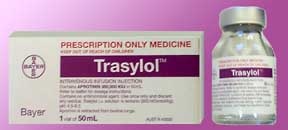
The pack contains 1 glass vial containing 50 ml of the solution, closed with a siliconized rubber stopper and an aluminum cap with a flip-off seal, in a cardboard box.
Marketing authorization holder and manufacturer
Marketing authorization holder
Nordic Group B.V.
Siriusdreef 41
2132 WT Hoofddorp
Netherlands
Manufacturer
Fresenius Kabi Austria GmbH
Hafnerstrasse 36
8055 Graz
Austria
Manufacturer
Apotek Produktion & Laboratorier AB (APL)
Formvägen 5B
906 21 Umeå
Sweden
To obtain more detailed information, contact the local representative of the marketing authorization holder:
AMRING FARMA SRL
Tel.: +40 31 620 1204
[email protected]
Date of last revision of the leaflet:
- Country of registration
- Dosage formSolution, 277.8 Ph. Eur. units (500,000 KIU)
- ATC codeB02AB01
- Active substance
- Prescription requiredNo
- Manufacturer
- ImporterApotek Produktion & Laboratorier AB (APL) Fresenius Kabi Austria GmbH
- This information is for reference only and does not constitute medical advice. Always consult a doctor before taking any medication. Oladoctor is not responsible for medical decisions based on this content.
- Alternatives to TrasilolDosage form: Powder, 500 mgActive substance: alfa1 antitrypsinManufacturer: Takeda Manufacturing Austria AGPrescription requiredDosage form: Powder, 1000 mgActive substance: alfa1 antitrypsinManufacturer: Takeda Manufacturing Austria AGPrescription requiredDosage form: Tablets, 500 mgActive substance: tranexamic acidPrescription required
Online doctors for Trasilol
Discuss questions about Trasilol, including use, safety considerations and prescription review, subject to medical assessment and local regulations.









Get Trasilol Prescription Online
Fill in a 2-min form
Tell us your symptoms, history, and what medicine you're requesting.
Pick a doctor or let us assign
Choose a specialist or we'll match you with the next available doctor.
Doctor reviews your case
Usually within 30 minutes. They may ask follow-up questions via chat.
Collect from any pharmacy
Electronic prescription sent to your email — valid across Spain.
Frequently Asked Questions
Trasilol does not require a prescription in Poland. You can check with a doctor online whether this medicine may be appropriate for your situation.
The active ingredient in Trasilol is aprotinin. This information helps identify medicines with the same composition but different brand names.
Trasilol is manufactured by Apotek Produktion & Laboratorier AB (APL) Fresenius Kabi Austria GmbH. Pharmacy brands and packaging may differ depending on the distributor.
Doctors such as Family doctors, Psychiatrists, Dermatologists, Cardiologists, Endocrinologists, Gastroenterologists, Pulmonologists, Nephrologists, Rheumatologists, Hematologists, Infectious disease physicians, Allergists, Geriatricians, Paediatricians, Oncologists may assess whether Trasilol is appropriate, depending on your situation and local regulations. You can book an online consultation to discuss your symptoms and possible next steps.
Spain has a well-developed healthcare infrastructure across major cities such as Madrid, Barcelona, Valencia, and Seville. Pharmacies are widely available and operate under strict regulations, ensuring access to prescribed medications.
You can buy Trasilol in Madrid, Barcelona, Seville, or Valencia at any local pharmacy with a valid prescription.
To obtain a prescription, you can use Oladoctor:
Other medicines with the same active substance (aprotinin) include Rimphisia, Rimphisia, Deporium Comfort. These may have different brand names or formulations but contain the same therapeutic ingredient. Always consult a doctor before switching or starting a new medicine.
