



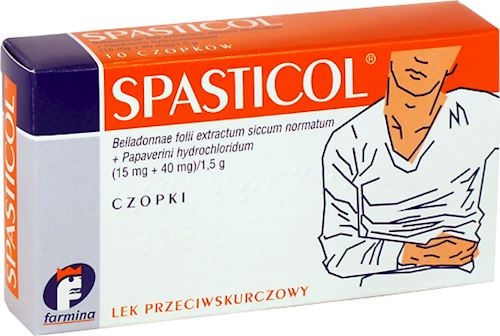
SPASTICOL (15 mg + 40 mg)/1.5 g Suppositories

Prescription review online
A doctor will review your case and decide whether a prescription is medically appropriate.

Talk to a doctor about this medicine
Discuss your symptoms and possible next steps in a quick online consultation.



How to use Spasticol
Contents of the leaflet
- Leaflet attached to the packaging: patient information
- What is Spasticol and what is it used for
- Important information before using Spasticol
- How to use Spasticol
- Possible side effects
- How to store Spasticol
- Package contents and other information
Leaflet attached to the packaging: patient information
SPASTICOL, (15 mg + 40 mg)/1.5 g, suppositories
Belladonnae folii extractum siccum normatum + Papavrini hydrochloridum
Please read the contents of the leaflet carefully before using the medicine, as it contains important information for the patient.
- Please keep this leaflet, so that you can read it again if necessary.
- In case of any further doubts, please consult a doctor or pharmacist.
- This medicine has been prescribed to a specific person. Do not pass it on to others. The medicine may harm another person, even if their illness symptoms are the same.
- If the patient experiences any side effects, including any side effects not listed in this leaflet, they should inform their doctor or pharmacist. See section 4.
Table of contents of the leaflet
- 1. What is Spasticol and what is it used for
- 2. Important information before using Spasticol
- 3. How to use Spasticol
- 4. Possible side effects
- 5. How to store Spasticol
- 6. Package contents and other information
1. What is Spasticol and what is it used for
Spasticol is a combined medicine with a spasmolytic effect. The medicine is used in spastic conditions within the abdominal cavity, in renal and biliary colic.

Not sure if this medicine is right for you?
Discuss your symptoms and treatment with a doctor online.
2. Important information before using Spasticol
When not to use Spasticol
Spasticol should not be used if the patient has:
- hypersensitivity (allergy) to papaverine or atropine;
- hypersensitivity (allergy) to any other component of this medicine (listed in section 6);
- prostatic hyperplasia;
- intestinal obstruction or atony (decreased intestinal motility);
- urinary bladder atony;
- ulcerative colitis;
- pyloric stenosis;
- glaucoma with a narrow angle of filtration.
Warnings and precautions
Caution should be exercised when using Spasticol in patients with elevated body temperature, reflux disease, after myocardial infarction, in patients with hypertension and other cardiovascular diseases, as well as in patients with conditions accompanied by tachycardia (rapid heart rate), such as hyperthyroidism, heart failure.
Before starting to use Spasticol, the patient should discuss it with their doctor.
Children and adolescents
There is no data confirming the safety of use. The medicine should be used only on the doctor's prescription. When using Spasticol in children, particular caution should be exercised due to the possible increased sensitivity to side effects.
Patients over 65 years of age
Particular caution should be exercised when using Spasticol in patients over 65 years of age, due to the possible increased sensitivity to side effects.
Spasticol and other medicines
The patient should inform their doctor or pharmacist about all medicines they are currently taking or have recently taken, as well as any medicines they plan to take. In particular, the patient should inform their doctor about taking:
- first-generation antihistamines used in allergic diseases;
- neuroleptics derived from phenothiazine, used in schizophrenia;
- tricyclic antidepressants, used in depression;
- trihexyphenidyl, biperiden, used in Parkinson's disease;
- quinidine, disopyramide, propafenone, used in cardiac arrhythmia. The inhibition of gastrointestinal motility caused by Spasticol may affect the absorption of other medicines.
Pregnancy and breastfeeding
The use of Spasticol is not recommended during pregnancy and breastfeeding.
Driving and operating machinery
The medicine contains atropine. Due to the vision disturbances it causes, the patient should not drive vehicles or operate machinery during treatment.
3. How to use Spasticol
Spasticol should be used in accordance with the doctor's recommendations.
The medicine is intended for rectal administration. Unless the doctor recommends otherwise, adults should use 1 suppository 1 to 3 times a day.
In case of doubts about the use of the medicine, the patient should consult their doctor.
Using a higher dose of Spasticol than recommended
The following symptoms may occur:
- rapid heart rate;
- elevated body temperature;
- rapid breathing;
- excitement, disorientation, and hallucinations. If a higher dose of the medicine than recommended is taken, the patient should immediately consult their doctor or pharmacist.

Started taking the medicine and have questions?
Discuss your symptoms and treatment with a doctor online.
4. Possible side effects
Like all medicines, Spasticol can cause side effects, although not everybody gets them. During treatment with the medicine, the following may occur:
- gastrointestinal disorders: dry mouth, constipation, vomiting;
- renal and urinary disorders: difficulty urinating;
- cardiac disorders: slowed or rapid heart rate;
- vascular disorders: decreased blood pressure;
- skin and subcutaneous tissue disorders: dryness and redness of the skin, facial redness, skin rash, increased sweating;
- nervous system disorders: headaches and dizziness, drowsiness;
- eye disorders: vision disturbances.
In case of any side effects, the patient should stop using the medicine. Side effects can be reported to a healthcare professional, the marketing authorization holder, or the President of the Office for Registration of Medicinal Products, Medical Devices, and Biocidal Products [current address, phone number, and fax number, email address].
5. How to store Spasticol
The medicine should be stored out of sight and reach of children.
Store in a temperature below 25°C.
Do not use after the expiry date stated on the packaging.
6. Package contents and other information
What Spasticol contains
The active substances of the medicine are standardized dry extract of belladonna leaves and papaverine hydrochloride.
The excipient is cocoa oil.
What Spasticol looks like and what the package contains
The medicine is in the form of suppositories packaged in blisters and a cardboard box.
The package contains 10 suppositories.
Marketing authorization holder and manufacturer
Farmina sp. z o.o.
ul. Lipska 44
- 30-721 Kraków [Logo]
Date of the last update of the leaflet:
- Country of registration
- Dosage formSuppositories, (15 mg + 40 mg)/1.5 g
- ATC codeA03AD01
- Active substance
- Prescription requiredNo
- Manufacturer
- ImporterFarmina Sp. z o.o.
- This information is for reference only and does not constitute medical advice. Always consult a doctor before taking any medication. Oladoctor is not responsible for medical decisions based on this content.
- Alternatives to SpasticolDosage form: Solution, 20 mg/mlActive substance: papaverinePrescription requiredDosage form: Tablets, 80 mgActive substance: drotaverineManufacturer: mibe GmbH ArzneimittelPrescription not requiredDosage form: Tablets, 40 mgActive substance: drotaverineManufacturer: mibe GmbH ArzneimittelPrescription not required
Online doctors for Spasticol
Discuss questions about Spasticol, including use, safety considerations and prescription review, subject to medical assessment and local regulations.









Get Spasticol Prescription Online
Fill in a 2-min form
Tell us your symptoms, history, and what medicine you're requesting.
Pick a doctor or let us assign
Choose a specialist or we'll match you with the next available doctor.
Doctor reviews your case
Usually within 30 minutes. They may ask follow-up questions via chat.
Collect from any pharmacy
Electronic prescription sent to your email — valid across Spain.
Frequently Asked Questions
Spasticol does not require a prescription in Poland. You can check with a doctor online whether this medicine may be appropriate for your situation.
The active ingredient in Spasticol is papaverine. This information helps identify medicines with the same composition but different brand names.
Spasticol is manufactured by Farmina Sp. z o.o.. Pharmacy brands and packaging may differ depending on the distributor.
Doctors such as Family doctors, Psychiatrists, Dermatologists, Cardiologists, Endocrinologists, Gastroenterologists, Pulmonologists, Nephrologists, Rheumatologists, Hematologists, Infectious disease physicians, Allergists, Geriatricians, Paediatricians, Oncologists may assess whether Spasticol is appropriate, depending on your situation and local regulations. You can book an online consultation to discuss your symptoms and possible next steps.
Spain has a well-developed healthcare infrastructure across major cities such as Madrid, Barcelona, Valencia, and Seville. Pharmacies are widely available and operate under strict regulations, ensuring access to prescribed medications.
You can buy Spasticol in Madrid, Barcelona, Seville, or Valencia at any local pharmacy with a valid prescription.
To obtain a prescription, you can use Oladoctor:
Other medicines with the same active substance (papaverine) include Papaverinum hidrohloricum Vzf, Drotafemme Forte, Drotafemme. These may have different brand names or formulations but contain the same therapeutic ingredient. Always consult a doctor before switching or starting a new medicine.
