



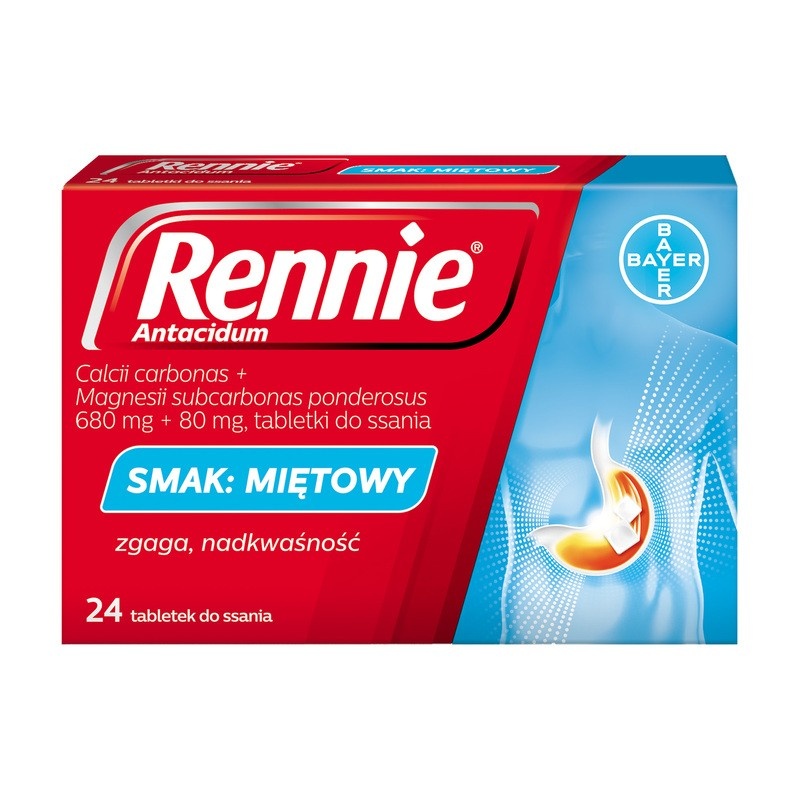
RENNIE 680 mg/80 mg Tablets

Prescription review online
A doctor will review your case and decide whether a prescription is medically appropriate.

Talk to a doctor about this medicine
Discuss your symptoms and possible next steps in a quick online consultation.



How to use Rennie Antacidum
Contents of the leaflet
- Leaflet attached to the packaging: patient information
- Warning! The leaflet should be kept. Information on the immediate packaging in a foreign language.
- Rennie Antacid (Rennie)
- What is Rennie Antacid and what is it used for
- Important information before taking Rennie Antacid
- How to take Rennie Antacid
- Possible side effects
- How to store Rennie Antacid
- Contents of the packaging and other information
Leaflet attached to the packaging: patient information
Warning! The leaflet should be kept. Information on the immediate packaging in a foreign language.

Not sure if this medicine is right for you?
Discuss your symptoms and treatment with a doctor online.
Rennie Antacid (Rennie)
680 mg + 80 mg, chewable tablets
Calcium carbonate + Magnesium carbonate heavy
Rennie Antacid and Rennie are different trade names for the same medicine.
You should carefully read the contents of the leaflet before taking the medicine, as it contains important information for the patient.
This medicine should always be used exactly as described in the patient leaflet or as directed by a doctor or pharmacist.
- The leaflet should be kept so that it can be read again if necessary.
- If advice or additional information is needed, you should consult a pharmacist.
- If the patient experiences any side effects, including any possible side effects not listed in the leaflet, they should inform their doctor, pharmacist, or nurse. See section 4.
- If there is no improvement after 7 days or the patient feels worse, they should contact their doctor.
Table of contents of the leaflet
- 1. What is Rennie Antacid and what is it used for
- 2. Important information before taking Rennie Antacid
- 3. How to take Rennie Antacid
- 4. Possible side effects
- 5. How to store Rennie Antacid
- 6. Contents of the packaging and other information
1. What is Rennie Antacid and what is it used for
Rennie Antacid is a medicine that neutralizes excess stomach acid.
It contains two active substances: calcium carbonate and magnesium carbonate heavy.
Rennie Antacid is used for the symptomatic treatment of disorders associated with excessive acidity of stomach juice, such as:
- heartburn,
- indigestion,
- bloating,
- nausea,
- feeling of fullness or heaviness in the upper abdomen,
- belching.

Started taking the medicine and have questions?
Discuss your symptoms and treatment with a doctor online.
2. Important information before taking Rennie Antacid
When not to take Rennie Antacid:
- If the patient is allergic to the active substances or any of the other ingredients of the medicine (listed in section 6).
- If the patient has increased calcium levels in the blood (hypercalcemia).
- If the patient has kidney stones with calcium.
- If the patient has severe kidney failure.
- If the patient has low levels of inorganic phosphates in the blood (hypophosphatemia).
Warnings and precautions
Before starting to take Rennie Antacid, the patient should discuss it with their doctor or pharmacist.
When taking Rennie Antacid, the patient should be particularly careful if:
- they have kidney failure; they should then regularly check their calcium, phosphate, and magnesium levels in the blood,
- they have excessive excretion of calcium in the urine (hypercalciuria),
- they take the medicine for a long time and in high doses; this may cause (especially in patients with kidney failure) an increase in magnesium and calcium levels in the blood and milk-alkali syndrome (a condition caused by excessive intake of calcium compounds orally). This, in turn, may cause nausea, vomiting, excessive urination, increased thirst, dehydration, fatigue, and disturbances of orientation and thinking (so-called confusion); increased risk of kidney stone formation; muscle weakness.
Rennie Antacid with other medicines
The patient should tell their doctor or pharmacist about all the medicines they are taking or have recently taken, as well as any medicines they plan to take.
Rennie Antacid may affect the speed and extent of absorption of other medicines. Therefore, all medicines, especially those listed below, should be taken 1 or 2 hours before or after taking Rennie Antacid:
- antibiotics from the tetracycline group and other antibacterial medicines - quinolones,
- cardiac glycosides, such as digoxin,
- bisphosphonates (used in the treatment of osteoporosis),
- dolutegravir (an antiretroviral medicine used in the treatment of HIV infection),
- levothyroxine (used, among other things, in hypothyroidism),
- eltrombopag (used in the treatment of thrombocytopenia),
- phosphates,
- fluorides,
- iron preparations,
- thiazide diuretics. Due to the increased risk of hypercalcemia when taking thiazide diuretics, calcium levels in the serum should be regularly monitored.
Rennie Antacid with food and drink
The medicine should be taken after a meal. The medicine should not be taken with large amounts of milk or dairy products.
Pregnancy and breastfeeding
If the patient is pregnant or breastfeeding, thinks they may be pregnant, or plans to have a child, they should consult their doctor or pharmacist before taking this medicine. Rennie Antacid can be used during pregnancy and breastfeeding. However, the recommended doses should be strictly followed and the medicine should be used as directed. The medicine should not be used for more than 2 weeks.
Driving and using machines
There is no effect.
Rennie Antacid contains sucrose.
One tablet contains 475 mg of sucrose. This should be taken into account in patients with diabetes.
If the patient has previously been diagnosed with intolerance to some sugars, they should consult their doctor before taking the medicine.
3. How to take Rennie Antacid
This medicine should always be taken exactly as described in the patient leaflet or as directed by a doctor or pharmacist. If in doubt, the patient should consult their doctor or pharmacist.
Recommended dose
Adults and children over 12 years old:
1 to 2 tablets at a time, 1 hour after a meal and before bedtime.
No more than 11 tablets should be taken per day.
Method of administration
- Take orally, tablets can be sucked or chewed.
- In case of heartburn or pain associated with excessive acidity, an additional 1 or 2 tablets can be taken between regular doses.
- Long-term use of the medicine should be avoided. Long-term use of the medicine in high doses may cause side effects (see section 4).
If symptoms do not improve within 7 daysor improve only partially, the patient should consult their doctor, as tests are recommended to rule out a more serious disease.
Use in children
Rennie Antacid should not be used in children under 12 years old.
Overdose of Rennie Antacid
In case of overdose, the medicine should be discontinued and plenty of fluids should be given to drink.
The following overdose symptoms may occur:
- nausea, vomiting, muscle weakness, drowsiness. If the symptoms are severe, medical advice should be sought, as other methods of hydration (e.g., infusions) may be necessary.
4. Possible side effects
Like all medicines, Rennie Antacid can cause side effects, although not everybody gets them.
Rennie Antacid may cause the following side effects:
- allergic reactions (very rarely reported); clinical symptoms may include: rash, urticaria, itching, angioedema, dyspnea, and anaphylactic shock;
- nausea, vomiting, stomach discomfort, constipation, and diarrhea;
- muscle weakness.
Long-term use of high doses, especially in patients with impaired kidney function, may cause hypermagnesemia (increased magnesium levels in the blood) or hypercalcemia (increased calcium levels in the blood) and alkalosis (increased levels of bases in the blood).
Symptoms of milk-alkali syndrome:
- taste disorders;
- calcifications;
- weakness;
- headaches;
- excess nitrogen in the blood (azotemia).
Reporting side effects
If any side effects occur, including any side effects not listed in the leaflet, the patient should inform their doctor, pharmacist, or nurse. Side effects can be reported directly to the Department for Monitoring of Adverse Reactions to Medicinal Products of the Office for Registration of Medicinal Products, Medical Devices, and Biocidal Products:
Al. Jerozolimskie 181C, 02-222 Warsaw, tel.: 22 49-21-301, fax: 22 49-21-309, website:
https://smz.ezdrowie.gov.pl
Reporting side effects can help gather more information on the safety of the medicine.
5. How to store Rennie Antacid
The medicine should be stored out of sight and reach of children.
Store in a temperature below 25°C.
Store in the original packaging to protect from moisture.
Do not use this medicine after the expiry date stated on the packaging.
The expiry date refers to the last day of the month stated.
Medicines should not be disposed of via wastewater or household waste containers. The patient should ask their pharmacist how to dispose of medicines that are no longer needed. This will help protect the environment.
6. Contents of the packaging and other information
What Rennie Antacid contains
The active substances of the medicine are calcium carbonate and magnesium carbonate heavy. One chewable tablet contains 680 mg of calcium carbonate and 80 mg of magnesium carbonate heavy.
The other ingredients of the medicine are: sucrose, corn starch, potato starch, magnesium stearate, talc, light liquid paraffin, peppermint flavor, lemon flavor.
What Rennie Antacid looks like and what the packaging contains
The medicine is in the form of white, square tablets with the inscription: "Rennie". The tablets are packaged in blisters.
The packaging contains 12, 24, 36, 48, or 96 chewable tablets.
For more detailed information, the patient should contact the marketing authorization holder or parallel importer.
Marketing authorization holder in the Czech Republic, the country of export:
Bayer s.r.o., Siemensova 4/2717, 155 00 Prague 5, Czech Republic
Manufacturer:
Delpharm Gaillard, 33, rue de l’Industrie, 74240 Gaillard, France
Parallel importer:
Delfarma Sp. z o.o., ul. Św. Teresy od Dzieciątka Jezus 111, 91-222 Łódź
Repackaged by:
Delfarma Sp. z o.o., ul. Św. Teresy od Dzieciątka Jezus 111, 91-222 Łódź
Marketing authorization number in the Czech Republic, the country of export: 09/852/94-C
Parallel import authorization number: 13/13 Date of approval of the leaflet: 11.01.2023
[Information about the trademark]
- Country of registration
- Dosage formTablets, 680 mg + 80 mg
- ATC codeA02AD01
- Active substance
- Prescription requiredNo
- Marketing authorisation holder (MAH)Bayer s.r.o.
- This information is for reference only and does not constitute medical advice. Always consult a doctor before taking any medication. Oladoctor is not responsible for medical decisions based on this content.
- Alternatives to Rennie AntacidumDosage form: Tablets, 450 mg + 300 mgActive substance: ordinary salt combinationsManufacturer: Teva Operations Polska Sp. z o.o.Prescription not requiredDosage form: Tablets, 400 mg + 400 mgActive substance: ordinary salt combinationsManufacturer: Sanofi S.p.A.Prescription not requiredDosage form: Tablets, 680 mg + 80 mgActive substance: ordinary salt combinationsPrescription not required
Online doctors for Rennie Antacidum
Discuss questions about Rennie Antacidum, including use, safety considerations and prescription review, subject to medical assessment and local regulations.









Get Rennie Antacidum Prescription Online
Fill in a 2-min form
Tell us your symptoms, history, and what medicine you're requesting.
Pick a doctor or let us assign
Choose a specialist or we'll match you with the next available doctor.
Doctor reviews your case
Usually within 30 minutes. They may ask follow-up questions via chat.
Collect from any pharmacy
Electronic prescription sent to your email — valid across Spain.
Frequently Asked Questions
Rennie Antacidum does not require a prescription in Poland. You can check with a doctor online whether this medicine may be appropriate for your situation.
The active ingredient in Rennie Antacidum is ordinary salt combinations. This information helps identify medicines with the same composition but different brand names.
Rennie Antacidum is manufactured by Bayer s.r.o.. Pharmacy brands and packaging may differ depending on the distributor.
Doctors such as Family doctors, Psychiatrists, Dermatologists, Cardiologists, Endocrinologists, Gastroenterologists, Pulmonologists, Nephrologists, Rheumatologists, Hematologists, Infectious disease physicians, Allergists, Geriatricians, Paediatricians, Oncologists may assess whether Rennie Antacidum is appropriate, depending on your situation and local regulations. You can book an online consultation to discuss your symptoms and possible next steps.
Spain has a well-developed healthcare infrastructure across major cities such as Madrid, Barcelona, Valencia, and Seville. Pharmacies are widely available and operate under strict regulations, ensuring access to prescribed medications.
You can buy Rennie Antacidum in Madrid, Barcelona, Seville, or Valencia at any local pharmacy with a valid prescription.
To obtain a prescription, you can use Oladoctor:
Other medicines with the same active substance (ordinary salt combinations) include Gastal (o smaku miemtovim), Maalox, Rennie Antacidum. These may have different brand names or formulations but contain the same therapeutic ingredient. Always consult a doctor before switching or starting a new medicine.
