


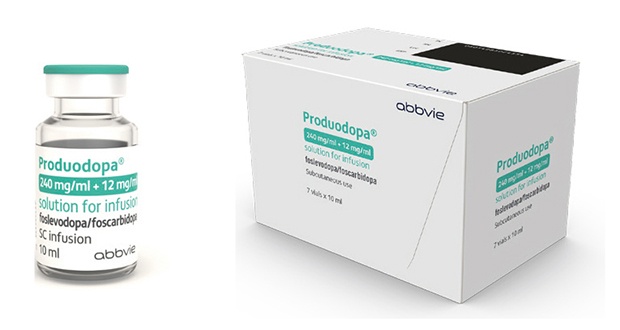
Produodopa
Ask a doctor about a prescription for Produodopa




How to use Produodopa
Package Leaflet: Information for the Patient
Produodopa, 240 mg/ml + 12 mg/ml, Solution for Infusion
Foslevodopa + Foscarbidopa
Read All of This Leaflet Carefully Before Using This Medicine.
- Keep This Leaflet. You May Need to Read It Again.
- If You Have Any Further Questions, Ask Your Doctor, Pharmacist, or Nurse.
- This Medicine Has Been Prescribed for You. Do Not Pass It on to Others. It May Harm Them, Even if Their Symptoms Are the Same as Yours.
- If You Experience Any Side Effects, Including Any Not Listed in This Leaflet, Tell Your Doctor, Pharmacist, or Nurse. See Section 4.
Table of Contents of the Leaflet
- 1. What Is Produodopa and What Is It Used For
- 2. Important Information Before Using Produodopa
- 3. How to Use Produodopa
- 4. Possible Side Effects
- 5. How to Store Produodopa
- 6. Contents of the Pack and Other Information
- 7. Instructions for Use of Produodopa Infusion Using the Vyafuser Pump
1. What Is Produodopa and What Is It Used For
Produodopa Contains Two Active Substances, Foslevodopa and Foscarbidopa, and Is Used in the Treatment of Parkinson's Disease.
How Produodopa Works
- In the Body, Foslevodopa Is Converted into a Substance Called Dopamine, Supplementing the Dopamine Present in the Brain and Spinal Cord. Dopamine Facilitates the Transmission of Impulses Between Nerve Cells.
- Too Little Dopamine Causes the Symptoms of Parkinson's Disease, Such as Tremors, Feeling Stiff, Slowness of Movement, and Balance Problems.
- Treatment with Foslevodopa Increases the Amount of Dopamine in the Body and Therefore Reduces the Severity of Symptoms.
- Foscarbidopa Enhances the Therapeutic Effect of Foslevodopa and Also Reduces Its Side Effects.
2. Important Information Before Using Produodopa
When Not to Use Produodopa
- If You Are Allergic to Foslevodopa, Foscarbidopa, or Any of the Other Ingredients of This Medicine (Listed in Section 6)
- If You Have a Condition Called Narrow-Angle Glaucoma
- If You Have Severe Heart Problems
- If You Have Irregular Heartbeats (Severe Arrhythmia)
- If You Have Had an Acute Phase of Stroke
- If You Are Taking Medicines Called Non-Selective MAO Inhibitors and Selective MAO-A Inhibitors, Such as Moclobemide or Phenelzine. You Must Stop Taking These Medicines at Least Two Weeks Before Starting Produodopa.
- If You Have a Tumor of the Adrenal Gland (Pheochromocytoma)
- If You Have Hormonal Disorders, Such as Excessive Production of Cortisol (Cushing's Syndrome) or High Levels of Thyroid Hormones (Hyperthyroidism)
- If You Have Had Skin Cancer or Have Unusual Moles (Naevi) or Skin Changes That Have Not Been Examined by a Doctor.
Do Not Use Produodopa If Any of the Above Applies to You. If You Are in Doubt, Consult Your Doctor Before Starting Produodopa.
Warnings and Precautions
Before Starting Produodopa and During Treatment, Discuss with Your Doctor, Pharmacist, or Nurse If:
- You Have Had a Heart Attack, Blockage of Blood Vessels in the Heart, or Other Heart Diseases, Including Arrhythmias
- You Have Had Lung Disease, Such as Asthma
- You Have Had Hormonal Disorders
- You Have Had Depression with Suicidal Thoughts or Other Mental Disorders
- You Have Had Eye Disease Called Open-Angle Glaucoma
- You Have Had Stomach Ulcers
- You Have Had Seizures (Convulsions)
- You Have Had Kidney or Liver Disease
- You Are on a Controlled Sodium Diet (See "Produodopa Contains Sodium")
- You Have Skin Changes at the Infusion Site, Such as Redness, Heat, Swelling, Pain, and Discoloration When Pressed
- You Have Increasing Weakness, Pain, Numbness, or Loss of Sensation in Fingers or Toes (Polyneuropathy). Before Starting Produodopa, Your Doctor Will Check If You Have Had Symptoms of Neuropathy and Will Perform Regular Checks. You Should Consult Your Doctor If You Already Have Neuropathy or Conditions Related to Neuropathy.
If Any of the Above Apply to You or If You Are Not Sure, Tell Your Doctor Before Starting Produodopa. You Should Inform Your Doctor If You Experience Involuntary and Uncontrolled Movements of the Limbs, Back, Neck, or Chin (Dyskinesia) or If Stiffness or Slowness of Movement Worsens. It May Be Necessary to Adjust the Daily Dose or the Cause Is Obstruction of the Device.
Malignant Neuroleptic Syndrome
Do Not Stop Using or Reduce the Dose of Produodopa Unless Your Doctor Tells You to Do So. Stopping or Rapidly Reducing the Dose of Produodopa Can Cause a Serious Condition Called "Malignant Neuroleptic Syndrome". Symptoms May Include:
- Rapid Heartbeat, Changes in Blood Pressure, and Sweating, Followed by Fever
- Rapid Breathing, Muscle Stiffness, Decreased Level of Consciousness, and Coma
- Increased Levels of an Enzyme Called Creatine Phosphokinase in the Blood. This Level Is Measured by Your Doctor.
Impulse Control Disorders – Changes in Patient Behavior
Tell Your Doctor If You, Your Family, or Your Caregiver Notice the Appearance of Urges or Irresistible Desires to Engage in Behaviors That Are Not Typical for You or You Are Unable to Resist the Impulsive Desire, Urge, or Temptation to Perform Certain Actions That May Be Harmful to Yourself or Others. Such Behaviors Include:
- Pathological Gambling
- Excessive Eating or Spending Money
- Increased Sexual Drive or Intense Sexual Thoughts or Feelings
It May Be Necessary to Re-Evaluate the Treatment Used by Your Doctor. Your Doctor Will Discuss with You Ways to Deal with These Symptoms or Reduce Their Severity (See Section 4 "Impulse Control Disorders – Changes in Patient Behavior").
Dopamine Dysregulation Syndrome
If You or Your Family (Caregiver) Notice the Appearance of Symptoms Similar to Addiction, Leading to the Desire to Take High Doses of Produodopa and Other Medicines Used to Treat Parkinson's Disease, Tell Your Doctor.
Infusion Site Infections
Tell Your Doctor If You Experience Skin Changes at the Infusion Site, Such as Redness, Heat, Swelling, Pain, and Discoloration When Pressed. Always Use Aseptic (Sterile) Techniques When Using This Medicine and Regularly Change the Infusion Site (At Least Every Third Day), Using a New Infusion Set. Make Sure the New Infusion Site Is at Least 2.5 cm Away from the Site Used in the Last 12 Days. It May Be Necessary to Change the Infusion Site More Often Than Every 3 Days If Any of the Above Skin Changes Occur.
Produodopa and Cancer
In the Body, Foscarbidopa (a Component of Produodopa) Breaks Down into a Substance Called Hydrazine. There Is a Possibility That Hydrazine Can Damage Genetic Material, Which May Lead to Cancer. However, It Is Not Known If the Amount of Hydrazine Produced During the Use of the Recommended Dose of Produodopa Can Cause This.
Children and Adolescents
Produodopa Should Not Be Used in Children and Adolescents Under 18 Years of Age. The Medicine Has Not Been Studied in This Age Group.
Produodopa and Other Medicines
Tell Your Doctor or Pharmacist About All Medicines You Are Taking Now or Have Recently Taken, as Well as Any Medicines You Plan to Take. This Includes Medicines Obtained Without a Prescription and Herbal Medicines.
Before Starting Produodopa, Tell Your Doctor or Pharmacist If You Are Taking Medicines for:
- Tuberculosis - Such as Isoniazid
- Anxiety - Such as Benzodiazepine Derivatives
- Nausea or Vomiting - Such as Metoclopramide
- High Blood Pressure - Such as Antihypertensive Medicines
- Vasoconstriction - Such as Papaverine
- Seizures (Convulsions) or Epilepsy - Such as Phenytoin
- Mental Disorders - Such as Antipsychotic Medicines, Including Phenothiazine Derivatives, Butyrophenone Derivatives, and Risperidone
- Parkinson's Disease - Such as Tolcapone, Entacapone, Opicapone, and Amantadine
- Depression - Such as Tricyclic Antidepressants, Including Amoxapine and Trimipramine
Tell Your Doctor or Pharmacist If You Are Taking a COMT Inhibitor (Catechol-O-Methyltransferase Inhibitor), as It May Increase the Level of Levodopa in the Blood. Your Doctor May Need to Adjust the Dose of These Medicines.
Tell Your Doctor or Pharmacist If You Are Taking Sympathomimetics, Such as Salbutamol, Phenylephrine, Isoproterenol, Dobutamine, for the Treatment of Low Blood Pressure. Sympathomimetics and Levodopa May Increase the Risk of High Blood Pressure (Hypertension) or Irregular Heartbeat (Arrhythmia).
Tell Your Doctor or Pharmacist About Medicines That Are Known to Be Eliminated by an Enzyme Called "CYP1A2". Examples of Such Medicines Include:
- Caffeine (Which Helps to Concentrate)
- Melatonin (Which Helps to Fall Asleep)
- Fluvoxamine, Duloxetine (Antidepressant Medicine That Improves Mood)
- Clozapine (Which Helps to Control Schizophrenia)
- Theophylline (Which Helps with Asthma)
Some Medicines (Such as Selegiline) Taken by You May Lower Blood Pressure, Which Can Cause Dizziness When Standing Up from a Chair or Bed (Orthostatic Hypotension). Produodopa May Increase Dizziness. Slowly Getting Up from a Lying or Sitting Position May Reduce the Feeling of Dizziness.
Do Not Use Produodopa If You Are Taking:
- Medicines Used in Depression, Called Selective MAO-A Inhibitors and Non-Selective MAO Inhibitors, Such as Moclobemide or Phenelzine
Pregnancy and Breastfeeding
If You Are Pregnant or Breastfeeding, Think You May Be Pregnant, or Plan to Have a Child, Ask Your Doctor for Advice Before Taking This Medicine.
Produodopa Is Not Recommended During Pregnancy or in Women of Childbearing Age Not Using Effective Contraception, Unless the Benefits to the Mother Outweigh the Possible Risks to the Unborn Child.
It Is Not Known If Produodopa Passes into Breast Milk. During Treatment with Produodopa, Breastfeeding Should Be Stopped.
Driving and Using Machines
Do Not Drive, Use Tools, or Operate Machines Until You Know How Produodopa Affects You.
- Produodopa Can Cause Significant Drowsiness or Sudden Sleep Attacks (Sleep Attacks).
- Produodopa Can Lower Blood Pressure, Which Can Cause a Feeling of Empty Head or Dizziness. Do Not Drive, Use Tools, or Operate Machines Until You Are Fully Awake or the Feeling of Empty Head or Dizziness Has Passed.
Produodopa Contains Sodium
Talk to Your Doctor or Pharmacist If You Need to Use More Than 9 ml of Produodopa per Day for a Long Time, Especially If You Have Been Advised to Follow a Low-Sodium Diet.
3. How to Use Produodopa
This Medicine Should Always Be Used Exactly as Your Doctor, Nurse, or Pharmacist Has Told You. If You Are Not Sure, Ask Your Doctor, Nurse, or Pharmacist.
How to Use Produodopa
- Before Starting Treatment, You or Your Caregiver Will Be Trained in the Use of the Product and the Infusion Pump.
- Produodopa Is a Solution That Is Given Under the Skin (by Subcutaneous Infusion) Usually in the Abdomen Using an Infusion Pump. You Should Avoid the Area Within 5 cm of the Navel.
- Your Doctor or Nurse Will Adjust the Pump Settings to Ensure the Dose Is Right for You.
- The Pump Gives the Medicine Continuously for 24 Hours. It May Be Necessary to Reload the Pump with a New Syringe Within 24 Hours to Ensure There Is Enough Medicine in the Blood to Control the Symptoms.
How Much to Use
- This Medicine Should Always Be Used Exactly as Your Doctor Has Told You.
- Your Doctor Will Decide What Dose of Produodopa You Should Take and for How Long. Usually, a Continuous Dose Is Given.
- If Needed, You May Receive Additional Doses (an Option Available in the Pump) to Control Sudden "Off" Symptoms During Continuous Infusion - Your Doctor Will Decide This.
- In Case of Breaks Longer Than 3 Hours, You May Need to Give Yourself a Loading Dose (an Option Available in the Pump) Before Restarting the Continuous Infusion to Quickly Restore Symptom Control.
Before Using Produodopa, Read Section 7 "Instructions for Use of Produodopa Infusion Using the Vyafuser Pump".
Using More Than the Recommended Dose of Produodopa
If You Use More Than the Recommended Dose of Produodopa, Contact Your Doctor or Go to the Hospital Immediately. You Should Take the Medicine Package with You. The Following Symptoms May Occur:
- Abnormal, Fast, Slow, or Irregular Heartbeat (Arrhythmia)
- Low Blood Pressure (Hypotension)
Missing a Dose or Stopping Produodopa
If You Forget to Use Produodopa, Start the Pump from the Usual Dose as Soon as Possible.
Using Produodopa Can Be Stopped for a Short Time, e.g., While Taking a Shower.
If the Infusion Is Stopped for More Than One Hour, Change the Infusion Set (Cannula and Needle) and Change the Infusion Site. If the Break Is Longer Than 3 Hours, You May Need to Give Yourself a Loading Dose to Quickly Restore Symptom Control. The Loading Dose Option Is Available in the Pump Set by Your Doctor or Nurse.
If You Have Any Further Questions on the Use of This Medicine, Ask Your Doctor, Pharmacist, or Nurse.
4. Possible Side Effects
Like All Medicines, This Medicine Can Cause Side Effects, Although Not Everybody Gets Them.
Stop Using Produodopa and Tell Your Doctor ImmediatelyIf You Experience Any of the Following Serious Side Effects. You May Need Urgent Medical Attention.
- Narrow-Angle Glaucoma (Sudden Eye Pain, Headache, Blurred Vision, Nausea, and Vomiting)
- Swelling of the Face, Tongue, or Throat, Which May Cause Difficulty in Swallowing or Breathing, or Skin Rash (Hives). These May Be Symptoms of a Severe Allergic Reaction (Anaphylactic Reaction). Frequency Not Known. Cannot Be Estimated from the Available Data.
Your Doctor Will Decide If You Can Continue Using Produodopa.
Other Side Effects
If You Experience Any of the Following Side Effects, Tell Your Doctor, Pharmacist, or Nurse Immediately.
Very Common:May Affect More Than 1 in 10 People
- Infusion Site Infection (Inflammation of the Tissue at the Infusion Site) (See Section 2)
- Anxiety
- Seeing, Hearing, or Feeling Things That Are Not There (Hallucinations)
- Depression
- Infusion Site Reactions (Redness, Lump, Swelling, Pain)
- Dizziness
- Urinary Tract Infections
Common:May Affect Up to 1 in 10 People
- Infusion Site Reactions (Bruising, Peeling of the Skin, Leaking of the Medicine, Bleeding, Inflammation, Irritation, Lump, Itching, Rash)
- Abscess at the Infusion Site
- Decreased Appetite
- Confusion
- False Beliefs (Delusions)
- Paranoia
- Thoughts of Suicide (Suicidal Thoughts)
- Problems with Thinking, Learning, and Memory (Cognitive Impairment)
- Involuntary Movements (Dyskinesia)
- Uncontrolled Muscle Contractions of the Eyes, Head, Neck, and Body (Dystonia)
- Headache
- Decreased Sensation of Touch, Tingling, or Burning Sensation in the Hands, Arms, Legs, or Feet (Hypoesthesia, Paresthesia)
- Progressive Weakness or Pain, or Numbness, or Loss of Sensation in the Fingers or Toes (Polyneuropathy)
- Sudden Return of Parkinson's Symptoms - Called "On/Off" Phenomenon
- Sudden Sleep Attacks, Feeling Very Sleepy, Sleep Disturbances
- High or Low Blood Pressure
- Dizziness
- Dizziness When Standing Up or Changing Position (Orthostatic Hypotension, Orthostatic Dizziness) - Caused by Low Blood Pressure. Always Change Your Position Slowly - Do Not Get Up Too Quickly.
- Fainting
- Abdominal Pain (Abdominal Pain)
- Constipation
- Dry Mouth
- Nausea (Nausea), Diarrhea, or Vomiting
- Urinary Incontinence
- Difficulty Urinating (Urinary Retention)
- Lack of Energy, Weakness (Fatigue)
- Swelling of the Lower Limbs or Hands Due to Excess Fluid (Peripheral Edema)
- Psychotic Disorder
- Vitamin B Deficiency
- Vitamin B Deficiency
- Increased Levels of Amino Acids, Small Particles That Form Proteins in the Body
- Increased Levels of Homocysteine in the Blood; This Is an Amino Acid That Helps Build Proteins in the Body
- Sore Throat
- Weight Gain
- Weight Loss
- Sleep Disturbances (Insomnia)
- Rashes, Itching, Increased Sweating
- Muscle Cramps
- Shortness of Breath
- General Feeling of Being Unwell
- Anemia
- Unusual Dreams
- Agitation
- Abdominal Distension (Bloating), Gas, Nausea (Dyspeptic Symptoms)
- Pain
- Neck Pain
- Difficulty Swallowing or Taste Disturbances (Bitter Taste)
- Irregular Heartbeat
Impulse Control Disorders – Changes in Patient Behavior. Common: May Affect Up to 1 in 10 People.
Some People Are Unable to Overcome the Impulse to Perform Actions That May Be Harmful to Themselves or Others. These Include:
- Strong Impulse to Pathological Gambling, Despite Serious Consequences for the Patient or Their Family
- Change or Increase in Sexual Thoughts and Behaviors, Which Can Be Very Disturbing for the Patient or Others, for Example, Increased Sexual Drive
- Uncontrolled Excessive Shopping or Spending Money
- Binge Eating - Eating Large Amounts of Food in a Short Time or Compulsive Overeating - Eating More Food Than Normal and More Than the Body Needs
Tell Your Doctor If You, Your Family, or Your Caregiver Notice Any of These Behaviors. It May Be Necessary to Re-Evaluate the Treatment Used by Your Doctor. Your Doctor Will Discuss with You Ways to Deal with These Symptoms or Reduce Their Severity.
Uncommon:May Affect Up to 1 in 100 People
- Desire to Take High Doses of Produodopa, Higher Than Necessary to Control Motor Symptoms, Called Dopamine Dysregulation Syndrome
- Dark Urine
- Hoarseness, Chest Pain
- Hair Loss, Redness of the Skin, Hives
- Increased Saliva Production
- Change in Gait
- Attempted Suicide or Suicide
- Low White Blood Cell Count or Changes in Blood Cell Count That Can Cause Bleeding
- Elevated Mood (Euphoric Mood), Increased Interest in Sex, Confusion, Feeling of Anxiety
- Difficulty Controlling Movements and Performing Involuntary Movements That Cannot Be Controlled
- Difficulty Opening the Eyes, Double Vision, Blurred Vision, Damage to the Optic Nerve (Ischemic Optic Neuropathy)
- Palpitations (Irregular Heartbeat)
- Confusion
- Nightmares
- Vein Swelling
Rare:May Affect Up to 1 in 1000 People
- Teeth Grinding
- Painful Erection That Does Not Go Away
- Appearance of Unusual Changes or Moles (Naevi) on the Skin or Their Worsening, or Skin Cancer (Malignant Melanoma)
- Darkening of Saliva or Sweat, Burning Sensation of the Tongue, Hiccup
- Unusual Thoughts
- Unusual Breathing
Reporting Side Effects
If You Experience Any Side Effects, Including Any Not Listed in This Leaflet, Tell Your Doctor, Pharmacist, or Nurse. You Can Also Report Side Effects Directly to the Department of Drug Safety Monitoring of the Office for Registration of Medicinal Products, Medical Devices, and Biocidal Products
Al. Jerozolimskie 181C
PL-02 222 Warsaw
Phone: +48 22 49 21 301
Fax: +48 22 49 21 309
Website: https://smz.ezdrowie.gov.pl
Side Effects Can Also Be Reported to the Marketing Authorization Holder.
By Reporting Side Effects, You Can Help Provide More Information on the Safety of This Medicine.
5. How to Store Produodopa
Keep This Medicine Out of the Sight and Reach of Children.
Store the Vials in the Outer Carton to Protect Them from Breakage.
Do Not Use This Medicine After the Expiry Date Stated on the Label and Carton. The Expiry Date Refers to the Last Day of the Month Stated.
- Do Not Freeze.
- Store and Transport in a Cool Place (2°C - 8°C).
- The Vials Can Be Stored at Room Temperature (Up to 30°C) for a Single Period of Up to 28 Days.
- There Is a Space on the Carton for the Date of Removal from the Refrigerator to Be Recorded.
- Once Removed from the Refrigerator, the Vial Should Not Be Put Back in the Refrigerator.
- Discard the Medicine If It Is Not Used Within 28 Days of Storage at Room Temperature.
- The Entire Contents of the Vial Should Be Transferred to the Syringe for Administration.
- Do Not Use a Previously Opened Vial Again; They Are for Single Use Only.
- After Opening: Use Immediately. Shelf Life After Transfer from the Vial to the Syringe: 24 Hours.
- Medicines Should Not Be Disposed of via Wastewater or Household Waste. Ask Your Pharmacist How to Dispose of Medicines No Longer Required. These Measures Will Help Protect the Environment.
- Discard the Vial After Transferring the Medicine to the Syringe.
- Discard the Syringe and Any Unused Medicine in the Syringe After 24 Hours from Administration.
6. Contents of the Pack and Other Information
What Produodopa Contains
- The Active Substances Are Foslevodopa and Foscarbidopa. 1 ml Contains 240 mg of Foslevodopa and 12 mg of Foscarbidopa.
- 1 Vial of 10 ml Contains 2400 mg of Foslevodopa and 120 mg of Foscarbidopa.
- The Other Ingredients Are Sodium Hydroxide 10N (for pH Adjustment), Hydrochloric Acid (for pH Adjustment), and Water for Injections.
What Produodopa Looks Like and Contents of the Pack
Produodopa Is a Clear to Slightly Opalescent, Particle-Free Solution in a Clear, Colorless Glass Vial Closed with a Gray Bromobutyl Rubber Stopper, Aluminum Cap, and Turquoise Plastic Flip-Off Cap. The Solution May Be Colorless, Yellow, or Brown and May Have a Purple or Red Tinge. Differences in Color Are Expected and Do Not Affect the Quality of the Medicine. The Solution May Become Darker in Color After the Vial Stopper Is Pierced or When It Is in the Syringe.
Each Pack Contains 7 Vials of 10 ml Each in a Carton.
Sterile, Single-Use Infusion Set Components (Syringe, Infusion Set, and Vial Adapter) That Have Been Qualified for Use Are Supplied Separately by Your Doctor or from a Pharmacy. The Vyafuser Pump Is Supplied Separately.
Marketing Authorization Holder
AbbVie Sp. z o.o.
ul. Postępu 21B
02-676 Warsaw
Phone: +48 22 372 78 00
Manufacturer/Importer
AbbVie S.r.l.
S.R. 148 Pontina Km 52 snc
04011 Campoverde di Aprilla (LT)
Italy
Date of Last Revision of the Leaflet
Other Sources of Information
Detailed Information on This Medicine Is Available on the Website of the Office for Registration of Medicinal Products, Medical Devices, and Biocidal Products http://urpl.gov.pl
This Medicinal Product Is Authorized in the Member States of the European Economic Area Under the Following Names:
| Country | Name |
| Austria, Belgium, Bulgaria, Croatia, Cyprus, Estonia, Finland, Greece, Ireland, Iceland, Liechtenstein, Luxembourg, Germany, Norway, Poland, Romania, Slovenia, Sweden, Hungary, United Kingdom (Northern Ireland) | Produodopa |
| Denmark, Spain, Netherlands, Lithuania, Portugal, Italy | Duodopa |
| Czech Republic, Slovakia | Duodopa SC |
| France | Scyova |
7. Instructions for Use of Produodopa Infusion Using the Vyafuser Pump
Read This Section Carefully Before Administering Produodopa.
Important Information
Read the Following Instructions Carefully - They Explain How to Prepare and Use Produodopa.
- Produodopa Is Given by Subcutaneous Infusion Using the Vyafuser Pump and Its Components (Syringe, Infusion Set, and Vial Adapter).
- Infusion Set Components Can Be Obtained from Your Doctor or from a Pharmacy.
- Before Using Produodopa, Also Read the Full Instructions for the Vial Adapter, Infusion Set, and Patient Instructions for the Vyafuser Pump.
- Your Doctor or Nurse Will Prepare the Pump for You, So You Always Receive the Correct Dose.
- Before Starting Treatment, Your Doctor or Nurse Will Inform You How to Take the Medicine and How to Operate the Pump.
- If Anything Is Unclear - Ask Your Doctor or Nurse.
1. Preparation
Always follow the instructions below in the given order when you need torefill the Produodopa pump.
- Wash your hands with soap and water and dry them.
- Make sure you have a flat, clean surface available. This will help prevent contamination when preparing the syringe.
- On the flat surface, place:
- the syringe (in its packaging)
- the vial of Produodopa solution
- the vial adapter (in its packaging). Use a new vial adapter with each new vial
with the Produodopa solution.
- alcohol swabs (not included in the medication package)
- Check the vial, vial adapter, and syringe for expiration dates and any damage to the packaging.
- Do notuse the vial, vial adapter, or syringe if their sterile packaging has been damaged.
- Do notuse the Produodopa solution, vial adapter, or syringe after the expiration date.
- Do notuse the medication if the Produodopa solution is cloudy or contains particles or precipitates.
2. Preparing the Vial of Solution
- 1) Prepare the vial of solution.
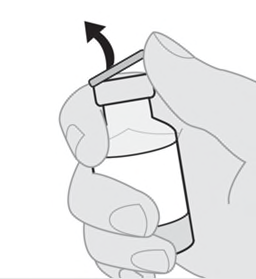
- a. Remove the plastic cap from the vial of solution.
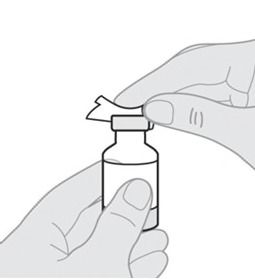
- b. Wipe the top of the vial of solution with an alcohol swab and let it air dry.
- 2) Attach the vial adapter to the vial of solution
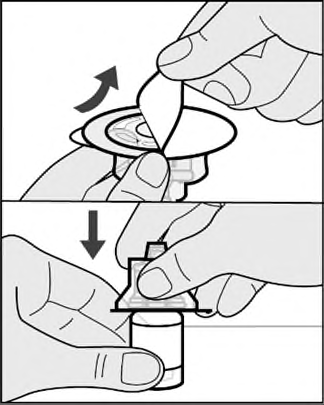
The vial adapter may look different from
the one shown in this section.
a.
Remove the paper cover from the
vial adapter packaging. Store the adapter
in its plastic packaging until step 3.
b.
Using the packaging, firmly push the
vial adapter straight down onto the vial
of solution until it clicks into place.
c.
Remove the packaging straight from the
vial adapter. Detailed instructions can be
found in the vial adapter instructions.
- 3) Holding the vial adapter firmly, attach the syringe to the vial adapter by pushing and then screwing it into place (in a clockwise direction). Do not overtighten.
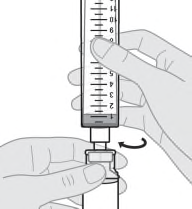
- 4) Hold the syringe vertically so that the vial of solution is above the syringe.
- 5) It is important to hold the syringe straight up.
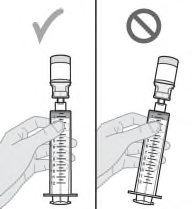
OK
- 6) Holding the syringe firmly in one hand, use the other hand to pull the plunger down to draw the entire contents of the vial of solution into the syringe, to a volume of about 12 ml or until air appears in the tip of the syringe.

a.
Make sure the entire contents of the vial
of solution have been drawn into the
syringe.
b.
Air will be visible in the tip of the syringe
(an empty space).
- 7) Check for air bubbles.
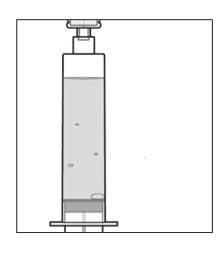
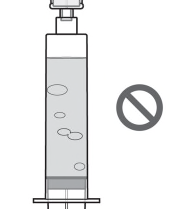
a.
Small air bubbles are acceptable, and air
in the tip of the syringe is expected. If
small air bubbles are visible or no air
bubbles are seen, you can skip the next
part and proceed to step 9: Removing air
from the syringe.
OK
b.
If large air bubbles are present, they must
be removed. If large air bubbles are visible,
proceed to the next part, step 8: Manual
air bubble removal.
- 8) Manual air bubble removal.
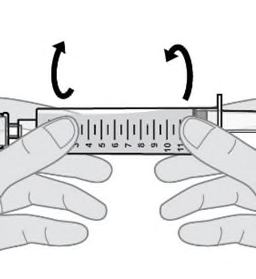
a.
Slowly and gently turn the syringe and
tilt it forward and backward. This will
collect the air bubbles into one bubble.
Do not shake or tap the syringe to remove
air bubbles.
b.
If air bubbles are still present, collect them
by gently turning the syringe up and down.
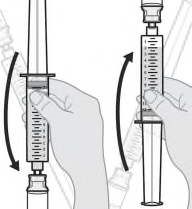
c.
Once the large air bubbles have merged
into one bubble, proceed to the next step.
- 9) Remove air from the syringe. a. With the vial of solution still attached, point the syringe upward.
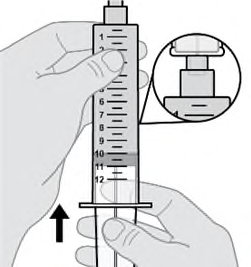
b.
Slowly push the air out of the syringe
into the vial of solution. You will feel some
resistance when pushing the air back into
the vial of solution.
c.
Continue pushing until all the air has been
pushed out of the syringe into the vial of
solution, and the solution is visible in the
tip of the syringe.

d.
If the syringe is tilted at an angle, a small
air bubble may appear. This is acceptable.
- 10) Invert the syringe and vial of solution so that the vial of solution is standing upright on a flat surface.
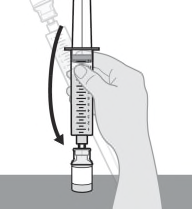
- 11) Detach the syringe from the vial adapter.
- a. Hold the vial adapter firmly with one hand and the syringe cylinder with the other.
- b. Unscrew the syringe from the vial adapter. When detaching the syringe from the vial, do not press the plunger, or the solution will spill.
- c. Place the syringe on a clean surface, making sure the tip of the syringe does not touch a non-sterile surface.
- 12) The syringe is now ready for use.
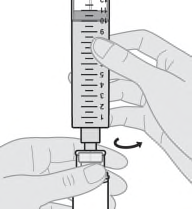
3. Preparing the Infusion of Produodopa
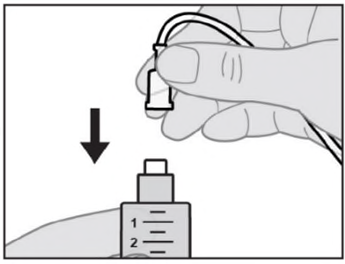
- •Attach the infusion set to the new syringe. o Hold the syringe firmly and attach the infusion set to the syringe, and tighten until it stops. o Detailed instructions can be found in the infusion set instructions.
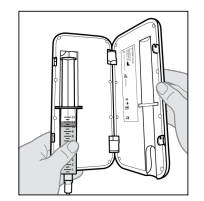
- Place the syringe in the pump. o Detailed instructions can be found in the patient instructions for the Vyafuser pump.
- Prime the infusion set. Priming means that the pump pushes the medication from the syringe through the infusion set to remove air from the set. o Detailed instructions can be found in the patient instructions for the Vyafuser pump.
4. Selecting and Preparing the Infusion Site
- Choose the shown area (on the abdomen) at least 5 cm from the navel.
- Avoid skin with scars, hardened tissue, stretch marks, or skin folds where the body naturally bends, or areas where clothing may cause irritation (e.g., near the waistline).
- Open an alcohol swab and wipe the chosen infusion site with the swab, letting it air dry for at least 1 minute.
Detailed instructions can be found in the infusion set instructionsand patient instructions for the Vyafuser pump.

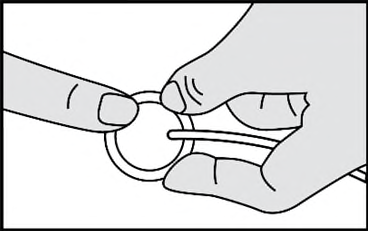
- Insert the cannula into the body and attach the infusion set to the cannula. o Insert the cannula into the body. o Attach the infusion set to the cannula. o Detailed instructions can be found in the infusion set instructions.
5. Starting the Infusion of Produodopa
- Turn on the pump. Detailed instructions can be found in the patient instructions for the Vyafuser pump.
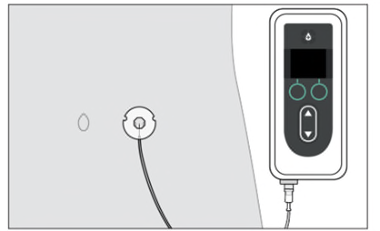
- Medication delivery options through the pump
| Purpose | When available | |
| Continuous infusion | Basic mode that delivers a constant dose of Produodopa throughout the day. | Always available, as prescribed. |
| Bolus dose | A small, single-volume dose administered over a short period (bolus) to quickly achieve the desired level of medication in the body. The bolus dose is available only when it has been set by the doctor. | Available as needed, defined by the pre-set lockout time for the Bolus dose option. |
| Loading dose | A large single dose administered over a short period (bolus) that may be given to quickly achieve the desired level of medication in the body, available only after a longer period when the | After the medication has not been administered for a longer period, defined by the lockout time for the Loading dose (minimum 3 hours), and after it has been set by the doctor. |
| pump has not been used and after it has been set by the doctor. |
- The pump has alternative delivery options that can be set by the doctor if needed.
6. After Use
- Dispose of used vials with the vial adapter still attached according to local regulations or as instructed by your doctor, pharmacist, or nurse.
- Country of registration
- Prescription requiredYes
- Manufacturer
- ImporterAbbVie S.r.l.
- This information is for reference only and does not constitute medical advice. Always consult a licensed doctor before taking any medication. Oladoctor is not responsible for medical decisions based on this content.
- Alternatives to ProduodopaDosage form: Gel, 20 mg/ml + 5 mg/mlActive substance: levodopa and decarboxylase inhibitorPrescription requiredDosage form: Gel, (20 mg + 5 mg + 20 mg)/mlActive substance: levodopa, decarboxylase inhibitor and COMT inhibitorPrescription requiredDosage form: Capsules, 100 mg + 25 mgActive substance: levodopa and decarboxylase inhibitorPrescription required
Alternatives to Produodopa in other countries
The best alternatives with the same active ingredient and therapeutic effect.
Alternative to Produodopa in Spain
Online doctors for Produodopa
Discuss dosage, side effects, interactions, contraindications, and prescription renewal for Produodopa – subject to medical assessment and local rules.









Get updates and exclusive offers
Be the first to know about new services, marketplace updates, and subscriber-only promos.

