



PELETHROCIN 500 mg Tablets

Prescription review online
A doctor will review your case and decide whether a prescription is medically appropriate.

Talk to a doctor about this medicine
Discuss your symptoms and possible next steps in a quick online consultation.



How to use Pelethrocin
Contents of the leaflet
- What is Pelethrocin and what is it used for
- Important information before using Pelethrocin
- How to use Pelethrocin
- Possible side effects
- How to store Pelethrocin
- Package contents and other information
1. What is Pelethrocin and what is it used for
Pelethrocin is a medicine that contains micronized diosmin.
The active substance of the medicine has a protective effect on blood vessels.
Pelethrocin increases venous tone and enhances lymphatic drainage by increasing the peristalsis of lymphatic vessels and lymph flow.
Pelethrocin acts on microcirculation, reducing capillary permeability, perivascular inflammation, stasis in microcirculation, and increasing vascular resistance.
If there is no improvement or the patient feels worse, they should consult their doctor.
Indications for use
Treatment of symptoms associated with venous insufficiency of the lower limbs:
- feeling of heavy legs
- pain
- night cramps
- Symptomatic treatment in case of exacerbation of hemorrhoid-related symptoms.
2. Important information before using Pelethrocin
When not to use Pelethrocin
Warnings and precautions
Before starting to use Pelethrocin, you should consult a pharmacist or doctor.
In case of circulatory disorders in the lower limbs, the therapeutic effect can be increased by an appropriate lifestyle: avoiding sun exposure, avoiding standing for long periods, maintaining a suitable body weight, wearing special stockings.
In case of exacerbation of hemorrhoid-related symptoms, you should remember that therapy with Pelethrocin is only symptomatic and should be short-term.
If the symptoms do not disappear, the doctor will perform a proctological examination and choose an appropriate treatment method.
The use of Pelethrocin for symptomatic treatment of hemorrhoid-related symptoms does not exclude the administration of other rectal medications.
Pelethrocin and other medicines
No interactions have been found between Pelethrocin and other medicines.
You should inform your pharmacist or doctor about all medicines you are currently taking or have recently taken, as well as any medicines you plan to take, including those available without a prescription.
Using Pelethrocin with food and drink
Pelethrocin should be taken during meals.
Pregnancy and breastfeeding
If you are pregnant or breastfeeding, think you may be pregnant, or plan to have a child, you should consult your pharmacist or doctor before using this medicine.
Due to the lack of sufficient data, Pelethrocin may be used during pregnancy only if necessary.
It has not been studied whether the medicine passes into breast milk, so it is not recommended to use the medicine during breastfeeding.
Driving and using machines
Pelethrocin has no effect on driving or using machines.

Not sure if this medicine is right for you?
Discuss your symptoms and treatment with a doctor online.
3. How to use Pelethrocin
This medicine should always be used exactly as described in the patient leaflet or as directed by a doctor or pharmacist.
In case of doubt, you should consult a doctor or pharmacist.
Recommended dose: 2 tablets per day (1 tablet in the morning and 1 tablet in the evening) during meals.
In case of exacerbation of hemorrhoid-related symptoms, the dose is 6 tablets per day (2 tablets three times a day) for the first 4 days, then - for the next 3 days - 4 tablets (2 tablets twice a day).
Pelethrocin is a medicine in the form of film-coated tablets for oral administration.
The dividing line on the tablet is not intended for breaking the tablet.
Using a higher than recommended dose of Pelethrocin
In known cases of overdose, no side effects have been observed.
Overdose may cause gastrointestinal disorders, vomiting, and nausea.
In case of worrying symptoms, you should consult a doctor.
Missing a dose of Pelethrocin
If you miss a dose, you should take it as soon as possible.
However, if it is almost time for the next dose, you should skip the missed dose and continue treatment as scheduled.
You should not take a double dose to make up for the missed dose.
Stopping the use of Pelethrocin
In case of any further doubts about using this medicine, you should consult a doctor or pharmacist.
4. Possible side effects
Like all medicines, Pelethrocin can cause side effects, although not everybody gets them.
Side effects have been described with regard to their frequency of occurrence in accordance with the following convention:
very common (more than 1 in 10 people),
common (more than 1 in 100 people, but less than 1 in 10 people),
uncommon (more than 1 in 1000 people, but less than 1 in 100 people),
rare (more than 1 in 10,000 people, but less than 1 in 1000 people),
very rare (less than 1 in 10,000 people).
Side effects reported rarely during the use of diosmin include:
- gastrointestinal disorders: diarrhea, indigestion, nausea, vomiting;
- nervous system disorders: dizziness, headache, malaise;
- skin and subcutaneous tissue disorders: rash, itching, urticaria
- In case of mild side effects related to the stomach and intestines, as well as neurovegetative disorders, it is not necessary to discontinue the medicine.
If any of the side effects worsen or if you experience any side effects not listed in the leaflet, you should inform your doctor or pharmacist.
Reporting side effects
If you experience any side effects, including any possible side effects not listed in the leaflet, you should inform your doctor or pharmacist.
Side effects can be reported directly to the Department of Monitoring of Adverse Reactions to Medicinal Products of the Office for Registration of Medicinal Products, Medical Devices, and Biocidal Products, Al. Jerozolimskie 181C, 02-222 Warsaw, tel.: +48 22 49 21 301, fax: +48 22 49 21 309, e-mail: [email protected].
By reporting side effects, you can help gather more information on the safety of the medicine.

Started taking the medicine and have questions?
Discuss your symptoms and treatment with a doctor online.
5. How to store Pelethrocin
Store in a temperature below 25°C.
The medicine should be stored out of sight and reach of children.
Do not use the medicine after the expiry date stated on the packaging.
The expiry date refers to the last day of the specified month.
Medicines should not be disposed of via wastewater or household waste containers.
You should ask your pharmacist how to dispose of medicines that are no longer needed.
This will help protect the environment.
6. Package contents and other information
What Pelethrocin contains
The active substance of the medicine is micronized diosmin.
Each tablet contains 500 mg of micronized diosmin.
The other ingredients are:
Tablet core: carboxymethylcellulose sodium, microcrystalline cellulose, gelatin, magnesium stearate, talc; Coating: beeswax, glycerol, hypromellose 2190, macrogol 6000, sodium lauryl sulfate, yellow iron oxide (E 172), red iron oxide (E 172), titanium dioxide (E 171), magnesium stearate.
What Pelethrocin looks like and what the package contains
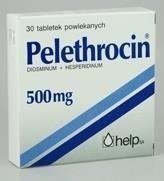
The carton contains 2 PVC/Aluminum blisters, each with 15 film-coated tablets - oval, biconvex tablets, pink-beige in color with a dividing line.
Responsible entity and manufacturer
HELP S.A., 10, Valaoritou Str.,
GR 144 52 Metamorphosis – Attica, Greece.
Tel: +30 210 2843479, 2815353
Fax: +30 210 2811850
e-mail: [email protected]
To obtain more detailed information, you should contact the local representative of the responsible entity:
BLUBIT sp. z o.o., ul. Wolska 84/86
PL-01 141 Warsaw
Correspondence address:
BLUBIT sp. z o.o., Pharmaceutical Warehouse ul. Szeligowska 75A
PL-01 320 Warsaw
Tel.: +48 22 664 27 27, Fax: 22 665 92 72
e-mail: [email protected]
Date of the last update of the leaflet
- -
[logo of the manufacturer]
- Country of registration
- Dosage formTablets, 500 mg
- ATC codeC05CA03
- Active substance
- Prescription requiredNo
- Manufacturer
- ImporterHelp S.A.
- This information is for reference only and does not constitute medical advice. Always consult a doctor before taking any medication. Oladoctor is not responsible for medical decisions based on this content.
- Alternatives to PelethrocinDosage form: Tablets, 1000 mgActive substance: diosminManufacturer: Polfarmex S.A.Prescription not requiredDosage form: Tablets, 1000 mgActive substance: diosminPrescription not required
Online doctors for Pelethrocin
Discuss questions about Pelethrocin, including use, safety considerations and prescription review, subject to medical assessment and local regulations.









Get Pelethrocin Prescription Online
Fill in a 2-min form
Tell us your symptoms, history, and what medicine you're requesting.
Pick a doctor or let us assign
Choose a specialist or we'll match you with the next available doctor.
Doctor reviews your case
Usually within 30 minutes. They may ask follow-up questions via chat.
Collect from any pharmacy
Electronic prescription sent to your email — valid across Spain.
Frequently Asked Questions
Pelethrocin does not require a prescription in Poland. You can check with a doctor online whether this medicine may be appropriate for your situation.
The active ingredient in Pelethrocin is diosmin. This information helps identify medicines with the same composition but different brand names.
Pelethrocin is manufactured by Help S.A.. Pharmacy brands and packaging may differ depending on the distributor.
Doctors such as Family doctors, Psychiatrists, Dermatologists, Cardiologists, Endocrinologists, Gastroenterologists, Pulmonologists, Nephrologists, Rheumatologists, Hematologists, Infectious disease physicians, Allergists, Geriatricians, Paediatricians, Oncologists may assess whether Pelethrocin is appropriate, depending on your situation and local regulations. You can book an online consultation to discuss your symptoms and possible next steps.
Spain has a well-developed healthcare infrastructure across major cities such as Madrid, Barcelona, Valencia, and Seville. Pharmacies are widely available and operate under strict regulations, ensuring access to prescribed medications.
You can buy Pelethrocin in Madrid, Barcelona, Seville, or Valencia at any local pharmacy with a valid prescription.
To obtain a prescription, you can use Oladoctor:
Other medicines with the same active substance (diosmin) include Aflavic Max, Dih Max Comfort, Dih. These may have different brand names or formulations but contain the same therapeutic ingredient. Always consult a doctor before switching or starting a new medicine.
