



MEPIDONT 0.01 mg/20 mg Solution

Prescription review online
A doctor will review your case and decide whether a prescription is medically appropriate.

Talk to a doctor about this medicine
Discuss your symptoms and possible next steps in a quick online consultation.



How to use Mepidont 2% z adrenalinom 1:100.000
Contents of the leaflet
- What is Mepidont and what is it used for
- Important information before using Mepidont
- How to use Mepidont
- Possible side effects
- How to store Mepidont
- Contents of the packaging and other information
1. What is Mepidont and what is it used for
Mepivacaine, the active substance of the medicine, is a local anesthetic of amide structure. Its properties result from the inhibition of ion currents responsible for the formation and spread of stimuli in the neuronal cell membrane.
The anesthetic effect starts quickly.
The duration of the medicine's effect depends on the injection site, concentration, and presence or absence of adrenaline, a vasoconstrictor agent.
Mepivacaine is quickly metabolized in the liver and excreted by the kidneys.
Mepivacaine binds to plasma proteins in an amount of 60% to 80% and the half-life in plasma is 115 minutes.
Indications:
All conservative and surgical procedures in dentistry.
MEPIDONT with adrenaline is indicated when prolonged local anesthesia or local anesthesia with vasoconstriction is desired.
2. Important information before using Mepidont
When not to use Mepidont:
- if the patient is allergic to mepivacaine hydrochloride or any of the other ingredients of this medicine (listed in section 6). The use of a medicine containing a vasoconstrictor agent is not recommended in patients with severe heart and peripheral vascular diseases, hypertension, migraine, hyperthyroidism, diabetes, prostatic hypertrophy, glaucoma, and nephropathy.
Warnings and precautions
There have been reports of rare cases of death in patients who had not previously been diagnosed with hypersensitivity.
Mepidont with adrenaline contains sodium metabisulfite.
This substance may cause allergic reactions and severe asthma attacks in sensitive individuals.
The efficacy and safety of mepivacaine in dentistry depend on the proper selection of dose and administration of the medicine, as well as the observance of appropriate precautions.
Before starting to use Mepidont, the patient should discuss it with their doctor.
Pregnancy, breastfeeding, and fertility
If the patient is pregnant or breastfeeding, or thinks they may be pregnant, they should
consult their doctor before using this medicine.
Mepidont should not be used during pregnancy.
Driving and using machines
MEPIDONT has a minor effect on the ability to drive and use machines.
The doctor should decide whether the patient can drive or use machines after administration of the medicine.
MEPIDONT and other medicines
A medicine containing adrenaline should be used with caution in patients treated with MAO inhibitors and tricyclic antidepressants (medicines used in psychiatry).
In each case, the lowest doses and concentrations necessary to achieve the desired effect should be used. The patient must be under close supervision, and administration of the medicine should be stopped immediately after the appearance of the first disturbing symptom (e.g., disorders of the senses).
A solution containing adrenaline may exhibit clinically significant interactions with MAO inhibitors and tricyclic antidepressants (severe hypertension), with phenothiazine or butyrophenone derivatives (possible reversal of the adrenaline effect), and with other medicines.
The patient should tell their doctor about all medicines they are currently taking or have recently taken, as well as any medicines they plan to take.

Not sure if this medicine is right for you?
Discuss your symptoms and treatment with a doctor online.
3. How to use Mepidont
1 to 2 ml or more, depending on the procedure, infiltratively or as a peripheral nerve block.
The anesthetic solution should be injected in small doses at a rate of about 1 ml/min, after prior aspiration.
In a healthy adult, who has not received sedatives, the maximum dose, administered either as a single dose or in several consecutive injections over a period not exceeding 90 minutes, is 7 mg of mepivacaine hydrochloride per kilogram of body weight, up to a total dose not exceeding 550 mg of mepivacaine hydrochloride, and 0.2 mg of adrenaline.
Maximum dose: 1000 mg of mepivacaine per 24 hours.
In children, the administered doses should be reduced depending on body weight and age.
If the patient feels that the effect of Mepidont is too strong or too weak, they should
inform their doctor.
Using a higher dose of Mepidont than recommended
Overdose of the anesthetic should be avoided, and never administer two maximum doses in a row if the interval between them is less than 24 hours.
It is recommended to use lower concentrations and doses that will achieve the desired anesthetic effect.
The following toxic effects have been reported due to overdose:
- central nervous system stimulation with excitement, tremors, disorientation, dizziness, dilated pupils, accelerated metabolism, and elevated body temperature;
- after very large doses: trismus and convulsions.
Procedure
After the appearance of the first disturbing symptom, administration of the medicine should be stopped. The patient should be placed in a horizontal position and ensured to breathe freely; if not, oxygen should be administered, and in case of apnea, artificial respiration should be used.
Analeptics acting on the prolonged medulla should be avoided, so as not to worsen the patient's condition by increasing oxygen consumption.
Convulsions can be controlled by administering diazepam in doses of 10 to 20 mg intravenously.
Barbiturates are not recommended, as they may exacerbate depression of the prolonged medulla.
Improvement of the cardiovascular system can be achieved by intravenous administration of glucocorticoids. Additionally, diluted solutions of alpha and beta receptor stimulants with vasoconstrictor effects (e.g., mefentermine, metaraminol, etc.) or atropine sulfate can be used.
Always have a suitable set for immediate assistance and properly trained personnel available.
In several cases, after the use of local anesthetics, without individual hypersensitivity in the history, the occurrence of severe complications, even with a tragic course, has been reported.
Mepidont with adrenaline contains sodium metabisulfite; this compound may cause an allergic reaction in sensitive individuals, especially those with asthma.
4. Possible side effects
Like all medicines, this medicine can cause side effects, although not everybody gets them.
Side effects that may occur during the use of mepivacaine are similar to those observed during the use of other local anesthetics of amide structure.
These effects depend on the dose and may be caused by high concentrations of the medicine in the plasma, resulting from overdose, rapid absorption, or accidental injection into a vessel, or may be caused by hypersensitivity, idiosyncrasy, or reduced tolerance in the patient.
The following side effects have been reported:
Nervous system disorders:
Central nervous system stimulation with excitement, tremors, disorientation, dizziness, dilated pupils, accelerated metabolism, and elevated body temperature. After very large doses: trismus and convulsions.
Vascular disorders:
Vasodilation, hypertension.
Cardiac disorders:
Heart rhythm disorders, bradycardia.
Immune system disorders:
Allergic reactions (in the most severe cases, anaphylactic shock).
Allergic reactions to mepivacaine are very rare (<1>Respiratory, thoracic, and mediastinal disorders:
Accelerated breathing, bronchodilation.
Gastrointestinal disorders:
Nausea, vomiting.
Skin and subcutaneous tissue disorders:
Skin changes, urticaria, edema, sweating.
The vasoconstrictor agent may cause the following reactions, especially in patients with cardiovascular disease: anxiety, sweating, respiratory disorders, heart rhythm disorders, hypertension (which may be a serious condition in patients with fixed hypertension and hyperthyroidism), severe headache, photophobia, costal pain, vomiting.
If any side effects occur, including any side effects not listed in this leaflet, the patient should
inform their doctor.
Reporting side effects
If any side effects occur, including any side effects not listed in this leaflet, the patient should inform their doctor or pharmacist. Side effects can be reported directly to the Department of Monitoring of Adverse Reactions to Medicinal Products of the Office for Registration of Medicinal Products, Medical Devices, and Biocidal Products,
Aleje Jerozolimskie 181C, 02-222 Warsaw, tel. (22) 49 21 301, fax (22) 49 21 309. Website: https://smz.ezdrowie.gov.pl.
By reporting side effects, more information can be collected on the safety of the use of this medicine.

Started taking the medicine and have questions?
Discuss your symptoms and treatment with a doctor online.
5. How to store Mepidont
Store in a temperature below 25°C.
Store in the original packaging to protect from light.
The medicine should be stored in a place inaccessible and invisible to children.
Do not use this medicine after the expiry date stated on the packaging. The expiry date refers to the last day of the specified month.
6. Contents of the packaging and other information
What Mepidont contains
MEPIDONT 3%
1 ml of solution contains 30 mg of mepivacaine hydrochloride (Mepivacaine hydrochloride).
1.8 ml of solution (1 cartridge) contains 54 mg of mepivacaine hydrochloride (Mepivacaine
hydrochloride).
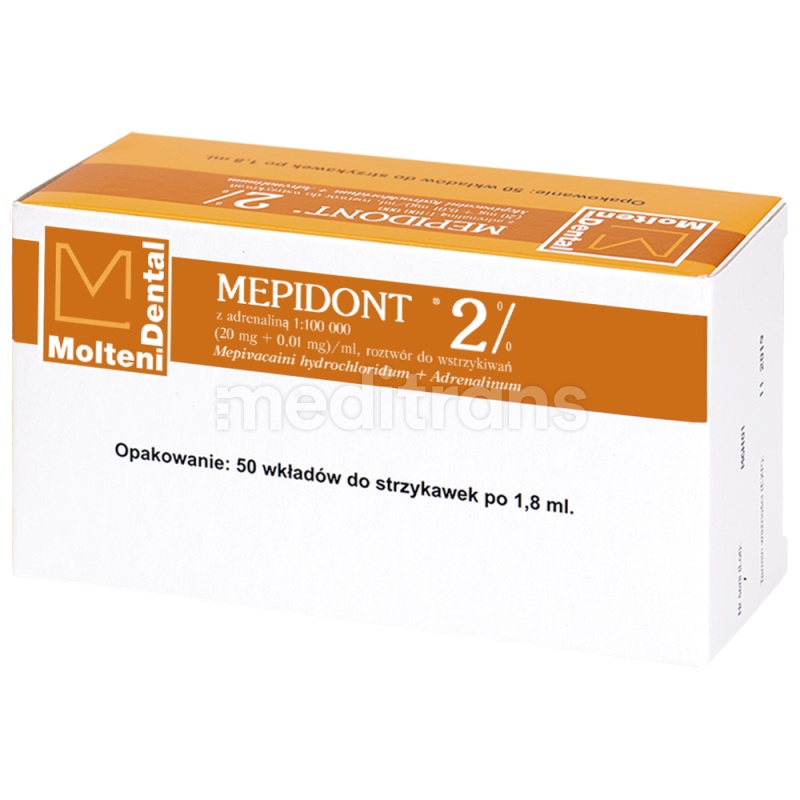
MEPIDONT 2% with adrenaline 1:100 000
1 ml of solution contains 20 mg of mepivacaine hydrochloride (Mepivacaine hydrochloride)
and 0.01 mg of adrenaline in the form of adrenaline tartrate.
1.8 ml of solution (1 cartridge) contains 36 mg of mepivacaine hydrochloride (Mepivacaine
hydrochloride) and 0.018 mg of adrenaline in the form of adrenaline tartrate.
Other ingredients:Mepidont 3% contains excipients: sodium chloride and water for injections, while Mepidont 2% with adrenaline also contains sodium metabisulfite.
What the packaging looks like and what it contains
A cardboard box contains 10 or 50 cartridges for dental use.
Marketing authorization holder:
Molteni Dental s.r.l., Via Ilio Barontini 8, Localita Granatieri 50018 Scandicci (Firenze), Italy
Manufacturer:
Laboratorios Normon S.A., Ronda de Valdecarrizo 6, 28760 Tres Cantos, Madrid, Spain
To obtain more detailed information, please contact:
Molteni Stomat Sp. z o.o.,
30-733, Krakow, ul. Obrońców Modlina 3,
Tel. (012) 653 25 85; Fax. (012) 654 15 60
Date of last update of the leaflet:19/04/2022
- Country of registration
- Dosage formSolution, (0.01 mg + 20 mg)/ml
- ATC codeN01BB53
- Active substance
- Prescription requiredYes
- Manufacturer
- ImporterLABORATORIOS NORMON S.A.
- This information is for reference only and does not constitute medical advice. Always consult a doctor before taking any medication. Oladoctor is not responsible for medical decisions based on this content.
- Alternatives to Mepidont 2% z adrenalinom 1:100.000Dosage form: Cream, (25 mg + 25 mg)/gActive substance: lidocaine, combinationsManufacturer: Pierre Fabre Medicament ProductionPrescription requiredDosage form: Gel, 0.5 g/100 gActive substance: lidocainePrescription not requiredDosage form: Aerosol, 96 mg/gActive substance: lidocaineManufacturer: Aflofarm Farmacja Polska Sp. z o.o.Prescription not required
Online doctors for Mepidont 2% z adrenalinom 1:100.000
Discuss questions about Mepidont 2% z adrenalinom 1:100.000, including use, safety considerations and prescription review, subject to medical assessment and local regulations.









Get Mepidont 2% z adrenalinom 1:100.000 Prescription Online
Fill in a 2-min form
Tell us your symptoms, history, and what medicine you're requesting.
Pick a doctor or let us assign
Choose a specialist or we'll match you with the next available doctor.
Doctor reviews your case
Usually within 30 minutes. They may ask follow-up questions via chat.
Collect from any pharmacy
Electronic prescription sent to your email — valid across Spain.
Frequently Asked Questions
Mepidont 2% z adrenalinom 1:100.000 requires a prescription in Poland. You can check with a doctor online whether this medicine may be appropriate for your situation.
The active ingredient in Mepidont 2% z adrenalinom 1:100.000 is mepivacaine, combinations. This information helps identify medicines with the same composition but different brand names.
Mepidont 2% z adrenalinom 1:100.000 is manufactured by Laboratorios Normon, S.A.. Pharmacy brands and packaging may differ depending on the distributor.
Doctors such as Family doctors, Psychiatrists, Dermatologists, Cardiologists, Endocrinologists, Gastroenterologists, Pulmonologists, Nephrologists, Rheumatologists, Hematologists, Infectious disease physicians, Allergists, Geriatricians, Paediatricians, Oncologists may assess whether Mepidont 2% z adrenalinom 1:100.000 is appropriate, depending on your situation and local regulations. You can book an online consultation to discuss your symptoms and possible next steps.
Spain has a well-developed healthcare infrastructure across major cities such as Madrid, Barcelona, Valencia, and Seville. Pharmacies are widely available and operate under strict regulations, ensuring access to prescribed medications.
You can buy Mepidont 2% z adrenalinom 1:100.000 in Madrid, Barcelona, Seville, or Valencia at any local pharmacy with a valid prescription.
To obtain a prescription, you can use Oladoctor:
Other medicines with the same active substance (mepivacaine, combinations) include Anesderm, Bobodent, Bravera Control. These may have different brand names or formulations but contain the same therapeutic ingredient. Always consult a doctor before switching or starting a new medicine.
