


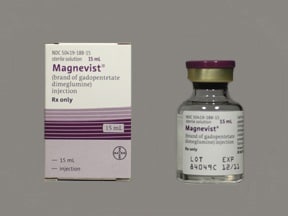
Magnevist
Ask a doctor about a prescription for Magnevist




How to use Magnevist
PATIENT INFORMATION LEAFLET: USER INFORMATION
Magnevist, 469 mg/ml, solution for injection
Dimeglumine gadopentetate
Read the leaflet carefully before using the medicine.
- You should keep this leaflet, you may need to read it again.
- If you have any further questions, ask your doctor or pharmacist.
- This medicine has been prescribed for you. Do not pass it on to others. It may harm them, even if their symptoms are the same as yours.
- If any of the side effects get serious, or if you notice any side effects not listed in this leaflet, please tell your doctor or pharmacist.
Contents of the pack:
- 1. What Magnevist is and what it is used for
- 2. Important information before using Magnevist
- 3. How to use Magnevist
- 4. Possible side effects
- 5. How to store Magnevist
- 6. Further information
1. WHAT MAGNEVIST IS AND WHAT IT IS USED FOR
Magnevist is a paramagnetic contrast agent for use in magnetic resonance imaging (MRI) of the brain, spine, vessels, and other parts of the body. It is well tolerated and rarely causes mild local or general side effects. The product is supplied as a solution for intravenous injection. The product is intended for diagnostic use only. MRI is a type of diagnostic imaging used in medicine that utilizes the behavior of water molecules in healthy and diseased tissues. The examination is performed using a complex system of magnets and radio waves. The activity is recorded by computers, which translate it into images.
Indications for use
For diagnostic purposes only, by intravenous administration.
- Magnetic resonance (NMR) of the head and spine
Particularly for the visualization of tumors and in cases of suspected meningioma, neurofibroma (acoustic nerve), infiltrating tumors (e.g., glioma), and metastases; for the visualization of small and/or isointense tumors; in cases of suspected recurrence after surgical or radiation therapy; for the differentiation of rare tumors, such as hemangioblastomas, ependymomas, and pituitary microadenomas; for better definition of the topography of extracerebral tumors. Additionally, in NMR of the spine: differentiation of intramedullary and extramedullary tumors; visualization of solid and cystic tumors in the spine; determination of the topography of intramedullary tumors.
- Whole-body NMR
Used in examinations of the face, neck, chest with heart and abdominal cavity, breast in women, pelvis, musculoskeletal system, and vessels of the whole body. Magnevist provides diagnostic information, especially: confirmation or exclusion of tumors, infiltrations, and vascular changes; determination of the topography and boundaries of these changes; differentiation of the internal structure of pathological changes; assessment of circulation in healthy and diseased tissues; differentiation of tumor and scar tissue after treatment; diagnosis of recurrent discopathy after surgery; semi-quantitative assessment of renal function, including anatomical diagnosis of the organ.
2. IMPORTANT INFORMATION BEFORE USING MAGNEVIST
When not to use Magnevist
Magnevist should not be used in patients with severe kidney disease and/or acute kidney injury, as well as in patients who have undergone or are scheduled to undergo liver transplantation. In this group of patients, the administration of Magnevist is associated with a disease called nephrogenic systemic fibrosis (NSF). NSF is a disease that causes thickening of the skin and connective tissue. NSF can cause limited joint mobility, muscle weakness, or affect the function of internal organs, which can be life-threatening. Magnevist should not be used in newborns under 4 weeks of age.
When to exercise caution when using Magnevist
Tell your doctorif:
- the patient has been diagnosed with hypersensitivity (allergy) to dimeglumine gadopentetate or any of the other ingredients of Magnevist (see "Further information");
- the patient has had a previous reaction to a contrast agent;
- the patient has allergies (e.g., hay fever, hives) or asthma;
- the patient has heart disease or vascular disease. In rare cases, an allergic reaction in the patient may be severe or life-threatening;
- the patient's kidneys do not work properly and/or the patient has acute kidney injury (see also "When not to use Magnevist");
- the patient has recently undergone or is scheduled to undergo liver transplantation;
- the patient has epilepsy or suffers from brain diseases with seizures or other brain damage. Seizures or fits rarely occur in patients under similar conditions.
- Before administering Magnevist, inform your doctor, radiologist, or MRI staff if any of these conditions exist. The doctor will decide whether the examination can be performed.
After using Magnevist, allergic reactions may occur. Severe reactions are possible. Most reactions occur within half an hour of administration. Therefore, it is recommended to monitor the patient for at least 30 minutes after injection. Delayed reactions (after hours or days) have been observed (see "Possible side effects"). Before performing any blood test, inform your doctor that you have received Magnevist. The product may affect the results of iron level tests in the blood for up to 24 hours after administration. Kidney function disorders Before receiving Magnevist, your doctor will check your kidney function. Before undergoing an MRI with Magnevist, a blood test will be performed to assess kidney function. If your kidneys do not work properly, your doctor will ensure that Magnevist is removed from your body before you receive another injection of Magnevist. Hemodialysis shortly after using Magnevist may help remove Magnevist from the body in patients undergoing hemodialysis. There is no evidence that starting hemodialysis in other non-dialyzed patients prevents or treats NSF. There have been reports of severe reactions, mainly associated with thickening of the skin and connective tissue (Nephrogenic Systemic Fibrosis - NSF). NSF can cause significant joint immobility, muscle weakness, or affect the function of internal organs, which can be life-threatening. NSF is associated with the use of some gadolinium-containing products, including Magnevist, in patients with severe kidney function disorders.
- Children and adolescents
Magnevist should not be used in newborns under 4 weeks of age. Due to the immature kidney function in infants under 1 year of age, Magnevist should only be used in infants after careful consideration by the doctor of the justification for such use. The recommended dose for infants should be administered manually.
Using other medicines
Tell your doctor, radiologist, or MRI staff
about all medicines you are currently taking or have recently taken, including those available without a prescription.
Pregnancy and breastfeeding
Before using any medicine, consult your doctor.
Pregnancy
Tell your doctor if you are pregnant or think you may be pregnant. Magnevist should not be used in pregnant women unless absolutely necessary.
Breastfeeding
Tell your doctor if you are breastfeeding or plan to breastfeed. It is recommended to stop breastfeeding for at least 24 hours after receiving Magnevist.
Driving and using machines
No effects of Magnevist on the ability to drive and use machines have been observed.
3. HOW TO USE MAGNEVIST
Magnevist is injected into a vein by medical staff using a needle or catheter. Magnevist will be administered immediately before the MRI examination. The actual dose of Magnevist suitable for a given patient will depend on their body weight and the area of the body being examined. In adults, a single injection of 0.2 ml of Magnevist per kilogram of body weight (which means a 70 kg person will receive a 14 ml dose) is usually sufficient. In special cases, the dose can be increased to a maximum of 0.6 ml of Magnevist per kilogram of body weight in adults and 0.4 ml of Magnevist per kilogram of body weight in children. The radiologist will decide how much Magnevist is needed to perform the examination. In patients under 2 years of age, experience with the use of Magnevist is limited, except for use in brain and spine examinations.
Dosing in special patient groups
Magnevist is contraindicated in patients with severe kidney disease and/or acute kidney injury, as well as in patients who are scheduled to undergo liver transplantation. Magnevist should not be used in newborns under 4 weeks of age. In patients with acute kidney function disorders or acute kidney failure, the dose should not exceed 0.2 ml/kg body weight. The doctor or radiologist will decide whether the examination can be performed (see "Important information before using Magnevist"). In patients with moderate kidney failure, no more than one dose of the medicine should be used during a single examination, and Magnevist should not be used at intervals of less than 7 days. Due to the immature kidney function in infants under 1 year of age, no more than one dose of the medicine should be used, and Magnevist should not be used at intervals of less than 7 days. When using the medicine in patients over 65 years of age, there is no need to adjust the dose, but a blood test should be performed to assess whether the kidneys are working properly. Further information on the use and preparation of Magnevist can be found at the end of the leaflet (see "Further information").
Using more than the recommended dose of Magnevist
If your kidneys do not work properly, your doctor may order dialysis to remove Magnevist from your body. If you have any further questions, consult your doctor or radiologist.
4. POSSIBLE SIDE EFFECTS
Like all medicines, Magnevist can cause side effects, although not everybody gets them. Most side effects are mild to moderate. In patients receiving Magnevist (occurring in 4 or more out of 1,000 patients), the most common symptoms are: various reactions at the injection site, headache, and nausea (feeling sick). The most severe side effects in patients receiving Magnevist are nephrogenic systemic fibrosis (NSF) and pseudoallergic reactions (allergic-type reactions), including severe reactions such as anaphylaxis. NSF is a severe reaction mainly associated with thickening of the skin and connective tissue. NSF can cause significant joint immobility, muscle weakness, or affect the function of internal organs, which can be life-threatening. Cases of nephrogenic systemic fibrosis (a disease that causes skin and connective tissue to thicken) have been observed. Rarely, allergic-type reactionsmay occur, including severe reactions that may require medical intervention. If you experience mild swelling of the face, lips, tongue, or throat, coughing, sneezing, difficulty breathing, itching, runny nose, hives (nettle rash), you should immediately inform your doctor, radiologist, or MRI staff. These symptoms may be the first signs of a severe reaction, which means that it may be necessary to interrupt the examination and administer appropriate treatment. Rarely, delayed allergic-type reactionshave been observed, occurring hours or days after administration of Magnevist. If these reactions occur, you should inform your doctor or MRI staff.
The following side effects have been reported based on their frequency:
Uncommon(occurring in 1 to 10 out of 1,000 patients)
- headache, dizziness, taste disorders;
- vomiting, nausea (feeling sick);
- pain, feeling of heat, feeling of cold;
- reactions at the injection site, such as feeling of coldness, paresthesia (tingling), swelling, feeling of heat, pain, redness (red and painful skin), malaise, necrosis (tissue death), thrombophlebitis (vein inflammation caused by or associated with a blood clot), phlebitis, inflammation, extravasation (bleeding into tissues at the injection site), pain, bruising, skin discoloration.
Rare(occurring in less than 1 out of 1,000 patients)
- hypersensitivity (allergy) / pseudoallergic reactions (allergic-type reactions), e.g., pseudoallergic anaphylaxis (severe allergic-type reactions), anaphylaxis (circulatory collapse), hypotension (low blood pressure), conjunctivitis, loss of consciousness, feeling of constriction in the throat, sneezing, hives (nettle rash), itching, rash, redness (skin redness), difficulty breathing, respiratory arrest, bronchospasm (breathing difficulties), wheezing, laryngospasm, laryngeal edema, throat edema, cyanosis (blue lips), angioedema (e.g., facial, throat, oral, and/or tongue edema), facial edema;
- disorientation;
- seizures (fits or seizures), paresthesia (numbness and tingling), burning sensation, muscle tremors;
- tachycardia (abnormally fast heart rate), arrhythmia (irregular heart rate);
- thrombophlebitis (vein inflammation caused by or associated with a blood clot), facial flushing, vasodilation (dilation of blood vessels);
- throat irritation, sore throat/discomfort in the throat, cough;
- abdominal pain or discomfort, diarrhea, toothache, dry mouth, oral soft tissue pain, and paresthesia (pain, numbness, and tingling in the mouth);
- arm, hand, leg, and foot pain (limb pain);
- chest pain, fever, peripheral edema (swelling of arms, hands, legs, and feet), malaise, fatigue, thirst, impotence;
Frequency not known(cannot be estimated from the available data):
- increased serum iron level (changes may be detected in blood tests);
- anxiety, restlessness;
- coma, somnolence, speech disorders, olfactory hallucinations (disturbed sense of smell);
- vision disorders, lacrimation, eye pain;
- hearing disorders, ear pain;
- cardiac arrest (sudden cardiac arrest), bradycardia (slow heart rate);
- syncope, vasovagal reaction (sudden severe drop in blood pressure, pallor that may cause loss of consciousness), increased blood pressure;
- respiratory failure, increased or decreased respiratory rate, pulmonary edema (fluid in the lungs);
- salivation;
- increased bilirubin level in the blood, increased liver enzyme activity (changes may be detected in blood tests);
- nephrogenic systemic fibrosis (NSF is a severe reaction mainly associated with thickening of the skin and connective tissue. NSF can cause significant joint immobility, muscle weakness, or affect the function of internal organs, which can be life-threatening);
- back pain, joint pain;
- acute kidney failure in patients with pre-existing kidney failure, increased creatinine level (a blood marker for kidney function, changes may be detected in blood tests), urinary incontinence (loss of control over the bladder), urgent need to urinate;
- chills, sweating, body temperature changes.
In patients with dialysis-dependent kidney failure who received Magnevist, delayed and transient reactions similar to inflammation, such as fever, chills, and increased C-reactive protein (a blood marker), were frequently observed. These patients underwent MRI with Magnevist the day before hemodialysis. The following side effects have been reported in some cases, resulting in a life-threatening situation or death: nephrogenic systemic fibrosis (NSF, a severe reaction mainly associated with thickening of the skin and connective tissue), pseudoallergic anaphylaxis (severe allergic-type reactions), pseudoallergic reactions (allergic-type reactions), hypersensitivity reactions (allergy), anaphylaxis (circulatory collapse), hypotension (low blood pressure), loss of consciousness, feeling of constriction in the throat, difficulty breathing, respiratory failure (respiratory arrest), bronchospasm (breathing difficulties), laryngospasm, laryngeal edema, throat edema, angioedema (e.g., facial, throat, oral, and/or tongue edema), facial edema. If any of the side effects worsen or if you experience any side effects not listed in this leaflet, inform your doctor or radiologist. Reporting side effects If you experience any side effects, including those not listed in this leaflet, inform your doctor, pharmacist, or nurse. Side effects can be reported directly to the Department of Drug Safety, Ministry of Health, via phone: +48 22 49 21 301, fax: +48 22 49 21 309, or e-mail: [[email protected]](mailto:[email protected]). By reporting side effects, you can help provide more information on the safety of this medicine.
5. HOW TO STORE MAGNEVIST
Magnevist is sensitive to light. Store in a temperature below 25°C, protected from light. Vials and bottles should be stored in the outer carton. During administration, no protection from light is required. After opening the vial or bottle, Magnevist remains stable for 24 hours at 30°C, after which it must be discarded. Do not use after the expiration date stated on the packaging. Store in a place inaccessible and out of sight of children.
6. FURTHER INFORMATION
What Magnevist contains
- The active substance isdimeglumine gadopentetate. Each ml of the aqueous solution contains 469 mg of dimeglumine gadopentetate (equivalent to 0.5 mmol of dimeglumine gadopentetate).
- Other ingredients aremeglumine pentaoctanoate, meglumine, water for injections.
What Magnevist looks like and contents of the pack
Magnevist is a clear, colorless to pale yellow solution. The pack contains: 1 vial of 5, 10, 15, 20, 30 ml, 10 vials of 20, 30 ml, 1 bottle of 100 ml, and 10 bottles of 100 ml.
Marketing authorization holder and manufacturer
Marketing authorization holder
Bayer AG
Kaiser-Wilhelm-Allee 1
51373 Leverkusen
Germany
Manufacturer
Bayer AG
Müllerstrasse 178
13353 Berlin
Germany
To obtain more detailed information, contact your doctor or the representative of the marketing authorization holder:
Bayer Sp. z o.o.
Al. Jerozolimskie 158
02-326 Warsaw, Poland
phone: +48 22 572 35 00
---------------------------------------------------------------------------------------------------------------------------
Information intended for healthcare professionals only
(see also points 1 to 6):
Instructions for use
- Before injection Before use, the product should be inspected. Magnevist is supplied as a clear, colorless to pale yellow solution. Do not use Magnevist if there is significant discoloration, presence of solid particles, or damage to the container.
Method of administration
The product is for intravenous use only.
Vials
Magnevist should be drawn into a syringe directly before administration. Never puncture the rubber stopper more than once. Product that has not been used during a single examination should be discarded.
Large volume containers
In addition, when using bottles for infusion containing 50 or 100 ml, the following recommendations apply: Magnevist should only be administered using an automatic syringe or another approved procedure that ensures the sterility of the product. Follow the instructions provided by the equipment manufacturer. The product should not be administered using an automatic syringe in newborns and infants. In children under 2 years of age, the required dose should be administered manually, not using an automatic syringe, to avoid injury. Unused Magnevist remaining in open containers should be discarded at the end of the day of examination (maximum 24 hours). See also "How to store Magnevist".
Dosing
Adults
- MRI of the head and spine
0.2 ml/kg body weight (equivalent to 0.1 mmol of dimeglumine gadopentetate per kilogram of body weight) of Magnevist. Maximum single dose of Magnevist: 0.6 ml/kg body weight.
- Whole-body MRI
0.2 ml/kg body weight of Magnevist. Maximum single dose of Magnevist: 0.6 ml/kg body weight.
Additional information for special patient groups
Children and adolescents(see "What Magnevist is and what it is used for")
Children: 0.2 ml of Magnevist per kilogram of body weight.
Maximum single dose: 0.4 ml of Magnevist per kilogram of body weight.
Children under 2 years of age: limited experience in whole-body MRI examinations.
In children under 2 years of age, the recommended dose should be administered manually, not using an automatic syringe, to avoid injury.
Special warnings and precautions for use
- Hypersensitivity In patients with a history of allergies, the decision to use Magnevist must be made after careful consideration of the benefit-to-risk ratio.
It is recommended to monitor the patient after the examination. It is necessary to have access to medications for the treatment of allergic reactions, as well as to be prepared for emergency measures (see also "When to exercise caution when using Magnevist").
- Kidney function disorders Before administering Magnevist to each patient, screening laboratory tests for kidney function disorders should be performed.
Interactions with other medicinal products and other forms of interaction
- Effect on diagnostic tests
The result of the serum iron level test using the complexometric method (e.g., using batofenantrolin) obtained from blood drawn within 24 hours after administration of Magnevist may be decreased, as the contrast agent solution contains free DTPA.
Pregnancy
Magnevist should not be used during pregnancy unless the clinical condition of the woman indicates the need for dimeglumine gadopentetate.
Breastfeeding
The patient should not breastfeed for at least 24 hours after receiving Magnevist.
Side effects
The overall safety profile of Magnevist is based on data from 11,000 patients who participated in clinical trials and from post-marketing surveillance (see "Possible side effects").
Overdose
In the event of accidental overdose, as a precautionary measure, it is recommended to monitor kidney function in patients with kidney failure. Magnevist can be removed from the body by hemodialysis (see "When to exercise caution when using Magnevist").
Incompatibilities
Due to the lack of compatibility studies, this product should not be mixed with other medicinal products. It is recommended to monitor the patient after the examination. It is necessary to have access to medications for the treatment of allergic reactions, as well as to be prepared for emergency measures. In the patient's medical record, a self-adhesive control label from the vial or bottle should be attached to document the use of the gadolinium-containing medicinal product. The dose used should also be documented. If electronic patient cards are used, the product name, batch number, and dose should be recorded.
Date of approval of the leaflet:November 2017
- Country of registration
- Prescription requiredNo
- Manufacturer
- ImporterBayer Pharma AG
- This information is for reference only and does not constitute medical advice. Always consult a licensed doctor before taking any medication. Oladoctor is not responsible for medical decisions based on this content.
- Alternatives to MagnevistDosage form: Solution, 0.5 mmol/mlActive substance: gadoteric acidManufacturer: GE Healthcare AS GE Healthcare IrelandPrescription requiredDosage form: Solution, 0.5 mmol/mlActive substance: gadoteric acidManufacturer: GE Healthcare ASPrescription requiredDosage form: Solution, 0.5 mmol/mlActive substance: gadoteric acidManufacturer: Sanochemia Pharmazeutika GmbHPrescription required
Alternatives to Magnevist in other countries
The best alternatives with the same active ingredient and therapeutic effect.
Alternative to Magnevist in Espanha
Online doctors for Magnevist
Discuss dosage, side effects, interactions, contraindications, and prescription renewal for Magnevist – subject to medical assessment and local rules.









Get updates and exclusive offers
Be the first to know about new services, marketplace updates, and subscriber-only promos.

