


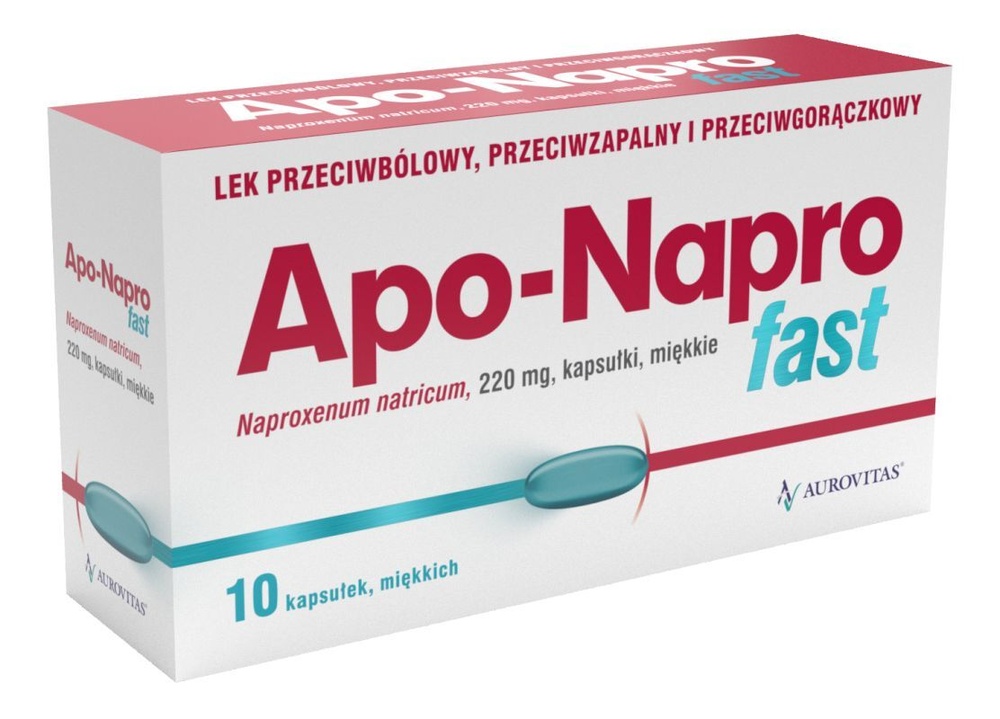
Apo-napro Fast
Ask a doctor about a prescription for Apo-napro Fast




How to use Apo-napro Fast
Leaflet attached to the packaging: patient information
Apo-Napro Fast, 220 mg, soft capsules, Naproxen sodium
Read the leaflet carefully before taking the medicine, as it contains important information for the patient.
This medicine should always be taken exactly as described in the patient leaflet or as directed by a doctor, pharmacist, or nurse.
- Keep this leaflet, you may need to read it again.
- If you need advice or additional information, consult a pharmacist.
- If the patient experiences any side effects, including any possible side effects not listed in the leaflet, they should inform their doctor, pharmacist, or nurse. See section 4.
- If after 3 days of fever treatment or 5 days of pain treatment there is no improvement or the patient feels worse, they should contact their doctor.
Table of contents of the leaflet
- 1. What is Apo-Napro Fast and what is it used for
- 2. Important information before taking Apo-Napro Fast
- 3. How to take Apo-Napro Fast
- 4. Possible side effects
- 5. How to store Apo-Napro Fast
- 6. Contents of the pack and other information
1. What is Apo-Napro Fast and what is it used for
Apo-Napro Fast contains naproxen, which is an anti-inflammatory, analgesic, and antipyretic medicine. It belongs to a group of medicines called NSAIDs (non-steroidal anti-inflammatory drugs).
Apo-Napro Fast is used for the short-term treatment of painful conditions in adults and children from 12 years of age.
Indications for use
Treatment of mild to moderate pain, such as:
- headache,
- toothache,
- muscle pain,
- joint pain,
- back pain,
- menstrual cramps,
- mild pain associated with colds. Reduction of fever.
Patient should contact their doctor if their condition does not improve or worsens after 3 days of fever treatment and 5 days of pain treatment.
2. Important information before taking Apo-Napro Fast
When not to take Apo-Napro Fast:
- if the patient is allergic to naproxen or naproxen sodium or any of the other ingredients of this medicine (listed in section 6)
- if the patient has ever had an allergic reaction, such as asthma, rhinitis, or itching after taking aspirin, ibuprofen, or other painkillers and anti-inflammatory medicines (NSAIDs)
- if the patient has had gastrointestinal bleeding or perforation after taking non-steroidal anti-inflammatory drugs (known as NSAIDs)
- if the patient has recurrent gastrointestinal ulcers or bleeding (at least two different episodes of confirmed ulceration or bleeding)
- if the patient has stomach or duodenal ulcer, gastritis, or stomach pain
- if the patient has internal bleeding (e.g., gastrointestinal, cerebral)
- if the patient has a tendency to bleed or is taking anticoagulant medicines (blood thinners)
- if the patient has severe kidney problems
- if the patient has severe liver problems
- if the patient has severe heart failure
- if the patient is in the last three months of pregnancy.
Warnings and precautions
Side effects can be minimized by using the smallest effective dose for the shortest duration necessary to control symptoms (see below - gastrointestinal and cardiovascular risk).
Before starting treatment with Apo-Napro Fast, the patient should discuss with their doctor, pharmacist, or nurse:
- if pain or fever does not improve, worsens, or recurs regularly, even if these symptoms are mild
- if gastrointestinal problems occur while taking this medicine (such as stomach pain or heartburn)
- if the patient has high blood pressure or heart disease
- if the patient has an infection
- if the patient is elderly
- if the patient has liver problems
- if the patient has kidney problems.
In case of heart problems, previous stroke, or suspected risk of these problems (e.g., high blood pressure, diabetes, high cholesterol, or smoking) before taking the medicine, the patient should discuss it with their doctor or pharmacist.
Taking medicines like Apo-Napro Fast may be associated with a small increased risk of heart attack (myocardial infarction) or stroke. This risk is more likely in patients taking high doses and during long-term treatment. The patient should not exceed the recommended dose or duration of treatment (10 days).
In patients with gastrointestinal problems, additional precautions are necessary:
During treatment with all NSAIDs, gastrointestinal bleeding, ulcers, and perforations have been reported, sometimes fatal. These symptoms have occurred at any time during treatment, with or without warning signs or if serious gastrointestinal events have occurred in the past.
The risk of gastrointestinal bleeding, ulcers, and perforations is higher with increasing doses of NSAIDs and is higher in patients with a history of ulcers, especially with complications such as bleeding or perforation (see section 2: When not to take Apo-Napro Fast) and in elderly patients. These patients should start treatment with the lowest available dose. In these patients, as well as those who require concomitant treatment with low-dose acetylsalicylic acid or other medicines that may increase the risk of gastrointestinal problems, concomitant treatment with protective agents (e.g., misoprostol or proton pump inhibitors) should be considered.
If the patient has had gastrointestinal side effects in the past, especially in the elderly, they should report any unusual abdominal symptoms (especially gastrointestinal bleeding), especially during the initial phase of treatment.
Care should be taken when taking other medicines that may increase the risk of ulcers or bleeding, such as oral corticosteroids, anticoagulant medicines (blood thinners), e.g., warfarin, selective serotonin reuptake inhibitors (used to treat mental disorders, including depression) or antiplatelet agents, e.g., acetylsalicylic acid (see section 2: Apo-Napro Fast and other medicines).
If gastrointestinal bleeding or ulcers occur during treatment with Apo-Napro Fast, the patient should stop treatment and consult their doctor.
NSAIDs should be used with caution in patients with a history of gastrointestinal disease (ulcerative colitis, Crohn's disease), as their condition may worsen (see section 4).
If gastrointestinal symptoms occur or have occurred in the past, the patient should not take Apo-Napro Fast unless advised by their doctor.
Patients with bleeding disorders should take this medicine only under medical supervision.
This medicine is not suitable for the treatment of pain caused by gastrointestinal problems.
The patient should avoid taking Apo-Napro Fast at the same time as other non-steroidal anti-inflammatory medicines, including so-called COX-2 inhibitors (cyclooxygenase-2 inhibitors).
Taking NSAIDs by elderly people is associated with an increased risk of side effects, particularly (sometimes fatal) gastrointestinal bleeding and perforation.
The patient should discuss with their doctor if any of the above warnings apply to their current or past situation.
Severe skin reactions, including (exfoliative dermatitis, Stevens-Johnson syndrome, toxic epidermal necrolysis, drug reaction with eosinophilia and systemic symptoms (DRESS)) have been reported with Apo-Napro Fast. The risk of these reactions seems to be highest at the beginning of therapy, as most of these reactions occurred within the first month of treatment. The patient should stop taking Apo-Napro Fast and immediately consult their doctor if they experience any symptoms associated with these severe skin reactions, described in section 4.
Apo-Napro Fast and other medicines
The patient should tell their doctor or pharmacist about all medicines they are currently taking or have recently taken, as well as any medicines they plan to take. This includes medicines without a prescription.
The patient should not take Apo-Napro Fast at the same time as the following medicines:
- certain anticoagulant medicines (blood thinners)
- certain oral antidiabetic medicines
- certain antibiotics
- certain antiepileptic medicines (hydantoin derivatives), such as phenytoin
- certain sulfonamides, such as sulfadoxine
- certain narcotic medicines, such as thiopental
- acetylsalicylic acid used to prevent blood clots.
Apo-Napro Fast may reduce the effect of certain antihypertensive medicines (beta blockers and diuretics).
Apo-Napro Fast may delay the excretion of lithium preparations (used to treat nervous system disorders).
Apo-Napro Fast increases the risk of side effects when taken with:
- methotrexate (used to treat rheumatism)
- angiotensin-converting enzyme inhibitors (medicines used, for example, to treat high blood pressure)
- cyclosporins (medicines used to treat autoimmune diseases - diseases in which the immune system produces antibodies against the body's own tissues)
- other painkillers and anti-inflammatory medicines.
Taking Apo-Napro Fast with probenecid (used to treat gout) may delay the elimination of naproxen.
The patient should consult their doctor when taking other medicines that increase the risk of ulcers or bleeding, such as oral corticosteroids (anti-inflammatory medicines), anticoagulant medicines (blood thinners), e.g., warfarin, selective serotonin reuptake inhibitors (used in depression) and antiplatelet agents, e.g., acetylsalicylic acid.
Pregnancy, breastfeeding, and fertility
If the patient is pregnant or breastfeeding, thinks they may be pregnant, or plans to have a child, they should consult their doctor or pharmacist before taking this medicine.
Pregnancy
The patient should not take Apo-Napro Fast during the last three months of pregnancy, as it may harm the unborn child or cause problems during delivery. The medicine may cause kidney and heart problems in the unborn child. It may also increase the risk of bleeding in the mother and child and prolong or complicate delivery. The patient should not take Apo-Napro Fast during the first six months of pregnancy unless absolutely necessary and advised by their doctor. If treatment is necessary during this period or when trying to conceive, the patient should use the smallest dose for the shortest time. If Apo-Napro Fast is used for more than a few days from the 20th week of pregnancy, it may cause kidney problems in the unborn child, leading to low amniotic fluid levels (oligohydramnios) or narrowing of the ductus arteriosus in the child's heart. If the patient requires treatment for a longer period, their doctor may recommend additional monitoring.
Breastfeeding
Naproxen, the active substance of Apo-Napro Fast, passes into breast milk. Therefore, the patient should not take Apo-Napro Fast during breastfeeding.
Fertility
Apo-Napro Fast is a non-steroidal anti-inflammatory medicine (NSAID) that may affect female fertility. This effect is reversible upon stopping the medicine. It is unlikely that occasional use of the medicine will affect the likelihood of becoming pregnant, but if the patient has problems becoming pregnant, they should consult their doctor before taking this medicine.
Driving and using machines
Apo-Napro Fast may cause drowsiness, dizziness, and difficulty sleeping as side effects. In such cases, the patient should not drive or operate machinery.
Apo-Napro Fast contains sorbitol
If the patient has previously been diagnosed with intolerance to some sugars, they should consult their doctor before taking this medicine.
Apo-Napro Fast contains soybean lecithin
Patient with an allergy (hypersensitivity) to peanuts or soy should not take this medicine.
Apo-Napro Fast contains sodium
This medicine contains less than 1 mmol (23 mg) of sodium per capsule, which means it is essentially "sodium-free".
3. How to take Apo-Napro Fast
The patient should always take this medicine exactly as described in the patient leaflet or as directed by their doctor, pharmacist, or nurse. If in doubt, the patient should consult their doctor, pharmacist, or nurse.
The recommended dose is:
Adults and children from 12 years of age:
The recommended dose is 1 capsule every 8 to 12 hours. As an initial dose, 2 capsules can also be taken, and if symptoms persist, the next capsule can be taken after 12 hours. The patient should not take more than 3 capsules in 24 hours.
The capsules should be taken with a large amount of water or milk, preferably immediately after a meal.
The patient should contact their doctor if they do not feel better or feel worse after 3 days of fever treatment and 5 days of pain treatment.
Without consulting their doctor, the patient should not take Apo-Napro Fast for more than 10 days.
Patient over 65 years of age:
The patient should not take more than 2 capsules per day.
Patient with kidney problems
Patient with mild kidney problems should take the smallest effective dose under medical supervision, which will recommend monitoring kidney function. In moderate kidney problems, the patient should avoid taking naproxen. Patients with severe kidney problems cannot take naproxen.
Patient with liver problems
Patient with liver problems should be cautious when taking Apo-Napro Fast. Patients with severe liver problems or liver cirrhosis should avoid taking Apo-Napro Fast.
Method of administration
The capsules should be taken orally, with a large amount of water or milk, preferably immediately after a meal.
Taking a higher dose of Apo-Napro Fast than recommended
In case of taking a higher dose of the medicine than recommended, the patient should immediately consult their doctor or pharmacist. The patient should show their doctor the packaging or leaflet of the medicine.
Symptoms of overdose are: nausea, vomiting, stomach pain, drowsiness, dizziness, disorientation, diarrhea, gastrointestinal bleeding, high sodium levels in the blood (hypernatremia), seizures (rarely), transient liver function disorders, kidney function disorders, respiratory depression, and acidosis (metabolic acidosis).
Missing a dose of Apo-Napro Fast
The patient should take the missed dose as soon as possible. The patient should not take a double dose to make up for the missed dose.
If the patient has any further doubts about taking this medicine, they should consult their doctor or pharmacist.
4. Possible side effects
Like all medicines, Apo-Napro Fast can cause side effects, although not everybody gets them.
The most commonly observed side effects are gastrointestinal disorders. Gastrointestinal ulcers (peptic ulcers), perforation, or gastrointestinal bleeding may occur, sometimes fatal (especially in elderly people). After taking the medicine, nausea, vomiting, diarrhea, bloating, constipation, indigestion, stomach pain, black stools (melena), bloody vomiting (hematemesis), oral mucosal inflammation (stomatitis), and exacerbation of ulcerative colitis and Crohn's disease have been reported. Less commonly, gastritis has been observed.
NSAIDs have been associated with fluid retention, high blood pressure, and heart failure.
Medicines like Apo-Napro Fast may be associated with a small increased risk of heart attack or stroke.
If the patient experiences any of the following side effects, they should stop taking Apo-Napro Fast and immediately consult their doctor:
- Frequent: may affect up to 1 in 10 people
- Rare: may affect up to 1 in 1,000 people
- Very rare: may affect up to 1 in 10,000 people
- Frequency not known: cannot be estimated from the available data
Very common (may affect more than 1 in 10 people)
- Abdominal discomfort.
Common (may affect 1 to 10 people in 100)
- Headache
- Dizziness
- Drowsiness
- Lightheadedness
- Visual disturbances
- Ringing or buzzing in the ears
- Nausea
- Indigestion
- Heartburn.
Uncommon (may affect 1 to 10 people in 1,000)
- Concentration disorders
- Sleep disorders (insomnia)
- Cognitive disorders or memory problems (cognitive impairment)
- Vomiting
- Diarrhea
- Constipation
- Gastrointestinal bleeding and (or) perforation
- Photosensitivity
- Rash
- Itching.
Rare (may affect 1 to 10 people in 10,000)
- Allergic reactions to naproxen and naproxen sodium. Allergic reactions usually occur in patients with known hypersensitivity to aspirin, other NSAIDs, and Apo-Napro Fast. However, they can also occur in patients who have not previously experienced such an allergy.
- High potassium levels in the blood (hyperkalemia)
- Hearing disorders
- Vasculitis
- Pneumonitis (eosinophilic pneumonitis)
- Oral ulcers
- Bloody vomiting.
Very rare (may affect less than 1 in 10,000 people)
- Significant reduction in blood cell count, which can cause weakness, bruising, or increased risk of infection (aplastic anemia)
- Reduction in red blood cell count, which can cause pale skin and shortness of breath (hemolytic anemia)
- Reduction in white blood cell count (granulocytopenia)
- Reduction in platelet count (thrombocytopenia)
- Seizures
- Non-infectious meningitis (aseptic meningitis)
- Increased heart rate
- Swollen ankles and feet (edema)
- High blood pressure
- Insufficient heart pumping (heart failure)
- Shortness of breath
- Asthma
- Colitis (inflammation of the colon)
- Life-threatening liver inflammation (fatal hepatitis)
- Jaundice
- Stevens-Johnson syndrome (blisters on hands and feet)
- Skin redness (erythema multiforme)
- Peeling skin (toxic epidermal necrolysis)
- Hair loss (alopecia)
- Reactions due to sunlight exposure, such as skin inflammation and blistering rashes (porphyria cutanea tarda or reactions similar to blistering epidermolysis).
- Blood in urine (hematuria)
- Kidney function disorders, including kidney inflammation (nephritis) or interstitial nephritis, and nephrotic syndrome (proteinuria).
Frequency not known (frequency cannot be estimated from the available data)
- Gout
- Gastrointestinal ulcers other than peptic ulcers, peptic ulcers
- Swelling of the neck and face (angioedema)
- Kidney failure
- Reduced fertility in women
- Mild swelling of the ankles and feet (mild peripheral edema).
Reporting side effects
If the patient experiences any side effects, including any possible side effects not listed in the leaflet, they should inform their doctor, pharmacist, or nurse. Side effects can be reported directly to the Department of Drug Safety Monitoring of the Office for Registration of Medicinal Products, Medical Devices, and Biocidal Products:
Al. Jerozolimskie 181C, 02-222 Warsaw, tel.: +48 22 49-21-301, fax: +48 22 49-21-309, website: https://smz.ezdrowie.gov.pl.
Side effects can also be reported to the marketing authorization holder or its representative in Poland.
Reporting side effects will help gather more information on the safety of the medicine.
5. How to store Apo-Napro Fast
The medicine should be stored out of sight and reach of children.
The patient should not take this medicine after the expiry date stated on the packaging after "EXP.". "Expiry date" means the last day of the month stated.
Store in a temperature below 25°C. Do not freeze.
Store in the original packaging to protect from moisture.
Medicines should not be disposed of via wastewater or household waste. The patient should ask their pharmacist how to dispose of medicines they no longer use. This will help protect the environment.
6. Contents of the pack and other information
What Apo-Napro Fast contains
- The active substance is naproxen sodium. One capsule contains 220 mg of naproxen sodium.
- The other ingredients (excipients) are: macrogol 600, lactic acid, propylene glycol, povidone K-30, gelatin, liquid sorbitol, partially dehydrated, glycerol, purified water, patent blue V (E 131), saturated fatty acid triglycerides, isopropyl alcohol, lecithin.
What Apo-Napro Fast looks like and contents of the pack
- Apo-Napro Fast is a blue, transparent soft gelatin capsule containing 220 mg of naproxen sodium in each capsule.
- Each carton contains 10 or 20 capsules, soft in PVDC/PE/PVC/Aluminum blisters. Not all pack sizes may be marketed.
Marketing authorization holder and manufacturer
Marketing authorization holder
Aurovitas Pharma Polska Sp. z o.o.
ul. Sokratesa 13D lok.27
01-909 Warsaw
Poland
Manufacturer
Generis Farmacêutica, S.A.
Rua João de Deus, n. 19,
Venda Nova, 2700-487 Amadora
Portugal
The leaflet does not contain all the information about the medicine. If the patient has any further questions or doubts, they should consult their doctor or pharmacist or the representative of the marketing authorization holder:
Aurovitas Pharma Polska Sp. z o.o.,
tel.: 22 311 20 00
Date of last revision of the leaflet: 12.2024
- Country of registration
- Active substance
- Prescription requiredNo
- Manufacturer
- ImporterGeneris Farmaceutica, S.A.
- This information is for reference only and does not constitute medical advice. Always consult a licensed doctor before taking any medication. Oladoctor is not responsible for medical decisions based on this content.
- Alternatives to Apo-napro Fast

Alternatives to Apo-napro Fast in other countries
The best alternatives with the same active ingredient and therapeutic effect.
Alternative to Apo-napro Fast in Іспанія
Alternative to Apo-napro Fast in Україна
Online doctors for Apo-napro Fast
Discuss dosage, side effects, interactions, contraindications, and prescription renewal for Apo-napro Fast – subject to medical assessment and local rules.

Get updates and exclusive offers
Be the first to know about new services, marketplace updates, and subscriber-only promos.

