


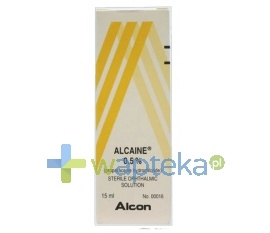



How to use Alcaine
Leaflet attached to the packaging: information for the user
Warning! The leaflet should be kept. Information on the immediate packaging in a foreign language.
ALCAINE, 5 mg/ml (0.5%), eye drops, solution
Proxymetacaine hydrochloride
You should carefully read the contents of the leaflet before using the medicine, as it contains important information for the patient.
- You should keep this leaflet, so that you can read it again if necessary.
- In case of any doubts, you should consult a doctor or pharmacist.
- This medicine has been prescribed to a specific person. It should not be given to others. The medicine may harm another person, even if the symptoms of their illness are the same.
- If the patient experiences any side effects, including any side effects not listed in this leaflet, they should tell their doctor, pharmacist, or nurse. See section 4.
Table of contents of the leaflet
- 1. What is Alcaine and what is it used for
- 2. Important information before using Alcaine
- 3. How to use Alcaine
- 4. Possible side effects
- 5. How to store Alcaine
- 6. Contents of the packaging and other information
1. What is Alcaine and what is it used for
Alcaine contains the active substance proxymetacaine hydrochloride, which has a local anesthetic effect.
Alcaine is used for surface anesthesia before ophthalmic procedures that require rapid and short-term anesthesia, such as: preparation for cataract surgery, removal of corneal sutures, tonometric measurement of intraocular pressure, gonioscopic examination, removal of foreign bodies, scraping of the conjunctiva for diagnostic purposes, and other procedures, if surface anesthesia is necessary.
2. Important information before using Alcaine
When not to use Alcaine
- if the patient is allergic to proxymetacaine hydrochloride or any of the other ingredients of this medicine (listed in section 6),
- without medical supervision,
- for a long time, as this may cause damage to the cornea, vision loss, and prolonged healing time,
- while wearing contact lenses, as Alcaine contains benzalkonium chloride.
Warnings and precautions
Before starting to use Alcaine, you should discuss it with your doctor or pharmacist.
- Alcaine is intended for local administration to the eye only by a doctor. It should not be injected.
- The medicine should be used only for eye drops (eyes).
- Repeated use or abuse of this medicine may lead to infections and corneal damage.
- Due to the anesthetic effect, the eyes will lose sensation, so you should be careful to avoid accidental eye injury. Do not touch or rub your eyes and take precautions to protect them from everyday contaminants (such as dust, dirt, etc.).
Repeated use of this medicine may lead to a shortened anesthetic effect.
- The hydrochloride of proxymetacaine may cause allergic contact dermatitis. You should avoid contact between Alcaine and the skin.
- In case of using other medicines, you should also read the section Alcaine and other medicines.
- You should be careful when using the medicine in patients:
- with epilepsy, heart disease, hyperthyroidism, or respiratory disorders,
- with myasthenia, as they are particularly sensitive to the effects of local anesthetics,
- with low acetylcholinesterase enzyme activity in the blood and patients treated with cholinesterase inhibitors, as there is an increased risk of systemic side effects after local use of local anesthetics from the ester group. Patients should avoid touching or rubbing their eyes until the local anesthetic effect has worn off.
In case of any symptoms of hypersensitivity or irritation, you should consult a doctor immediately.
Alcaine and other medicines
You should tell your doctor or pharmacist about all medicines you are currently taking or have recently taken, as well as any medicines you plan to take.
Pregnancy, breastfeeding, and fertility
If you are pregnant or breastfeeding, think you may be pregnant, or plan to have a child, you should consult your doctor before using this medicine.
Using Alcaine during pregnancy and breastfeeding is not recommended.
Driving and using machines
After using Alcaine, temporary blurred vision may occur. You should not drive or operate machines until this symptom has resolved.
Alcaine contains benzalkonium chloride
The medicine contains 0.0035 mg of benzalkonium chloride in each drop, which corresponds to 0.1 mg/ml.
Benzalkonium chloride may be absorbed by soft contact lenses and change their color. You should remove contact lenses before instillation and wait at least 15 minutes before reinserting them. Benzalkonium chloride may also cause eye irritation, especially in people with dry eye syndrome or corneal disorders (the transparent layer at the front of the eye). If you experience any abnormal sensations in the eye, stinging, or eye pain after using the medicine, you should consult a doctor.
3. How to use Alcaine
Alcaine is intended for use only by a doctor.
Recommended dose
When preparing a patient for a simple examination, e.g., tonometric examination or other short-term procedures, usually one to two drops are instilled directly before the procedure.
Before minor surgical procedures, such as foreign body removal or suture removal, one to two drops should be instilled every five to ten minutes, one to three times.
To achieve long-term anesthesia, for example, during cataract surgery, one to two drops of the medicine should be instilled into the eye (eyes) every five to ten minutes, three to five times.
You should remember that the local anesthetic effect occurs within 30 seconds and may last up to 15 minutes.
Method of administration
Alcaine should be instilled only into the eye (eyes).
Open the cap. If the protective collar is loose after removing the cap, it should be discarded before using the medicine.
To prevent infection of the dropper tip or solution, you should be careful not to touch the dropper tip to the eyelids or surrounding tissues. The bottle should be kept tightly closed when not in use.
Absorption of the medicine into the general circulation can be reduced by using the following methods after instillation:
- closing the eyelids for 2 minutes;
- pressing the nasolacrimal duct with your finger for 2 minutes.
You should not use the solution if it is cloudy or has changed color.
Note: Since there is no blinking reflex after using the medicine, it is recommended to apply an eye patch after the procedure.
If the patient is using other eye drops or ointments, you should wait at least 5 minutes between administrations of the next medicines. Eye ointments should be used last.
Using a higher dose of Alcaine than recommended
In case of using a higher dose than recommended, Alcaine should be rinsed from the eye with lukewarm water.
In case of overdose or accidental ingestion, you should immediately consult a doctor, pharmacist, or poison control center, as severe reactions from the nervous or respiratory system may occur.
Missing a dose of Alcaine
You should not double the dose of the medicine to make up for a missed dose.
In case of any further doubts about using this medicine, you should consult a doctor or pharmacist.
4. Possible side effects
Like all medicines, Alcaine can cause side effects, although not everybody gets them.
The following side effects have been observed with the use of Alcaine, the frequency of which cannot be determined from the available data:
- Eye disorders: corneal damage, clouding of the eye surface, eye surface inflammation, blurred vision, photophobia, pupil dilation, eye pain, eye irritation, eye swelling, eye discomfort, eye redness, increased tear production.
- General disorders: hypersensitivity (allergy), fainting. Transient symptoms, such as a feeling of stinging, burning, or conjunctival redness, may occur. In rare cases, an allergic reaction of the cornea (characterized by acute, diffuse corneal epithelial inflammation with the formation of membranes and (or) separation of large areas of necrotic epithelium, diffuse edema of the subepithelium, inflammation of the posterior limiting layer, and uveitis) may occur.
In very rare cases, after local administration to the eye, systemic toxic effects may occur, manifested by central nervous system stimulation, followed by its depression.
Additionally, uncontrolled use or abuse of Alcaine may lead to permanent corneal disorders and (or) eye damage.
Reporting side effects
If you experience any side effects, including any side effects not listed in this leaflet, you should tell your doctor, pharmacist, or nurse. Side effects can be reported directly to the Department of Monitoring of Adverse Reactions to Medicinal Products of the Office for Registration of Medicinal Products, Medical Devices, and Biocidal Products
Al. Jerozolimskie 181C
02-222 Warsaw
tel.: +48 (22) 49 21 301
fax: +48 (22) 49 21 309
website: https://smz.ezdrowie.gov.pl
By reporting side effects, you can help gather more information on the safety of this medicine.
5. How to store Alcaine
The medicine should be stored out of sight and reach of children.
Store in a refrigerator at a temperature between 2°C and 8°C.
Shelf life after opening the bottle: 4 weeks.
After each use, the bottle should be tightly closed.
You should not use this medicine after the expiry date stated on the packaging. The expiry date refers to the last day of the specified month.
You should not use this medicine if you notice clouding or a change in color.
Medicines should not be disposed of via wastewater or household waste containers. You should ask your pharmacist how to dispose of medicines that are no longer needed. This will help protect the environment.
6. Contents of the packaging and other information
What Alcaine contains
- The active substance of the medicine is proxymetacaine hydrochloride. 1 ml of the solution contains 5 mg of proxymetacaine hydrochloride.
- The other ingredients (excipients) are: glycerol, hydrochloric acid, and (or) sodium hydroxide, benzalkonium chloride, purified water.
What Alcaine looks like and what the packaging contains
Alcaine is available as a sterile, isotonic aqueous solution.
A white, opaque bottle (DROPTAINER) made of low-density polyethylene (LDPE) with a white cap and dropper made of low-density polyethylene, containing 15 ml of the solution.
For more detailed information, you should contact the marketing authorization holder or parallel importer:
Marketing authorization holder in Greece, the country of export:
Alcon Laboratories Hellas - Monoprósopi Α.Ε.Β.Ε.
Agiou Thoma 27, 151 24 Maroussi
Greece
Manufacturer:
Alcon Laboratories Belgium
Lichterveld 3
2870 Puurs-Sint-Amands
Belgium
S.A. Alcon-Couvreur N.V.
Rijksweg 14
B-2870 Puurs
Belgium
Parallel importer:
Delfarma Sp. z o.o.
ul. Św. Teresy od Dzieciątka Jezus 111, 91-222 Łódź
Repackaged by:
Delfarma Sp. z o.o.
ul. Św. Teresy od Dzieciątka Jezus 111, 91-222 Łódź
License number in Greece, the country of export: 43182/10/12-05-2011
Parallel import license number: 187/23
Date of leaflet approval:06.09.2023
[Information about the trademark]
- Country of registration
- Active substance
- Prescription requiredYes
- Marketing authorisation holder (MAH)Alcon Laboratories Hellas - Monoprósopi Α.Ε.Β.Ε.
- This information is for reference only and does not constitute medical advice. Always consult a licensed doctor before taking any medication. Oladoctor is not responsible for medical decisions based on this content.
- Alternatives to AlcaineDosage form: Drops, 5 mg/mlActive substance: proxymetacainePrescription requiredDosage form: Drops, 5 mg/mlActive substance: proxymetacainePrescription requiredDosage form: Drops, 5 mg/mlActive substance: proxymetacainePrescription required
Alternatives to Alcaine in other countries
The best alternatives with the same active ingredient and therapeutic effect.
Alternative to Alcaine in Spain
Online doctors for Alcaine
Discuss dosage, side effects, interactions, contraindications, and prescription renewal for Alcaine – subject to medical assessment and local rules.

Get updates and exclusive offers
Be the first to know about new services, marketplace updates, and subscriber-only promos.

