



PENTACARINAT 300 mg Solución Inyectable

Revisión de receta online
Un médico revisará tu caso y determinará si la prescripción es médicamente apropiada.

Habla con un médico sobre este medicamento
Comenta tus síntomas y las opciones de tratamiento en una consulta online.



Cómo usar PENTACARINAT 300 MG POLVO PARA SOLUCION INYECTABLE
Contenido del prospecto
- Introducción
- Qué es Pentacarinat y para qué se utiliza
- Qué necesita saber antes de empezar a usar Pentacarinat
- Cómo usar Pentacarinat
- Posibles efectos adversos
- Conservación de Pentacarinat
- Contenido del envase e información adicional
Introducción
Prospecto: información para el usuario
Pentacarinat 300 mg polvo para solución inyectable
Pentamidina isetionato
Lea todo el prospecto detenidamente antes de empezar a usar este medicamento, porque contiene información importante para usted.
- Conserve este prospecto, ya que puede tener que volver a leerlo.
- Si tiene alguna duda, consulte a su médico, farmacéutico o enfermero.
- Este medicamento se le ha recetado solamente a usted y no debe dárselo a otras personas, aunque tengan los mismos síntomas que usted, ya que puede perjudicarles.
- Si experimenta efectos adversos, consulte a su médico, farmacéutico o enfermero, incluso si se trata de efectos adversos que no aparecen en este prospecto. Ver sección 4
Contenido del prospecto:
- Qué es Pentacarinat y para qué se utiliza
- Qué necesita saber antes de empezar a usar Pentacarinat
- Cómo usar Pentacarinat
- Posibles efectos adversos
- Conservación de Pentacarinat
- Contenido del envase e información adicional
1. Qué es Pentacarinat y para qué se utiliza
Pentacarinat 300 mg polvo para solución inyectable es un polvo para administrar por vía intramuscular o vía intravenosa.
El principio activo de Pentacarinat es la pentamidina isetionato, que es un antiprotozoario que actúa de forma letal frente a los microorganismos Pneumocystis jirovecii(anteriormente conocido como Pneumocystis carinii), Trypanosoma gambiensey Leishmania, posiblemente inhibiendo la síntesis de las proteínas.
Está indicado para el tratamiento de:
- neumonía debida a Pneumocystis jirovecii(anteriormente conocido como Pneumocystis carinii),
- leishmaniasis cutánea,
- fase temprana de la enfermedad del sueño africana causada por Trypanosoma gambiense.

¿No estás seguro de si este medicamento es adecuado para ti?
Comenta tus síntomas y tratamiento con un médico online.
2. Qué necesita saber antes de empezar a usar Pentacarinat
No use Pentacarinat
- si es alérgico a pentamidina isetionato o a cualquiera de los demás componentes de este medicamento (incluidos en la sección 6).
Advertencias y precauciones
Consulte a su médico, farmacéutico o enfermero antes de empezar a usar Pentacarinat:
- Si su función hepática y/o renal está alterada, tiene la tensión alta o baja, sus niveles de azúcar en sangre son elevados o bajos, o tiene un número disminuido de glóbulos blancos, rojos o plaquetas en sangre.
- Por la posibilidad de aparición de reacciones adversas graves, a veces con resultado de muerte, tales como tensión arterial baja (hipotensión), disminución del nivel del azúcar en sangre (hipoglucemia), inflamación del páncreas (pancreatitis aguda) y alteración del ritmo cardiaco (arritmias cardiacas).
- Después de una dosis de Pentacarinat su tensión puede alcanzar niveles muy bajos de forma repentina. Por ello, su médico le controlará la presión sanguínea antes y durante la administración, así como a intervalos regulares durante el tratamiento. El medicamento le será administrado en posición tumbado, boca arriba.
- Debido a la posibilidad de que se produzca prolongación del intervalo QT. Se han comunicado casos de arritmias cardiacas (alteración del ritmo del corazón) graves (a veces con desenlace mortal) producidas por este efecto, como “Torsades de pointes”. Por ello, su médico considerará la posibilidad de realizar un electrocardiograma antes de empezar el tratamiento. Por lo tanto, se deberá tener especial cuidado al administrar Pentacarinat si presenta condiciones que aumenten el riesgo de padecer arritmias incluyendo pacientes con síndrome QT largo, enfermedad del corazón, antecedentes de arritmias, niveles bajos de potasio y/o niveles bajos de magnesio en sangre, bradicardia (ritmo lento del corazón) o durante la administración conjunta con medicamentos que prolongan el intervalo QT (ver “Uso de Pentacarinat con otros medicamentos”).
- Por la posible alteración de determinados parámetros en sangre, orina o de la función hepática. Se deberá controlar mediante pruebas de laboratorio, realizadas antes, durante y después del tratamiento:
- diariamente durante el tratamiento: urea en sangre, nitrógeno y creatinina en suero, recuento sanguíneo y plaquetario completo, análisis de orina y de los niveles de electrolitos en suero,
- nivel de azúcar en sangre en ayunas, a diario durante el tratamiento y a intervalos regulares después de finalizarlo. El aumento del azúcar y la diabetes mellitus, con o sin disminución previa de azúcar, pueden aparecer incluso varios meses después de terminar el tratamiento,
- niveles de calcio, semanalmente, y de magnesio, dos veces por semana,
- electrocardiograma a intervalos regulares,
- pruebas del funcionamiento del hígado (función hepática), incluyendo la determinación de bilirrubina, fosfatasa alcalina, aspartato aminotransferasa (AST/SGOT) y alanino aminotransferasa (ALT/SGPT). Si los valores basales son normales y permanecen normales durante el tratamiento, se harán los controles cada semana.
Si las determinaciones basales de las pruebas de función hepática son elevadas, o se elevan durante el tratamiento, se le controlará semanalmente, a menos que esté en tratamiento con fármacos que puedan dañar el hígado, en cuyo caso se le controlará cada 3-5 días.
Uso de Pentacarinat con otros medicamentos
Informe a su médico o farmacéutico si está utilizando, ha utilizado recientemente otros medicamentos o pudiera tener que utilizar cualquier otro medicamento.
Se aconseja precaución si está utilizando, al mismo tiempo que Pentacarinat:
- medicamentos conocidos por prolongar el intervalo QT, entre los que se encuentran:
- ciertos medicamentos para el tratamiento de las arritmias (tales como quinidina, disopiramida y procainamida o amiodarona y sotalol),
- medicamentos para la depresión (antidepresivos tricíclicos o ciertos antidepresivos tetracíclicos como maprotilina),
- ciertos medicamentos para el tratamiento de las psicosis (tales como fenotiazinas y pimozida),
- ciertos medicamentos para la alergia (tales como astemizol y terfenadina),
- antibióticos (tales como quinolonas, eritromicina intravenosa),
- medicamentos para el tratamiento de la malaria (tales como halofantrina, mefloquina),
- bepridil (para el tratamiento de la angina de pecho),
- cisaprida (medicamento para mejorar la motilidad gástrica).
- foscarnet (medicamento usado para tratar ciertas infecciones causadas por virus), por el riesgo de que disminuyan los niveles de calcio.
Embarazo y lactancia
Si está embarazada o en periodo de lactancia, cree que podría estar embarazada o tiene intención de quedarse embarazada, consulte a su médico o farmacéutico antes de utilizar este medicamento.
Embarazo:
Si está embarazada o cree que pudiera estarlo, no use Pentacarinat ya que la seguridad del uso de Pentacarinat durante el embarazo no ha sido estudiada.
Lactancia:
Si está en periodo de lactancia, no se recomienda usar Pentacarinat.
Conducción y uso de máquinas
No se conoce la influencia de Pentacarinat sobre la capacidad para conducir o utilizar máquinas.
Se han comunicado casos de mareo por lo que se debe tener en cuenta cuando se conduzca o se utilicen máquinas.
3. Cómo usar Pentacarinat
Siga exactamente las instrucciones de administración de este medicamento indicadas por su médico.
En caso de duda, consulte de nuevo a su médico o farmacéutico.
Si estima que la acción de Pentacarinat es demasiado fuerte o débil comuníqueselo a su médico, farmacéutico o enfermero.
La dosis recomendada para:
- Adultos, niños y lactantes:
- Neumonía por Pneumocystis jiroveci: 4 mg/kg de peso de pentamidina isetionato, una vez al día, durante al menos 14 días, preferentemente por perfusión intravenosa lenta. No se recomienda la administración por vía intramuscular en estos casos. La vía IV es la vía preferida de administración para el tratamiento de la neumonía por Pneumocystis jiroveci.
- Leishmaniasis cutánea: 4 mg/kg de peso de pentamidina isetionato, tres dosis en días alternos, en inyección por vía intramuscular o intravenosa.
- Tripanosomiasis: 4 mg/kg de peso de pentamidina isetionato, una vez al día, o cada dos días, hasta un total de 7 – 10 dosis. Se puede emplear la vía intramuscular o la vía intravenosa.
- Pacientes con la función renal alterada:
- En la neumonía por Pneumocystisjiroveci:
- en los casos con riesgo vital, administrar 4 mg/kg de peso una vez al día, durante 7 a 10 días y después 4 mg/kg de peso, en días alternos, hasta completar el ciclo de al menos 14 dosis.
- en casos menos graves: administrar 4 mg/kg de peso, en días alternos, hasta completar el ciclo de al menos 14 dosis.
No se recomienda la administración por vía intramuscular en estos casos. La vía IV es la vía de administración para el tratamiento de la neumonía por Pneumocystisjiroveci.
- En los casos de leishmaniasis y tripanosomiasis no es necesario reducir las dosis.
- Pacientes de edad avanzada y pacientes con la función hepática alterada:
No existen recomendaciones especiales en la dosis para las personas de edad avanzada y las que tengan la función hepática alterada.
Pentacarinat se administra en inyección intramuscular profunda o en perfusión intravenosa lenta (ver “Instrucciones para la correcta administración del preparado por profesionales sanitarios”).
Debe administrarse siempre con el paciente en posición horizontal, tanto para la administración por vía intramuscular profunda o para la perfusión intravenosa lenta.
La dosis a administrar se debe reconstituir en agua para preparaciones inyectables (ver “Instrucciones para la correcta administración del preparado por profesionales sanitarios”).
Su médico le indicará la duración de su tratamiento con Pentacarinat. No suspenda su tratamiento antes, ya que éste debe continuar hasta que él lo considere necesario.
Si usa más Pentacarinat del que debe
Consulte inmediatamente a su médico. Se han comunicado alteraciones del ritmo cardiaco, incluida la denominada “Torsade de Pointes”, después de la sobredosis de pentamidina isetionato.
En caso de sobredosis o ingestión accidental, consulte inmediatamente a su médico o farmacéutico o llame al Servicio de Información Toxicológica, teléfono 91 562 04 20, indicando el medicamento y la cantidad administrada o ingerida.
Si olvidó usar Pentacarinat
No se le administrará una dosis doble para compensar las dosis olvidadas.

¿Has empezado a tomar el medicamento y tienes preguntas?
Comenta tus síntomas y tratamiento con un médico online.
4. Posibles efectos adversos
Al igual que todos los medicamentos, este medicamento puede producir efectos adversos, aunque no todas las personas los sufran.
Se han comunicado los siguientes efectos adversos según las frecuencias detalladas a continuación:
Muy frecuentes: pueden afectar a más de 1 de cada 10 pacientes
Frecuentes: pueden afectar hasta 1 de cada 10 pacientes
Poco frecuentes: pueden afectar hasta 1 de cada 100 pacientes
Raros: pueden afectar hasta 1 de cada 1.000 pacientes
Muy raros: pueden afectar hasta 1 de cada 10.000 pacientes
Frecuencia no conocida: no puede estimarse a partir de los datos disponibles.
Trastornos de la sangre y del sistema linfático
Frecuentes:disminución de la cantidad de glóbulos blancos (leucopenia), disminución de la cantidad de glóbulos rojos (anemia), disminución del número de plaquetas (trombocitopenia)
Trastornos del sistema inmunológico
Frecuencia no conocida: reacciones de hipersensibilidad, incluyendo reacciones anafilácticas y reacción alérgica grave (shock anafiláctico), urticaria generalizada acompañada de inflamación de pies, manos, garganta, labios y vías respiratorias (angioedema)
Trastornos del metabolismo y de la nutrición
Muy frecuentes: presencia de urea u otras sustancias nitrogenadas en sangre (azotemia)
Frecuentes:disminución de azúcar en sangre (hipoglucemia), aumento de azúcar en sangre (hiperglucemia), diabetes mellitus con o sin disminución de azúcar en sangre (hipoglucemia) previa (se han dado casos hasta varios meses después de finalizar el tratamiento), aumento de los niveles de potasio en sangre (hipercaliemia), disminución de los niveles de calcio (hipocalcemia), disminución de los niveles de magnesio (hipomagnesemia)
Trastornos del sistema nervioso
Frecuentes: desmayos (síncope), mareo
Frecuencia no conocida: se han dado casos de sensación de hormigueo, adormecimiento (parestesia) en las extremidades y de disminución de las sensaciones (hipoestesia) en la cara o en la zona alrededor de la boca, en niños y adultos, con la administración intravenosa de pentamidina. Estos efectos ocurrieron durante o poco después de la perfusión intravenosa y desaparecieron al terminar o interrumpir la perfusión
Trastornos cardiacos
Raros:prolongación del intervalo QT cardiaco, alteración en el ritmo del corazón (arritmia cardiaca)
Frecuencia no conocida: tipo de taquicardia (“Torsade de Pointes”), ritmo lento del corazón (bradicardia)
Trastornos vasculares
Frecuentes: bajada de la tensión arterial (hipotensión), enrojecimiento de la piel (rubefacción)
Trastornos gastrointestinales
Frecuentes: náuseas y vómitos, alteración del gusto
Raros:inflamación del páncreas (pancreatitis)
Trastornos hepatobiliares
Frecuentes: resultados anormales en pruebas de la función del hígado (función hepática)
Trastornos de la piel y del tejido subcutáneo
Frecuentes:erupción cutánea (rash)
Frecuencia no conocida: puede aparecer un conjunto de síntomas denominado síndrome de Stevens-Johnson que está caracterizado por un enrojecimiento de la piel (rubefacción) junto con reacciones vesiculosas graves de la piel y de las membranas mucosas
Trastornos renales y urinarios
Muy frecuentes: sangre en orina (hematuria macroscópica), disminución de la capacidad de filtración de los riñones (insuficiencia renal aguda)
Trastornos generales y alteraciones en el lugar de administración
Muy frecuentes: reacciones locales desde un simple malestar y dolor a acumulación de pus (abscesos), endurecimiento de la zona (induración) y muerte del tejido muscular (necrosis muscular)
Frecuencia no conocida: tras la administración por vía intramuscular, se han producido casos de destrucción de fibras musculares acompañados con excreción de mioglobina en la orina (rabdomiólisis).
Comunicación de efectos adversos
Si experimenta cualquier tipo de efecto adverso, consulte a su médico o farmacéutico, incluso si se trata de posibles efectos adversos que no aparecen en este prospecto. También puede comunicarlos directamente a través del Sistema Español de Farmacovigilancia de medicamentos de Uso Humano: https://www.notificaram.es. Mediante la comunicación de efectos adversos usted puede contribuir a proporcionar más información sobre la seguridad de este medicamento.
5. Conservación de Pentacarinat
Conservar por debajo de 25ºC.
Una vez reconstituida, conservar la solución en nevera entre 2ºC y 8ºC.
Desechar cualquier cantidad no utilizada si han transcurrido 24 horas después de la reconstitución.
Mantener este medicamento fuera de la vista y del alcance de los niños.
Caducidad
No utilice este medicamento después de la fecha de caducidad que aparece en el envase. La fecha de caducidad es el último día del mes que se indica.
Los medicamentos no se deben tirar por los desagües ni a la basura. Pregunte a su farmacéutico cómo deshacerse de los envases y de los medicamentos que no necesita. De esta forma, ayudará a proteger el medio ambiente.
6. Contenido del envase e información adicional
Composición de Pentacarinat 300 mg polvo para solución inyectable
- El principio activo es pentamidina isetionato. Cada vial contiene 300 mg de pentamidina isetionato.
Aspecto del producto y contenido del envase
El vial contiene un polvo blanco a blanquecino.
Se presenta en envases conteniendo 1 vial.
Titular de la autorización de comercialización y responsable de la fabricación
Titular
The Simple Pharma Company Limited
Ground Floor, 71 Lower Baggot Street
Dublin, D02 P593
Irlanda
Responsable de la fabricación
SANOFI S.r.l.
Via Valcanello, 4
03012 Anagni (FR)
Italia
Fecha de la última revisión de este prospecto: Febrero 2021
La información detallada y actualizada de este medicamento está disponible en la página Web de la Agencia Española de Medicamentos y Productos Sanitarios (AEMPS) http://www.aemps.gob.es/
INSTRUCCIONES PARA LA CORRECTA ADMINISTRACIÓN DEL PREPARADO POR PROFESIONALES SANITARIOS
El polvo de pentamidina isetionato debe reconstituirse con agua para preparaciones inyectables (3 ml de agua para preparaciones inyectables). Para la administración intravenosa, la dosis requerida de pentamidina isetionato debe ser diluida, después de su reconstitución, en 50-250 ml de solución de glucosa (5 %) para perfusión o en 150-300 ml de cloruro de sodio al 0,9 %.
Para la reconstitución inicial de la solución de pentamidina isetionato, no deben utilizarse soluciones salinas porque pueden provocar precipitación del medicamento. La solución resultante de la reconstitución no debe mezclarse con otras soluciones inyectables a no ser solución de glucosa (perfusión intravenosa) o cloruro de sodio al 0,9 %.
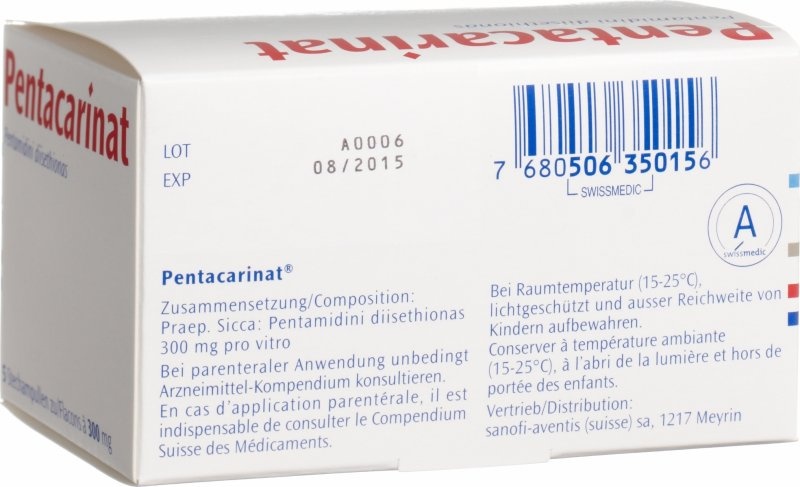
- País de registro
- Forma farmacéuticaINYECTABLE, 300 mg pentamidina isetionanto
- Código ATCP01CX01
- Principio activo
- Requiere recetaSí
- Fabricante
- Esta información es de carácter general y no sustituye la consulta con un profesional sanitario.
- Alternativas a PENTACARINAT 300 MG POLVO PARA SOLUCION INYECTABLEForma farmacéutica: INYECTABLE, 1,5 g meglumina antimoniato/5 mlPrincipio activo: meglumine antimonateFabricante: Sanofi Aventis S.A.Requiere recetaForma farmacéutica: COMPRIMIDO, 120 mgPrincipio activo: nifurtimoxFabricante: Bayer Hispania S.L.Requiere recetaForma farmacéutica: COMPRIMIDO, 30 mgPrincipio activo: nifurtimoxFabricante: Bayer Hispania S.L.Requiere receta
Médicos online para PENTACARINAT 300 MG POLVO PARA SOLUCION INYECTABLE
Comenta la dosis, los posibles efectos secundarios, interacciones, contraindicaciones o la revisión de receta de PENTACARINAT 300 MG POLVO PARA SOLUCION INYECTABLE, sujeto a valoración médica y a la normativa local.









Obtén una receta de PENTACARINAT 300 MG POLVO PARA SOLUCION INYECTABLE online
Rellena un formulario de 2 minutos
Cuéntanos tus síntomas, historial y el medicamento que necesitas.
Elige un médico o nosotros te asignamos uno
Escoge un especialista o te conectamos con el próximo médico disponible.
El médico revisa tu caso
Normalmente en 30 minutos. Puede hacerte preguntas adicionales por chat.
Recógela en cualquier farmacia
Receta electrónica enviada a tu correo, válida en toda España.
Preguntas frecuentes
PENTACARINAT 300 MG POLVO PARA SOLUCION INYECTABLE requiere receta en España. Puedes confirmarlo con un médico online según tu caso.
El principio activo de PENTACARINAT 300 MG POLVO PARA SOLUCION INYECTABLE es pentamidine isethionate. Esta información ayuda a identificar medicamentos con la misma composición pero con diferentes nombres comerciales.
PENTACARINAT 300 MG POLVO PARA SOLUCION INYECTABLE es fabricado por The Simple Pharma Company Limited. La marca y el envase pueden variar según el distribuidor.
Los Médicos de familia, Psiquiatras, Dermatólogos, Cardiólogos, Endocrinólogos, Gastroenterólogos, Neumólogos, Nefrólogos, Reumatólogos, Hematólogos, Infectólogos, Alergólogos, Geriatras, Pediatras, Oncólogos pueden valorar la prescripción de PENTACARINAT 300 MG POLVO PARA SOLUCION INYECTABLE cuando esté clínicamente indicado. Puedes reservar una videoconsulta para comentar tu caso y las opciones de tratamiento.
España cuenta con una infraestructura sanitaria bien desarrollada en ciudades principales como Madrid, Barcelona, Valencia y Sevilla. Las farmacias están ampliamente disponibles y operan bajo estrictas regulaciones, garantizando el acceso a medicamentos con receta.
Puedes comprar PENTACARINAT 300 MG POLVO PARA SOLUCION INYECTABLE en Madrid, Barcelona, Sevilla o Valencia en cualquier farmacia local con una receta válida.
Para obtener una receta, puedes utilizar Oladoctor:
Otros medicamentos con el mismo principio activo (pentamidine isethionate) incluyen GLUCANTIME 1500 MG/5 ML SOLUCIÓN INYECTABLE, LAMPIT 120 MG COMPRIMIDOS, LAMPIT 30 MG COMPRIMIDOS. Pueden tener diferentes nombres comerciales o formulaciones, pero contienen el mismo componente terapéutico. Consulta siempre con un médico antes de cambiar o iniciar un nuevo medicamento.
