


Omeprazol Noridem 40 mg polvo para solución for infusion

Prescription review online
A doctor will review your case and decide whether a prescription is medically appropriate.

Talk to a doctor about this medicine
Discuss your symptoms and possible next steps in a quick online consultation.



How to use OMEPRAZOL NORIDEM 40 mg POWDER FOR SOLUTION FOR INFUSION
Contents of the leaflet
- Introduction
- What is Omeprazole Noridem and what is it used for
- What you need to know before you are given Omeprazole Noridem
- How to use Omeprazole Noridem
- Possible side effects
- If you notice any of the following serious side effects, stop taking this medicine and contact a doctor immediately:
- Storage of Omeprazole Noridem
- Container Content and Additional Information
- Incompatibilities
Introduction
Package Leaflet: Information for the Patient
Omeprazole Noridem40mg powder for solution for infusion EFG
Read all of this leaflet carefully before you are given this medicine because it contains important information for you.
- Keep this leaflet. You may need to read it again.
- If you have any further questions, ask your doctor, nurse or pharmacist.
- If you get any side effects, talk to your doctor, nurse or pharmacist. This includes any possible side effects not listed in this leaflet. See section 4.
Contents of the pack
- What is Omeprazole Noridem and what is it used for
- What you need to know before you are given Omeprazole Noridem
- How to use Omeprazole Noridem
- Possible side effects
- Storage of Omeprazole Noridem
- Contents of the pack and other information
1. What is Omeprazole Noridem and what is it used for
Omeprazole Noridem contains the active substance omeprazole. It belongs to a group of medicines called “proton pump inhibitors”. They work by reducing the amount of acid that the stomach produces.
Omeprazole Noridem powder for solution for infusion can be used as an alternative to oral therapy.

Not sure if this medicine is right for you?
Discuss your symptoms and treatment with a doctor online.
2. What you need to know before you are given Omeprazole Noridem
You should not be givenOmeprazole Noridem
- if you are allergic to omeprazole or any of the other ingredients of this medicine (listed in section 6).
- if you are allergic to other proton pump inhibitors (e.g. pantoprazole, lansoprazole, rabeprazole, esomeprazole).
- if you are taking a medicine that contains nelfinavir (used for HIV infection).
You should not be given this medicine if you are in any of the above situations. If you are not sure, consult your doctor, nurse or pharmacist before you are given this medicine.
Warnings and precautions
Consult your doctor, nurse or pharmacist before you start taking this medicine.
When taking omeprazole, kidney inflammation may occur. The signs and symptoms can include decreased urine volume or blood in the urine and/or hypersensitivity reactions such as fever, rash and joint stiffness. You should report such signs to your doctor.
Severe skin reactions, including Stevens-Johnson syndrome, toxic epidermal necrolysis, drug rash with eosinophilia and systemic symptoms (DRESS) and acute generalized exanthematous pustulosis (AGEP) have been reported in association with omeprazole treatment. You should stop using this medicine and seek immediate medical attention if you notice any of the symptoms related to these severe skin reactions described in section 4.
Omeprazole Noridem may mask the symptoms of other diseases. Therefore, if you have any of the following conditions before or after you are given this medicine, you should consult your doctor immediately:
- you lose a lot of weight without reason and have difficulty swallowing,
- you have stomach pain or indigestion,
- you start vomiting food or blood,
- your stools are black (stools stained with blood),
- you experience severe or persistent diarrhea, as omeprazole has been associated with a small increase in infectious diarrhea,
- you have severe liver problems,
- you have ever had a skin reaction after treatment with a medicine similar to omeprazole that reduces stomach acid,
- a specific blood test (chromogranin A) needs to be performed.
Using a proton pump inhibitor like this medicine, especially for a period of more than one year, may slightly increase the risk of hip, wrist or spine fracture. You should inform your doctor if you have osteoporosis or if you are taking corticosteroids (which can increase the risk of osteoporosis).
If you get a rash on your skin, especially in areas exposed to the sun, you should inform your doctor as soon as possible, as you may need to stop treatment with omeprazole. Also, mention any other adverse effect such as joint pain.
Children and adolescents up to 18 years
This medicine should not be given to children and adolescents under 18 years. There is limited experience with omeprazole for intravenous use (administered in a vein) in children.
Other medicines andOmeprazole Noridem
Tell your doctor, nurse or pharmacist if you are taking, have recently taken or might take any other medicines. This is because omeprazole may affect the way some medicines work and some medicines may affect the way omeprazole works.
You should not be given this medicine if you are taking a medicine that contains nelfinavir(used to treat HIV infection).
Tell your doctor or pharmacist if you are taking any of the following medicines:
- ketoconazole, itraconazole, posaconazole or voriconazole (used to treat fungal infections),
- digoxin (used to treat heart problems),
- diazepam (used to treat anxiety, relax muscles or in epilepsy),
- phenytoin (used in epilepsy). If you are taking phenytoin, your doctor should monitor you when you start or stop taking this medicine,
- medicines used to thin the blood, such as warfarin or other vitamin K antagonists. Your doctor may need to monitor you when you start or stop taking this medicine,
- rifampicin (used to treat tuberculosis),
- atazanavir (used to treat HIV infection),
- tacrolimus (in cases of organ transplantation),
- St. John's Wort (Hypericum perforatum) (used to treat mild depression),
- cilostazol (used to treat intermittent claudication),
- saquinavir (used to treat HIV infection),
- clopidogrel (used to prevent blood clots),
- erlotinib (used to treat cancer),
- methotrexate (a chemotherapy medicine used in high doses to treat cancer): if you are taking high-dose methotrexate, your doctor may temporarily stop treatment with this medicine.
If your doctor has prescribed you the antibiotics amoxicillin and clarithromycin, as well as omeprazole to treat ulcers caused by Helicobacter pyloriinfection, it is very important that you inform your doctor about any other medicine you are taking.
Pregnancy and breastfeeding
If you are pregnant or breastfeeding, think you may be pregnant or are planning to have a baby, ask your doctor or pharmacist for advice before taking this medicine.
Omeprazole is excreted in breast milk, but it is unlikely to affect the baby when used at therapeutic doses. Your doctor will decide whether you can receive this medicine if you are breastfeeding.
Driving and using machines
This medicine is unlikely to affect your ability to drive or use tools or machines. However, side effects such as dizziness and visual disturbances (see section 4) may occur. If you are affected, you should not drive or use machinery.
Omeprazole Noridem contains sodium
This medicine contains less than 1 mmol of sodium (23 mg) per vial, i.e. it is essentially “sodium-free”.
3. How to use Omeprazole Noridem
Omeprazole Noridem can be given to adults, including the elderly.
There is limited experience with omeprazole for intravenous use in children.
Treatment with Omeprazole Noridem
- Treatment with this medicine will be given to you by a doctor, who will decide the amount you need.
- This medicine will be given to you by intravenous infusion.
If you have been given too much Omeprazole Noridem
If you think you have been given too much omeprazole, consult your doctor immediately.
In case of overdose or accidental ingestion, consult your doctor or pharmacist immediately or call the Toxicology Information Service, telephone 91 562 04 20, indicating the medicine and the amount ingested.
If you have any further questions on the use of this product, ask your doctor or nurse.

Started taking the medicine and have questions?
Discuss your symptoms and treatment with a doctor online.
4. Possible side effects
Like all medicines, this medicine can cause side effects, although not everybody gets them.
If you notice any of the following serious side effects, stop taking this medicine and contact a doctor immediately:
- sudden wheezing, swelling of the lips, tongue and throat or body, rash, fainting or difficulty swallowing (severe allergic reaction). The frequency of this side effect is rare.
- redness of the skin with blisters or peeling. It can also cause blisters and bleeding in the lips, eyes, mouth, nose and genitals. This may be “Stevens-Johnson syndrome” or “toxic epidermal necrolysis”. The frequency of this side effect is very rare.
- widespread rash, high body temperature and enlarged lymph nodes (DRESS or drug hypersensitivity syndrome). The frequency of this side effect is rare.
- a red, scaly, widespread rash with bumps under the skin and blisters, accompanied by fever. The symptoms usually appear at the start of treatment (acute generalized exanthematous pustulosis). The frequency of this side effect is rare.
- yellow skin, dark urine and tiredness that can be symptoms of liver problems. The frequency of this side effect is rare.
Other side effects include:
Common(may affect up to 1 in 10 people)
- Headache.
- Effects on the stomach or intestines: diarrhea, stomach pain, constipation, gas (flatulence).
- Feeling sick (nausea) or being sick (vomiting).
- Benign stomach polyps
Uncommon(may affect up to 1 in 100 people)
- Swelling of the feet and ankles.
- Sleep disturbance (insomnia)
- Dizziness, tingling sensations like “pins and needles”, feeling sleepy.
- Feeling of spinning (vertigo).
- Changes in blood tests that check liver function.
- Skin rash, rash with bumps (urticaria) and itching of the skin.
- General malaise and lack of energy.
Rare(may affect up to 1 in 1,000 people)
- Blood problems such as a reduced number of white blood cells or platelets. This can cause weakness, bruising or make infections more likely.
- Low levels of sodium in the blood. This can cause weakness, nausea (vomiting) and cramps.
- Feeling agitated, confused or depressed.
- Changes in taste.
- Vision problems such as blurred vision.
- Sudden sensation of wheezing or difficulty breathing (bronchospasm).
- Dry mouth.
- Inflammation of the inside of the mouth.
- An infection called “candidiasis” that can affect the intestine and is caused by a fungus.
- Hair loss (alopecia).
- Skin rash due to sun exposure.
- Pain in the joints (arthralgia) or muscle pain (myalgia).
- Severe kidney problems (interstitial nephritis).
- Increased sweating.
Very rare(may affect up to 1 in 10,000 people)
- Changes in the blood count, including agranulocytosis (lack of white blood cells).
- Aggression.
- Seeing, feeling or hearing things that do not exist (hallucinations).
- Severe liver problems that can cause liver failure and brain inflammation.
- Multi-form erythema (red, raised, target-shaped rash on the skin or mucous membranes).
- Muscle weakness.
- Enlarged breasts in men.
Frequency not known(frequency cannot be estimated from the available data)
- Inflammation of the intestine that causes diarrhea.
- If you receive omeprazole for more than three months, it is possible that the magnesium levels in your blood may decrease. Low magnesium levels can cause fatigue (tiredness), involuntary muscle contractions, disorientation, convulsions (seizures), dizziness or increased heart rate. If you experience any of these symptoms, inform your doctor immediately. Low magnesium levels can also cause a decrease in potassium or calcium levels in the blood. Your doctor may decide to perform periodic blood tests to monitor the magnesium levels in your blood.
- Rash, possibly with joint pain
Irreversible visual impairment has been reported in isolated cases of critically ill patients who have received omeprazole intravenously (in a vein), especially in high doses, but a causal relationship has not been established.
Omeprazole may, in very rare cases, affect the white blood cells and cause immunodeficiency. If you have an infection with symptoms such as fever with a severely reduced general condition or fever with symptoms of a local infection such as pain in the neck, throat or mouth or difficulty urinating, you should consult your doctor as soon as possible so that the lack of white blood cells (agranulocytosis) can be ruled out by a blood test. It is important that you provide information about your medicine at this time.
Reporting of side effects
If you experience any side effects, talk to your doctor, pharmacist or nurse. This includes any possible side effects not listed in this leaflet. You can also report side effects directly via the Spanish Pharmacovigilance System for Human Use Medicines, www.notificaRAM.es. By reporting side effects, you can help provide more information on the safety of this medicine.
5. Storage of Omeprazole Noridem
Keep this medicine out of the sight and reach of children.
Do not use this medicine after the expiry date which is stated on the label and carton after EXP. The expiry date is the last day of the month stated.
Store below 25°C. Store the vials in the outer carton to protect from light.
However, the vials can be stored exposed to normal indoor lighting outside of the carton for a period of up to 24 hours.
Shelf-life after reconstitution:
Chemical and physical stability in use has been demonstrated for 12 hours at 25±2°C under artificial light and for 24 hours at 5±3°C when dissolved with 5 ml of 0.9% sodium chloride and immediately after the reconstituted solution is further diluted to 100 ml with the same solvent.
Chemical and physical stability in use has been demonstrated for 6 hours at 25±2°C under artificial light and for 24 hours at 5±3°C when dissolved with 5 ml of 5% glucose and immediately after the reconstituted solution is further diluted to 100 ml with the same solvent.
From a microbiological point of view, unless the opening method precludes the risk of microbial contamination, the product should be used immediately. If not used immediately, the in-use storage times and conditions are the responsibility of the user.
The unused solution should be discarded.
Medicines should not be disposed of via wastewater or household waste. Ask your pharmacist how to dispose of medicines no longer required. This will help protect the environment.
6. Container Content and Additional Information
Composition ofOmeprazol Noridem
- The active ingredient is omeprazole. Each vial of powder for solution for infusion contains omeprazole sodium equivalent to 40 mg of omeprazole.
- The other ingredients are disodium edetate and sodium hydroxide.
Appearance ofOmeprazol Noridemand Container Content
Omeprazol Noridem 40 mg powder for solution for infusion is presented in type I colorless glass vials with a capacity > 8 ml, which contain a white to off-white powder, closed with a bromobutyl rubber stopper and sealed with aluminum caps.
The dry powder in the vial is dissolved before administration.
This medicinal product is available in packs of 1, 5, 10 or 50 vials.
Only some pack sizes may be marketed.
Marketing Authorization Holder and Manufacturer
Marketing Authorization Holder
Noridem Enterprises Ltd.
Evagorou & Makariou
Mitsi Building 3, Office 115
1065 Nicosia, Cyprus
Manufacturer
DEMO S.A. PHARMACEUTICAL INDUSTRY
21st Km National Road Athens-Lamia.
14568 Greece
T:+30 210 8161802, F:+30 2108161587.
This medicinal product is authorized in the Member States of the European Economic Area under the following names:
Romania | Omeprazol Noridem 40 mg Pulbere pentru solutie perfuzabila |
Czech Republic | Omeprazol Noridem |
Italy | Omeprazolo Noridem |
Poland | Omeprazole Noridem |
Slovakia France Spain | Omeprazol Noridem 40 mg Prášok na infúzny roztok Omeprazole Noridem 40 mg Poudre pour solution pour perfusion Omeprazol Noridem 40 mg Polvo para solución para perfusión |
Date of the last revision of this leaflet: April 2023
The following information is intended for healthcare professionals only:
Preparation and Handling
The complete contents of each vial must be dissolved in approximately 5 ml and then immediately diluted in 100 ml of infusion solution. A 9 mg/ml (0.9%) sodium chloride infusion solution or a 50 mg/ml (5%) glucose infusion solution must be used. The stability of omeprazole is influenced by the pH of the infusion solution, so no other solvent or amount should be used for dilution.
Preparation:
- With a syringe, withdraw 5 ml of infusion solution from the 100 ml infusion bottle or bag.
- Add this volume to the vial with the lyophilized omeprazole, mix well ensuring that all the omeprazole is dissolved.
- Return the omeprazole solution to the syringe.
- Transfer the solution to the infusion bag or bottle.
- Repeat steps 1 to 4 to ensure that all the omeprazole is transferred from the vial to the infusion bag or bottle.
Alternative preparation for perfusions in flexible containers
- Use a double-pointed transfer needle and connect it to the injection membrane of the infusion bag.
Connect the other end of the needle from the vial with lyophilized omeprazole.
- Dissolve the omeprazole substance by pumping the infusion solution back and forth between the infusion bag and the vial.
- Ensure that all the omeprazole is dissolved.
Administration
The infusion solution is practically free of visible particles and should be administered by intravenous infusion over 20–30 minutes.
Incompatibilities
This medicinal product must not be mixed with other medicinal products except those mentioned in the “Preparation and Handling” section.
Posology
Alternative to Oral Therapy
In patients where the use of oral medicinal products is inadequate, Omeprazol Noridem IV 40 mg once daily is recommended. In patients with Zollinger-Ellison syndrome, the recommended initial dose of omeprazole administered intravenously is 60 mg per day. Higher daily doses may be required and the dose should be adjusted individually. When doses exceed 60 mg daily, they should be divided and administered twice daily.
Special Populations
Renal Impairment
Dose adjustment is not necessary in patients with renal impairment.
Hepatic Impairment
In patients with hepatic impairment, a daily dose of 10–20 mg may be sufficient.
Elderly (>65 years)
Dose adjustment is not necessary for the elderly.
Pediatric Population
There is limited experience with omeprazole for intravenous use in children.
Overdose
Information available on the effects of omeprazole overdoses in humans is limited. In the literature, doses of up to 560 mg have been described, and occasional reports have been received when single oral doses have reached up to 2,400 mg of omeprazole (120 times the usual recommended clinical dose). Nausea, vomiting, dizziness, abdominal pain, diarrhea, and headache have been reported. Apathy, depression, and confusion have also been described in individual cases.
The described symptoms have been transient and no serious outcomes have been reported. The elimination rate did not change (first-order kinetics) with increasing doses. Treatment, if necessary, is symptomatic.
Intravenous doses of up to 270 mg in a single day and up to 650 mg over a period of three days have been administered in clinical trials without dose-related adverse reactions.
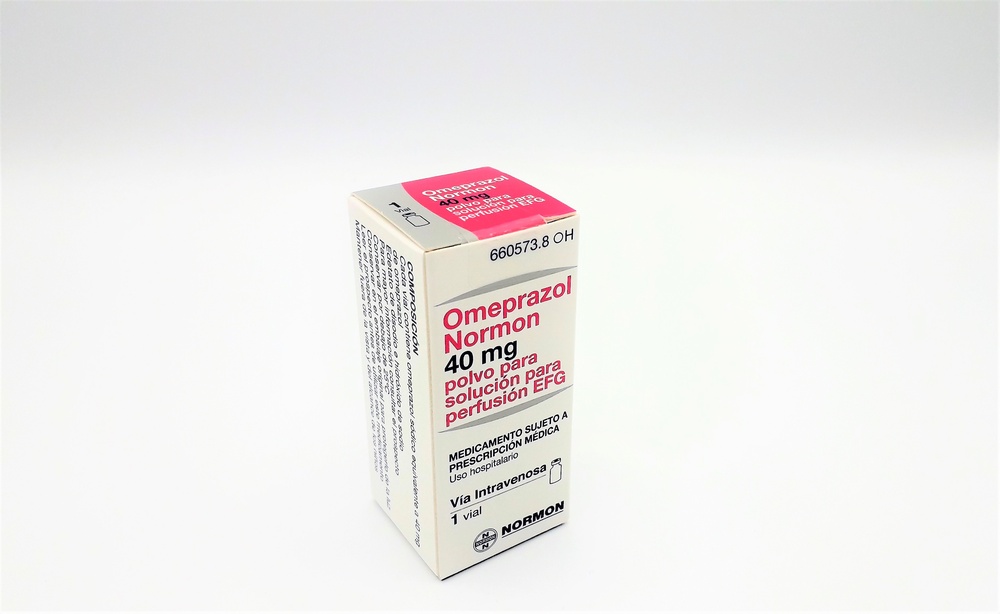
- Country of registration
- Dosage formINJECTABLE PERFUSION, 40 mg
- ATC codeA02BC01
- Active substance
- Prescription requiredYes
- Manufacturer
- CompositionEDETATO DE DISODIO (1,50 mg mg), HIDROXIDO DE SODIO (E 524) (7 - 18,6 Microlitro mg)
- This information is for reference only and does not constitute medical advice. Always consult a doctor before taking any medication. Oladoctor is not responsible for medical decisions based on this content.
- Alternatives to OMEPRAZOL NORIDEM 40 mg POWDER FOR SOLUTION FOR INFUSIONDosage form: CAPSULE, 20 mgActive substance: omeprazoleManufacturer: Arafarma Group S.A.Prescription requiredDosage form: CAPSULE, 40 mgActive substance: omeprazoleManufacturer: Arafarma Group S.A.Prescription requiredDosage form: CAPSULE, 20 mgActive substance: omeprazoleManufacturer: Especialidades Farmaceuticas Centrum S.A.Prescription required
Online doctors for OMEPRAZOL NORIDEM 40 mg POWDER FOR SOLUTION FOR INFUSION
Discuss questions about OMEPRAZOL NORIDEM 40 mg POWDER FOR SOLUTION FOR INFUSION, including use, safety considerations and prescription review, subject to medical assessment and local regulations.









Frequently Asked Questions
OMEPRAZOL NORIDEM 40 mg POWDER FOR SOLUTION FOR INFUSION requires a prescription in Spain. You can check with a doctor online whether this medicine may be appropriate for your situation.
The active ingredient in OMEPRAZOL NORIDEM 40 mg POWDER FOR SOLUTION FOR INFUSION is omeprazole. This information helps identify medicines with the same composition but different brand names.
OMEPRAZOL NORIDEM 40 mg POWDER FOR SOLUTION FOR INFUSION is manufactured by Noridem Enterprises Limited. Pharmacy brands and packaging may differ depending on the distributor.
Doctors such as Family doctors, Psychiatrists, Dermatologists, Cardiologists, Endocrinologists, Gastroenterologists, Pulmonologists, Nephrologists, Rheumatologists, Hematologists, Infectious disease physicians, Allergists, Geriatricians, Paediatricians, Oncologists may assess whether OMEPRAZOL NORIDEM 40 mg POWDER FOR SOLUTION FOR INFUSION is appropriate, depending on your situation and local regulations. You can book an online consultation to discuss your symptoms and possible next steps.
The prescription is issued by a doctor after assessing your health. In Spain, OMEPRAZOL NORIDEM 40 mg POWDER FOR SOLUTION FOR INFUSION is then dispensed in pharmacies with that prescription. An online consultation does not guarantee that a prescription will be issued: the decision always rests with the doctor.
To request a review, you can use Oladoctor:
Other medicines with the same active substance (omeprazole) include ARAPRIDE 20 mg GASTRO-RESISTANT HARD CAPSULES, ARAPRIDE 40 mg GASTRO-RESISTANT HARD CAPSULES, AULCER 20 mg HARD GASTRO-RESISTANT CAPSULES. These may have different brand names or formulations but contain the same therapeutic ingredient. Always consult a doctor before switching or starting a new medicine.
