



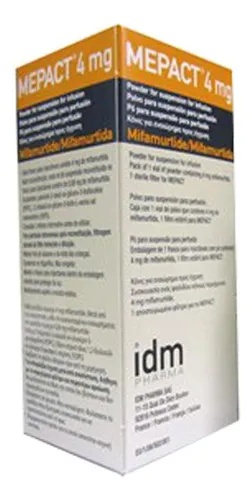
MEPACT 4 mg Polvo Para Suspensión Para Perfusión

Revisión de receta online
Un médico revisará tu caso y determinará si la prescripción es médicamente apropiada.

Habla con un médico sobre este medicamento
Comenta tus síntomas y las opciones de tratamiento en una consulta online.



Cómo usar MEPACT 4 mg POLVO PARA SUSPENSION PARA PERFUSION
Contenido del prospecto
- Introducción
- Qué es MEPACT y para qué se utiliza
- Qué necesita saber antes de empezar a usar MEPACT
- Cómo usar MEPACT
- Posibles efectos adversos
- Conservación de MEPACT
- Contenido del envase e información adicional
Introducción
Prospecto: información para el usuario
MEPACT 4 mg polvo para concentrado para dispersión para perfusión.
mifamurtida
Lea todo el prospecto detenidamente antes de empezar a usar el medicamento, porque contiene información importante para usted.
- Conserve este prospecto, ya que puede tener que volver a leerlo.
- Si tiene alguna duda, consulte a su médico.
- Si experimenta efectos adversos, consulte a su médico, incluso si se trata de efectos adversos que no aparecen en este prospecto. Ver sección 4.
Contenido del prospecto
- Qué es MEPACT y para qué se utiliza
- Qué necesita saber antes de empezar a usar MEPACT
- Cómo usar MEPACT
- Posibles efectos adversos
- Conservación de MEPACT
- Contenido del envase e información adicional
1. Qué es MEPACT y para qué se utiliza
MEPACT contiene el principio activo mifamurtida, similar a un componente de la pared celular de algunas bacterias. Estimula el sistema inmunitario para ayudar a su organismo a destruir las células tumorales.
MEPACT se utiliza para el tratamiento del osteosarcoma (cáncer de huesos) en niños, adolescentes y adultos jóvenes (entre 2 y 30 años). Se utiliza después de haberse sometido a cirugía para eliminar el tumor y tratarse con quimioterapia para destruir las células cancerosas que puedan quedar y reducir así el riesgo de recaída del cáncer.

¿No estás seguro de si este medicamento es adecuado para ti?
Comenta tus síntomas y tratamiento con un médico online.
2. Qué necesita saber antes de empezar a usar MEPACT
No use MEPACT:
- si es alérgico (hipersensible) a la mifamurtida o a cualquiera de los demás componentes de este medicamento (incluidos en la sección 6).
- si está utilizando medicamentos que contengan ciclosporinas u otros inhibidores de calcineurina o altas dosis de antiinflamatorios no esteroideos (AINEs) (ver más abajo “Uso de otros medicamentos”).
Advertencias y precauciones
Consulte a su médico antes de empezar a usar MEPACT:
- si tiene o ha tenido problemas de corazón o de los vasos sanguíneos, como coágulos de sangre (trombosis), sangrado (hemorragias) o inflamación de las venas (vasculitis). Durante el tratamiento de MEPACT se le someterá a una estrecha vigilancia. Si sus síntomas no desaparecen con el tiempo o empeoran, debe ponerse en contacto con su médico, ya que es posible que tenga que retrasar o suspender el tratamiento con MEPACT.
- si tiene antecedentes de asma u otros trastornos respiratorios. Antes de usar MEPACT, consulte a su médico acerca de si debe seguir usando los medicamentos para el asma mientras utilice
MEPACT.
- si tiene antecedentes de enfermedad inflamatoria o autoinmune o ha sido tratado con corticosteroides u otros medicamentos que pueden afectar a su sistema inmunitario.
- Si tiene alguna reacción alérgica a medicamentos incluyendo erupción, falta de aliento, y presión sanguínea alta. Si padece un empeoramiento de los síntomas, debe contactar con su médico, ya que estos pueden haber sido causados por MEPACT.
- Si tiene problemas de estómago, como náuseas, vómitos y pérdida de apetito. Si sus problemas aumentan, debe contactar con su médico, ya que estos pueden haber sido causados por MEPACT cuando se usa con la quimioterapia.
- Si desarrolla escalofríos o tiritona, o siente calor. Debe tomarse la temperatura ya que puede tener fiebre. La presencia de fiebre con un recuento bajo de glóbulos blancos (neutropenia) puede ser un signo de infección grave.
En la sección 4 se incluye información detallada sobre las advertencias y precauciones relacionadas con los efectos adversos que pueden producirse mientras esté tomando este medicamento.
Niños
No administre este medicamento a niños menores de 2 años porque no se dispone de información sobre su seguridad y su eficacia en este grupo de edad.
Otros medicamentos y MEPACT
Informe a su médico si está utilizando, ha utilizado recientemente o podría tener que utilizar cualquier otro medicamento, incluso los adquiridos sin receta. Es muy importante que informe a su médico si está utilizando medicamentos que contengan alguna de las siguientes substancias:
- ciclosporina, tacrolimus, utilizados después de un trasplante para evitar el rechazo de los órganos trasplantados, y otros inmunosupresores utilizados por ejemplo para tratar la psoriasis (una enfermedad cutánea).
- medicamentos antiinflamatorios no esteroideos (AINE), como ácido acetilsalicílico, ibuprofeno o diclofenaco, utilizados para el tratamiento de dolores de cabeza, fiebre o dolor. No use MEPACT si está utilizando antiinflamatorios no esteroideos en altas dosis (AINE).
- corticosteroides, para el tratamiento de inflamaciones, alergias o asma. Se debe evitar el uso regular de corticoides cuando se esté utilizando MEPACT, ya que éste puede afectar la manera en que actúan los medicamentos.
Se recomienda separar los horarios de administración de MEPACT y doxorrubicina u otros medicamentos si se combinan en el mismo régimen quimioterapéutico.
Embarazo, lactancia y fertilidad
Si está embarazada o en periodo de lactancia, cree que podría estar embarazada o tiene intención de quedarse embarazada, consulte a su médico antes de utilizar este medicamento.
MEPACT no se ha probado en mujeres embarazadas. Por lo tanto, MEPACT no debe utilizarse durante el embarazo, ni en mujeres en edad fértil que no utilicen un método anticonceptivo eficaz. Utilice un método anticonceptivo eficaz si recibe tratamiento con MEPACT.
No se sabe si MEPACT pasa a la leche materna. Si está dando el pecho a su hijo, consulte a su médico.
Conducción y uso de máquinas
Algunos efectos adversos muy frecuentes o frecuentes del tratamiento con MEPACT (como mareo, vértigo, fatiga y visión borrosa) pueden afectar a la capacidad para conducir y utilizar máquinas.
MEPACT contiene sodio
Este medicamento contiene menos de 23 mg de sodio (1 mmol ) por unidad de dosis; esto es, esencialmente “exento de sodio”.
3. Cómo usar MEPACT
Dosis y duración del tratamiento
MEPACT se administrará sólo bajo la supervisión de un médico especialista. Siga exactamente las instrucciones de administración de este medicamento indicadas por su médico. En caso de duda, consulte de nuevo a su médico.
La dosis recomendada de MEPACT es de 2 mg/m2 de superficie corporal. Se le administrará dos veces a la semana (con al menos tres días de diferencia) durante las primeras 12 semanas, y después una vez a la semana durante otras 24 semanas.
El programa de tratamientos podrá ajustarse para que encaje con su programa de quimioterapia. No es necesario que interrumpa el programa de MEPACT si se retrasa su quimioterapia; tendrá que completar 36 semanas (9 meses) de tratamiento con MEPACT sin interrupciones
Cómo se administra MEPACT
El polvo liofilizado tiene que ser reconstituido en una suspensión líquida, filtrarse usando el filtro que se proporciona y posteriormente diluirse antes de su uso. La perfusión de MEPACT se hace directamente en una vena (por vía intravenosa) durante cerca de 1 hora. Esto será llevado a cabo por su médico o una enfermera, quien también le controlará durante ese tiempo. No es necesario que le hospitalicen para recibir MEPACT. También puede administrarse a pacientes ambulatorios.
Si usa más MEPACT del que debiera
Puede que experimente más efectos adversos graves, como fiebre, escalofríos, fatiga, náuseas, vómitos, cefalea, tensión arterial alta o tensión arterial baja. En caso de sobredosis, póngase en contacto con su médico o diríjase al hospital más cercano.
Si interrumpe el tratamiento con MEPACT
No debe interrumpir el tratamiento con MEPACT antes de terminar el programa de tratamiento sin consultar previamente con su médico. Si tiene cualquier otra duda sobre el uso de este producto, pregunte a su médico.

¿Has empezado a tomar el medicamento y tienes preguntas?
Comenta tus síntomas y tratamiento con un médico online.
4. Posibles efectos adversos
Al igual que todos los medicamentos, MEPACT puede producir efectos adversos, aunque no todas las personas los sufran.
La mayoría de los pacientes experimentaron escalofríos, fiebre y fatiga, especialmente durante la primera administración de MEPACT. Estos efectos son normalmente leves a moderados y transitorios y pueden ser tratados por su médico; por ejemplo, con paracetamol para la fiebre. Cuando se utiliza junto con quimioterapia, a menudo el tratamiento con MEPACT puede causar problemas de estómago, tales como náuseas, vómitos y pérdida de apetito.
Consulte a su médico inmediatamente:
- si persisten la fiebre o los escalofríos más de 8 horas después de recibir la dosis de MEPACT, porque podría ser indicativo de una infección, o
- si experimenta erupción o presenta otros problemas respiratorios (sibilancias) o
- si experimenta cualquier problema de estómago.
Efectos adversos muy frecuentes(pueden afectar a más de 1 de cada 10 personas):
- fiebre, escalofríos/tiritona, debilidad, cansancio o malestar general
- náuseas y/o vómitos, diarrea o estreñimiento
- cefalea o mareo
- latidos rápidos del corazón (taquicardia)
- presión arterial alta o baja
- falta de apetito
- sudoración
- dolor, que puede ser dolor general, dolor de los músculos y/o articulaciones y dolor de espalda, pecho, abdomen, brazos o piernas
- tos, problemas para respirar o jadeo
- baja temperatura corporal
- bajo recuento de eritrocitos
Efectos adversos frecuentes(pueden afectar hasta 1 de cada 10 personas):
- coloración azul de los tejidos, como la piel o las encías, debido a la falta de oxígeno
- aumento apreciable de la frecuencia o la fuerza de los latidos del corazón
- edema en los brazos o las piernas, o en otros sitios
- molestias en el pecho
- malestar de estómago, pérdida de apetito o pérdida de peso
- enrojecimiento, inflamación, infección u otra reacción local en el lugar de la inyección o el lugar de inserción del catéter.
- eritema o enrojecimiento, inflamación de la piel, picor, sequedad, palidez o enrojecimiento transitorio
- inflamación de la piel, tendones, músculos o tejidos similares que apoyan la estructura corporal
- inflamación de una vena
- dolor abdominal en la parte superior o en la pared torácica; distensión o dolor abdominal; indigestión o dolor en el hígado
- otro tipo de dolor, también en cuello, hombro, ingle, huesos o garganta; dolor posoperatorio
- espasmo o rigidez muscular
- sensación de frío
- cansancio, mareo o somnolencia
- quemazón, sensación de picor u hormigueo, sensibilidad reducida a las sensaciones o sensación de sensibilidad sin estímulos
- movimientos de sacudida involuntarios
- deshidratación
- baja concentración de potasio en sangre
- inflamación de las mucosas
- congestión o inflamación de la nariz, la garganta o los senos
- infecciones del tracto respiratorio superior (como un resfriado) o el tracto urinario (como una infección de vejiga)
- infección generalizada
- infección por Herpes simplex (virus)
- tos productiva, sibilancias o dificultad respiratoria por esfuerzo o exacerbada
- moqueo o hemorragia nasal
- líquido en la cavidad pulmonar
- sangre en la orina, dificultad o dolor al orinar o micción frecuente
- dificultad para dormir, depresión, ansiedad o confusión
- mareo
- zumbido de oídos
- visión borrosa
- caída del pelo
- menstruación difícil, dolorosa
- pérdida de audición
- número bajo de glóbulos blancos con o sin fiebre, número bajo de plaquetas
Frecuencia no conocida(no puede estimarse a partir de los datos disponibles:
- acumulación excesiva de líquido alrededor del corazón (derrame pericárdico)
Comunicación de efectos adversos
Si experimenta cualquier tipo de efecto adverso, consulte a su médico, incluso si se trata de posibles efectos adversos que no aparecen en este prospecto. También puede comunicarlos directamente a través del sistema nacional de notificación incluido en el Apéndice V.
Mediante la comunicación de efectos adversos usted puede contribuir a proporcionar más información sobre la seguridad de este medicamento.
5. Conservación de MEPACT
Mantener este medicamento fuera de la vista y del alcance de los niños.
No utilice este medicamento después de la fecha de caducidad que aparece en el envase después de “EXP”.
La fecha de caducidad es el último día del mes que se indica.
Vial sin abrir:
Conservar en nevera (entre 2?C y 8?C). No congelar.
Conservar el vial en el embalaje exterior para protegerlo de la luz.
Suspensión reconstituida:
Una vez reconstituida con una solución de cloruro sódico 9 mg/ml (0,9%), conservar a temperatura ambiente (aproximadamente 20ºC - 25ºC) y utilizar en un plazo máximo de 6 horas. No utilice este medicamento si observa indicios visibles de deterioro.
Los medicamentos no se deben tirar por los desagües ni a la basura. De esta forma, ayudará a proteger el medio ambiente.
6. Contenido del envase e información adicional
Qué contiene MEPACT
- El principio activo es mifamurtida. Cada vial contiene 4 mg de mifamurtida. Tras su reconstitución, cada ml contiene 0,08 mg de mifamurtida.
- Los otros componentes son palmitoil-2-oleoil-sn-glicero-3-fosfocolina (POPC) y
1,2-dioleoil-sn-glicero-3-fosfo-L-serina sal monosódica (OOPS). Ver sección 2 “MEPACT contiene sodio”.
Aspecto de MEPACT y contenido del envase
MEPACT es un polvo o masa de color blanco a blanquecino para concentrado para dispersión para perfusión.
MEPACT se presenta en una caja de cartón que contiene:
- Un vial de 50 ml con un tapón de caucho butílico gris, precinto de aluminio y lengüeta de plástico.
- Un filtro estéril suministrado en un blíster.
Titular de la autorización de comercialización:
Takeda France SAS
112 avenue Kléber
75116 Paris
Francia
Responsable de la fabricación:
Takeda Austria GmbH
St. Peter-Straβe 25
A-4020 Linz
Austria
Delpharm Novara S.r.l.
Via Crosa, 86
28065 Cerano (NO)
Italia
Fecha de la última revisión de este prospecto:
Otras fuentes de información
La información detallada de este medicamento está disponible en la página web de la Agencia Europea de Medicamentos: http://www.ema.europa.eu.
-------------------------------------------------------------------------------------------------------------------------
---
La siguiente información está dirigida exclusivamente a los profesionales sanitarios:
Instrucciones para la preparación de MEPACT para perfusión intravenosa
Materiales suministrados en cada caja -
- 1 vial de MEPACT (mifamurtida)
- 1 filtro para MEPACT
Materiales requeridos pero no suministrados -
- Solución inyectable de cloruro sódico de 9 mg/ml (0,9%), bolsa de 100 ml
- Jeringa estéril de 60 o 100 ml para 1 solo uso con llave luer
- 2 agujas para inyección estéril de calibre medio (18)
Se recomienda que la reconstitución de la suspensión liposomal se realice en una cabina de flujo laminar utilizando guantes estériles y técnicas asépticas.
Se debe dejar que el polvo liofilizado alcance una temperatura de aproximadamente 20ºC – 25ºC antes de su reconstitución, filtrado mediante el filtro proporcionado y dilución. Esto tarda unos 30 minutos.
- Retire el precinto del vial y limpie el tapón utilizando un algodón empapado en alcohol.
- Retire el filtro del blíster, y retire la tapa del filtro con aguja.
Introduzca seguidamente la aguja en el vial, perforando con firmeza la tapa hasta quedar bien asegurada. En este momento no debe retirarse la tapa del conector luer del filtro.
- Desembale la bolsa con 100 ml de solución inyectable de cloruro sódico de 9 mg/ml (0,9%), la aguja y la jeringa (no suministradas en la caja).
- Limpie con un algodón empapado en alcohol el lugar de la bolsa de solución inyectable de cloruro sódico de 9 mg/ml (0,9%) donde se vaya a insertar la aguja.
- Utilizando la aguja y la jeringa, retire de la bolsa 50 ml de solución inyectable de cloruro sódico de 9 mg/ml (0,9%).
- Después de retirar la aguja de la jeringa, ésta debe acoplarse al filtro abriendo la tapa del conector luer del filtro (figura 1).
|
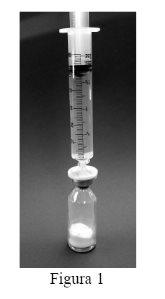
- Añada al vial la solución inyectable de cloruro sódico de 9 mg/ml (0,9%) mediante una presión lenta pero firme del émbolo de la jeringa. No debe retirar el filtro ni la jeringa del vial.
- Debe dejar reposar el vial durante 1 minuto para asegurar una hidratación profunda de la sustancia seca.
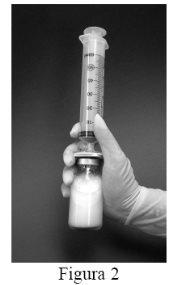
- A continuación, agite con fuerza el vial durante 1 minuto mientras mantiene acoplados el filtro y la jeringa.Durante este tiempo, se forman espontáneamente los liposomas (figura 2).
|
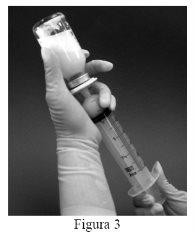
- Puede retirar la dosis necesaria del vial invirtiéndolo y retirando lentamente el émbolo de la jeringa (figura 3). Tras la reconstitución, cada ml de suspensión contiene 0,08 mg de mifamurtida. El volumen de suspensión que debe retirarse según la dosis se calcula como sigue:
Volumen que debe retirarse = [12,5 x dosis calculada (mg)] ml
Para mayor facilidad, se proporciona la siguiente tabla de concordancia:
Dosis | Volumen |
1,0 mg | 12,5 ml |
2,0 mg | 25 ml |
3,0 mg | 37,5 ml |
4,0 mg | 50 ml |
|
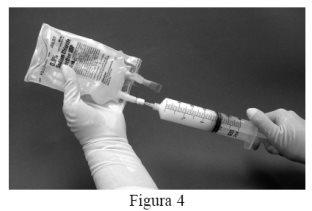
- Retire seguidamente la jeringa del filtro y coloque una nueva aguja en la jeringa que contiene la suspensión. Limpie el lugar de inyección de la bolsa con un algodón empapado en alcohol e inyecte la suspensión de la jeringa a la bolsa original que contiene los restantes 50 ml de solución inyectable de cloruro sódico de 9 mg/ml (0,9%) (figura 4).
|
- Dé varias vueltas a la bolsa suavemente para mezclar la solución.
- Añada a la etiqueta de la bolsa que contiene la suspensión liposomal reconstituida y diluida la identificación del paciente, la hora y la fecha.
- Se ha demostrado la estabilidad química y física durante el uso durante 6 horas a temperatura ambiente (aproximadamente entre 20ºC – 25ºC).
- Desde el punto de vista microbiológico, el producto debe utilizarse de inmediato. Si no se va a utilizar de inmediato, los tiempos y condiciones de conservación del producto una vez abierto son responsabilidad del usuario y normalmente no deben sobrepasar las 6 horas a temperatura ambiente.
Ningún requisito especial para su eliminación.
- País de registro
- Forma farmacéuticaINYECTABLE PERFUSION, 4 mg
- Código ATCL03AX15
- Principio activo
- Requiere recetaSí
- Fabricante
- Composición1,2 DIOLEOIL –SN-GLICERO-3-FOSFO-L-SERINA SAL MONOSODICA (- - mg)
- Esta información es de carácter general y no sustituye la consulta con un profesional sanitario.
- Alternativas a MEPACT 4 mg POLVO PARA SUSPENSION PARA PERFUSIONForma farmacéutica: INYECTABLE, DesconocidaPrincipio activo: TasonerminaFabricante: Belpharma S.A.Requiere recetaForma farmacéutica: INYECTABLE, 0,5 MG histamina dihidrocloruro/0,5 MLPrincipio activo: diclorhidrato de histaminaFabricante: Laboratoires DelbertRequiere recetaForma farmacéutica: INYECTABLE, 20 mg acetato glatiramero/ mlPrincipio activo: Glatiramero acetatoFabricante: Teva GmbhRequiere receta
Médicos online para MEPACT 4 mg POLVO PARA SUSPENSION PARA PERFUSION
Comenta la dosis, los posibles efectos secundarios, interacciones, contraindicaciones o la revisión de receta de MEPACT 4 mg POLVO PARA SUSPENSION PARA PERFUSION, sujeto a valoración médica y a la normativa local.









Obtén una receta de MEPACT 4 mg POLVO PARA SUSPENSION PARA PERFUSION online
Rellena un formulario de 2 minutos
Cuéntanos tus síntomas, historial y el medicamento que necesitas.
Elige un médico o nosotros te asignamos uno
Escoge un especialista o te conectamos con el próximo médico disponible.
El médico revisa tu caso
Normalmente en 30 minutos. Puede hacerte preguntas adicionales por chat.
Recógela en cualquier farmacia
Receta electrónica enviada a tu correo, válida en toda España.
Preguntas frecuentes
MEPACT 4 mg POLVO PARA SUSPENSION PARA PERFUSION requiere receta en España. Puedes confirmarlo con un médico online según tu caso.
El principio activo de MEPACT 4 mg POLVO PARA SUSPENSION PARA PERFUSION es Mifamurtida. Esta información ayuda a identificar medicamentos con la misma composición pero con diferentes nombres comerciales.
MEPACT 4 mg POLVO PARA SUSPENSION PARA PERFUSION es fabricado por Takeda France S.A.S.. La marca y el envase pueden variar según el distribuidor.
Los Médicos de familia, Psiquiatras, Dermatólogos, Cardiólogos, Endocrinólogos, Gastroenterólogos, Neumólogos, Nefrólogos, Reumatólogos, Hematólogos, Infectólogos, Alergólogos, Geriatras, Pediatras, Oncólogos pueden valorar la prescripción de MEPACT 4 mg POLVO PARA SUSPENSION PARA PERFUSION cuando esté clínicamente indicado. Puedes reservar una videoconsulta para comentar tu caso y las opciones de tratamiento.
España cuenta con una infraestructura sanitaria bien desarrollada en ciudades principales como Madrid, Barcelona, Valencia y Sevilla. Las farmacias están ampliamente disponibles y operan bajo estrictas regulaciones, garantizando el acceso a medicamentos con receta.
Puedes comprar MEPACT 4 mg POLVO PARA SUSPENSION PARA PERFUSION en Madrid, Barcelona, Sevilla o Valencia en cualquier farmacia local con una receta válida.
Para obtener una receta, puedes utilizar Oladoctor:
Otros medicamentos con el mismo principio activo (Mifamurtida) incluyen BEROMUN 1 mg POLVO PARA SOLUCION PARA PERFUSION, CEPLENE 0,5 mg/0,5 ml SOLUCION INYECTABLE, COPAXONE 20 mg/ml SOLUCION INYECTABLE EN JERINGA PRECARGADA. Pueden tener diferentes nombres comerciales o formulaciones, pero contienen el mismo componente terapéutico. Consulta siempre con un médico antes de cambiar o iniciar un nuevo medicamento.
