



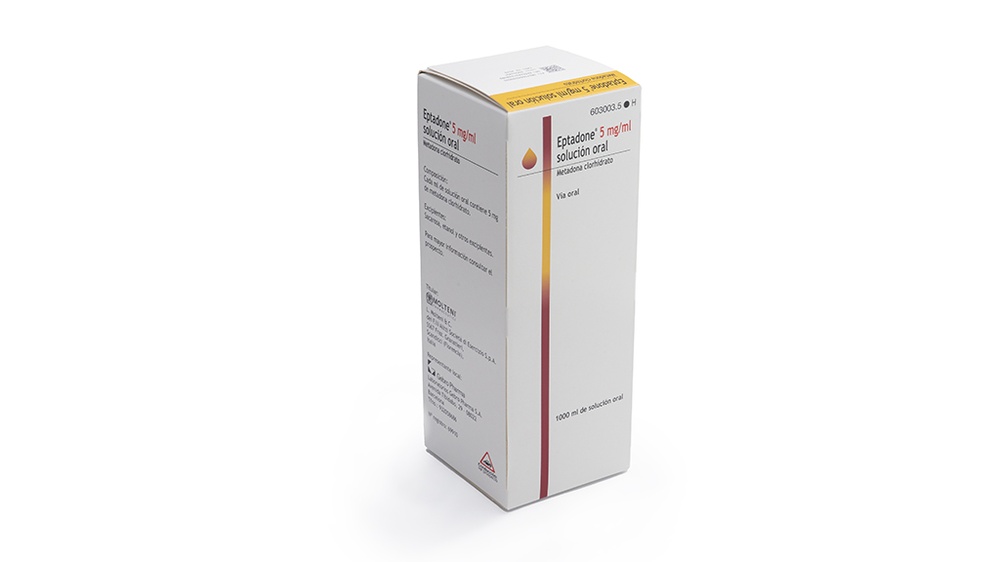
EPTADONE 5 mg /Ml Solucion Oral

Revisión de receta online
Un médico revisará tu caso y determinará si la prescripción es médicamente apropiada.

Habla con un médico sobre este medicamento
Comenta tus síntomas y las opciones de tratamiento en una consulta online.



Cómo usar EPTADONE 5 mg/ml SOLUCION ORAL
Contenido del prospecto
- Introducción
- Qué es Eptadone 5 mg/ml solución oral y para qué se utiliza
- Qué necesita saberantes de empezar a tomar Eptadone 5 mg/ml solución oral
- Cómo tomar Eptadone 5 mg/ml solución oral
- Posibles efectos adversos
- Conservación de Eptadone 5mg/ml solución oral
- Contenido del envase e información adicional
Introducción
Prospecto:información para el paciente
Eptadone 5 mg/ml solución oral
Metadona clorhidrato
Lea todo el prospecto detenidamente antes de empezar a tomar este medicamento,porque contiene información importante para usted.
- Conserve este prospecto, ya que puede tener que volver a leerlo.
- Si tiene alguna duda, consulte a su médico o farmacéutico.
- Este medicamento se le ha recetado solamente a usted, y no debe dárselo a otras personas, aunque tengan los mismos síntomas, ya que puede perjudicarles.
- Si experimenta efectos adversos, consulte a su médico o farmacéutico, incluso si se trata de efectos adversos que no aparecen en este prospecto. Ver sección 4.
Contenido del prospecto:
- Qué es Eptadone 5 mg/ml solución oral y para qué se utiliza
- Qué necesita saberantes de empezar a tomar Eptadone 5 mg/ml solución oral
- Cómo tomar Eptadone 5 mg/ml solución oral
- Posibles efectos adversos
5 Conservación de Eptadone 5 mg/ml solución oral
- Contenido del envase e información adicional
1. Qué es Eptadone 5 mg/ml solución oral y para qué se utiliza
Eptadone contiene un medicamento llamado metadona, que pertenece a un grupo de medicamentos que actúan en el sistema nervioso como la morfina y la diamorfina (también llamada heroína). A veces se los conoce como “opiáceos”. Eptadone es un medicamento líquido bebible que sólo se debe tomar por vía oral.
Eptadone se utiliza:
- para tratar la adicción a drogas como la morfina o la heroína (opiáceos). Actúa como sustituto de las sustancias adictivas, pero es menos adictiva

¿No estás seguro de si este medicamento es adecuado para ti?
Comenta tus síntomas y tratamiento con un médico online.
2. Qué necesita saberantes de empezar a tomar Eptadone 5 mg/ml solución oral
No tome Eptadone:
- Si es alérgico al hidrocloruro de metadona o a alguno de los demás componentes de este medicamento (incluidos en la sección 6).
- Si tiene adicción a medicamentos que no son como la morfina o la heroína (medicamentos “opiáceos”).
- Si ha tenido problemas respiratorios o pulmonares, ahora o en el pasado.
- Si usted espera ponerse de parto.
Advertencias y precauciones
Consulte a su médico o farmacéutico antes de empezar a tomar Eptadone:
- Si tiene problemas de riñón.
- Si tiene problemas de hígado.
- Si tiene un fuerte dolor de cabeza o ha tenido una lesión en la cabeza recientemente.
- Si a usted le han diagnosticadopresión intracraneal alta.
- Si tiene problemas de corazón, como por ejemploproblemas con el ritmo cardiaco.
- Si tiene la tensión arterial baja.
- Si le han diagnosticado baja función de la glándula tiroides.
- Si le han diagnosticado alto funcionamiento de la “glándula suprarrenal”.
- Si es un hombre con problemas de próstata.
- Si usted tiene más de 65 años.
- Si habitualmente se encuentra mal.
Hable con su médico o farmacéutico si presenta alguno de los siguientes síntomas mientras está tomando Eptadone:
- Debilidad, cansancio, falta de apetito, náuseas, vómitos o hipotensión arterial. Esto puede ser un síntoma de que las glándulas suprarrenales están produciendo una cantidad muy baja de la hormona cortisol, por lo que puede tener que tomar un suplemento hormonal.
El consumo a largo plazo puede causar una disminución de los niveles de hormonas sexuales y un aumento de la hormona prolactina. Consulte a su médico si presenta síntomas como disminución de la libido, impotencia o ausencia de menstruación (amenorrea).
Tolerancia, dependencia y adicción
Este medicamento contiene un medicamento opioide denominado metadona. El uso repetido de opioides puede disminuir la eficacia del medicamento (su organismo se acostumbra al medicamento, esto es lo que se conoce como tolerancia). El uso repetido de Eptadone también puede causar dependencia, abuso y adicción, lo que puede dar lugar a una sobredosis potencialmente mortal.
La dependencia o la adicción pueden hacerle sentir que ya no tiene el control de la cantidad de medicamento que necesita tomar o con qué frecuencia debe tomarlo.
El riesgo de volverse dependiente o adicto varía según la persona. Puede presentar un mayor riesgo de volverse dependiente o adicto a Eptadone si:
- Usted o algún miembro de su familia tiene antecedentes de abuso o dependencia del alcohol, medicamentos de venta con receta o sustancias ilícitas (“adicción”).
- Es fumador.
- Alguna vez ha tenido problemas con su estado de ánimo (depresión, ansiedad o un trastorno de la personalidad) o ha recibido tratamiento de un psiquiatra para otras enfermedades mentales.
Si nota alguno de los siguientes signos mientras toma Eptadone, podría ser una señal de que se ha vuelto dependiente o adicto.
- Necesita tomar el medicamento durante más tiempo del recomendado por su médico.
- Necesita tomar más dosis de la recomendada.
- Está usando el medicamento por razones distintas a las prescritas, por ejemplo, “para calmarse” o “para ayudarle a dormir”.
- Ha hecho intentos repetidos y sin éxito de dejar o controlar el uso del medicamento.
- No se encuentra bien cuando deja de tomar el medicamento y se siente mejor cuando vuelve a tomarlo (“síntomas de abstinencia”).
Si nota alguno de estos signos, hable con su médico para abordar la estrategia terapéutica más adecuada en su caso, incluido cuándo es apropiado dejar de tomarlo y cómo hacerlo de forma segura (ver sección 3 “Si interrumpe el tratamiento con Eptadone”).
Trastornos respiratorios relacionados con el sueño
Eptadone puede causar trastornos respiratorios relacionados con el sueño como, por ejemplo, apnea del sueño (pausas respiratorias durante el sueño) e hipoxemia relacionada con el sueño (bajos niveles de oxígeno en la sangre). Los síntomas pueden incluir pausas respiratorias durante el sueño, despertares nocturnos por la falta de aliento, dificultades para mantener el sueño o somnolencia excesiva durante el día. Si usted u otra persona observa estos síntomas, póngase en contacto con su médico. Su médico podría considerar una reducción de la dosis.
Niños y adolescentes
Este medicamento está contraindicado en niños.
Uso en deportistas:
Este medicamento contiene Metadona que puede producir un resultado positivo en las pruebas de dopaje.
Otros medicamentos y Eptadone
Informe a su médico o farmacéutico si está utilizando o ha utilizado recientemente o pudiera tener que utilizar cualquier otro medicamento. Eptadone puede afectar la forma en la que actúan algunos medicamentos. Además, otros medicamentos pueden afectar la forma en la que actúa Eptadone.
No tome este medicamento y consulte a su médico si está tomando:
- Medicamentos para el tratamiento de la depresión llamados IMAO (inhibidores de la monoaminooxidasa) o los ha tomado en las últimas 2 semanas. Los IMAO son medicamentos como moclobemida, fenelzina y tranilcipromina.
Consulte a su médico si está tomando alguno de los siguientes medicamentos:
- Medicamentos para infecciones de hongos como fluconazol, itraconazol o ketoconazol.
- Medicamentos para la epilepsia como barbitúricos, fenitoína o carbamazepina.
- Medicamentos para la diarrea como loperamida o co-fenotropo.
- Medicamentos que acidifican la orina como cloruro de amonio.
- Medicamentos utilizados para detener la acción de los opiáceos como la naltrexona.
- Medicamentos utilizados para tratar la adicción como la buprenofina.
- Medicamentos para la depresión como la fluoxetina, paroxetina, sertralina, nefazodona o fluvoxamina.
- Medicamentos para el VIH como nevirapina, delavirdina, didanosina, estavudina, zidovudina, ritonavir, abacavir o efavirenz.
- Antibióticos como rifampicina, claritromicina o eritromicina.
- Analgésicos potentes como morfina, butorfanol, nalbufina, pentazocina.
- Naloxona utilizada para anular los efectos de medicamentos opiáceos.
- Octreotida utilizada para tratar algunos tipos de cáncer y para reducir las secreciones.
- Verapamilo utilizado para problemas del corazón.
- “Cannabinoides” utilizados para el dolor, como dronabinol y nabilona.
- Metamizol, un medicamento utilizado para tratar el dolor y la fiebre.
- Cannabidiol (un medicamento utilizado para tratar las convulsiones).
- Gabapentina y pregabalina (medicamentos utilizados para tratar la epilepsia, el dolor nervioso o la ansiedad). Estos pueden aumentar el riesgo de sobredosis de opioides, depresión respiratoria (dificultades para respirar) y pueden ser potencialmente mortales.
- Medicamentos para calmarle, llamados benzodiazepinas, como diazepam o flunitrazepam.El uso concomitante de Eptadone y medicamentos sedantes como las benzodiazepinas o medicamentos relacionados aumenta el riesgo de somnolencia, dificultad para respirar (depresión respiratoria), coma y puede ser potencialmente mortal. Debido a esto, solo se debe considerar el concomitante cuando otras opciones de tratamiento no sean posibles.Sin embargo, si su médico le prescribe Eptadone junto con medicamentos sedantes, su médico debe limitar la dosis y la duración del tratamiento concomitante.Informe a su médico sobre todos los medicamentos sedantes que esté tomando y siga atentamente las recomendaciones de su médico con respecto a la dosis. Podría ser de utilidad informar a amigos o familiares que estén al tanto de los signos y síntomas indicados anteriormente. Póngase en contacto con su médico cuando experimente dichos síntomas.
El riesgo de efectos secundarios aumenta si se consume metadona simultáneamente con antidepresivos (como citalopram, duloxetina, escitalopram, fluoxetina, fluvoxamina, paroxetina, sertralina, venlafaxina, amitriptilina, clomipramina, imipramina, nortriptilina). Consulte a su médico si presenta síntomas como:
- cambios en el estado mental (como inquietud, alucinaciones, coma)
- pulso rápido, tensión arterial inestable, fiebre
- exaltación de los reflejos, descoordinación, rigidez muscular
- síntomas gastrointestinales (como náuseas, vómitos, diarrea)
Si no está seguro si alguno de los puntos anteriores es aplicable a usted, consulte a su médico o farmacéutico antes de tomar Eptadone.
Uso de Eptadone con alimentos, bebidas y alcohol
No beba alcohol mientras esté tomando este medicamento.El alcohol puede aumentar los efectos secundarios de la metadona. No beba zumo de pomelo mientras está tomando este medicamento.El zumo de pomelo puede alterar el efecto de la metadona.
Embarazo, lactancia y fertilidad
Si está embarazada o en periodo de lactancia, cree que podría estar embarazada o tiene intención de quedarse embarazada, consulte a su médicoofarmacéutico antes de utilizar este medicamento.
Embarazo:
- No tome Eptadone si se va a poner de parto.
Lactancia:
- Hable con su médico si está dando el pecho o pensando en hacerlo mientras está tomando metadona, ya que podría afectar a su bebé. Pequeñas cantidades podrían pasar a la leche materna.
- Vigile a su bebé por si aparecen signos y síntomas anormales, como una mayor somnolencia (más de lo normal), dificultades para respirar o flojera. Acuda inmediatamente al médico si observa cualquiera de estos síntomas.
Conducción y uso de máquinas:
- No debe conducir ni utilizar máquinas cuando tome Eptadone. Su capacidad para manejar esta maquinaria se verá afectada. Esto sucederá mientras lo esté tomando, y también durante algún tiempo después.
- Empiece a conducir o a utilizar herramientas o máquinas sólo cuando su médico se lo indique.
Eptadone contiene:
- 0,1% de etanol(alcohol), esta pequeña cantidad se corresponde con 0,0002ml por mg.
- Este medicamento contiene sacarosa. Si su médico le ha indicado que padece una intolerancia a ciertos azúcares, consulte con él antes de tomar este medicamento. Los pacientes con diabetes deben tener en cuenta que este medicamento contiene 40 g de sacarosa por cada 100 ml.
3. Cómo tomar Eptadone 5 mg/ml solución oral
Siga exactamente las instrucciones de administración de este medicamento indicadas por su médico. En caso de duda, consulte de nuevo a su médico o farmacéutico.
La dosificación debe ser individualizada por lo que su médico establecerá la dosis adecuada para usted y realizará los ajustes que considere oportunos.
- No tome más ni menos de la dosis que se le ha indicado.
- No la tome con más ni menos frecuencia de la que se le ha indicado.
- No la tome durante más tiempo del que su médico se la recete.
- Tome este medicamento por vía oral.
- La concentración de este líquido es de 5 miligramos en cada mililitro.
Si estima que la acción de Eptadone es demasiado fuerte o débil, comuníqueselo a su médico o farmacéutico.
Para la dependencia de sustancias
- La dosis habitual es inicialmente de 10 a 30 mg (2 a 6 ml) cada día, aumentando a 40-60 mg (8-12 ml) por día según sea necesario en el transcurso de 1 a 2 semanas. Esto dependerá de cómo le afecte el medicamento.
- La dosis de mantenimiento se sitúa en torno a los 60/100mg día.
- Tome siempre la dosis recetada por su médico.
Si toma más Eptadone del que debe
En caso de sobredosis o ingestión accidental, consulte al Servicio de Información Toxicológica, teléfono 915 620 420, indicando el medicamento y la cantidad tomada.
Pueden aparecer los siguientes efectos:
- problemas respiratorios
- sensación de somnolencia, casi inconsciente o incluso pérdida de la consciencia
- las pupilas de los ojos muy pequeñas
- piel fría y húmeda
- pulso muy lento
- debilidad muscular
- un trastorno cerebral (conocido como leucoencefalopatía tóxica)
En casos extremos su respiración o circulación sanguínea pueden detenerse y puede tener un ataque al corazón.
Puede producirse un nivel bajo de azúcar en sangre.
Si olvidó tomar Eptadone
Si olvida una dosis, no tome el medicamento cuando lo recuerde.
Espere hasta que le toque la siguiente dosis y tome sólo una dosis. No tome una dosis doble para compensar las dosis olvidadas.
Si interrumpe el tratamiento con Eptadone
No deje de tomar Eptadone sin consultarlo antes con su médico
Podría tener efectos secundarios. Si necesita dejar de tomar Eptadone, su médico se lo hará dejar poco a poco.
Si tiene cualquier otra duda sobre el uso de este medicamento, pregunte a su médico o farmacéutico.

¿Has empezado a tomar el medicamento y tienes preguntas?
Comenta tus síntomas y tratamiento con un médico online.
4. Posibles efectos adversos
Al igual que todos los medicamentos, este medicamento puede producir efectos adversos, aunque no todas las personas los sufran.
Se ha utilizado el siguiente criterio para la clasificación de la frecuencia de las reacciones adversas:
Muy frecuentes (pueden afectar a más de 1 de cada 10 personas)
Frecuentes (pueden afectar hasta 1 de cada 10 personas)
Poco frecuente (pueden afectar hasta 1 de cada 100 personas)
Raros (pueden afectar hasta 1 de cada 1.000 personas)
Muy raros (pueden afectar hasta 1 de cada 10.000 personas)
Frecuencia no conocida (no puede estimarse a partir de los datos disponible
Con este medicamento pueden aparecer los siguientes efectos adversos:
Frecuentes(pueden afectar hasta 1 de cada 10 personas)
- problemas respiratorios
- dolor de cabeza, sensación de debilidad, somnolencia, confusión, dificultad para dormir, sensación de nerviosismo o irritabilidad o cambios del estado de ánimo, sensación de cabeza vacía
- problemas de visión o las pupilas se hacen más pequeñas (miosis)
- sensación de mareo (náuseas), vómitos, estreñimiento, sequedad bucal o pérdida del apetito
- ritmo del corazón más lento o latidos del corazón desiguales (palpitaciones)
- dificultad para orinar
- pérdida de apetencia sexual o impotencia sexual
- sudoración excesiva, enrojecimiento de la cara o picor y edema
Poco frecuentes(pueden afectar hasta 1 de cada 100 personas)
- baja tensión arterial y sensación de mareo (especialmente al ponerse de pie)
- síncope
Raros(pueden afectar hasta 1 de cada 1.000 personas)
- debilidad extrema que provoca que se pare el corazón
- cambios en una prueba llamada electrocardiograma o ECG
- sangrado interno
- niveles altos en la sangre de una hormona llamada prolactina
- parada respiratoria
- urticaria hemorrágica
- choque
Frecuencia no conocida(no puede estimarse a partir de los datos disponibles)
- nivel bajo de azúcar en sangre
- se puede volver dependiente a Eptadone (para obtener más información, ver la sección 2 “Advertencias y precauciones”)
- apnea del sueño (pausas respiratorias durante el sueño)
Puede observar que algunos de los efectos adversos disminuyen su intensidad con el tiempo.
Comunicación de efectos adversos
Si experimenta cualquier tipo de efecto adverso, consulte a su médico o farmacéutico, incluso si se trata de posibles efectos adversos que no aparecen en este prospecto. También puede comunicarlos directamente a través del Sistema Español de Farmacovigilancia de medicamentos de Uso Humano: https://www.notificaram.es. Mediante la comunicación de efectos adversos usted puede contribuir a proporcionar más información sobre la seguridad de este medicamento.
5. Conservación de Eptadone 5mg/ml solución oral
Conservar el frasco en el embalaje original.
- Mantener fuera de la vista y del alcance de los niños. Conserve este medicamento en un lugar seguro y protegido, donde otras personas no puedan acceder a él. Puede causar daños graves y ser mortal para las personas cuando no se les ha recetado.
- No utilice este medicamento después de la fecha de caducidad que aparece en el envase después de CAD.
- Una vez abierto el frasco, debe utilizarlo en 12 meses.
Los medicamentos no se deben tirar por los desagües ni a la basura. En caso de duda pregunte a su farmacéutico cómo deshacerse de los envases y de los medicamentos que no necesita. De esta forma, ayudará a proteger el medio ambiente..
6. Contenido del envase e información adicional
Composición de Eptadone
- El principio activo es hidrocloruro de metadona. Cada ml de Eptadone contiene 5 mg de hidrocloruro de metadona.
- Los demás componentes (excipientes) son sacarosa, glicerol, ácido cítrico monohidrato, aroma de limón (incluye citropten, citral y etanol), benzoato sódico y agua purificada.
Aspecto del producto y contenido del envase:
Eptadone 5 mg/ml solución oral es un líquido transparente sabor limón que se presenta en frasco multidosis de 1000 ml, para administración únicamente oral.
Contiene un vaso dosificador. Cada frasco contiene 5000 mg de metadona clorhidrato.
Titular de la autorización de comercialización y responsable de la fabricación:
- Molteni & C. dei F.lli Alitti Società di Esercizio S.p.A.
SS67 Fraz. Granatieri
50018 Scandicci (Florencia)
Italia
Pueden solicitar más información respecto a este medicamento dirigiéndose al representante local del titular de la autorización de comercialización:
Laboratorios Gebro Pharma, S.A.
Avenida Tibidabo nº 29
08022 Barcelona
Tfno.: 93 205 86 86
Fecha de la última revisión de este prospecto:
Mayo 2023
Otras fuentes de información
La información detallada de este medicamento está disponible en la página web de la {Agencia Española de Medicamentos y Productos Sanitarios (AEMPS)} (http://www.aemps.gob.es/)
- País de registro
- Forma farmacéuticaSOLUCIÓN/SUSPENSIÓN ORAL, 5 mg/ml
- Código ATCN07BC02
- Principio activo
- Requiere recetaSí
- Fabricante
- ComposiciónSACAROSA (400 mg mg), GLICEROL (E 422) (100 mg mg), BENZOATO DE SODIO (E 211) (0,5 mg mg)
- Esta información es de carácter general y no sustituye la consulta con un profesional sanitario.
- Alternativas a EPTADONE 5 mg/ml SOLUCION ORALForma farmacéutica: SOLUCIÓN/SUSPENSIÓN ORAL, 100 mg metadona hidrocloruro/ 20 mlPrincipio activo: methadoneRequiere recetaForma farmacéutica: SOLUCIÓN/SUSPENSIÓN ORAL, 20 mg metadona hidrocloruro/ 20 mlPrincipio activo: methadoneRequiere recetaForma farmacéutica: INYECTABLE, 10 mgPrincipio activo: methadoneFabricante: Esteve Pharmaceuticals S.A.Requiere receta
Médicos online para EPTADONE 5 mg/ml SOLUCION ORAL
Comenta la dosis, los posibles efectos secundarios, interacciones, contraindicaciones o la revisión de receta de EPTADONE 5 mg/ml SOLUCION ORAL, sujeto a valoración médica y a la normativa local.









Obtén una receta de EPTADONE 5 mg/ml SOLUCION ORAL online
Rellena un formulario de 2 minutos
Cuéntanos tus síntomas, historial y el medicamento que necesitas.
Elige un médico o nosotros te asignamos uno
Escoge un especialista o te conectamos con el próximo médico disponible.
El médico revisa tu caso
Normalmente en 30 minutos. Puede hacerte preguntas adicionales por chat.
Recógela en cualquier farmacia
Receta electrónica enviada a tu correo, válida en toda España.
Preguntas frecuentes
EPTADONE 5 mg/ml SOLUCION ORAL requiere receta en España. Puedes confirmarlo con un médico online según tu caso.
El principio activo de EPTADONE 5 mg/ml SOLUCION ORAL es methadone. Esta información ayuda a identificar medicamentos con la misma composición pero con diferentes nombres comerciales.
EPTADONE 5 mg/ml SOLUCION ORAL es fabricado por L. Molteni & C. Dei Fratelli Alitti Societa Di Esercizio S.P.A.. La marca y el envase pueden variar según el distribuidor.
Los Médicos de familia, Psiquiatras, Dermatólogos, Cardiólogos, Endocrinólogos, Gastroenterólogos, Neumólogos, Nefrólogos, Reumatólogos, Hematólogos, Infectólogos, Alergólogos, Geriatras, Pediatras, Oncólogos pueden valorar la prescripción de EPTADONE 5 mg/ml SOLUCION ORAL cuando esté clínicamente indicado. Puedes reservar una videoconsulta para comentar tu caso y las opciones de tratamiento.
España cuenta con una infraestructura sanitaria bien desarrollada en ciudades principales como Madrid, Barcelona, Valencia y Sevilla. Las farmacias están ampliamente disponibles y operan bajo estrictas regulaciones, garantizando el acceso a medicamentos con receta.
Puedes comprar EPTADONE 5 mg/ml SOLUCION ORAL en Madrid, Barcelona, Sevilla o Valencia en cualquier farmacia local con una receta válida.
Para obtener una receta, puedes utilizar Oladoctor:
Otros medicamentos con el mismo principio activo (methadone) incluyen EPTADONE 100 mg SOLUCION ORAL, EPTADONE 20 mg SOLUCION ORAL, METASEDIN 10 MG/ML SOLUCIÓN INYECTABLE. Pueden tener diferentes nombres comerciales o formulaciones, pero contienen el mismo componente terapéutico. Consulta siempre con un médico antes de cambiar o iniciar un nuevo medicamento.
