



CEFTAZIDIMA 1 g Injectable

Prescription review online
A doctor will review your case and decide whether a prescription is medically appropriate.

Talk to a doctor about this medicine
Discuss your symptoms and possible next steps in a quick online consultation.



How to use CEFTAZIDIME KABI 1 g POWDER FOR INJECTABLE SOLUTION
Contents of the leaflet
- Introduction
- What is Ceftazidime Kabi and what is it used for
- What you need to know before you use Ceftazidime Kabi
- How to use Ceftazidime Kabi
- Possible side effects
- Storage of Ceftazidime Kabi
- Contents of the pack and further information
Introduction
Package Leaflet: Information for the User
Ceftazidime Kabi 1 g powder for solution for injection EFG
Read all of this leaflet carefully before you start using this medicine because it contains important information for you.
- Keep this leaflet, you may need to read it again.
- If you have any further questions, ask your doctor, pharmacist, or nurse.
- If you get any side effects, talk to your doctor, pharmacist, or nurse. This includes any possible side effects not listed in this leaflet. See section 4.
Contents of the pack
- What is Ceftazidime Kabi and what is it used for
- What you need to know before you use Ceftazidime Kabi
- How to use Ceftazidime Kabi
- Possible side effects
- Storage of Ceftazidime Kabi
- Contents of the pack and further information
1. What is Ceftazidime Kabi and what is it used for
Ceftazidime is an antibiotic used in adults and children (including newborns). It works
by killing the bacteria that cause infections. It belongs to a group of medicines
known as cephalosporins.
Antibiotics are used to treat bacterial infections and are not effective against viral infections such as the flu or the common cold. It is important that you follow the instructions regarding the dose, administration interval, and treatment duration indicated by your doctor. Do not store or reuse this medicine. If you have any leftover antibiotic after finishing treatment, return it to the pharmacy for proper disposal. Do not throw medicines down the drain or in the trash. |
Ceftazidime Kabi is used to treat serious bacterial infections of:
- the lungs or chest
- the lungs and bronchi in patients with cystic fibrosis
- the brain (meningitis)
- the ear
- the urinary tract
- the skin and soft tissues
- the abdomen and abdominal wall (peritonitis)
- the bones and joints.
Ceftazidime Kabi can also be used:
- to prevent infections during prostate surgery in men
- to treat patients with a low white blood cell count (neutropenia) and
fever due to a bacterial infection.

Not sure if this medicine is right for you?
Discuss your symptoms and treatment with a doctor online.
2. What you need to know before you use Ceftazidime Kabi
Ceftazidime Kabi should not be administered to you:
- Tell your doctor beforestarting treatment with Ceftazidime Kabi if you think this applies to you. You should not be given Ceftazidime Kabi.
Warnings and precautionsWhile you are being given Ceftazidime Kabi, you should be aware of certain symptoms such as allergic reactions, nervous system disorders, and gastrointestinal disorders such as
diarrhea. This will reduce the risk of possible problems. See (“Symptoms to be aware of)” in section 4. If you have ever had an allergic reaction to other antibiotics, you may also be allergic to Ceftazidime Kabi.
Severe skin reactions, including Stevens-Johnson syndrome, toxic epidermal necrolysis, drug reaction with eosinophilia and systemic symptoms (DRESS), and acute generalized exanthematous pustulosis (AGEP) have been reported in relation to ceftazidime treatment. Seek medical attention immediately if you notice any of the symptoms related to these severe skin reactions described in section 4.
If you need a blood or urine test
Ceftazidime may affect the results of urine glucose tests and a blood test known as the Coombs test. If you are having tests:
- Tell the person taking the samplethat you have been given Ceftazidime.
Use of other medicines
Tell your doctor or pharmacist if you are using, have recently used, or might use other medicines, including those obtained without a prescription.
You should not be given Ceftazidime without talking to your doctor if you are also taking:
- a type of antibiotic called chloramphenicol
- a type of antibiotics called aminoglycosides, such as gentamicin, tobramycin
- a “water pill” (a diuretic called furosemide)
- Tell your doctorif this applies to you.
Pregnancy and breastfeeding
Tell your doctor before you are given Ceftazidime:
- If you are pregnant, think you may be pregnant, or plan to become pregnant
- If you are breastfeeding
Your doctor will weigh the benefits of treating you with Ceftazidime against the risks to the baby.
Driving and using machines
Ceftazidime may cause side effects such as dizziness that affect your ability to
drive.
Do not drive or operate machinery unless you are sure it does not affect you.
Ceftazidime Kabi contains sodium
Ceftazidime Kabi 1 g contains 52 mg of sodium (a major component of table salt/cooking salt) in each vial. This is equivalent to 2.6% of the maximum recommended daily intake of sodium for an adult.
3. How to use Ceftazidime Kabi
Ceftazidime Kabi is usually administered by a doctor or nurse. It can
be administered as a drip(intravenous infusion) or directly as an injectioninto a
vein or muscle.
Ceftazidime Kabi is reconstituted by the doctor, pharmacist, or nurse using water for
injectable preparations.
Recommended dose
The correct dose of Ceftazidime for you will be decided by your doctor and depends on: the severity and
type of infection, whether you are being treated with other antibiotics, your weight and age, and your kidney function.
Newborn babies (0-2 months)
For every 1 kg of the baby's weight, 25 to 60 mg of ceftazidime will be administered per day, divided into two doses.
Babies (over 2 months) and childrenwho weigh less than 40 kg
For every 1 kg of the baby's or child's weight, 100 to 150 mg of ceftazidime will be administered per day, divided into three doses. Maximum 6 g per day.
Adults and adolescentswho weigh 40 kg or more
1 g to 2 g of ceftazidime three times a day. Maximum 9 g per day.
Patients over 65 years of age:
The daily dose should not normally exceed 3 g per day, especially if you are over 80 years old.
Patients with kidney problems
You may be given a different dose than usual. The doctor will decide how much ceftazidime you need, depending on the severity of the kidney disease. Your doctor will closely monitor you and perform kidney tests more frequently.
If you are given too much Ceftazidime Kabi
If you accidentally receive more than the prescribed dose, contact your doctor or the nearest hospital
immediately. In case of overdose or accidental ingestion, consult the Toxicology Information Service. Phone 91 562 04 20.
If you miss a dose of Ceftazidime Kabi
If you miss an injection, you should receive it as soon as possible. However, if it is almost time for
the next injection, skip the missed injection. Do not use a double dose (two injections at the same time) to make up for the missed dose; receive the next dose at the usual time.
If you stop treatment with Ceftazidime Kabi
Do not stop receiving Ceftazidime Kabi unless your doctor tells you to.
If you have any further questions about the use of this medicine, ask your doctor or nurse.

Started taking the medicine and have questions?
Discuss your symptoms and treatment with a doctor online.
4. Possible side effects
Like all medicines, Ceftazidime Kabi can cause side effects, although not everybody gets them.
Seek medical attention immediately if you notice any of the following symptoms:
- Red skin patches with a target-like shape or circular shape on the torso, often with blisters in the center, skin peeling, ulcers in the mouth, throat, nose, genitals, or eyes. These severe skin rashes can be preceded by fever and flu-like symptoms (Stevens-Johnson syndrome, toxic epidermal necrolysis).
- Widespread rash, high body temperature, and enlarged lymph nodes (DRESS or drug hypersensitivity syndrome).
- Widespread and red rash with peeling, bumps under the skin, and blisters accompanied by fever. The symptoms usually appear at the start of treatment (acute generalized exanthematous pustulosis).
Symptoms to be aware of
The following serious side effects have occurred in a small number of people, but their exact frequency is unknown:
- Severe allergic reaction. The signs include itchy, lumpy rash, swelling, sometimes in the face or mouth that causes difficulty breathing.
- Skin rash, which can form blistering, and appears as small targets(a dark central spot surrounded by a lighter area, with a dark ring around the edge).
- Nervous system disorders: tremors, seizures, and, in some cases, coma. These have occurred in patients given very high doses, especially in patients with kidney disease.
Contact your doctor or nurse immediately if you experience any of these symptoms.
Common side effects
May affect up to 1 in 10patients:
- Diarrhea,
- swelling and redness around a vein,
- red, itchy, lumpy rash,
- pain, burning, swelling, or inflammation at the injection site.
- Tell your doctorif any of these side effects worry you
Common side effects that may appear in blood tests:
- an increase in a type of white blood cell (eosinophilia)
- an increase in the number of cells that help blood clot
- an increase in liver enzymes.
Uncommon side effects
May affect up to 1 in 100people:
- inflammation of the intestine that can cause pain or diarrhea that may contain blood
- fungal infections in the mouth or vagina
- headache
- dizziness
- stomach pain
- nausea or vomiting
- fever and chills.
Tell your doctorif you experience any of these.
Uncommon side effects that may appear in blood tests:
- a decrease in the number of white blood cells
- a decrease in the number of platelets (cells that help blood clot)
- an increase in the level of urea, ureic nitrogen, or serum creatinine in the blood.
Other side effects
Other side effects that have occurred in a small number of patients, but whose exact frequency is unknown:
- inflammation or kidney failure
- tingling
- bad taste in the mouth
- yellowing of the skin or the whites of the eyes.
Other side effects that may appear in blood tests:
- rapid destruction of red blood cells
- an increase in a certain type of white blood cell
- a significant decrease in the number of white blood cells.
Reporting of side effects
If you experience any side effects, talk to your doctor, pharmacist, or nurse, even if they are not listed in this leaflet. You can also report side effects directly through the Spanish Pharmacovigilance System for Human Use Medicines: www.notificaRAM.es. By reporting side effects, you can help provide more information on the safety of this medicine.
5. Storage of Ceftazidime Kabi
Keep out of the reach and sight of children.
Do not use Ceftazidime Kabi after the expiration date stated on the packaging after EXP. The expiration date is the last day of the month indicated.
Do not store above 25°C. Keep the vial in the outer packaging to protect it from light.
Once Ceftazidime Kabi powder is reconstituted into a solution, it should be administered immediately.
Do not use the solution if it is cloudy; it should be completely clear. The unused solution should be discarded.
Medicines should not be disposed of via wastewater or household waste. Place the packaging and any unused medicines in the SIGRE collection point at the pharmacy. If in doubt, ask your pharmacist how to dispose of the packaging and any unused medicines. This will help protect the environment.
6. Contents of the pack and further information
Composition of Ceftazidime Kabi
Ceftazidime Kabi 1 g powder for solution for injection EFGcontains the active
ingredient ceftazidime (1 g) in the form of ceftazidime pentahydrate.
The other ingredients are: sodium carbonate for injectable preparations.
Appearance and packaging of the product
- Ceftazidime Kabi 1 g comes in boxes containing 1 and 10 glass vials with powder,
closed with a rubber stopper, aluminum cap, and flip-off cap.
- Not all pack sizes may be marketed.
Marketing authorization holder and manufacturer
Marketing authorization holder:
Fresenius Kabi España, S.A.U.
C/ Marina, 16-18
08005 Barcelona (Spain)
Manufacturer:
LABESFAL – Laboratórios Almiro S.A. (Fresenius Kabi Group)
Lagedo, P-3465 157
Santiago de Besteiros (Portugal)
This leaflet was approved in February 2022.
Detailed and updated information on this medicine is available on the website of the Spanish Agency for Medicines and Health Products (AEMPS) http://www.aemps.gob.es/
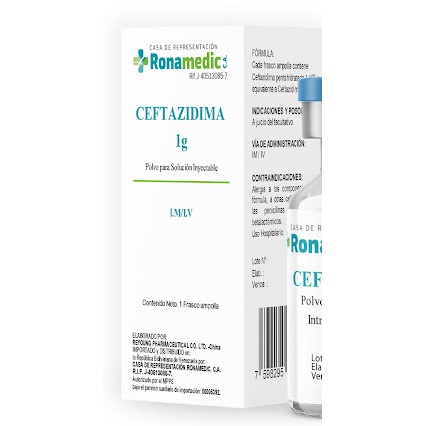
- Country of registration
- Dosage formINJECTABLE, 1 g
- ATC codeJ01DD02
- Active substance
- Prescription requiredYes
- Manufacturer
- CompositionCARBONATO DE SODIO ANHIDRO (121 mg mg)
- This information is for reference only and does not constitute medical advice. Always consult a doctor before taking any medication. Oladoctor is not responsible for medical decisions based on this content.
- Alternatives to CEFTAZIDIME KABI 1 g POWDER FOR INJECTABLE SOLUTIONDosage form: INJECTABLE, 2000 mgActive substance: ceftazidimeManufacturer: Fresenius Kabi España, S.A.U.Prescription requiredDosage form: INJECTABLE, 1 gActive substance: ceftazidimeManufacturer: Ldp Laboratorios Torlan S.A.Prescription requiredDosage form: INJECTABLE, 1gActive substance: ceftazidimeManufacturer: Ldp Laboratorios Torlan S.A.Prescription required
Online doctors for CEFTAZIDIME KABI 1 g POWDER FOR INJECTABLE SOLUTION
Discuss questions about CEFTAZIDIME KABI 1 g POWDER FOR INJECTABLE SOLUTION, including use, safety considerations and prescription review, subject to medical assessment and local regulations.









Get CEFTAZIDIME KABI 1 g POWDER FOR INJECTABLE SOLUTION Prescription Online
Fill in a 2-min form
Tell us your symptoms, history, and what medicine you're requesting.
Pick a doctor or let us assign
Choose a specialist or we'll match you with the next available doctor.
Doctor reviews your case
Usually within 30 minutes. They may ask follow-up questions via chat.
Collect from any pharmacy
Electronic prescription sent to your email — valid across Spain.
Frequently Asked Questions
CEFTAZIDIME KABI 1 g POWDER FOR INJECTABLE SOLUTION requires a prescription in Spain. You can check with a doctor online whether this medicine may be appropriate for your situation.
The active ingredient in CEFTAZIDIME KABI 1 g POWDER FOR INJECTABLE SOLUTION is ceftazidime. This information helps identify medicines with the same composition but different brand names.
CEFTAZIDIME KABI 1 g POWDER FOR INJECTABLE SOLUTION is manufactured by Fresenius Kabi España, S.A.U.. Pharmacy brands and packaging may differ depending on the distributor.
Doctors such as Family doctors, Psychiatrists, Dermatologists, Cardiologists, Endocrinologists, Gastroenterologists, Pulmonologists, Nephrologists, Rheumatologists, Hematologists, Infectious disease physicians, Allergists, Geriatricians, Paediatricians, Oncologists may assess whether CEFTAZIDIME KABI 1 g POWDER FOR INJECTABLE SOLUTION is appropriate, depending on your situation and local regulations. You can book an online consultation to discuss your symptoms and possible next steps.
Spain has a well-developed healthcare infrastructure across major cities such as Madrid, Barcelona, Valencia, and Seville. Pharmacies are widely available and operate under strict regulations, ensuring access to prescribed medications.
You can buy CEFTAZIDIME KABI 1 g POWDER FOR INJECTABLE SOLUTION in Madrid, Barcelona, Seville, or Valencia at any local pharmacy with a valid prescription.
To obtain a prescription, you can use Oladoctor:
Other medicines with the same active substance (ceftazidime) include CEFTAZIDIME KABI 2 g POWDER FOR INJECTION AND INFUSION SOLUTION, CEFTAZIDIME LDP TORLAN 1 g POWDER FOR INJECTION AND INFUSION SOLUTION, CEFTAZIDIME LDP TORLAN 1.000 mg powder and solvent for injectable solution. These may have different brand names or formulations but contain the same therapeutic ingredient. Always consult a doctor before switching or starting a new medicine.
