



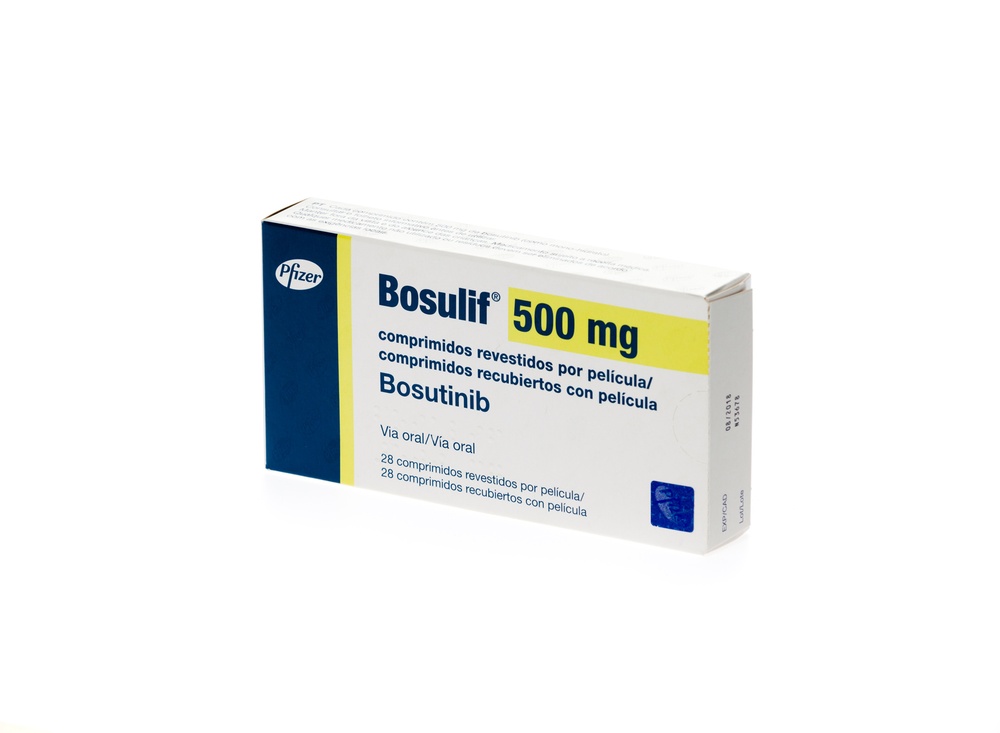
BOSULIF 500 mg Comprimidos Recubiertos Con Pelicula

Revisión de receta online
Un médico revisará tu caso y determinará si la prescripción es médicamente apropiada.

Habla con un médico sobre este medicamento
Comenta tus síntomas y las opciones de tratamiento en una consulta online.



Cómo usar BOSULIF 500 MG COMPRIMIDOS RECUBIERTOS CON PELICULA
Contenido del prospecto
- Introducción
- Qué es Bosulif y para qué se utiliza
- Qué necesita saber antes de empezar a tomar Bosulif
- Cómo tomar Bosulif
- Posibles efectos adversos
- Conservación de Bosulif
- Contenido del envase e información adicional
Introducción
Prospecto: información para el usuario
Bosulif 100mg comprimidos recubiertos con película
Bosulif 400mg comprimidos recubiertos con película
Bosulif 500mg comprimidos recubiertos con película
bosutinib
Lea todo el prospecto detenidamente antes de empezar a tomar este medicamento, porque contiene información importante para usted.
- Conserve este prospecto, ya que puede tener que volver a leerlo.
- Si tiene alguna duda, consulte a su médico o farmacéutico.
- Este medicamento se le ha recetado solamente a usted, y no debe dárselo a otras personas aunque tengan los mismos síntomas que usted, ya que puede perjudicarles.
- Si experimenta efectos adversos, consulte a su médico, incluso si se trata de efectos adversos que no aparecen en este prospecto. Ver sección 4.
Contenido del prospecto
- Qué es Bosulif y para qué se utiliza
- Qué necesita saber antes de empezar a tomar Bosulif
- Cómo tomar Bosulif
- Posibles efectos adversos
- Conservación de Bosulif
- Contenido del envase e información adicional
1. Qué es Bosulif y para qué se utiliza
Bosulif contiene el principio activo bosutinib. Se utiliza para tratar a pacientes adultos que padezcan un tipo de leucemia llamada leucemia mieloide crónica (LMC) con cromosoma Philadelphia positivo (Ph-positiva) recién diagnosticada o para quienes los medicamentos anteriores para tratar la LMC no han sido efectivos o no sean adecuados. La LMC Ph-positiva es un cáncer de la sangre que hace que el organismo produzca una cantidad excesiva de un tipo concreto de glóbulos blancos llamados granulocitos.
Si tiene alguna duda acerca de cómo actúa Bosulif o del motivo por el que se le ha recetado este medicamento, consulte a su médico.

¿No estás seguro de si este medicamento es adecuado para ti?
Comenta tus síntomas y tratamiento con un médico online.
2. Qué necesita saber antes de empezar a tomar Bosulif
No tome Bosulif
- si es alérgico a bosutinib o a alguno de los demás componentes de este medicamento (incluidos en la sección 6).
- si su médico le ha dicho que tiene el hígado deteriorado y que no funciona normalmente.
Advertencias y precauciones
Consulte a su médico, farmacéutico o enfermero antes de empezar a tomar Bosulif:
- si sufre, o ha sufrido en el pasado, problemas de hígado.Informe a su médico si tiene antecedentes de problemas de hígado, incluido cualquier tipo de hepatitis (infección o inflamación del hígado), o antecedentes de cualquiera de los siguientes signos y síntomas de problemas de hígado: picazón, ojos o piel amarillentos, orina oscura, y dolor o molestias en la zona superior derecha del estómago. Su médico debería realizarle análisis de sangre para comprobar su función hepática antes de iniciar el tratamiento con Bosulif y durante los 3 primeros meses de tratamiento con Bosulif, o según indicación clínica.
- si tiene diarreay vómitos.Informe a su médico si presenta alguno de los siguientes signos y síntomas: aumento de la cantidad de deposiciones al día, aumento de la cantidad de episodios de vómitos, sangre en el vómito, en las heces o en la orina, o aparición de heces negras (“alquitranadas”). Consulte a su médico si el tratamiento para los vómitos puede dar lugar a un mayor riesgo de arritmias cardiacas. En especial, consulte a su médico si desea usar algún medicamento que contenga domperidona para el tratamiento de las náuseas y/o vómitos. El tratamiento de las náuseas o de los vómitos con medicamentos de este tipo, si se usan junto con Bosulif, puede ocasionar un riesgo mayor de arritmias cardiacas peligrosas.
- si sufre problemas hemorrágicos.Informe a su médico si presenta alguno de los siguientes signos y síntomas, tales como hemorragias anormales o cardenales sin haber tenido ninguna lesión.
- si sufre una infección.Informe a su médico si presenta alguno de los siguientes signos y síntomas, tales como fiebre, problemas con la orina como sensación de quemazón al orinar, tos de nueva aparición o dolor de garganta de nueva aparición.
- si tiene retención de líquidos.Informe a su médico si presenta alguno de los siguientes signos y síntomas de retención de líquidos durante el tratamiento con Bosulif, tales como hinchazón de los tobillos, pies o piernas; dificultad para respirar, dolor en el pecho o tos (todos ellos pueden ser signos de retención de líquidos en los pulmones o en el pecho).
- si sufre problemas cardiacos.Informe a su médico si tiene alguna alteración cardiaca, tales como insuficiencia cardiaca y una disminución del flujo sanguíneo hacia el corazón que puede provocar un ataque al corazón. Busque ayuda médica inmediatamente si presenta dificultad para respirar, aumenta de peso, nota dolor en el pecho o padece hinchazón de las manos, los tobillos o los pies.
- si le han dicho que tiene un ritmo cardiaco anormal. Informe a su médico si tiene arritmias o una señal eléctrica anormal llamada "prolongación del intervalo QT". Estos problemas son siempre importantes, pero aún más si sufre diarrea frecuente o prolongada como se ha indicado anteriormente. Si se desmaya (pierde el conocimiento) o experimenta latidos cardiacos irregulares durante el tratamiento con Bosulif, informe inmediatamente a su médico, ya que pueden ser signos de una enfermedad cardiaca grave.
- si le han dicho que tiene problemas en los riñones.Informe a su médico si orina con más frecuencia y produce mayores cantidades de orina con una coloración clara, o si orina con menos frecuencia y produce menores cantidades de orina de color oscuro. Informe también a su médico si pierde peso o si padece hinchazón de los pies, los tobillos, las piernas, las manos o la cara.
- si alguna vez ha tenido o podría tener en este momento una infección por el virus de la hepatitis B. Esto se debe a que Bosulif podría hacer que la hepatitis B se volviese activa de nuevo, lo que puede resultar mortal en algunos casos. El médico deberá comprobar atentamente si hay signos de esta infección antes de comenzar el tratamiento.
- si tiene o ha tenido en el pasado problemas de páncreas.Informe a su médico si presenta dolor o molestias abdominales.
- si tienecualquiera de estos síntomas: erupciones cutáneas graves.Informe a su médico si presenta cualquiera de los siguientes signos y síntomas de erupción dolorosa de color rojo o púrpura que se extiende y si comienzan a aparecer ampollas y/u otras lesiones en la membrana mucosa (p. ej., la boca y los labios).
- si nota cualquiera de estos síntomas: dolor en el costado, sangre en la orina o disminución en la cantidad de orina.Si su enfermedad es muy grave, puede que su cuerpo no sea capaz de eliminar todos los productos de desecho de las células cancerosas que mueren. Esto se conoce como síndrome de lisis tumoral y puede producir insuficiencia renal y problemas cardiacos en las 48 horas siguientes a la primera dosis de Bosulif. Su médico se asegurará de que esté adecuadamente hidratado y le dará otros medicamentos para ayudar a prevenirlo.
Sol/Protección UV
Durante el tratamiento con bosutinib, usted puede ser más sensible al sol o a los rayos UV. Es importante que cubra las zonas corporales expuestas a la luz solar y que utilice protector solar con un alto factor de protección solar (FPS).
Niños y adolescentes
Bosulif no está recomendado para menores de 18 años de edad. Este medicamento no ha sido estudiado en niños ni adolescentes.
Otros medicamentos y Bosulif
Informe a su médico o farmacéutico si está tomando, ha tomado recientemente o pudiera tener que tomar cualquier otro medicamento, incluidos los medicamentos obtenidos sin receta, las vitaminas y las plantas medicinales. Algunos medicamentos pueden afectar a las concentraciones de Bosulif en su organismo. Debe informar a su médico si está utilizando medicamentos que contengan principios activos como los que se enumeran a continuación:
Los siguientes principios activos pueden aumentar el riesgo de sufrir efectos adversos con Bosulif:
- ketoconazol, itraconazol, voriconazol, posaconazol y fluconazol, utilizados para tratar las infecciones por hongos.
- claritromicina, telitromicina, eritromicina y ciprofloxacino, utilizados para tratar infecciones bacterianas.
- nefazodona, utilizado para tratar la depresión.
- mibefradil, diltiazem y verapamilo, utilizados para reducir la tensión arterial en personas con la tensión arterial alta.
- ritonavir, lopinavir/ritonavir, indinavir, nelfinavir, saquinavir, atazanavir, amprenavir, fosamprenavir y darunavir, utilizados para tratar la infección por el virus de la inmunodeficiencia humana (VIH)/SIDA.
- boceprevir y telaprevir, utilizados para tratar la hepatitis C.
- aprepitant, utilizado para evitar y controlar las náuseas y los vómitos.
- imatinib, utilizado para tratar un tipo de leucemia.
- crizotinib, usado para tratar un tipo de cáncer de pulmón llamado cáncer no microcítico de pulmón.
Los siguientes principios activos pueden reducir la eficacia de Bosulif:
- rifampicina, utilizado para tratar la tuberculosis.
- fenitoína y carbamacepina, utilizados para tratar la epilepsia.
- bosentano, utilizado para reducir la tensión arterial alta en los pulmones (hipertensión pulmonar).
- nafcilina, un antibiótico que se utiliza para tratar infecciones bacterianas.
- hierba de San Juan (una planta medicinal que se obtiene sin receta), utilizada para tratar la depresión.
- efavirenz y etravirina, utilizados para tratar infecciones por VIH/SIDA.
- modafinilo, utilizado para tratar ciertos tipos de trastornos del sueño.
Debe evitar el uso de estos medicamentos durante el tratamiento con Bosulif. Si está utilizando alguno de ellos, informe a su médico. Es posible que su médico le cambie las dosis de dichos medicamentos, le cambie la dosis de Bosulif o le haga utilizar algún otro medicamento diferente.
Los siguientes principios activos pueden afectar a la frecuencia cardiaca:
- amiodarona, disopiramida, procainamida, quinidina y sotalol, utilizados para tratar los trastornos cardiacos.
- cloroquina y halofantrina, utilizados para tratar la malaria.
- claritromicina y moxifloxacino, que son antibióticos que se usan para tratar las infecciones bacterianas.
- haloperidol, utilizado para tratar los trastornos psicóticos como la esquizofrenia.
- domperidona, utilizado para tratar las náuseas y los vómitos, o para estimular la producción de leche materna.
- metadona, utilizado para tratar el dolor.
Esos medicamentos se deben tomar con precaución durante el tratamiento con Bosulif. Si está tomando alguno de ellos, informe a su médico.
Es posible que los medicamentos citados en este prospecto no sean los únicos que podrían interaccionar con Bosulif.
Toma de Bosulif con alimentos y bebidas
No tome Bosulif con pomelo ni con zumo de pomelo, ya que podría aumentar el riesgo de efectos adversos.
Embarazo, lactancia y fertilidad
Bosulif no debe utilizarse durante el embarazo a menos que se considere claramente necesario, ya que Bosulif podría dañar al feto. Si está embarazada o cree que podría estar embarazada, consulte a su médico antes de empezar a tomar Bosulif.
A las mujeres que tomen Bosulif se las debe aconsejar que utilicen métodos anticonceptivos efectivos durante el tratamiento y durante al menos 1 mes después de la última dosis. Los vómitos y la diarrea pueden reducir la eficacia de los anticonceptivos orales.
Solicite información sobre la preservación del esperma antes de iniciar el tratamiento, si así lo desea, dado el riesgo de que el tratamiento con Bosulif produzca una reducción de la fertilidad.
Si está dando el pecho, informe a su médico. No dé el pecho durante el tratamiento con Bosulif, ya que podría dañar al bebé.
Conducción y uso de máquinas
Si experimenta mareo, tiene visión borrosa o siente una fatiga inusual, no conduzca ni utilice máquinas hasta que esos efectos adversos hayan desaparecido.
Bosulif contienesodio
Este medicamento contiene menos de 1 mmol de sodio (23 mg) por comprimido de 100 mg, 400 mg o 500 mg; esto es, esencialmente “exento de sodio”.
3. Cómo tomar Bosulif
Siga exactamente las instrucciones de administración de este medicamento indicadas por su médico. En caso de duda, consulte de nuevo a su médico o farmacéutico.
Bosulif solo le será recetado por un médico que tenga experiencia con los medicamentos que se usan para tratar la leucemia.
Dosis y forma de administración
La dosis recomendada es de 400 mg una vez al día para pacientes con LMC recién diagnosticada. La dosis recomendada es de 500 mg una vez al día para pacientes cuyos medicamentos anteriores para tratar la LMC no han sido efectivos o no son adecuados. En caso de problemas renales moderados o graves, su médico reducirá la dosis en 100 mg una vez al día para problemas renales moderados y en 100 mg adicionales una vez al día para problemas renales graves. Es posible que su médico ajuste la dosis utilizando los comprimidos de 100 mg, en función de su estado de salud, de acuerdo a la respuesta al tratamiento y/o a los efectos adversos que pueda experimentar. Tome el/los comprimido/s una vez al día, junto con alimentos. Trague el/los comprimido/s entero/s con un poco de agua.
Si toma más Bosulifdel que debe
Si toma accidentalmente demasiados comprimidos de Bosulif o una dosis más alta de la que necesita, acuda inmediatamente a un médico. Si es posible, muestre al médico el envase o este prospecto. Es posible que necesite atención médica.
Si olvidó tomar Bosulif
Si han pasado menos de 12 horas, tome la dosis recomendada. Si han pasado más de 12 horas, tome su siguiente dosis a la hora habitual, al día siguiente.
No tome una dosis doble para compensar las dosis olvidadas.
Si interrumpe el tratamiento con Bosulif
No deje de tomar Bosulif a menos que se lo indique su médico. Si no puede tomar el medicamento de la manera indicada por su médico o cree que ya no lo necesita, consulte inmediatamente con su médico.
Si tiene cualquier otra duda sobre el uso de este medicamento, pregunte a su médico o farmacéutico.

¿Has empezado a tomar el medicamento y tienes preguntas?
Comenta tus síntomas y tratamiento con un médico online.
4. Posibles efectos adversos
Al igual que todos los medicamentos, este medicamento puede producir efectos adversos, aunque no todas las personas los sufran.
Debe consultar de forma inmediata con su médico si sufre cualquier efecto adverso grave (ver también la sección 2 “Qué necesita saber antes de empezar a tomar Bosulif”):
Trastornos sanguíneos.Informe inmediatamente a su médico si tiene alguno de los siguientes síntomas: hemorragias, fiebre o cardenales frecuentes (es posible que tenga un trastorno de la sangre o del sistema linfático).
Trastornos hepáticos.Informe inmediatamente a su médico si tiene alguno de los siguientes síntomas: picazón, ojos o piel amarillentos, orina oscura, y dolor o molestias en la zona superior derecha del estómago o fiebre.
Trastornos del estómago/intestinales.Informe a su médico si presenta dolor de estómago, ardor de estómago, diarrea, estreñimiento, náuseas o vómitos.
Problemas cardiacos.Informe a su médico si tiene una alteración cardiaca, tales como insuficiencia cardiaca, una disminución del flujo sanguíneo hacia el corazón, una señal eléctrica anormal llamada “prolongación del intervalo QT”, o si se desmaya (pierde el conocimiento) o tiene una frecuencia cardiaca irregular durante el tratamiento con Bosulif.
Reactivación del virus de la hepatitis B.Recurrencia (reactivación) de la infección por el virus de la hepatitis B si ha tenido hepatitis B en el pasado (una infección del hígado).
Reacciones cutáneas graves.Informe a su médico inmediatamente si tiene cualquiera de estos síntomas: erupción dolorosa de color rojo o púrpura que se extiende y si comienzan a aparecer ampollas y/u otras lesiones en la membrana mucosa (p. ej., la boca y los labios).
Los efectos adversos que pueden aparecer con Bosulif son:
Efectos adversos muy frecuentes (pueden afectar a más de1 de cada 10pacientes):
- reducción del número de plaquetas, glóbulos rojos y/o neutrófilos (un tipo de glóbulos blancos).
- diarrea, vómitos, dolor de estómago, náuseas.
- fiebre, hinchazón de las manos, pies o cara, fatiga, debilidad.
- infección del aparato respiratorio.
- nasofaringitis.
- alteración de las pruebas de función sanguínea por si Bosulif está afectando al hígado y/o al páncreas, riñones.
- disminución del apetito.
- dolor articular, dolor de espalda.
- dolor de cabeza.
- erupción cutánea, con picor en la piel y/o generalizada.
- tos.
- dificultad para respirar.
- sensación de inestabilidad (mareo).
- líquido en los pulmones (derrame pleural).
- picores.
Efectos adversos frecuentes (pueden afectar hasta 1 de cada 10pacientes):
- disminución en el recuento de glóbulos blancos (leucopenia).
- irritación del estómago (gastritis), sangrado en el estómago o el intestino.
- dolor en el pecho, dolor.
- lesiones tóxicas en el hígado, función hepática anormal, incluyendo trastorno hepático.
- infección pulmonar (neumonía), gripe, bronquitis.
- el corazón no bombea la sangre como debería (insuficiencia cardiaca).
- disminución en la frecuencia cardiaca que predispone al desmayo, al mareo y a las palpitaciones.
- aumento de la presión arterial.
- elevación de potasio en la sangre, disminución de fósforo en la sangre, pérdida excesiva de líquidos corporales (deshidratación).
- dolor muscular.
- alteración del sentido del gusto (disgeusia).
- insuficiencia renal aguda, fallo renal, deterioro renal.
- líquido alrededor del corazón (derrame pericárdico).
- pitido en los oídos (acúfenos).
- urticaria (habones), acné.
- reacción de fotosensibilidad (sensibilidad a los rayos UV procedentes del sol y de otras fuentes de luz).
- reacción alérgica.
- presión arterial anormalmente alta en las arterias de los pulmones (hipertensión pulmonar).
- inflamación aguda del páncreas (pancreatitis aguda).
- insuficiencia respiratoria.
Efectos adversos poco frecuentes (pueden afectar hasta 1 de cada 100pacientes):
- fiebre asociada a un recuento bajo de glóbulos blancos (neutropenia febril).
- daño hepático.
- reacción alérgica con peligro de muerte (shock anafiláctico).
- acumulación anormal de líquido en los pulmones (edema pulmonar agudo).
- erupción cutánea.
- inflamación de la cubierta del corazón o pericardio (pericarditis).
- disminución importante en el número de granulocitos (un tipo de glóbulos blancos).
- trastorno grave de la piel (eritema multiforme).
- náuseas, dificultad para respirar, latidos cardíacos irregulares, calambres musculares, convulsiones, enturbiamiento de la orina y cansancio relacionado con resultados anómalos en las pruebas analíticas (elevación de potasio, ácido úrico y fósforo en la sangre y disminución de calcio en la sangre) que pueden producir cambios en la función renal e insuficiencia renal aguda (síndrome de lisis tumoral [SLT]).
Frecuencia no conocida (no puede estimarse a partir de los datos disponibles):
- trastorno grave de la piel (síndrome de Stevens‑Johnson, necrólisis epidérmica tóxica) que se debe a una reacción alérgica, erupción exfoliativa (descamación)
- enfermedad pulmonar intersticial (trastornos que causan cicatrices en los pulmones): los signos son tos, dificultad para respirar y respiración dolorosa).
Comunicación de efectos adversos
Si experimenta cualquier tipo de efecto adverso, consulte a su médico, farmacéutico o enfermero, incluso si se trata de posibles efectos adversos que no aparecen en este prospecto. También puede comunicarlos directamente a través del Sistema Español de Farmacovigilancia de Medicamentos de Uso Humano: www.notificaRAM.es. Mediante la comunicación de efectos adversos usted puede contribuir a proporcionar más información sobre la seguridad de este medicamento.
5. Conservación de Bosulif
- Mantener este medicamento fuera de la vista y del alcance de los niños.
- No utilice este medicamento después de la fecha de caducidad que aparece en la lámina de aluminio del blíster y en el envase después de “EXP”. La fecha de caducidad es el último día del mes que se indica.
- Este medicamento no requiere condiciones especiales de conservación.
- No utilice este medicamento si observa que el envase está deteriorado o que presenta signos de haber sido alterado.
- Los medicamentos no se deben tirar por los desagües ni a la basura. Pregunte a su farmacéutico cómo deshacerse de los envases y de los medicamentos que ya no necesita. De esta forma, ayudará a proteger el medio ambiente.
6. Contenido del envase e información adicional
Composición de Bosulif
- El principio activo es bosutinib. Bosulif comprimidos recubiertos con película se presenta en diversas dosis.
Bosulif 100 mg: cada comprimido recubierto con película contiene 100 mg de bosutinib (como monohidrato).
Bosulif 400 mg: cada comprimido recubierto con película contiene 400 mg de bosutinib (como monohidrato).
Bosulif 500 mg: cada comprimido recubierto con película contiene 500 mg de bosutinib (como monohidrato).
- Los demás componentes son: celulosa microcristalina (E460), croscarmelosa de sodio (E468), poloxámero 188, povidona (E1201) y estearato de magnesio (E470b). El recubrimiento del comprimido contiene alcohol polivinílico, dióxido de titanio (E171), macrogol 3350, talco (E553b) y óxido de hierro amarillo (E172, en Bosulif 100 mg y 400 mg) u óxido de hierro rojo (E172, en Bosulif 400 mg y 500 mg).
Aspecto del producto y contenido del envase
Bosulif 100 mg comprimidos recubiertos con película son de color amarillo y con forma ovalada biconvexa, marcados con la leyenda “Pfizer” en una cara y con “100” en la otra.
Bosulif 100 mg se comercializa en blísteres que contienen 14 o 15 comprimidos en envases de 28 o 30 comprimidos o 112 comprimidos.
Bosulif 400 mg comprimidos recubiertos con película son de color naranja y con forma ovalada biconvexa, marcados con la leyenda “Pfizer” en una cara y con “400” en la otra.
Bosulif 400 mg se comercializa en blísteres que contienen 14 o 15 comprimidos en envases de 28 o 30 comprimidos.
Bosulif 500 mg comprimidos recubiertos con película son de color rojo y con forma ovalada biconvexa, marcados con la leyenda “Pfizer” en una cara y con “500” en la otra.
Bosulif 500 mg se comercializa en blísteres que contienen 14 o 15 comprimidos en envases de 28 o 30 comprimidos.
Puede que solamente estén comercializados algunos tamaños de envases.
Titular de la autorización de comercialización
Pfizer Europe MA EEIG
Boulevard de la Plaine 17
1050 Bruxelles
Bélgica
Responsable de la fabricación
Pfizer Manufacturing Deutschland GmbH
Betriebsst?tte Freiburg
Mooswaldallee 1
79090 Freiburg
Alemania
Pueden solicitar más información respecto a este medicamento dirigiéndose al representante local del titular de la autorización de comercialización:
België / Belgique / Belgien Luxembourg/Luxemburg Pfizer NV/SA Tél/Tel: +32 (0)2 554 62 11 | Lietuva Pfizer Luxembourg SARL filialas Lietuvoje Tel. + 370 52 51 4000 |
| |
Ceská republika Pfizer, spol. s r.o. Tel: +420 283 004 111 | Magyarország Pfizer Kft. Tel.: +36-1-488-37-00 |
Danmark Pfizer ApS Tlf: +45 44 20 11 00 | Malta Vivian Corporation Ltd. Tel: +356 21344610 |
Deutschland PFIZER PHARMA GmbH Tel: +49 (0)30 550055 51000 | Nederland Pfizer BV Tel: +31 (0)10 406 43 01 |
Eesti Pfizer Luxembourg SARL Eesti filiaal Tel: +372 666 7500 | Norge Pfizer AS Tlf: +47 67 52 61 00 |
Ελλ?δα Pfizer Ελλ?ς A.E. Τ?λ: +30 210 6785 800 | Österreich Pfizer Corporation Austria Ges.m.b.H. Tel: +43 (0)1 521 15-0 |
España Pfizer, S.L. Tél: +34 91 490 99 00 | Polska Pfizer Polska Sp. z o.o. Tel:+48 22 335 61 00 |
France Pfizer Tél: +33 (0)1 58 07 34 40 | Portugal Laboratórios Pfizer, Lda. Tel: +351 21 423 5500 |
Hrvatska Pfizer Croatia d.o.o. Tel: + 385 1 3908 777 | România Pfizer Romania S.R.L. Tel: +40 (0) 21 207 28 00 |
Ireland Pfizer Healthcare Ireland Tel: 1800 633 363 (toll free) +44 (0)1304 616161 | Slovenija Pfizer Luxembourg SARL Pfizer, podružnica za svetovanje s podrocja farmacevtske dejavnosti, Ljubljana Tel.: + 386 (0)1 52 11 400 |
Ísland Icepharma hf. Sími: +354 540 8000 | Slovenská republika Pfizer Luxembourg SARL, organizacná zložka Tel.: + 421 2 3355 5500 |
Italia Pfizer S.r.l. Tel: +39 06 33 18 21 | Suomi/Finland Pfizer Oy Puh./Tel: +358 (0)9 43 00 40 |
K?προς Pfizer Ελλ?ς Α.Ε. (Cyprus Branch) Tηλ+357 22 817690 | Sverige Pfizer AB Tel: +46 (0)8 550 520 00 |
Latvija Pfizer Luxembourg SARL filiale Latvija Tel.: + 371 670 35 775 | United Kingdom(Northern Ireland) Pfizer Limited Tel: +44 (0) 1304 616161 |

Fecha de la última revisión de este prospecto:11/2024.
La información detallada de este medicamento está disponible en la página web de la Agencia Europea de Medicamentos: https://www.ema.europa.eu.
- País de registro
- Forma farmacéuticaCOMPRIMIDO, 500 mg
- Código ATCL01EA04
- Principio activo
- Requiere recetaSí
- Fabricante
- ComposiciónCROSCARMELOSA SODICA (14,49 mg mg), CROSCARMELOSA SODICA (14,50 mg mg)
- Esta información es de carácter general y no sustituye la consulta con un profesional sanitario.
- Alternativas a BOSULIF 500 MG COMPRIMIDOS RECUBIERTOS CON PELICULAForma farmacéutica: CAPSULA, 100 mgPrincipio activo: BosutinibFabricante: Pfizer Europe Ma EeigRequiere recetaForma farmacéutica: COMPRIMIDO, 100 mgPrincipio activo: BosutinibFabricante: Pfizer Europe Ma EeigRequiere recetaForma farmacéutica: COMPRIMIDO, 400 mgPrincipio activo: BosutinibFabricante: Pfizer Europe Ma EeigRequiere receta
Médicos online para BOSULIF 500 MG COMPRIMIDOS RECUBIERTOS CON PELICULA
Comenta la dosis, los posibles efectos secundarios, interacciones, contraindicaciones o la revisión de receta de BOSULIF 500 MG COMPRIMIDOS RECUBIERTOS CON PELICULA, sujeto a valoración médica y a la normativa local.
Obtén una receta de BOSULIF 500 MG COMPRIMIDOS RECUBIERTOS CON PELICULA online
Rellena un formulario de 2 minutos
Cuéntanos tus síntomas, historial y el medicamento que necesitas.
Elige un médico o nosotros te asignamos uno
Escoge un especialista o te conectamos con el próximo médico disponible.
El médico revisa tu caso
Normalmente en 30 minutos. Puede hacerte preguntas adicionales por chat.
Recógela en cualquier farmacia
Receta electrónica enviada a tu correo, válida en toda España.
Preguntas frecuentes
BOSULIF 500 MG COMPRIMIDOS RECUBIERTOS CON PELICULA requiere receta en España. Puedes confirmarlo con un médico online según tu caso.
El principio activo de BOSULIF 500 MG COMPRIMIDOS RECUBIERTOS CON PELICULA es Bosutinib. Esta información ayuda a identificar medicamentos con la misma composición pero con diferentes nombres comerciales.
BOSULIF 500 MG COMPRIMIDOS RECUBIERTOS CON PELICULA es fabricado por Pfizer Europe Ma Eeig. La marca y el envase pueden variar según el distribuidor.
Los Médicos de familia, Psiquiatras, Dermatólogos, Cardiólogos, Endocrinólogos, Gastroenterólogos, Neumólogos, Nefrólogos, Reumatólogos, Hematólogos, Infectólogos, Alergólogos, Geriatras, Pediatras, Oncólogos pueden valorar la prescripción de BOSULIF 500 MG COMPRIMIDOS RECUBIERTOS CON PELICULA cuando esté clínicamente indicado. Puedes reservar una videoconsulta para comentar tu caso y las opciones de tratamiento.
España cuenta con una infraestructura sanitaria bien desarrollada en ciudades principales como Madrid, Barcelona, Valencia y Sevilla. Las farmacias están ampliamente disponibles y operan bajo estrictas regulaciones, garantizando el acceso a medicamentos con receta.
Puedes comprar BOSULIF 500 MG COMPRIMIDOS RECUBIERTOS CON PELICULA en Madrid, Barcelona, Sevilla o Valencia en cualquier farmacia local con una receta válida.
Para obtener una receta, puedes utilizar Oladoctor:
Otros medicamentos con el mismo principio activo (Bosutinib) incluyen BOSULIF 100 MG CAPSULAS DURAS, BOSULIF 100 MG COMPRIMIDOS RECUBIERTOS CON PELICULA, BOSULIF 400 MG COMPRIMIDOS RECUBIERTOS CON PELICULA. Pueden tener diferentes nombres comerciales o formulaciones, pero contienen el mismo componente terapéutico. Consulta siempre con un médico antes de cambiar o iniciar un nuevo medicamento.
