


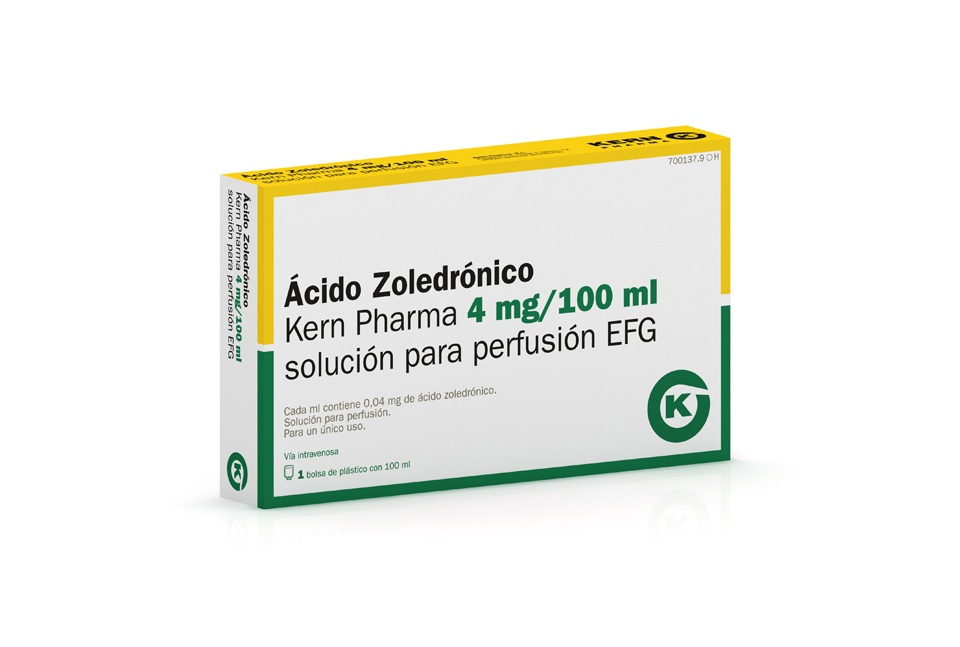
Acido zoledronico Altan 4 mg/100 ml solución para perfusión

Revisión de receta online
Un médico revisará tu caso y determinará si la prescripción es médicamente apropiada.

Habla con un médico sobre este medicamento
Comenta tus síntomas y las opciones de tratamiento en una consulta online.



Cómo usar ACIDO ZOLEDRONICO ALTAN 4 MG/100 ML SOLUCION PARA PERFUSION EFG
Contenido del prospecto
- Introducción
- Qué es Ácido Zoledrónico Altan y para qué se utiliza
- Qué necesita saber antes de empezar a usar Ácido Zoledrónico Altan
- Cómo usar Ácido Zoledrónico Altan
- Posibles efectos adversos
- Conservación de Ácido Zoledrónico Altan
- Contenido del envase e información adicional
Introducción
Prospecto: información para el paciente
Ácido Zoledrónico Altan 4 mg/100 ml solución para perfusión EFG
Lea todo el prospecto detenidamente antes de que le administren este medicamento, porque contiene información importante para usted.
- Conserve este prospecto, ya que puede tener que volver a leerlo.
- Si tiene alguna duda, consulte a su médico, farmacéutico o enfermero.
- Si experimenta efectos adversos, consulte a su médico, farmacéutico o enfermero, incluso si se trata de efectos adversos que no aparecen en este prospecto. Ver sección 4.
Contenido del prospecto
- Qué es Ácido Zoledrónico Altan y para qué se utiliza
- Qué necesita saber antes de empezar a usar Ácido Zoledrónico Altan
- Cómo usar Ácido Zoledrónico Altan
- Posibles efectos adversos
- Conservación de Ácido Zoledrónico Altan
- Contenido del envase e información adicional
1. Qué es Ácido Zoledrónico Altan y para qué se utiliza
El principio activo de este medicamento es el ácido zoledrónico, que pertenece a un grupo de sustancias llamadas bisfosfonatos. El ácido zoledrónico actúa uniéndose a los huesos y reduciendo la velocidad del remodelamiento óseo. Se utiliza para:
- Prevenir las complicaciones óseas, p.ej. fracturas, en pacientes adultos con metástasis óseas (diseminación del cáncer desde el lugar primario hasta el hueso)
Reducir la cantidad de calcioen la sangre en pacientes adultos en que es demasiado alto debido a la presencia de un tumor. Los tumores pueden acelerar el remodelamiento óseo normal de manera que la liberación de calcio desde el hueso esté aumentada. Esta condición se conoce como hipercalcemia inducida por tumor (HIT).

¿No estás seguro de si este medicamento es adecuado para ti?
Comenta tus síntomas y tratamiento con un médico online.
2. Qué necesita saber antes de empezar a usar Ácido Zoledrónico Altan
Siga cuidadosamente todas las instrucciones que le dé su médico.
Su médico le realizará análisis de sangre antes de empezar el tratamiento con Ácido Zoledrónico Altan y controlará su respuesta al tratamiento a intervalos regulares.
No se le debe administrar Ácido Zoledrónico Altan:
- si está en periodo de lactancia.
- si es alérgico al ácido zoledrónico, otro bisfosfonato (grupo de sustancias a las que pertenece Ácido Zoledrónico Altan), o a cualquiera de los demás componentes de este medicamento (incluidos en la sección 6).
Advertencias y precauciones
Consulte a su médicoo farmacéuticoantes deempezar a usarÁcido Zoledrónico Altan:
- si tiene o ha tenido un problema de riñón.
- si tiene o ha tenido dolor, hinchazón o adormecimientode la mandíbula, o una sensación de pesadez en la mandíbula o se le mueve un diente. Su médico le puede recomendar que se someta a un examen dental antes de iniciar el tratamiento con ácido zoledrónico.
- si está recibiendo tratamiento dentalo va a someterse a cirugía dental, informe a su dentista que está siendo tratado con ácido zoledrónico e informe a su médico sobre su tratamiento dental.
Mientras esté siendo tratado con este medicamento, debe mantener una buena higiene bucal (incluyendo cepillado regular de los dientes) y someterse a chequeos dentales rutinarios.
Contacte con su médico y su dentista inmediatamente si experimenta cualquier problema con su boca o dientes, tales como, pérdida dental, dolor o hinchazón, o dificultad en la curación de las úlceras o secreción, ya que estos pueden ser signos de una situación denominada osteonecrosis de la mandíbula.
Los pacientes que están recibiendo quimioterapia y/o radioterapia, que están tomando corticosteroides, que están sometidos a cirugía dental, que no reciben un cuidado dental rutinario, que tienen enfermedad en las encías, que son fumadores o que no recibieron un tratamiento previo con un bisfosfonato (utilizado para tratar o prevenir alteraciones en los huesos) pueden presentar un mayor riesgo de desarrollar osteonecrosis de la mandíbula.
Se han descrito niveles reducidos de calcio en la sangre (hipocalcemia), que a veces se manifiestan con calambres musculares, piel seca y sensación de quemazón en pacientes que han recibido ácido zoledrónico. Se ha descrito ritmo irregular del corazón (arritmia cardíaca), convulsiones, espasmos y contracciones musculares involuntarias (tetania) secundarios a hipocalcemia grave. En algunos casos, la hipocalcemia puede resultar potencialmente mortal. Si tiene alguna de las condiciones descritas, informe a su médico inmediatamente. Si sufre una hipocalcemia previa, esta se deberá corregir antes de recibir la primera dosis de ácido zoledrónico. Le proporcionarán suplementos adecuados de calcio y vitamina D.
Pacientes de 65 años y mayores
Ácido zoledrónico se puede administrar a personas de 65 años y mayores. No existen evidencias que sugieran que son necesarias precauciones adicionales.
Niños y adolescentes
No se recomienda el uso de ácido zoledrónico en adolescentes y niños menores de 18 años.
Otros medicamentos y Ácido Zoledrónico Altan
Informe a su médico si está utilizando, ha utilizado recientemente o pudiera tener que utilizar cualquier otro medicamento. Es especialmente importante que informe a su médico si también está tomando:
- Aminoglucósidos (medicamentos utilizados para el tratamiento de infecciones graves), calcitonina (un tipo de medicamento utilizado para el tratamiento de la osteoporosis postmenopáusica y la hipercalcemia), diuréticos de asa (un tipo de medicamento para el tratamiento de la tensión arterial alta o edema) u otros medicamentos que disminuyen el calcio, dado que la combinación de éstos con bisfosfonatos puede disminuir acentuadamente la concentración de calcio en sangre.
- Talidomida (un medicamento utilizado para tratar un tipo de cáncer de la sangre que afecta al hueso) o cualquier otro medicamento que pueda perjudicar los riñones.
- Aclasta (un medicamento que también contiene ácido zoledrónico y que se utiliza para tratar la osteoporosis y otras enfermedades no cancerosas del hueso), o cualquier otro bisfosfonato, puesto que se desconocen los efectos combinados de estos medicamentos administrados junto a ácido zoledrónico.
- Medicamentos antiangiogénicos (utilizados para tratar el cáncer), puesto que la combinación de estos medicamentos con ácido zoledrónico se ha asociado con un riesgo mayor de osteonecrosis de mandíbula (ONM).
Embarazo y lactancia
No le deben administrar ácido zoledrónico si está embarazada. Informe a su médico si está o piensa que puede estar embarazada.
No le deben administrar ácido zoledrónico si está en periodo de lactancia.
Consulte a su médico antes de utilizar cualquier medicamento si está embarazada o durante el periodo de lactancia.
Conducción y uso de máquinas
En casos muy raros se ha observado somnolencia y adormecimiento con el uso de ácido zoledrónico. Por lo tanto deberá tener cuidado al conducir, utilizar máquinas o realizar otras actividades que requieran mucha atención.
Ácido Zoledrónico Altan contiene sodio
Este medicamento contiene menos de 23 mg (1 mmol) de sodio por dosis, por lo que se considera esencialmente “exento de sodio”.
3. Cómo usar Ácido Zoledrónico Altan
- Ácido zoledrónico sólo debe ser administrado por profesionales sanitarios experimentados en la administración de bisfosfonatos intravenosos, es decir, administrados en la vena.
- Su médico le recomendará beber una cantidad suficiente de agua antes de cada tratamiento para ayudar a prevenir la deshidratación.
- Siga cuidadosamente todas las demás instrucciones dadas por su médico, farmacéutico o enfermero.
Qué cantidad de Ácido Zoledrónico Altan se administra
- La dosis usual única administrada es de 4 mg.
- Si sufre un problema de riñón, su médico le dará una dosis más baja en función de la gravedad de su problema de riñón.
Con qué frecuencia se administra Ácido Zoledrónico Altan
- Si está siendo tratado para la prevención de complicaciones óseas debidas a metástasis óseas, le administrarán una perfusión de Ácido Zoledrónico Altan cada tres a cuatro semanas.
- Si está siendo tratado para reducir la cantidad de calcio en la sangre, normalmente sólo le administrarán una perfusión de Ácido Zoledrónico Altan.
Cómo se administra Ácido Zoledrónico Altan
- Ácido Zoledrónico Altan se administra como un goteo (perfusión) en vena que debe durar como mínimo 15 minutos y que se debe administrar como una solución intravenosa única en una vía de perfusión distinta.
A los pacientes que no tienen niveles de calcio en la sangre demasiado altos también se les prescribirá suplementos de calcio y vitamina D para tomar cada día.
Si le administran más Ácido Zoledrónico Altan del que debe
Si ha recibido dosis superiores a las recomendadas debe ser controlado estrechamente por su médico. Esto se debe a que puede desarrollar alteraciones de los electrolitos séricos (p.ej. valores anormales de calcio, fósforo y magnesio en sangre) y/o cambios en la función del riñón, incluyendo insuficiencia renal grave. Si el nivel de calcio llega a ser demasiado bajo, puede ser necesario que le administren un suplemento de calcio mediante perfusión.
En caso de sobredosis o ingestión accidental, consulte inmediatamente a su médico o farmacéutico o llame al Servicio de Información Toxicológica, teléfono 91 562 04 20.

¿Has empezado a tomar el medicamento y tienes preguntas?
Comenta tus síntomas y tratamiento con un médico online.
4. Posibles efectos adversos
Al igual que todos los medicamentos, este medicamento puede producir efectos adversos, aunque no todas las personas los sufran. Los más frecuentes son generalmente leves y probablemente desaparecerán después de un corto intervalo de tiempo.
Informe a su médico inmediatamente si sufre alguno de los siguientes efectos adversos:
Frecuentes (pueden afectar hasta 1 de cada 10 pacientes):
- Alteración grave del riñón (normalmente lo determinará su médico con un análisis de sangre específico).
- Nivel bajo de calcio en la sangre.
Poco frecuentes (pueden afectar hasta 1 de cada 100 pacientes):
- Dolor en la boca, los dientes y/o la mandíbula, hinchazón o dificultad en la curación de las llagas dentro de la boca o de la mandíbula, secreción,, adormecimiento o sensación de pesadez en la mandíbula, o pérdida de un diente. Estos pueden ser signos de daño en el hueso de la mandíbula (osteonecrosis). Informe a su médico y dentista inmediatamente si presenta estos síntomas mientras está siendo tratado con ácido zoledrónico o después de finalizar el tratamiento.
- Se ha observado ritmo cardíaco irregular (fibrilación auricular) en pacientes tratados con ácido zoledrónico para osteoporosis postmenopáusica. Se desconoce actualmente si el ácido zoledrónico causa este ritmo cardiaco irregular pero debe informar a su médico si presenta estos síntomas después de haber recibido ácido zoledrónico.
- Reacción alérgica grave: dificultad para respirar, hinchazón sobretodo de la cara y la garganta.
Raros (pueden afectar hasta 1 de cada 1.000 pacientes):
- A consecuencia de niveles de calcio bajos: ritmo irregular del corazón (arritmia cardiaca; secundaria a hipocalcemia).
- Una alteración en la función del riñón denominada síndrome de Fanconi (normalmente la detectará su médico mediante un análisis de orina).
Muy raros (pueden afectar hasta 1 de cada 10.000 pacientes):
- Como consecuencia de los niveles de calcio bajos: convulsiones, adormecimiento y tetania (secundarias a hipocalcemia).
- Consulte a su médico si usted tiene dolor de oído, el oído le supura o sufre una infección de oído. Estos podrían ser síntomas de daño en los huesos del oído.
- También se han observado de forma rara casos de osteonecrosis en otros huesos a parte de la mandíbula, especialmente en la cadera o el muslo. Informe a su médico inmediatamente si tiene síntomas como la aparición o un empeoramiento de molestias, dolor o rigidez mientras está recibiendo tratamiento con ácido zoledrónico o después de interrumpir el tratamiento.
Frecuencia no conocida: no puede estimarse a partir de los datos disponibles:
- Inflamación renal (nefritis tubulointersticial): los signos y síntomas pueden incluir reducción del volumen de la orina, sangre en la orina, náuseas, sensación de malestar general.
Informe a su médico tan pronto como sea posible de cualquiera de los siguientes efectos adversos:
Muy frecuentes (pueden afectar más de 1 de cada 10 pacientes):
- Bajo nivel de fosfatos en la sangre.
Frecuentes (pueden afectar hasta 1 de cada 10 pacientes):
- Dolor de cabeza y síndrome similar a la gripe que consiste en fiebre, fatiga, debilidad, somnolencia, escalofríos y dolor de huesos, articulaciones y/o músculos. En la mayoría de los casos no se requiere tratamiento específico y los síntomas desaparecen después de un corto periodo de tiempo (un par de horas o días).
- Reacciones gastrointestinales como náuseas y vómitos, así como pérdida de apetito.
- Conjuntivitis.
- Nivel bajo de glóbulos rojos en la sangre (anemia).
Poco frecuentes (pueden afectar hasta 1 de cada 100 pacientes):
- Reacciones de hipersensibilidad.
- Tensión arterial baja.
- Dolor en el pecho.
- Reacciones en la piel (enrojecimiento e hinchazón) en el lugar de la perfusión, erupción, picor.
- Tensión arterial elevada, dificultad para respirar, mareo, ansiedad, trastornos del sueño, alteraciones del gusto, temblores, hormigueo o entumecimiento de las manos o los pies, diarrea, estreñimiento, dolor abdominal, sequedad de boca.
- Disminución del número de glóbulos blancos y plaquetas.
- Nivel bajo de magnesio y potasio en la sangre. Su médico lo controlará y tomará cualquier medida necesaria.
- Aumento de peso.
- Aumento de sudoración.
- Adormecimiento.
- Visión borrosa, lagrimeo en los ojos, sensibilidad de los ojos a la luz.
- Repentino enfriamiento con desmayo, flojedad o colapso.
- Dificultad para respirar con silbidos o tos.
- Urticaria.
Raros (pueden afectar hasta 1 de cada 1.000 pacientes):
- Disminución del ritmo cardiaco.
- Confusión.
- Fracturas atípicas del fémur (hueso del muslo) que pueden ocurrir en raras ocasiones sobre todo en pacientes en tratamiento prolongado para la osteoporosis. Informe a su médico si nota dolor, debilidad o molestias en el muslo, la cadera o la ingle, ya que pueden ser síntomas precoces e indicativos de una posible fractura del fémur.
- Enfermedad intersticial del pulmón (inflamación del tejido que rodea los sacos de aire de los pulmones).
- Síntomas parecidos a la gripe que incluyen artritis e hinchazón de las articulaciones.
- Enrojecimiento doloroso del ojo y/o hinchazón.
Muy raros (pueden afectar hasta 1 de cada 10.000 personas):
- Desvanecimiento debido a una tensión arterial baja.
- Dolor intenso en los huesos, las articulaciones y/o los músculos, ocasionalmente incapacitante.
Comunicación de efectos adversos
Si experimenta cualquier tipo de efectos adversos, consulte a su médico, farmacéutico o enfermero, incluso si se trata de posibles efectos adversos que no aparecen en este prospecto. También puede comunicarlos directamente a través del Sistema Español de Farmacovigilancia de Medicamentos de Uso Humano (www.notificaRAM.es). Mediante la comunicación de efectos adversos usted puede contribuir a proporcionar más información sobre la seguridad de este medicamento.
5. Conservación de Ácido Zoledrónico Altan
Su médico, farmacéutico o enfermero sabe cómo conservar este medicamento adecuadamente (ver sección 6).
Mantener este medicamento fuera de la vista y del alcance de los niños.
No utilice este medicamento después de la fecha de caducidad que aparece en la bolsa. La fecha de caducidad es el último día del mes que se indica.
No conservar a temperatura superior a 30°C
6. Contenido del envase e información adicional
Composición de Ácido Zoledrónico Altan
- El principio activo es el ácido zoledrónico. Cada bolsa con 100 ml de solución contiene 4 mg de ácido zoledrónico, equivalentes a 4,265 mg de ácido zoledrónico monohidrato.
- Un ml de solución contiene 0,04 mg de ácido zoledrónico.
- Los demás componentes son: manitol (E421), citrato de sodio (E331), agua para preparaciones inyectables, ácido clorhídrico y/o hidróxido de sodio (para ajuste de pH).
Aspecto del producto y contenido del envase
Solución transparente e incolora envasada en una bolsa transparente e incolora.
Se presenta como un envase unitario que contiene una bolsa o como envases múltiples formados por 4 o 5 bolsas.
Puede que solamente estén comercializados algunos tamaños de envases.
Titular de la autorización de comercialización y responsable de la fabricación
Titular de la autorización de comercialización
ALTAN PHARMACEUTICALS, S.A.
C/Cólquide, Nº 6, Portal 2, 1ª Planta,
Oficina F. Edificio Prisma, Las Rozas,
28230 Madrid
España
Responsable de la fabricación
ALTAN PHARMACEUTICALS, S.A.
Polígono Industrial de Bernedo, s/n
01118 Bernedo (Álava)
España
Este medicamento está autorizado en los estados miembros del Espacio Económico Europeo con los siguientes nombres:
Alemania: Zoledronsäure Altan 4 mg/100 ml Infusionslösung
Bélgica: Zoledroninezuur Altan 4 mg/100 ml oplossing voor infusie
España: Ácido Zoledrónico Altan 4 mg/100 ml solución para perfusión EFG
Francia: ACIDE ZOLEDRONIQUE ALTAN 4 mg/100 mL, solution pour perfusion
Italia: Acido zoledronico Altan Pharma 4 mg/100 ml soluzione per infusion
Portugal: Ácido Zoledrónico Altan 4 mg/100 ml Solução para perfusão
Reino Unido: Zoledronic Acid Altan 4 mg/100 ml solution for infusion
Fecha de la última revisión de este prospecto:09/2024
La información detallada de este medicamento está disponible en la página Web de la Agencia Española de Medicamentos y Productos Sanitarios (AEMPS) http://www.aemps.gob.es/
INFORMACIÓN PARA EL PROFESIONAL SANITARIO
Cómo preparar y administrar Ácido Zoledrónico Altan
- Ácido Zoledrónico Altan contiene 4 mg de ácido zoledrónico en 100 ml de solución para perfusión para el uso inmediato en pacientes con función renal normal.
- Para un único uso. Cualquier parte de la solución no utilizada se debe eliminar. Sólo se deben utilizar soluciones transparentes libres de partículas y de coloración. Durante la preparación de la perfusión se deben utilizar técnicas asépticas.
- Desde el punto de vista microbiológico, la solución para perfusión se debe utilizar inmediatamente después de la primera apertura. Si no se utiliza inmediatamente, el tiempo y las condiciones de almacenamiento durante su uso antes de su administración son responsabilidad del usuario y no deben superar en condiciones normales las 24 horas a 2°C – 8°C, a excepción que la dilución se realice en condiciones asépticas controladas y validadas. La solución conservada en nevera debe alcanzar la temperatura ambiente antes de la administración.
- La solución que contiene ácido zoledrónico no se debe diluir ni mezclar con otras soluciones de perfusión. Se administra como perfusión intravenosa única durante 15 minutos en una vía de perfusión separada. Antes y después de la administración de ácido zoledrónico deberá valorarse el estado de hidratación de los pacientes para asegurar que están adecuadamente hidratados.
- Este medicamento se puede utilizar inmediatamente sin requerir una dilución adicional en pacientes con función renal normal. En pacientes con insuficiencia renal leve a moderada, se deben preparar dosis reducidas, tal como se detalla a continuación.
Para preparar dosis reducidas para pacientes con un valor basal de CLcr ≤ 60 ml/min, ver la Tabla 1 inferior. Extraer el volumen indicado de solución de ácido zoledrónico y sustituirlo con un volumen igual de solución inyectable de cloruro de sodio estéril 9 mg/ml (0,9%) estéril o de solución inyectable de glucosa al 5%.
Tabla 1: Preparación de dosis reducidas de Ácido Zoledrónico Altan
Aclaramiento de creatinina basal (ml/min) | Extraer la siguiente cantidad de ácido zoledrónico solución para perfusión (ml) | Sustituir con el siguiente volumen de cloruro de sodio estéril 9 mg/ml (0.9%) o solución inyectable de glucosa al 5% (ml) | Dosis ajustada (mg de ácido zoledrónico en 100 ml) |
50-60 | 12,0 | 12,0 | 3,5 |
40-49 | 18,0 | 18,0 | 3,3 |
30-39 | 25,0 | 25,0 | 3,0 |
*Las dosis se han calculado asumiendo un objetivo de AUC de 0,66 (mg•hr/l) (CLcr = 75 ml/min). Se espera que las dosis reducidas para pacientes con insuficiencia renal alcancen la misma AUC que la observada en pacientes con aclaramiento de creatinina de 75 ml/min.
- Los estudios realizados con diferentes líneas de perfusión de cloruro de polivinilo, polietileno y polipropileno no revelaron incompatibilidad con Ácido Zoledrónico Altan.
- Dado que no hay datos disponibles de la compatibilidad de ácido zoledrónico con otras sustancias administradas por vía intravenosa, este medicamento no debe mezclarse con otros medicamentos/sustancias y debe administrarse siempre por una línea de perfusión separada.
Cómo conservar Ácido Zoledrónico Altan
- Mantener este medicamento fuera de la vista y del alcance de los niños.
- No utilice este medicamento después de la fecha de caducidad que aparece en el envase.
- No conservar a temperatura superior a 30°C.
- Después de abrir la bolsa, el producto se debe utilizar inmediatamente para evitar la contaminación microbiana.
- País de registro
- Forma farmacéuticaINYECTABLE PERFUSION, 4 mg/100 ml
- Código ATCM05BA08
- Principio activo
- Requiere recetaSí
- Fabricante
- ComposiciónCITRATO DE SODIO (E-331) (27,35 mg mg), HIDROXIDO DE SODIO (E 524) (CSP mg mg), MANITOL (E-421) (49,50 g mg)
- Esta información es de carácter general y no sustituye la consulta con un profesional sanitario.
- Alternativas a ACIDO ZOLEDRONICO ALTAN 4 MG/100 ML SOLUCION PARA PERFUSION EFGForma farmacéutica: INYECTABLE PERFUSION, 4 mg/5 mlPrincipio activo: Acido zoledronicoFabricante: Actavis Group Ptc Ehf.Requiere recetaForma farmacéutica: INYECTABLE PERFUSION, 4 mg/5 mlPrincipio activo: Acido zoledronicoFabricante: Altan Pharmaceuticals SaRequiere recetaForma farmacéutica: INYECTABLE PERFUSION, 5 mg/100 mlPrincipio activo: Acido zoledronicoFabricante: Altan Pharmaceuticals SaRequiere receta
Médicos online para ACIDO ZOLEDRONICO ALTAN 4 MG/100 ML SOLUCION PARA PERFUSION EFG
Comenta la dosis, los posibles efectos secundarios, interacciones, contraindicaciones o la revisión de receta de ACIDO ZOLEDRONICO ALTAN 4 MG/100 ML SOLUCION PARA PERFUSION EFG, sujeto a valoración médica y a la normativa local.


Preguntas frecuentes
ACIDO ZOLEDRONICO ALTAN 4 MG/100 ML SOLUCION PARA PERFUSION EFG requiere receta en España. Puedes confirmarlo con un médico online según tu caso.
El principio activo de ACIDO ZOLEDRONICO ALTAN 4 MG/100 ML SOLUCION PARA PERFUSION EFG es Acido zoledronico. Esta información ayuda a identificar medicamentos con la misma composición pero con diferentes nombres comerciales.
ACIDO ZOLEDRONICO ALTAN 4 MG/100 ML SOLUCION PARA PERFUSION EFG es fabricado por Altan Pharmaceuticals Sa. La marca y el envase pueden variar según el distribuidor.
Los Médicos de familia, Psiquiatras, Dermatólogos, Cardiólogos, Endocrinólogos, Gastroenterólogos, Neumólogos, Nefrólogos, Reumatólogos, Hematólogos, Infectólogos, Alergólogos, Geriatras, Pediatras, Oncólogos pueden valorar la prescripción de ACIDO ZOLEDRONICO ALTAN 4 MG/100 ML SOLUCION PARA PERFUSION EFG cuando esté clínicamente indicado. Puedes reservar una videoconsulta para comentar tu caso y las opciones de tratamiento.
La receta la emite un médico tras valorar tu estado de salud. En España, ACIDO ZOLEDRONICO ALTAN 4 MG/100 ML SOLUCION PARA PERFUSION EFG se dispensa en las farmacias con esa receta médica. Una consulta online no garantiza su emisión: la decisión corresponde siempre al médico.
Para solicitar una valoración puedes usar Oladoctor:
Otros medicamentos con el mismo principio activo (Acido zoledronico) incluyen Acido zoledronico Actavis 4 mg/5 ml concentrado para solucion para perfusion EFG, ACIDO ZOLEDRONICO ALTAN 4 MG/ 5ML CONCENTRADO PARA SOLUCION PARA PERFUSION EFG, ACIDO ZOLEDRONICO ALTAN 5 MG/100 ML SOLUCION PARA PERFUSION EFG. Pueden tener diferentes nombres comerciales o formulaciones, pero contienen el mismo componente terapéutico. Consulta siempre con un médico antes de cambiar o iniciar un nuevo medicamento.
